Best GCSE Subjects to Pair with Biblical Hebrew
GCSE subjects to pair with Biblical Hebrew: choose balanced options that support language study, protect maths revision time and avoid needless overload.

Choosing GCSE options can feel like being asked to predict the person you will become. You may enjoy Biblical Hebrew, but then face a second question: what should sit beside it on your timetable?
The best GCSE subjects to pair with Biblical Hebrew are usually history or geography, one contrasting creative or practical subject, and the compulsory core of English, maths and science. Religious Studies can also be a natural companion, while a modern language, Latin, Classical Greek or Triple Science may suit some students but can create unnecessary pressure when chosen for appearance rather than genuine interest.
The goal is not to assemble the most impressive-looking list. It is to choose a combination you can sustain through lessons, homework, mocks and final exams while protecting enough time for maths revision.
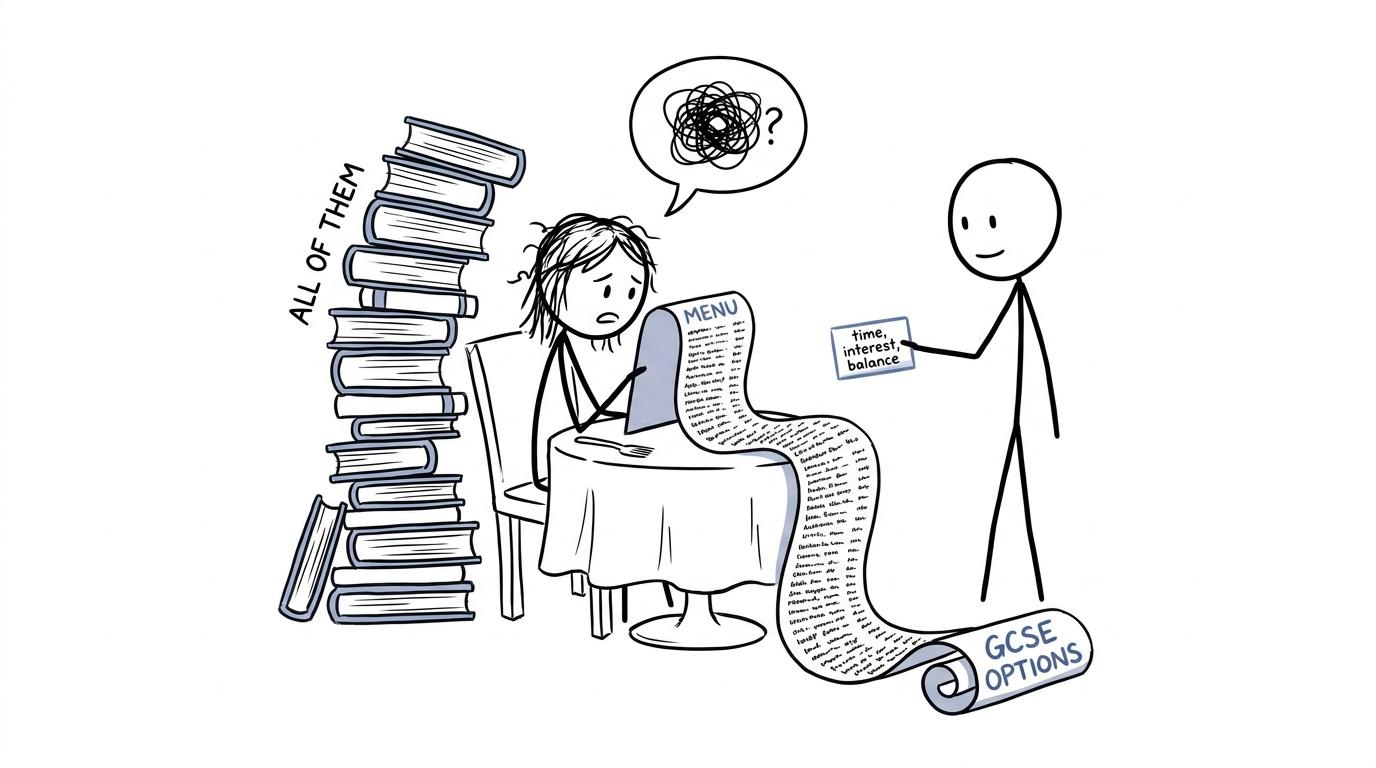 A student faces an absurdly long GCSE options menu while a calm waiter recommends time, interest and balance
Your GCSE options checklist
Before comparing individual subjects, ask five practical questions:
- Does my school offer this combination within its option blocks?
- Do I enjoy the normal weekly work, not merely the subject title?
- Does the combination include too many essay, vocabulary or project deadlines?
- Does it keep open the sixth-form routes I am seriously considering?
- Will I still have regular time for English, science and GCSE maths revision?
Your school’s options booklet is decisive. Schools determine which subjects they offer, how many options students take and which combinations fit the timetable. Check with your teachers before treating any suggested combination as possible.
What Biblical Hebrew demands
The current Pearson Edexcel GCSE in Biblical Hebrew is a grades 999-111 qualification assessed through two externally examined components: Language and Literature. It involves grammar, vocabulary, translation, comprehension and close engagement with set texts.
For examinations from 2026 to 2028, the prescribed material includes passages concerning Joseph’s rise to power in Genesis and the miracles of Elisha in Kings. Set texts can change between examination cycles, so students should always use the specification and materials supplied for their own exam year.
This matters when choosing companion subjects. Biblical Hebrew is not simply another general essay subject. It combines several kinds of effort:
- precise recall of vocabulary and grammatical forms;
- regular translation practice;
- careful reading of unfamiliar and prepared passages;
- literary and contextual analysis;
- sustained revision of prescribed texts.
Because it is examined rather than assessed through coursework, the pressure tends to gather around mocks and the final examination period. A good subject combination avoids placing every other demanding written paper in the same revision basket.
The strongest subjects to pair with Biblical Hebrew
History
History is one of the most natural academic companions. Both subjects reward accurate reading, attention to context and the ability to support an interpretation with evidence. History can therefore strengthen habits that are useful in Biblical Hebrew literature without duplicating its language work.
There is still a workload warning. History specifications commonly involve substantial content and extended written answers. Pairing History with Biblical Hebrew is sensible for a student who likes reading, explanation and evidence. It is less sensible if long-form writing already consumes most of your revision time.
History also fills the history-or-geography part of the English Baccalaureate subject combination in England. Biblical Hebrew may count in the language category when the approved qualification is used, but students should confirm eligibility with their school because performance-measure rules and school policies can change.
Geography
Geography offers breadth. It still requires written explanations, but it also involves data, maps, processes, case studies and numerical interpretation. That mixture can provide a useful contrast with translation and set-text revision.
It is often the better humanities pairing for a student who enjoys Biblical Hebrew but does not want another subject dominated by historical argument. Geography also occupies the history-or-geography position in the EBacc combination.
Do not choose it merely because somebody calls it easier. Fieldwork knowledge, case studies and geographical skills all need consistent attention. The benefit is variety, not an absence of work.
Religious Studies
Religious Studies has an obvious thematic connection. Students who enjoy discussing beliefs, texts, ethics and interpretation may find the combination intellectually coherent. Familiarity with religious ideas may also make some contextual discussion feel more approachable.
However, overlap in interest is not the same as a light workload. Both subjects may demand close textual reading and carefully structured written responses. Religious Studies also does not replace history or geography in the EBacc subject combination.
Choose it if the questions genuinely interest you. Avoid choosing it only because the title appears connected to Biblical Hebrew.
Computer Science
Computer Science can provide a productive change of thinking. Biblical Hebrew asks you to notice linguistic structures; Computer Science asks you to build and trace logical structures. Both reward precision, but the day-to-day tasks feel different.
It can work particularly well for students considering computing, engineering or mathematically related A Levels. Yet programming requires practice, not occasional rereading. Check the specification, teaching approach and expected independent work at your school before committing.
Art, music, drama or design subjects
A creative subject can bring welcome variety to an otherwise text-heavy timetable. Making, performing or designing uses a different kind of concentration from translating passages or revising grammatical forms.
The important issue is assessment timing. Art, design and performing arts specifications may include portfolios, non-examined assessment or practical preparation. These can create intense periods of work before formal examinations begin. Ask when major submissions and performances occur, then compare those dates with Biblical Hebrew mocks and your school’s revision calendar.
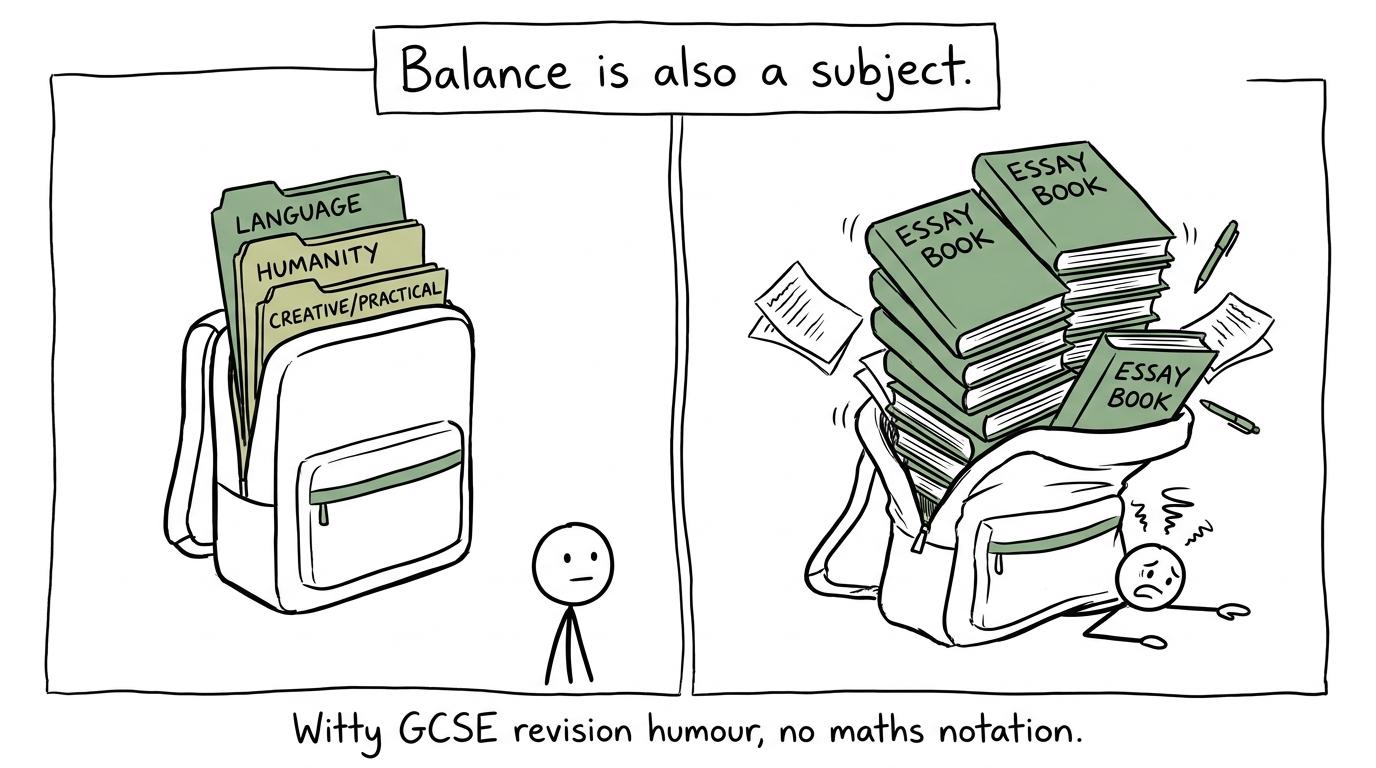 One balanced revision backpack sits beside another overloaded with identical essay books
Where maths fits into the combination
Maths will normally be part of your compulsory GCSE core rather than an option. That does not make it secondary. It means its workload must be included before you add optional subjects.
Biblical Hebrew and maths share a useful habit: small misunderstandings compound. Missing one grammatical distinction can weaken a translation, just as an insecure number skill can make later algebra harder. Both respond better to short, regular practice than to last-minute rereading.
Use the MathsGenie GCSE maths hub to select your board and tier. Students taking Pearson Edexcel can follow the Edexcel GCSE maths revision pathway, while those taking AQA can use the AQA GCSE maths revision resources.
If your school offers Further Maths, treat it as an additional commitment rather than a prestige badge. It can be valuable preparation for A Level Maths, but only when your core GCSE Maths is secure and you have enough time to practise unfamiliar problems. Ask your maths teacher whether it matches your current attainment and future plans.
Combinations that can add unnecessary stress
No combination is automatically wrong. The danger comes from stacking several subjects with the same pressure points.
| Combination | Why it may become stressful | When it can still work |
|---|---|---|
| Biblical Hebrew, Latin and Classical Greek | Several grammar systems, translation tasks and vocabulary lists | You genuinely love ancient languages and already manage regular recall well |
| Biblical Hebrew plus two modern languages | Frequent vocabulary retrieval and several language examinations | Languages are a clear strength and your timetable provides enough teaching time |
| Biblical Hebrew, History and Religious Studies | Heavy reading, content recall and extended writing | You enjoy analytical writing and do not avoid essay practice |
| Biblical Hebrew, Triple Science and Further Maths | Large volume of technical content and problem-solving | Your foundations are secure and the subjects support realistic sixth-form plans |
| Biblical Hebrew plus several portfolio subjects | Project deadlines may converge before exams | Your school staggers deadlines and you work consistently from the start |
A common trap is choosing every subject that appears academically demanding. Universities and sixth forms care about attainment and relevant entry requirements, not just the number of difficult titles on an options form. Strong grades across a coherent programme are more useful than an overloaded timetable that weakens the compulsory core.
A balanced selection strategy
Think in terms of workload types rather than labels. Biblical Hebrew already supplies language learning, textual analysis and substantial recall. Your remaining options might then include:
- history or geography for humanities breadth;
- Computer Science, business or another structured subject if offered;
- one creative or practical option for contrast;
- a modern language only if you enjoy sustained vocabulary practice;
- Triple Science or Further Maths only where it supports a genuine direction.
You should also inspect how each subject is assessed. Compare the number and length of examinations, practical requirements, non-examined assessment and major internal deadlines. Exam boards including Edexcel, AQA, OCR and Eduqas organise subjects differently, so general reputation is less useful than the actual specification your school teaches.
Once your options are chosen, build a weekly rhythm rather than waiting for pressure to arrive. MathsGenie’s GCSE maths revision timetable guide explains how to combine topic practice, marking and timed work. On busy language days, an effective 202020-minute maths routine can preserve momentum without overwhelming the evening.
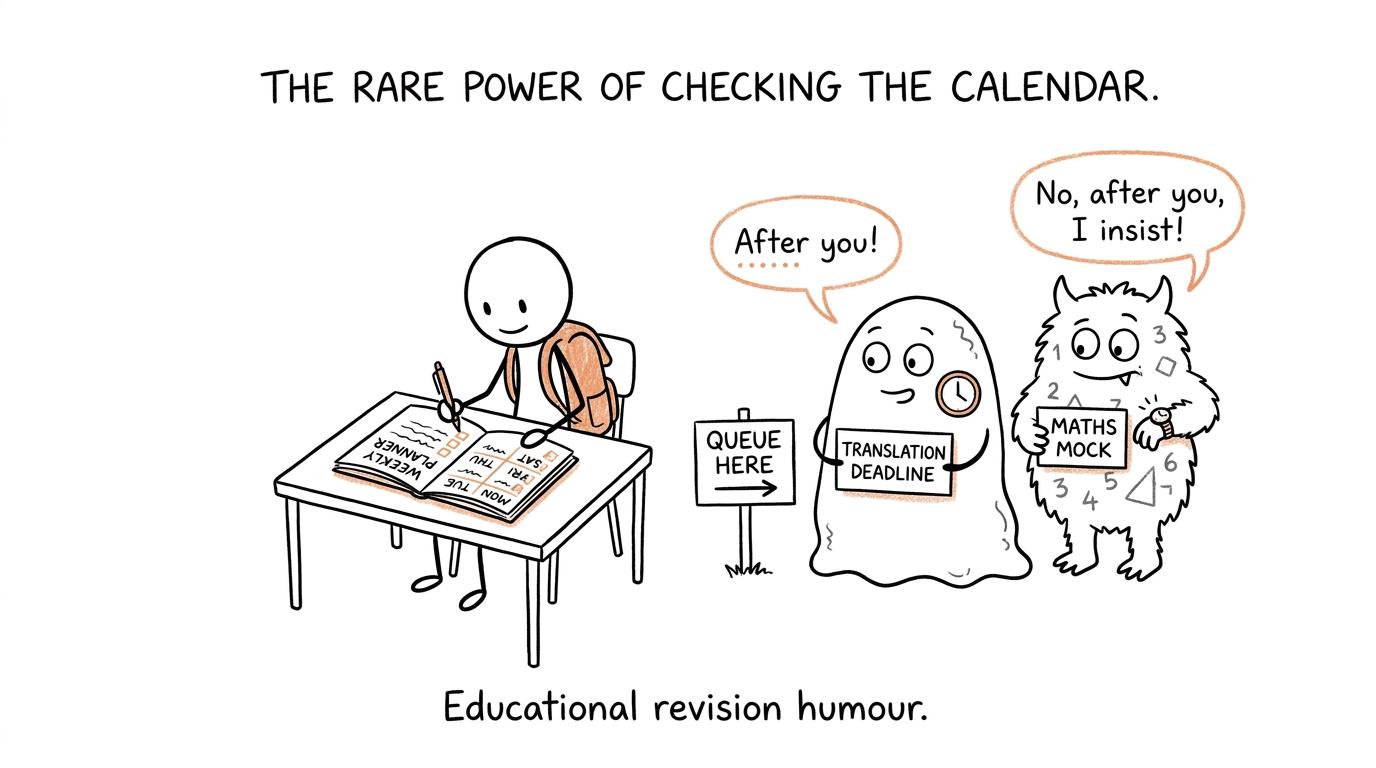 A planner makes the translation deadline and maths mock monsters wait politely in a queue
Common mistakes when choosing companion subjects
Choosing by reputation
A subject is not a good option simply because it sounds traditional, difficult or impressive. Read its specification and look at real assessment materials. The weekly reality matters more than the label.
Assuming related subjects reduce the workload
Biblical Hebrew and Religious Studies may share themes, but each has distinct content and assessment objectives. Latin may use similar learning habits, but it introduces another language system. Intellectual overlap does not remove revision.
Ignoring option blocks and entry rules
A theoretically perfect combination is irrelevant if lessons run simultaneously or your school requires particular prior learning. Confirm availability before becoming attached to a plan.
Forgetting the compulsory core
Your options do not replace English, maths and science. A crowded optional programme can quietly take time away from core subjects. Protect a recurring maths slot and use GCSE maths mini tests to identify weaknesses before they expand.
Treating predicted papers as predictions of everything
Predicted papers are useful for realistic practice, not as a substitute for the full specification. The same principle applies to every GCSE. Learn the complete course, use past papers to understand assessment, then use predicted papers to sharpen final preparation.
Choose a combination you can carry
The best GCSE subjects to pair with Biblical Hebrew are not identical for every student. History or geography usually offers valuable breadth, Religious Studies provides thematic connection, and a creative, practical or technical subject can balance the timetable. Extra languages, Triple Science and Further Maths can be excellent choices, but only when they reflect your interests, readiness and available time.
A timetable is a promise to your future self. Make it demanding enough to open doors, but not so crowded that every week becomes a rescue operation.
Once your choices are settled, let MathsGenie simplify the maths side of that promise. Begin with the best order for learning GCSE maths topics, use revision lessons and practice questions to repair gaps, and then progress to mini tests, past papers, predicted papers, mark schemes and video solutions. The aim is not to revise everything at once. It is to keep moving, one well-chosen subject and one secure method at a time.