Best GCSE Subjects to Pair with Arabic
GCSE subjects to pair with Arabic: compare balanced options, workloads and future routes, then make a realistic choice that protects your maths revision.
Choosing GCSE options can feel strangely permanent. A subject that occupies one box on a form will soon occupy lessons, homework, revision sessions and exam days. If you are looking for the best GCSE subjects to pair with Arabic, the short answer is this: history or geography usually provides the strongest academic balance, while computer science, business or a creative subject can make sense when they suit your interests and workload.
The best combination is not the one that looks most impressive. It is the one you can study consistently without allowing Arabic, maths, English and science to compete for the same exhausted hour.
Arabic already develops communication, cultural understanding and careful recall. Pair it with subjects that broaden your skills, support a possible next step and leave enough time to prepare properly for compulsory GCSE maths.
A quick GCSE options checklist
Before comparing individual subjects, ask:
- Is Arabic being taken inside an option block or as an additional GCSE?
- Which subjects are compulsory at your school?
- Does your school expect you to follow the English Baccalaureate, or EBacc, combination?
- Are you genuinely interested in each option's content?
- How is each subject assessed: written examinations, practical work or non-exam assessment?
- Will the total workload leave regular time for maths revision?
- Does a sixth form course you may want have specific entry requirements?
- Can your school actually timetable the combination?
School rules matter. In England, pupils study a core curriculum at Key Stage 4, while individual schools decide how their GCSE option blocks work. The EBacc is not a separate qualification. It is a combination covering English, maths, science, a language, and history or geography. An approved Arabic GCSE can fulfil its language component, but you should confirm the qualification and entry arrangements with your school.
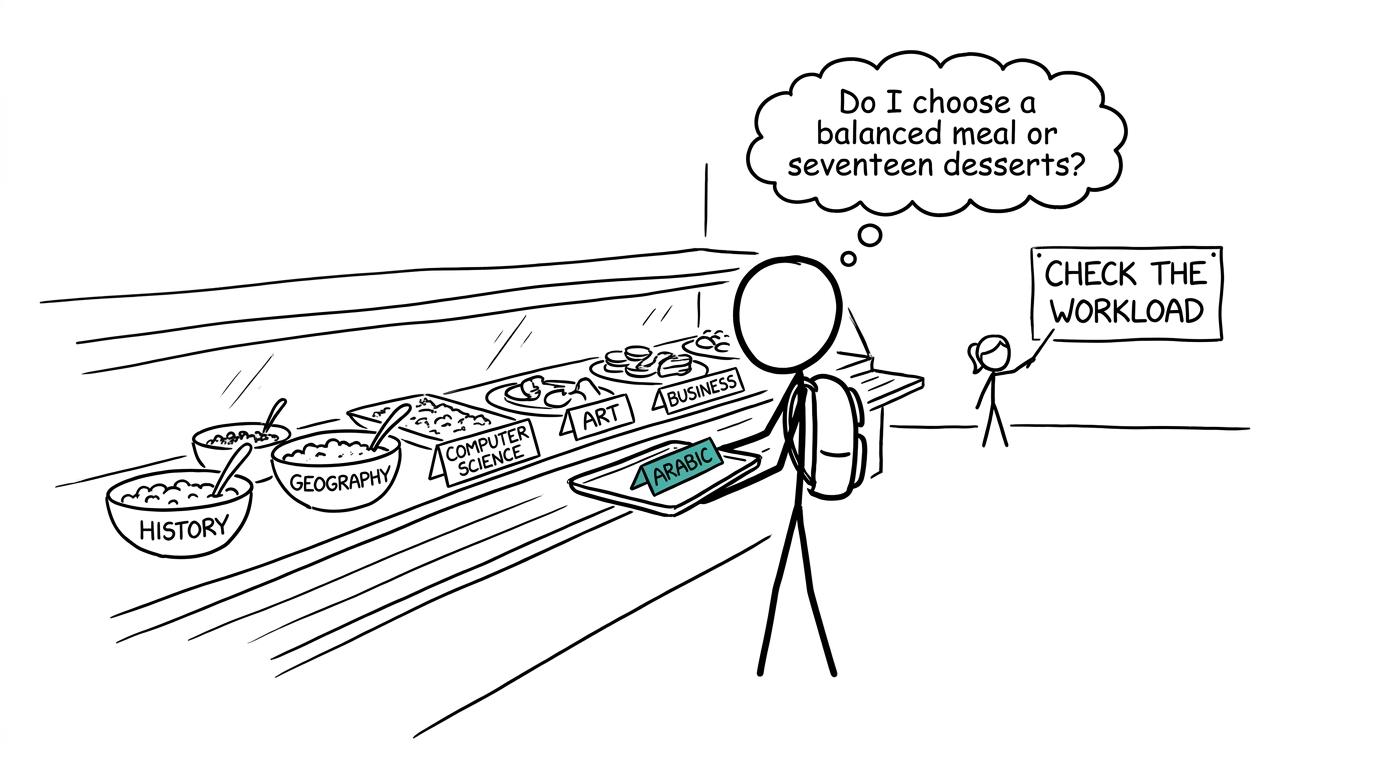 A student choosing subjects from an options buffet
What studying GCSE Arabic involves
Do not judge the workload by how often you speak Arabic at home. Everyday fluency can be a valuable foundation, but the examination may expect Modern Standard Arabic, accurate writing, formal vocabulary and responses shaped around a specification.
Under the current Pearson Edexcel GCSE Arabic specification, assessment covers listening, speaking, reading and writing. Each skill contributes an equal share of the qualification, and candidates take either foundation or higher tier across all papers. Arrangements can change, so verify your specification, tier and assessment details with your teacher.
That structure has an important consequence. Arabic revision cannot be reduced to reading vocabulary the evening before an examination. You need repeated listening, speaking practice, written accuracy and familiarity with question formats. If Arabic is an additional GCSE taught after school or prepared independently, its true workload may be larger than its place on your timetable suggests.
History or geography: the strongest all-round pairing
For many students, the most sensible subject to take alongside Arabic is either history or geography.
Both complete the humanities element of the EBacc combination when the other required subjects are also taken. More importantly, they add a different way of thinking.
Arabic and history
History suits students who enjoy interpretation, argument and extended writing. You will examine evidence, explain causes and consequences, and build conclusions from competing accounts. Those habits complement the close reading and communication involved in Arabic without simply repeating language study.
The pressure point is writing. English language, English literature, history and Arabic can produce a reading-heavy, writing-heavy timetable. That combination is manageable for an organised student who enjoys essays, but unnecessarily draining for someone who already finds extended responses slow.
Arabic and geography
Geography combines written explanation with data, maps, physical processes and human issues. It can therefore offer more variety beside a language GCSE. Themes such as migration, development, cities and environmental change may also deepen your understanding of regions in which Arabic is used, although the exact content depends on your exam board's specification.
Geography still requires precise terminology and longer answers. It is not a low-revision alternative to history. Its advantage is balance: interpretation, data handling and structured writing sit together.
If you want the EBacc and have no strong preference, compare actual specification topics and assessment structures rather than relying on the claim that one humanity is universally easier.
Maths, science and computer science
Maths is normally part of the compulsory core, so you are not choosing whether to pair it with Arabic. You are choosing whether your optional subjects leave enough room to succeed in it.
Arabic and maths make a useful contrast. One asks you to communicate across four language skills; the other requires fluency with number, algebra, ratio, geometry, probability and statistics. Switching between different kinds of thinking can make a timetable feel more balanced.
Use the GCSE Maths revision hub to check the topics required for your board and tier. The GCSE maths topics by exam board and tier guide is especially useful before planning your week.
When computer science makes sense
Computer science is a strong option if you enjoy algorithms, logical reasoning and programming. It can support later interests in technology, engineering or data, while giving your subject combination a clear analytical dimension.
Choose it for the course itself, not because you enjoy using computers. Programming problems demand persistence, and theory brings its own vocabulary and written examination content. Arabic plus computer science is balanced in subject type, but it is not automatically light in workload.
Combined or separate sciences
Whether you study combined science or separate biology, chemistry and physics may depend on school policy, available option blocks and teacher guidance. Separate sciences involve greater breadth and can be appropriate for students who enjoy science and may continue it after GCSE. They also create more content to revisit.
Do not assume that the longest academic-looking combination is always the wisest. Strong results across a sustainable set of subjects are more useful than an overloaded timetable that weakens your performance everywhere.
Business, economics and religious studies
Business can pair naturally with Arabic for students interested in organisations, marketing, finance or international trade. It usually blends written explanation with interpretation and some numerical work. The connection is practical rather than compulsory: language skills and commercial understanding can sit well together, but neither guarantees a particular career.
Economics, where offered at GCSE, is more focused on how choices, markets and economies work. It may appeal if you enjoy current affairs and analytical reasoning. Check the specification carefully because business and economics are distinct subjects, despite some overlap in everyday language.
Religious studies can also be valuable. It develops evaluation, ethical reasoning and the ability to compare viewpoints carefully. Arabic is a language, not a religious studies course, so the two subjects should not be treated as interchangeable. Their connection may be personally meaningful for some students, but the academic content and assessment remain separate.
Creative subjects can improve the balance
Art and design, music, drama, design and technology, or GCSE PE can prevent your timetable becoming a wall of written examinations. If you genuinely enjoy one of them, that difference can be healthy.
But variety is not the same as low effort. Portfolio development, rehearsal, practical assessment and project deadlines can create sustained demands throughout the course. A creative option becomes stressful when students choose it as a supposed break, then discover that unfinished work accumulates quietly.
Ask the department what work is completed in lessons, what must be done independently and when major deadlines usually fall. The answer matters more than the subject's reputation.
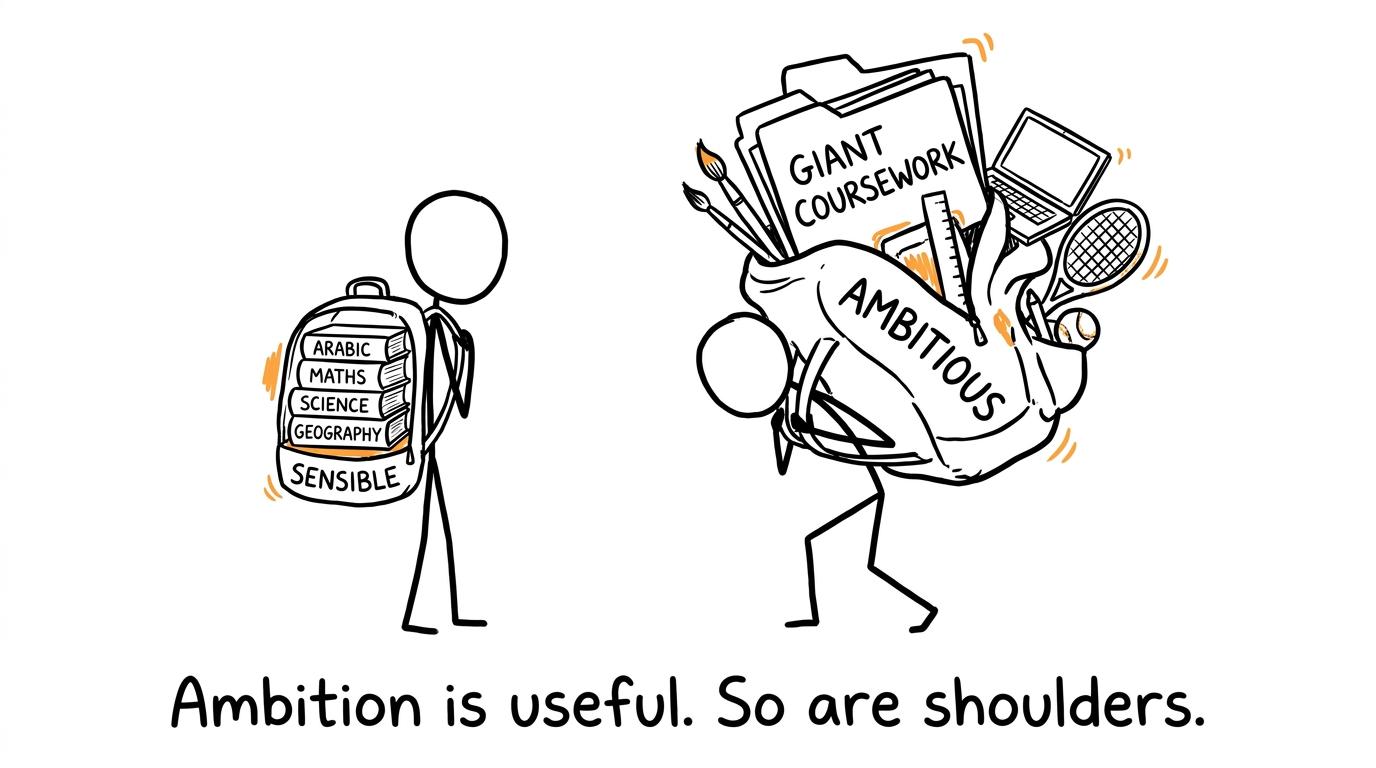 Two revision backpacks showing balanced and excessive workloads
Combinations that may create unnecessary stress
No pairing is automatically wrong. Stress usually comes from how the demands overlap.
Too many writing-heavy subjects
Arabic, history, religious studies and another language can be a rewarding combination for a strong linguist. It also creates vocabulary, source analysis, extended responses and regular recall across several subjects. Add English language and literature, and the volume of reading becomes significant.
Too many deadline-heavy subjects
Combining several portfolio, performance or project-based options can mean deadlines arriving together. Art, drama, music and design subjects may provide welcome variety, but choosing several without understanding their independent workload is risky.
An additional GCSE without protected time
Some students take Arabic outside their normal timetable. That can preserve an option slot, but it does not make the work disappear. You still need teaching, speaking preparation, feedback and examination practice. Put those hours into your weekly plan before accepting another subject.
Choices based mainly on prestige
Triple science, computer science, history and Arabic may sound impressive. It is sensible only if you like the content, have the appropriate support and can maintain the whole programme. Prestige is a poor source of energy on a tired Tuesday evening.
Protecting your maths revision time
A good option plan has spare capacity. That space is where mistakes get corrected.
Start by following the best order for learning GCSE maths topics, then use short sessions during busy Arabic or coursework weeks. The Edexcel GCSE Maths mini tests are useful for focused timed practice if that is your board.
As examinations approach, use evidence rather than intuition. The guide to finding your weakest GCSE topics explains how to turn lost marks into a focused revision list. Then learn the missing method, complete practice questions, mark them and re-test.
Past papers should enter your plan while there is still time to respond to what they reveal. Read when to start GCSE past papers and avoid measuring progress only by the number completed. Careful marking and correction matter more than rushing through another paper.
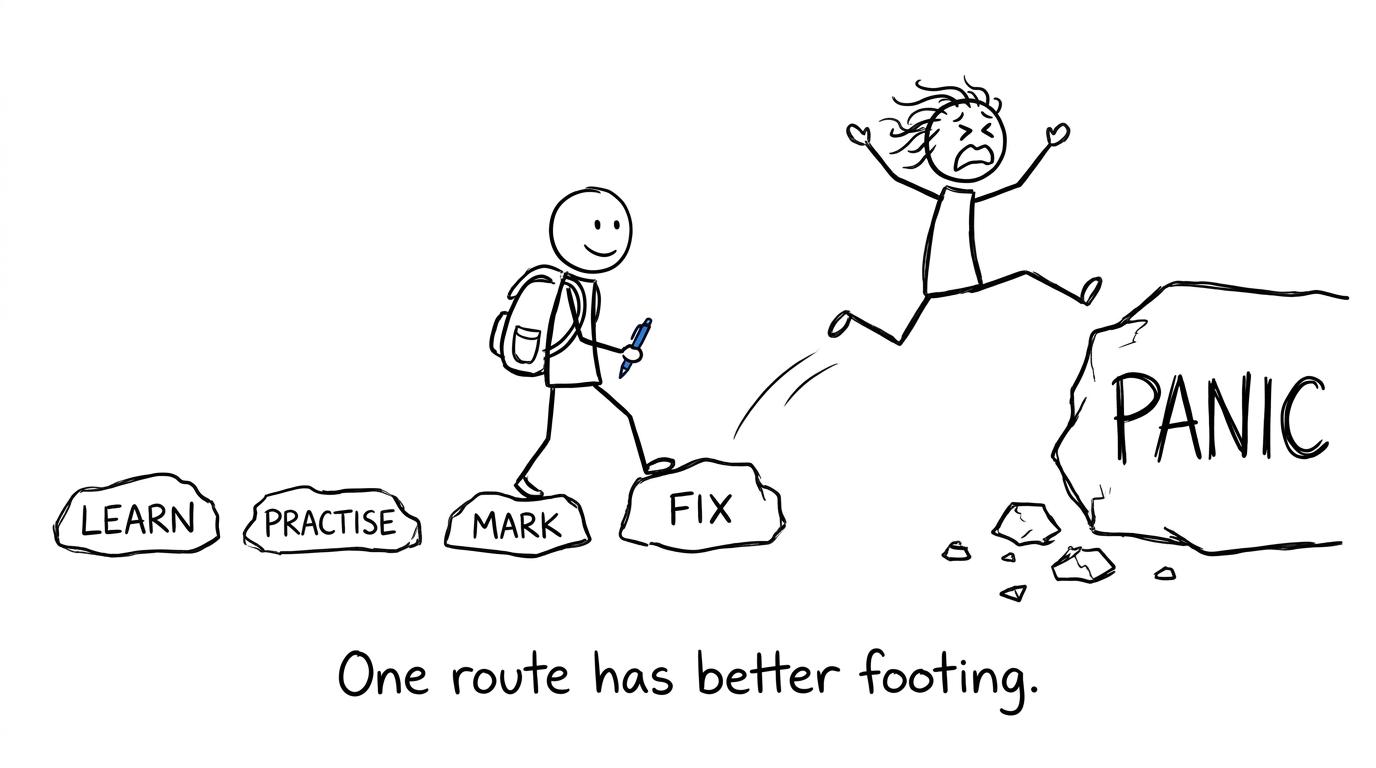 A calm revision route compared with a leap towards panic
Common mistakes when choosing subjects
- Assuming home fluency makes Arabic effortless: formal reading, writing and examination technique still need preparation.
- Ignoring option blocks: a perfect theoretical combination is useless if your school cannot timetable it.
- Choosing because friends are choosing: teachers, classes and friendships can change; the specification remains.
- Calling a subject easy: every GCSE requires knowledge, practice and assessment preparation.
- Forgetting compulsory subjects: options must fit around English, maths and science, not replace their workload.
- Overlooking assessment clashes: essays, performances and portfolio deadlines can converge.
- Planning only for a future career: interests change. A broad, manageable combination usually keeps more routes open.
- Failing to ask about Arabic support: confirm who teaches speaking, marks writing and provides specification-specific feedback.
Make the combination sustainable
For most students, Arabic plus history or geography is the clearest academic pairing. Computer science or business can add an analytical or practical direction. A creative subject can provide welcome variety. The right answer depends on your interests, school rules, likely next steps and the honest weekly workload.
Choose subjects you can still imagine revising when the novelty has gone. Then protect the core. MathsGenie gives you free revision lessons, practice questions, mini tests, mark schemes, video solutions, past papers and predicted papers so that maths does not become the subject squeezed into whatever time remains.
Begin with the MathsGenie GCSE Maths revision area, identify one weak topic and schedule your next session now. A sensible subject combination opens the door. A repeatable revision routine is what carries you through it.