GCSE Sociology Long Answer Questions: Top Marks
GCSE sociology long answer questions explained: learn how examiners reward knowledge, application, analysis, evaluation and focused conclusions in exams.
A long-answer question can create a strange kind of panic. You recognise the topic. You remember several sociologists. Yet the empty page makes everything feel less certain.
The key to GCSE sociology long answer questions is not writing down everything you know. Examiners reward a focused argument that uses accurate sociological knowledge, applies it to the question, develops relationships between ideas and evaluates competing explanations. The strongest responses make every paragraph serve that purpose.
This guide explains what tends to separate a top-mark response from an average one. Exact question formats and mark allocations vary between exam boards and specifications, so always check the wording of your current AQA or Eduqas materials and use the relevant mark scheme.
The long-answer checklist
Before writing, make sure you can do the following:
- identify the precise issue and command word;
- select relevant concepts, evidence and sociologists;
- make a clear claim in each paragraph;
- explain how your evidence supports that claim;
- connect every paragraph to the question;
- consider an alternative interpretation or limitation;
- reach a reasoned judgement where the question requires one;
- organise your time so the final section is completed.
These are not separate tricks. They form a chain. Accurate knowledge gives you something to argue with; application keeps the argument relevant; analysis explains it; evaluation tests it.
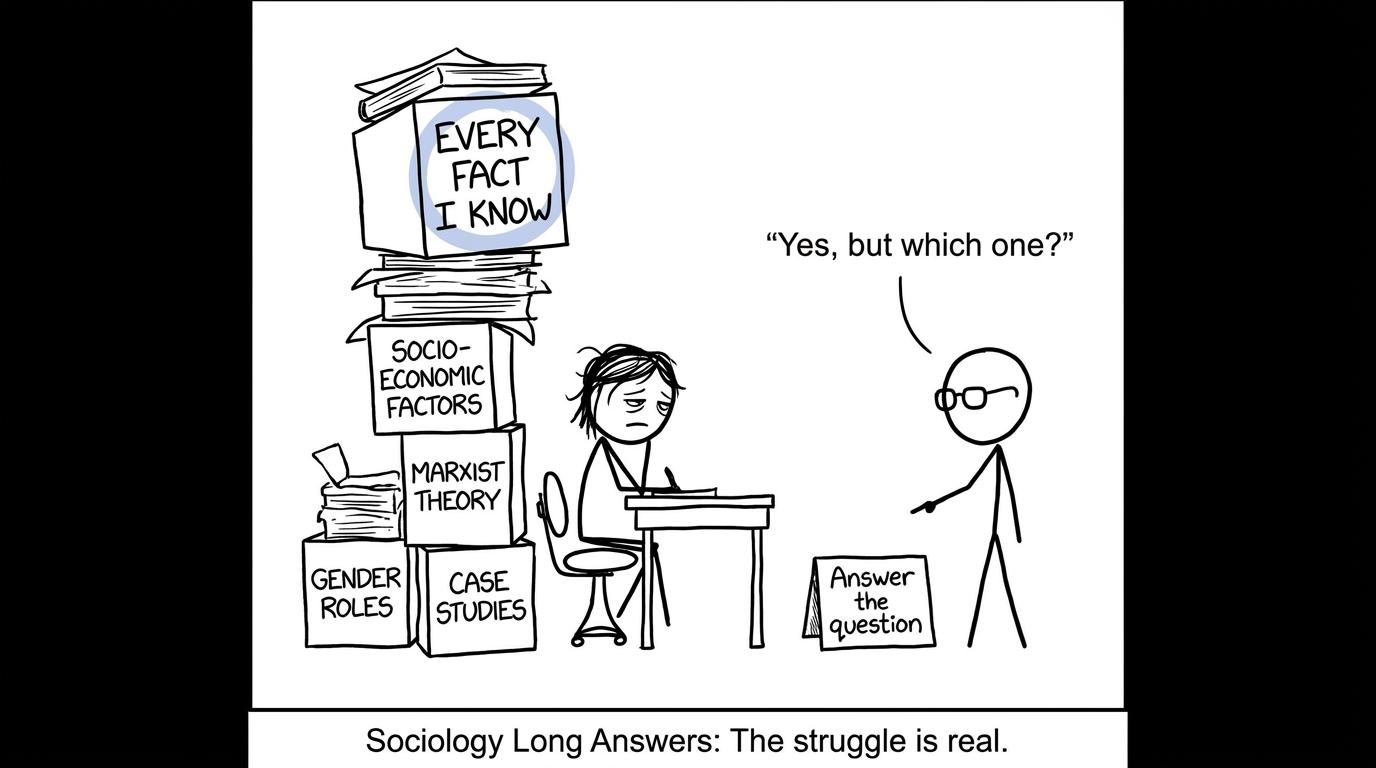 A student discovers that answering the question matters more than listing every remembered fact
What examiners actually reward
Accurate and relevant sociological knowledge
Strong answers demonstrate secure knowledge of the topic. This may include concepts, perspectives, research findings, methods, social processes and named sociologists where these are genuinely relevant.
Accuracy matters, but relevance matters just as much. A detailed account of a study earns little if it does not help answer the question. Before including a piece of knowledge, ask: What claim will this help me establish?
Top responses are selective. They choose the best material rather than emptying an entire revision notebook onto the page. This is similar to selecting the correct method in maths: knowing ten techniques is less useful than recognising which one solves the problem in front of you.
Application to the exact question
Application means using knowledge in the context set by the question. Repeating a memorised paragraph about education, families or crime is not enough if the paragraph never addresses the specific group, relationship or claim being examined.
A useful test is to look at the final sentence of each paragraph. Could it have been written for almost any question on the topic? If so, the application may be too weak.
Use the important language from the question naturally. Explain why your evidence supports or challenges the stated view. This turns recalled knowledge into a response.
Developed analysis
Analysis explains relationships. It answers questions such as:
- Why might this happen?
- Through what social process does it happen?
- What consequence follows?
- How does the evidence support the argument?
- How are social institutions, groups or inequalities connected?
An average response often makes a claim and attaches a fact. A stronger response develops the chain between them. It shows not merely that two things are associated, but how one may influence the other and why that relationship matters to the question.
Words such as “therefore” and “consequently” can help signal reasoning, but they do not create analysis by themselves. The explanation after the connective must add a genuine logical step.
Evaluation that changes the argument
Evaluation is not simply adding “however” before an unrelated point. It tests the strength of an argument.
Useful evaluation may:
- offer a contrasting sociological perspective;
- identify evidence that challenges a generalisation;
- question whether a study is representative or current;
- distinguish between different social groups;
- consider whether another factor provides a stronger explanation;
- examine the strengths or limitations of the research method;
- explain that an argument works in some circumstances but not others.
The best evaluation has consequences. It tells the examiner whether the original claim remains convincing, needs qualification or is less persuasive than an alternative.
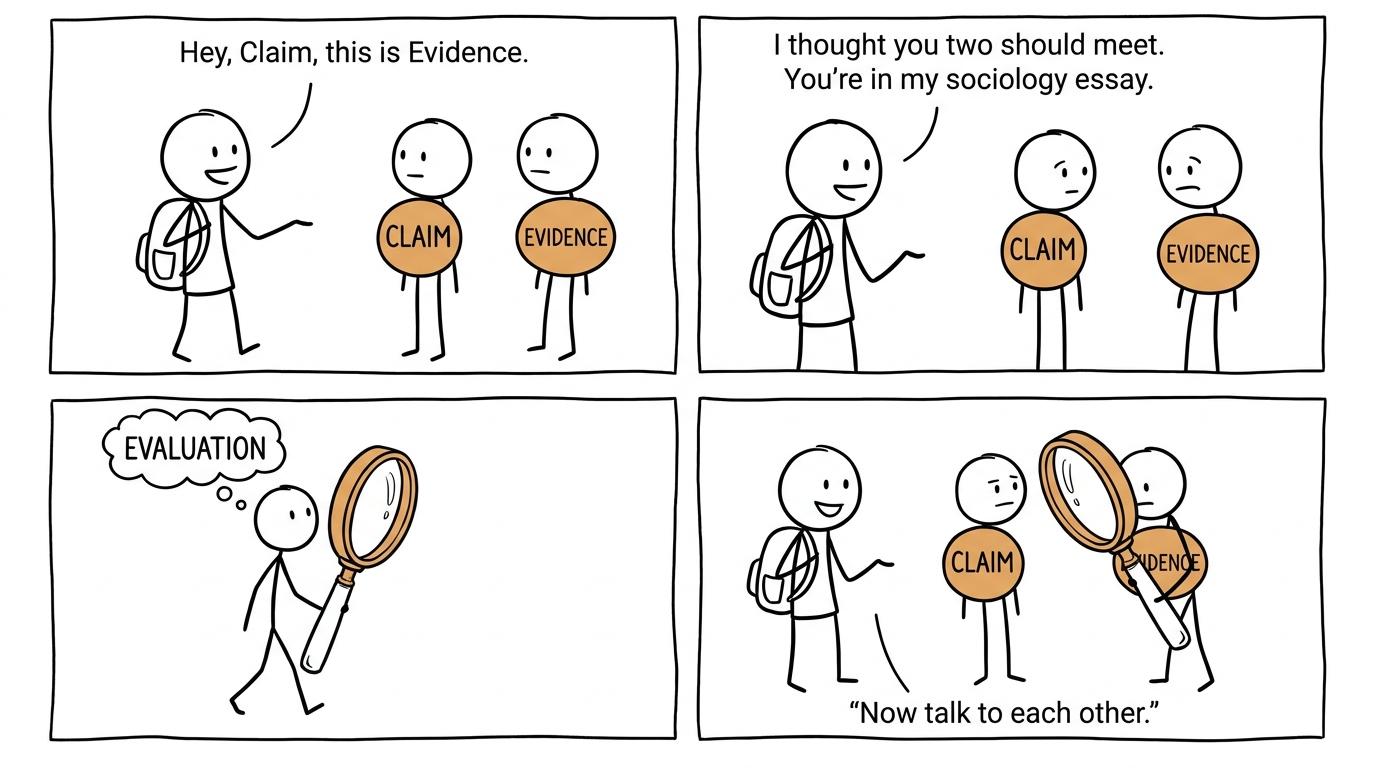 Sociological claims, evidence and evaluation are encouraged to talk to each other
How to structure a top-mark response
There is no compulsory paragraph acronym that guarantees marks. Examiners assess the quality of the answer, not whether every paragraph follows a fashionable label. A reliable structure is still useful because it protects your reasoning under time pressure.
Begin by decoding the task
Read the command word carefully. “Explain” requires developed reasons or processes. “Discuss” and “evaluate” normally demand competing arguments and consideration of their relative strength. A question asking how far you agree requires a judgement, not just two disconnected lists.
Underline the topic, the particular issue and any group or context named. Then decide what the central disagreement is. That disagreement should shape the entire response.
Build paragraphs around claims
Each main paragraph should have one clear job:
- state a claim that answers the question;
- support it with precise sociological knowledge;
- explain the connection between the evidence and claim;
- examine a limitation, qualification or alternative where appropriate;
- link the resulting judgement back to the question.
This is not a worked response to memorise. It is a decision-making framework. Some paragraphs need more evidence; others need deeper evaluation. Let the question determine the balance.
Make comparisons explicit
Placing two perspectives in separate paragraphs does not automatically compare them. Explain the difference.
Do they disagree about the cause of a social pattern? Does one focus on consensus while another focuses on conflict? Does one explanation operate at the level of institutions while another examines everyday interaction? Which is better supported by the evidence you have selected?
Explicit comparison raises the quality of the argument because it shows that you understand the relationship between perspectives, not merely their definitions.
Finish with a reasoned conclusion
A conclusion should answer the question directly. It should not introduce a new sociologist or repeat the introduction word for word.
Make a judgement, identify the strongest reason for it and acknowledge any important condition. A qualified conclusion is often more convincing than an absolute claim because sociological explanations commonly depend on context, social group and the quality of available evidence.
Why average answers remain average
Many middle-level responses contain plenty of knowledge. Their problem is control.
The student may describe several studies without explaining their importance. They may present a supporting argument and an opposing argument but never decide between them. They may mention a limitation without showing how it affects the conclusion. Each ingredient is present, but the reasoning connecting them is missing.
Top responses feel different because they are purposeful. The writer keeps returning to the exact question and makes small judgements throughout. The final conclusion then grows naturally from the discussion rather than appearing as a last-minute opinion.
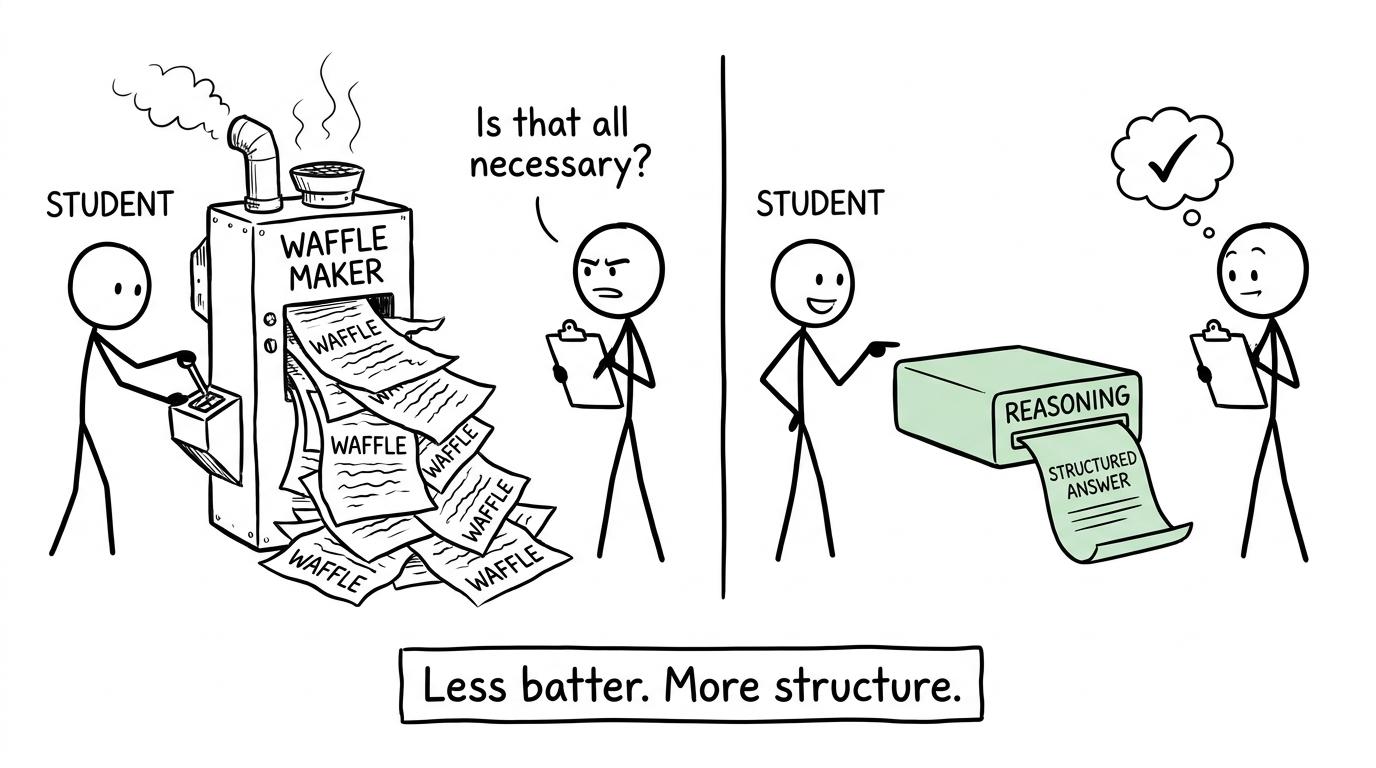 A revision waffle machine is replaced by a smaller reasoning machine
Revise for arguments, not isolated facts
A list of names and definitions can create the comforting feeling of progress. Long-answer performance depends on being able to use that knowledge.
Organise each topic around debates. For every major explanation, record:
- the central claim;
- the concepts and evidence supporting it;
- the social process that makes it plausible;
- a competing explanation;
- an evidence-based limitation;
- the circumstances in which it may be most convincing.
Then practise planning responses without immediately writing them in full. Planning forces you to select material and compare arguments. Full timed responses remain essential, but not every revision session needs to produce several pages.
After completing a question, use the official mark scheme for your exam board. Identify where you demonstrated knowledge, application, analysis and evaluation. Mark schemes are not model essays, however. They indicate valid content and assessment standards rather than prescribing one perfect answer.
This feedback cycle resembles effective maths revision. On MathsGenie, students can combine GCSE revision lessons with GCSE exam papers, checking methods rather than merely counting marks. The same principle applies in sociology: diagnose the missing skill, then practise it deliberately.
Managing long answers in the examination
Do not allocate time by instinct alone. Use the mark value and the overall paper length to form a sensible plan, while allowing time to read questions and check responses. Your teacher can help you adapt this to the current specification.
A brief plan can prevent three expensive problems: repeating the same point, forgetting the counterargument and leaving the conclusion unfinished. Note the sequence of claims and evidence, then begin.
If time is running short, prioritise complete reasoning over decorative prose. Clear sentences, precise terminology and direct links to the question matter more than an elaborate introduction.
Students preparing for maths alongside sociology can use MathsGenie predicted papers to rehearse making decisions under timed conditions. The GCSE revision resources also divide a large specification into manageable topics, while past exam papers reveal whether knowledge survives outside familiar exercises.
Common mistakes in GCSE sociology long answer questions
Describing instead of arguing
A long description of a theory may be accurate but still fail to address the debate. Turn knowledge into a claim and explain why it matters.
Using evidence as decoration
Naming a sociologist is not analysis. Explain what the research found, how it supports the argument and whether there is a meaningful limitation.
Writing generic evaluation
Statements such as “the study may be biased” are weak without a reason. Identify the source of the possible bias and explain how it affects the claim.
Treating balance as two equal lists
Evaluation is not a mechanical sequence of one point for and one point against. Compare the strength, relevance and scope of the arguments.
Ignoring the wording of the question
A polished memorised essay can lose focus if the question changes slightly. Reuse knowledge, not entire answers.
Making an unsupported conclusion
Your final judgement must follow from the evidence considered. Avoid choosing a side simply because the question asks for an opinion.
Neglecting timed practice
Knowing how to construct an answer and producing it under examination conditions are different skills. Regular practice reduces the gap.
Turn examiner expectations into a revision routine
The difference between an average and top-mark long answer is rarely one remarkable fact. It is usually a series of disciplined choices: selecting relevant knowledge, developing the reasoning, testing the claim and reaching a justified judgement.
Start with one question. Plan it, write it under sensible time pressure and compare it with the current mark scheme. Then identify one improvement for the next attempt. Small feedback loops are less dramatic than last-minute cramming, but they are far more dependable.
MathsGenie can support that same disciplined approach across your maths revision. Use the free GCSE maths revision programme, practise with exam-style papers and mark schemes, and add predicted GCSE papers when you are ready to test complete-paper technique. Revision lessons, practice questions, video solutions and mini tests help turn mistakes into specific next steps, which is where improvement usually begins.