GCSE Psychology Harder Than Before: Has It Changed?
GCSE psychology harder than before? Compare old and current exams, understand why they feel tougher, and learn how maths revision can make them manageable.
The unsettling thing about a difficult subject is not always the difficulty itself. It is the suspicion that someone else had an easier version.
So, is GCSE psychology harder than before? In one sense, yes: England's reformed GCSE Psychology specifications introduced more demanding content, greater emphasis on application and evaluation, linear assessment and clearer mathematical requirements. But it is not accurate to say that students are simply being awarded lower grades for the same ability. Grade boundaries are set after papers are marked to reflect their difficulty, while key grades were designed to remain comparable with the previous system.
The fairest conclusion is this: the course may demand a broader range of skills than older versions, but several features of modern GCSE revision make those demands easier to understand and prepare for.
The short answer
Here is the distinction that matters:
- The content and questions can be more demanding. Modern specifications expect recall, application, analysis, evaluation and research-methods skills.
- The qualification is linear. Students normally take all assessment at the end of the course rather than completing modular units along the way.
- Mathematical skills are explicit. At least 10%10\%10% of the marks must reward maths used within research methods.
- Research methods matter significantly. At least 20%20\%20% of the qualification must assess them.
- Grades are not directly comparable number by number. The current scale runs from grade 999 to grade 111, while older GCSEs used letters.
- A harder paper does not automatically mean a harder grade. Boundaries can move to account for differences in paper difficulty.
The modern course therefore feels harder for understandable reasons. Yet difficulty is not the same as unfairness, and it is certainly not the same as impossibility.
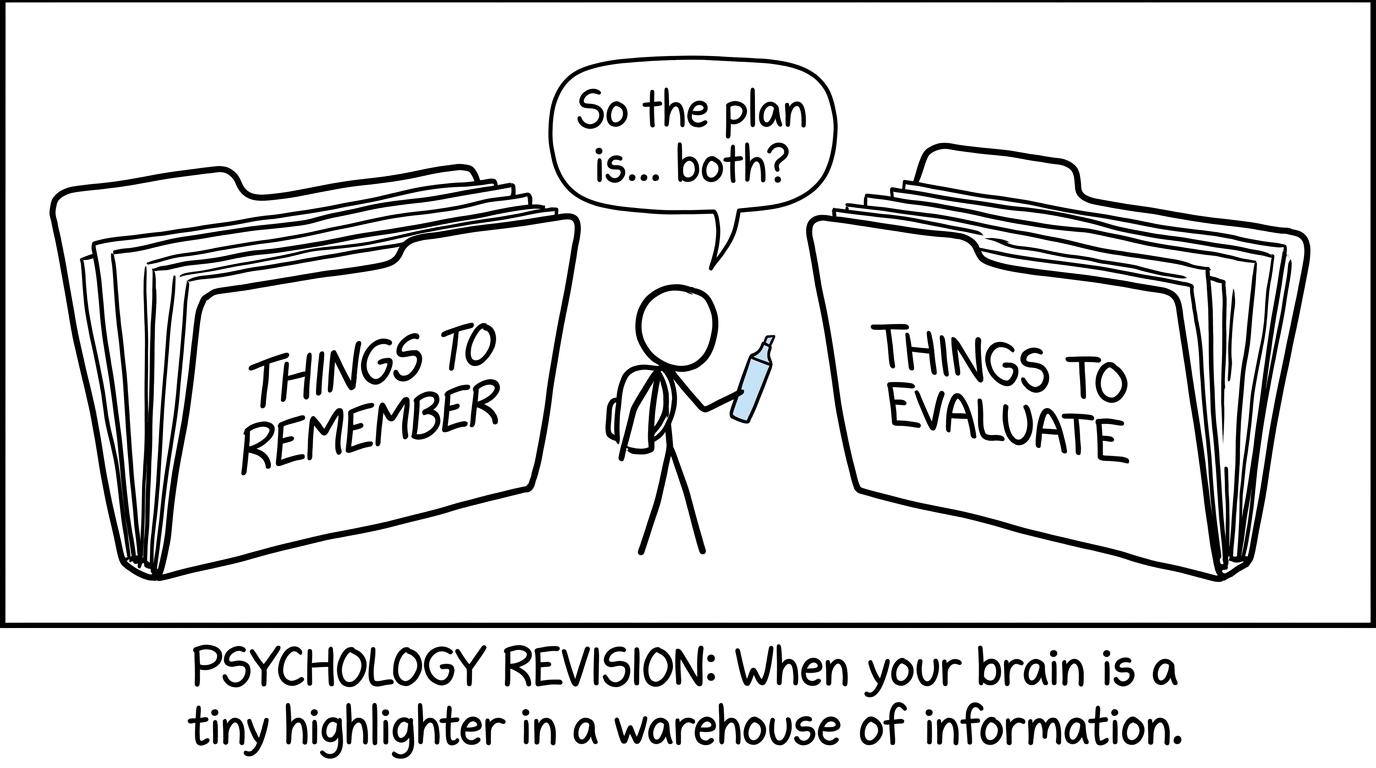 A student facing enormous psychology revision folders with a tiny highlighter
What genuinely changed in GCSE Psychology?
GCSE reform was intended to create more demanding subject content while keeping qualifications accessible to the range of students who traditionally took them. Reformed Psychology specifications were first awarded in 201920192019, using the numerical grade scale.
More than remembering studies
Psychology has always involved learning theories, evidence and terminology. The modern assessment framework, however, makes the balance of skills especially clear:
- AO1, knowledge and understanding: 35%35\%35%
- AO2, application: 35%35\%35%
- AO3, analysis and evaluation: 30%30\%30%
That means almost two-thirds of the marks are not awarded for simple recall alone. Students must apply ideas to an unfamiliar scenario, interpret evidence, compare explanations or reach a supported judgement.
This is one reason the examination can feel harder than a revision card suggests. Knowing a definition is useful, but the paper may ask you to recognise that concept inside a description you have never seen before.
Linear exams increase the memory burden
Current GCSE Psychology qualifications are linear. All assessment is completed in the final examination series, so knowledge from the whole course must remain available at once.
For AQA GCSE Psychology, students take two written papers, each lasting 111 hour 454545 minutes and worth 100100100 marks. Each paper contributes 50%50\%50% of the qualification. Pearson Edexcel also assesses the qualification through two externally examined papers, although its content organisation, paper weightings and mark totals differ.
This is important because exam boards are not interchangeable. AQA and Pearson Edexcel specifications select and organise topics differently, even though Ofqual's assessment objectives apply across GCSE Psychology qualifications. Always revise from the specification named by your school rather than from a generic topic list.
Psychology is also not divided into foundation and higher tiers. Every student following a particular specification sits the same papers, with questions designed to differentiate across grades 999 to 111.
Why the course may feel harder now
A qualification can feel more difficult even when grading arrangements protect students from an unusually demanding paper. That apparent contradiction disappears when we separate the experience of taking the exam from the process of awarding grades.
Questions combine several skills
A single scenario can test whether you can identify a method, apply psychological knowledge, interpret data and evaluate a conclusion. The individual pieces may be familiar, but combining them under timed conditions creates cognitive pressure.
The best response is not to revise every fact with equal intensity. Organise revision around three actions:
- Know: retrieve the theory, study, term or procedure accurately.
- Apply: connect it to the details given in the question.
- Evaluate: explain a strength, limitation or justified conclusion.
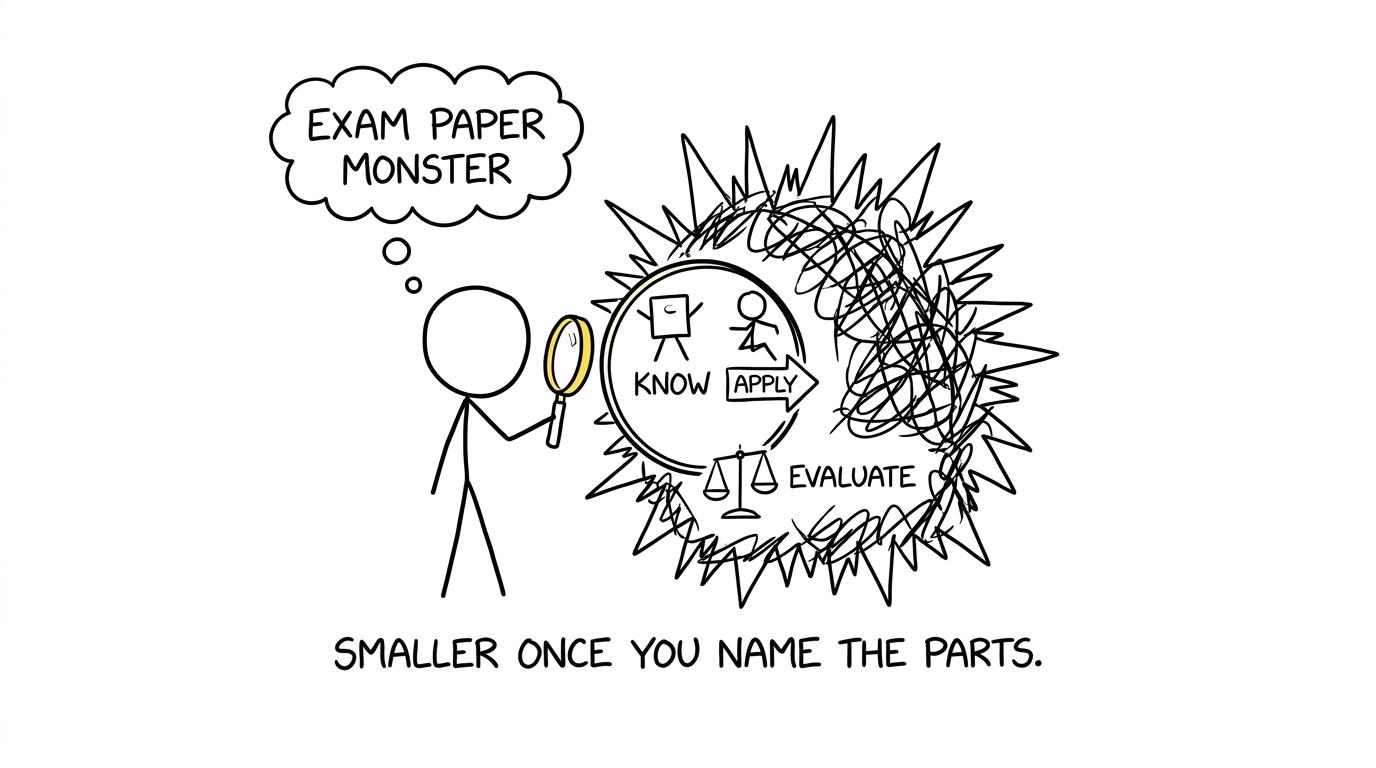 A frightening exam paper becoming smaller when divided into know, apply and evaluate
Research methods have real weight
Research methods are not a small appendix to the course. Ofqual requires at least 20%20\%20% of the total marks to assess knowledge, application and evaluation of psychological research methods.
Students may need to understand hypotheses, variables, sampling, experimental designs, ethical issues, reliability, validity and ways of presenting data. Scenario-based questions then test whether those ideas can be used rather than merely recited.
A useful revision check is to ask two questions about each method: When would it be appropriate? and What could weaken the conclusion? This moves revision beyond memorised lists of advantages and disadvantages.
The maths is visible and compulsory
At least 10%10\%10% of the qualification's marks must assess mathematical skills at no lower than Key Stage 333 demand, within research methods. Required skills can include:
- ratios, fractions and percentages;
- decimal and standard form;
- estimation and significant figures;
- mean, median, mode and range;
- frequency tables, bar charts and histograms;
- scatter diagrams and correlation;
- interpreting numerical and graphical information.
None of this requires advanced GCSE algebra. The challenge is recognising familiar maths inside a psychological investigation.
The arithmetic mean, for instance, is represented by:
mean=sum of scoresnumber of scores\text{mean}=\frac{\text{sum of scores}}{\text{number of scores}}mean=number of scoressum of scoresA percentage is calculated using:
percentage=partwhole×100\text{percentage}=\frac{\text{part}}{\text{whole}}\times 100percentage=wholepart×100These are familiar skills, but accuracy still matters. MathsGenie's free GCSE maths revision hub brings together lessons, worksheets, exam questions and videos for rebuilding them. If correlation feels uncertain, use the scatter graphs revision guide, then check understanding with scatter graph practice questions.
Does harder content mean lower grades?
Not automatically. Grade boundaries are set after students' work has been marked. They can change from one examination series to another because papers differ in difficulty.
The current and old scales are not directly equivalent at every grade. However, official comparison points place the bottom of grade 777 alongside the bottom of the former grade A, grade 444 alongside the former grade C, and grade 111 alongside the former grade G.
This prevents two common misunderstandings. First, a grade 999 is not simply a renamed A*. Second, a change in a raw grade boundary does not by itself prove that the qualification has become easier or harder. Boundaries are part of the mechanism used to maintain standards.
Comparisons with an older relative's result are therefore limited. They may have followed a different specification, sat modular assessments or answered questions with a different balance of skills. Their experience can be interesting without being a reliable measurement of yours.
A practical revision checklist
The most useful question is not whether a past cohort had an easier course. It is whether your current revision matches your current paper.
- Download the correct specification and turn each statement into a checklist.
- Separate factual knowledge from application and evaluation practice.
- Learn the command words used by your exam board.
- Complete research-methods questions every week rather than leaving them until the end.
- Practise percentages, averages, range and graphs without notes.
- Use current-specification past papers under timed conditions.
- Mark answers carefully and record the reason for every lost mark.
- Return to weak skills after a short delay instead of merely rereading the answer.
For the numerical side, MathsGenie's guide to GCSE maths topics by exam board and tier can help you locate the statistics and number skills you need. The article on GCSE maths topics that appear regularly also explains a useful three-stage process: learn the method, practise it by topic, then test it in papers.
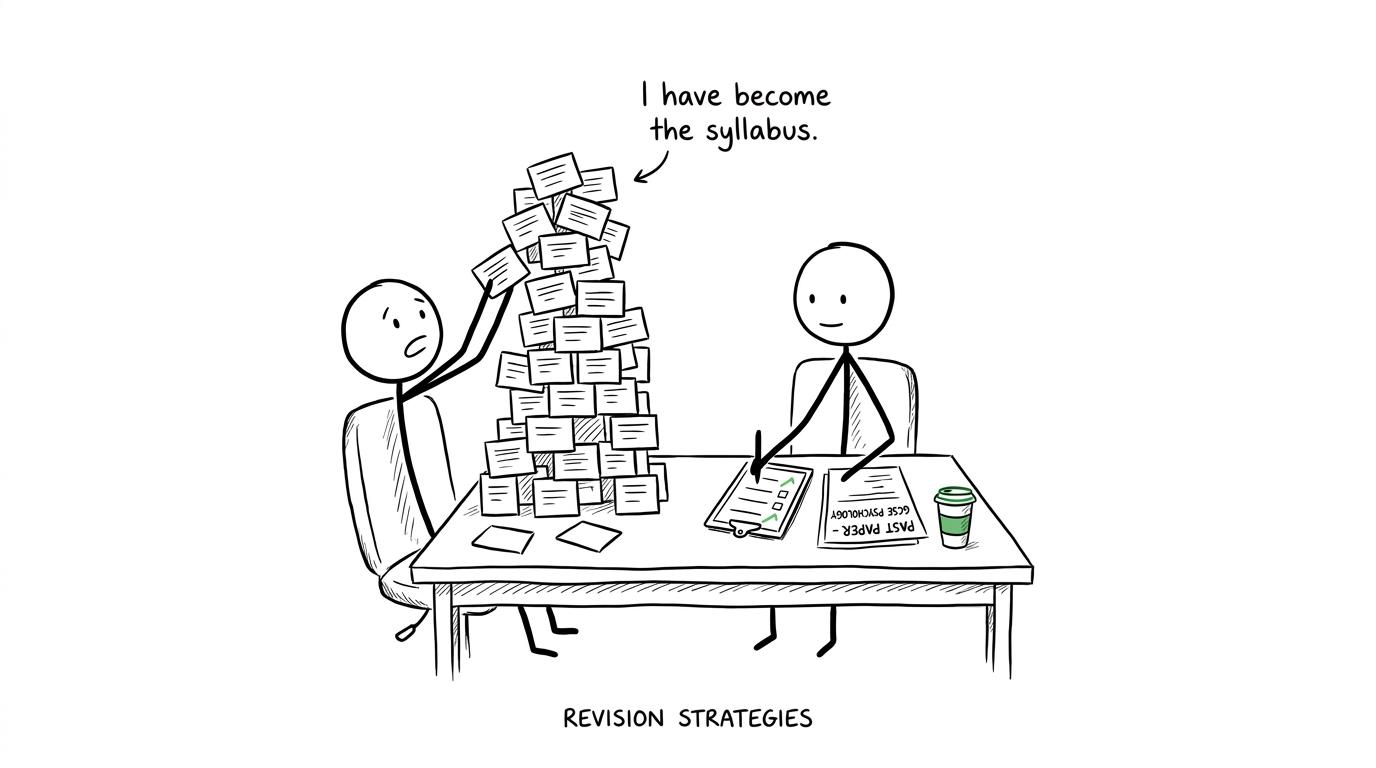 One student building a flashcard tower while another uses a calm revision checklist
Common mistakes when judging difficulty
Comparing specifications by topic count
Ten short topics are not necessarily harder than eight deep ones. Difficulty depends on the required depth, question style and balance between recall, application and evaluation.
Treating grade boundaries as fixed pass marks
Boundaries vary between examination series. A boundary from one year cannot tell you exactly what will be needed in another, nor can it reliably predict whether your future paper will be difficult.
Revising Psychology as pure memorisation
Flashcards can build AO1 knowledge, but they do not automatically prepare you for AO2 and AO3. Add scenario questions, data interpretation and timed evaluation to your routine.
Avoiding research methods because they feel technical
The weighting makes this expensive. Research methods and mathematical skills are planned parts of the assessment, not optional extras. Weakness here can affect questions across more than one topic.
Using resources from the wrong exam board
A useful explanation can still teach a general concept, but only your own specification defines what you must know. Check the exam-board name, qualification code and current specification before committing facts to memory.
Doing papers without learning from them
A completed paper is evidence, not improvement by itself. Use the mark scheme to identify whether each error came from missing knowledge, weak application, vague evaluation, arithmetic or timing. MathsGenie's advice on revising efficiently with papers and mark schemes demonstrates how to turn errors into a focused revision list.
The calmer conclusion
GCSE Psychology has genuinely changed. Modern specifications contain demanding content, linear assessment, substantial research methods and compulsory mathematical skills. It is reasonable for students to feel that the course asks for more than memorising interesting studies.
Yet that does not mean today's students are simply facing harsher grading. Boundaries account for paper difficulty, and key grade standards connect the numerical scale with important points on the former letter scale. The course is demanding in a more structured and visible way.
That visibility can help you. Once the paper is divided into knowledge, application, evaluation, research methods and maths, it becomes a collection of trainable skills rather than one intimidating subject.
Use official Psychology specifications and past papers for your exam board. Then make MathsGenie your free base for the numerical skills that support Psychology and your wider GCSE preparation. Begin with revision lessons and practice questions, check your methods with video solutions and mark schemes, and build exam confidence through mini tests, past papers, predicted papers and the revision planner. Difficulty becomes manageable when every revision session has a clear purpose.