GCSE Psychology Handwriting Speed: Does It Matter?
GCSE psychology handwriting speed can affect completion, not marks directly. Learn how to stay legible, pace answers and seek support before your exams.
A student can know the content, recognise the evaluation point and plan a strong conclusion, yet still watch the invigilator call time before that conclusion reaches the page. That is why GCSE psychology handwriting speed matters, but not quite in the way many students fear.
You do not normally receive marks for writing quickly. Examiners award marks according to the mark scheme and assessment objectives. However, slow handwriting can cost marks indirectly if you leave questions unfinished, shorten important explanations or produce writing that becomes difficult to read. The aim is not to turn your pen into a racing car. It is to make your knowledge visible within the available time.
This guide explains how to judge whether handwriting is genuinely affecting you, how to improve your exam pacing and when to speak to your school about support.
The quick answer and checklist
Handwriting speed is probably an issue if timed practice repeatedly shows that you:
- know what you wanted to say but cannot finish the paper;
- leave extended responses incomplete despite understanding the topic;
- rush later answers and lose clarity or legibility;
- experience significant pain, fatigue or loss of control when writing;
- complete much more when typing than when handwriting;
- regularly need substantially longer than the official time.
One unfinished practice paper proves little. A repeated pattern across lessons, assessments and mock exams is more meaningful.
Before changing your handwriting, check four things:
- Knowledge: did you know enough psychology to answer promptly?
- Planning: did you spend too long deciding what to write?
- Pacing: did you allocate time in proportion to the marks?
- Physical writing: could your hand produce readable sentences at a sustainable rate?
These causes can look identical when the clock reaches zero, but they need different solutions.
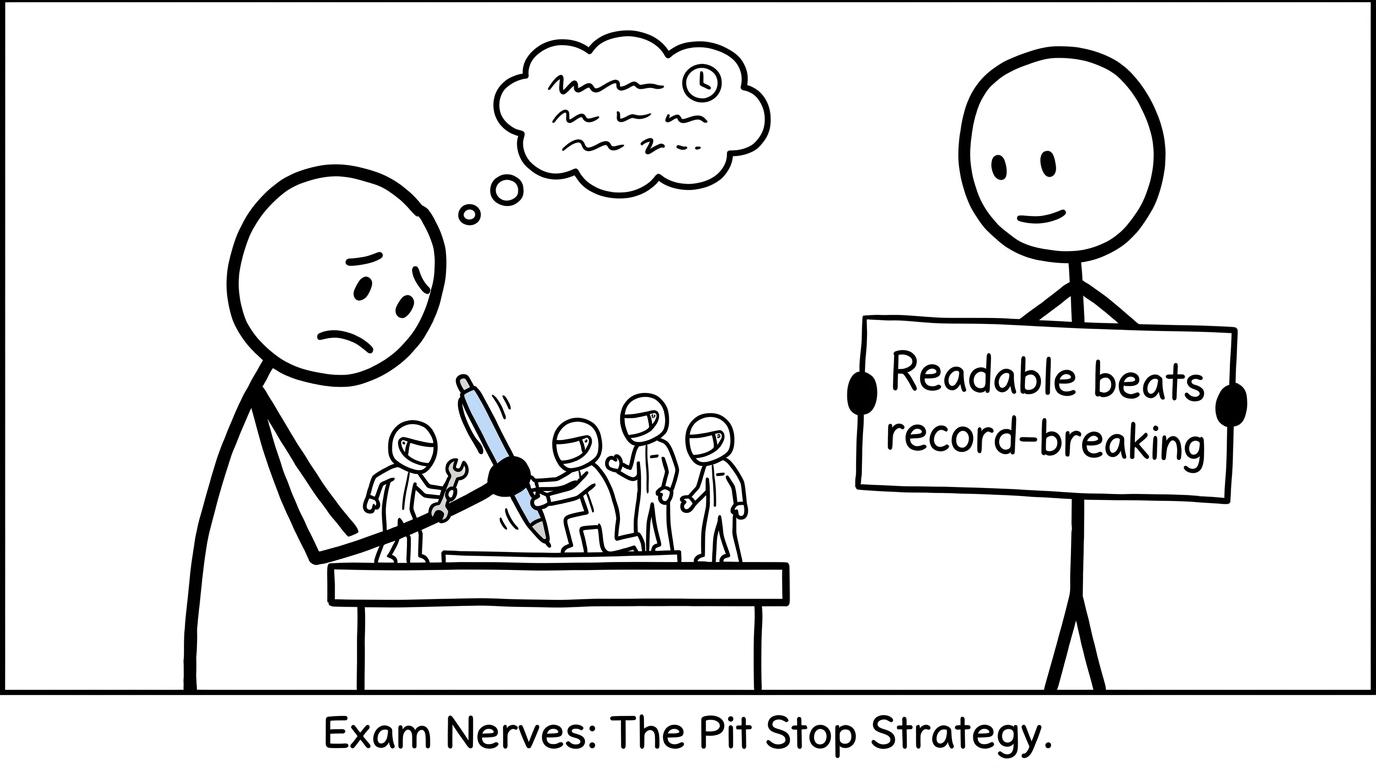 A tiny exam pit crew changes a student's pen while an examiner reminds them that readable writing beats record-breaking speed
Does slow handwriting directly lose marks?
Usually, no. GCSE Psychology assesses psychological knowledge, application, analysis and evaluation rather than raw handwriting speed. For example, AQA's assessment objectives are AO1, AO2 and AO3. Its papers contain multiple-choice questions, short answers and extended writing, so candidates must move between very different response styles.
AQA GCSE Psychology currently has two written papers. Each is worth 100100100 marks and lasts 111 hour 454545 minutes. That creates an average allowance of:
105 minutes100 marks=1.05 minutes per mark\frac{105\text{ minutes}}{100\text{ marks}}=1.05\text{ minutes per mark}100 marks105 minutes=1.05 minutes per markThat is an average pacing guide, not a rule for every question. Reading a scenario, interpreting data and planning an extended response all use time too. Your own exam board may have a different structure, so follow its current specification and your teacher's guidance.
Speed becomes relevant through three indirect routes.
You do not reach available marks
An examiner cannot award content that never reaches the answer booklet. If a final answer worth several marks remains blank, the problem is completion rather than handwriting quality itself.
Your writing becomes illegible
Examiners must be able to identify what you have written. AQA examiner reports have specifically warned that barely legible handwriting can make scripts difficult to mark on screen. Neatness is not a beauty contest, but recognisable words, clear paragraph breaks and unambiguous corrections matter.
Rushing weakens the response
A fast final paragraph can become a string of undeveloped claims. On extended questions, the mark scheme may reward accurate knowledge, application to the scenario, logical analysis and supported evaluation. More words do not automatically earn more marks, but incomplete reasoning can restrict an otherwise promising answer.
Find out whether the pen is really the problem
There is a useful distinction between writing slowly and answering slowly.
Suppose you pause for two minutes because you cannot recall a study, then write quickly. That is primarily a retrieval problem. If you know the answer immediately but your hand cannot record it before time runs out, handwriting is more likely to be the limiting factor.
Use three timed papers or substantial sections rather than judging yourself from one stressful mock. Record:
| Evidence | What it may suggest |
|---|---|
| Long pauses before writing | Recall, planning or question interpretation issue |
| Strong early answers but blank final questions | Pacing or physical writing-speed issue |
| Finished paper with thin explanations | Answer development or knowledge issue |
| Writing deteriorates throughout the paper | Fatigue, grip, pressure or speed issue |
| Pain or persistent discomfort | A reason to speak to school staff promptly |
Ask a teacher to inspect the scripts without being told what you suspect. They can often see whether you are over-writing low-mark questions, repeating points or genuinely struggling to record enough relevant content.
This evidence-first approach is useful in maths too. A timed paper separates knowledge gaps from execution and pacing problems. MathsGenie's GCSE Maths revision hub provides board-specific questions and papers for building that evidence.
Build a pace that protects marks
Allocate time using the marks
Use the number of marks as your strongest clue about expected depth. A low-mark question should not consume the time needed for an extended response.
A general planning relationship is:
target time=marks available×minutes per mark\text{target time}=\text{marks available}\times\text{minutes per mark}target time=marks available×minutes per markDo not follow this mechanically. Allow time for reading and checking, and use the pattern recommended for your board. The value is in noticing when one answer has expanded beyond its importance.
Write a few time checkpoints on the front of your practice paper. If you miss one, do not panic and make every letter smaller. Finish the current sentence, leave space if useful and move to the next question.
Plan briefly before extended writing
A compact plan can make writing faster because it removes mid-paragraph indecision. Note the knowledge needed, the scenario detail to apply and the evaluation points you intend to develop. Use keywords rather than complete sentences.
The plan must save more time than it consumes. If planning becomes a miniature version of the answer, it has stopped helping.
Write for marks, not length
Students sometimes respond to time pressure by trying to write faster when the better solution is to write less repetition. Each paragraph should do a distinct job.
Ask:
- What precise claim am I making?
- What psychological evidence or reasoning supports it?
- Have I applied it to the scenario where required?
- Does this sentence add something new?
Clear, selective writing is usually quicker to produce and easier to mark than a long answer circling the same idea.
Preserve legibility under pressure
Practise at the fastest pace that remains readable. Keep letters large enough to distinguish, leave visible spaces between words and cross out errors with one clean line. Avoid repeatedly scribbling over a word.
A comfortable pen, relaxed grip and sensible posture may reduce unnecessary strain. Equipment cannot solve an underlying access need, but it can remove avoidable friction. Bring spare black pens that you have already used in timed practice.
Train handwriting speed without sacrificing revision
Handwriting improves most usefully when attached to genuine exam practice. Copying pages from a textbook may exercise your hand, but it does not train recall, selection or mark-aware pacing.
Use a simple weekly cycle:
- complete one short-answer section under time pressure;
- complete one extended response under time pressure;
- mark or review it using the relevant criteria;
- identify whether marks were lost through knowledge, structure, application or completion;
- repeat a similar task later at a sustainable pace.
Build duration gradually. A short, focused session is more informative than forcing yourself through an entire paper with an aching hand.
Maths students can develop the same exam discipline with MathsGenie's Edexcel GCSE Maths 454545-minute tests. Full Edexcel GCSE Maths past papers, AQA GCSE Maths past papers and OCR GCSE Maths past papers then test whether the pace lasts across a complete assessment.
Psychology also includes research methods and data interpretation. If calculations or graphical questions slow you down, revise the skill rather than trying to handwrite around the uncertainty. MathsGenie's AQA probability revision resources and scatter graphs revision can strengthen useful statistical foundations.
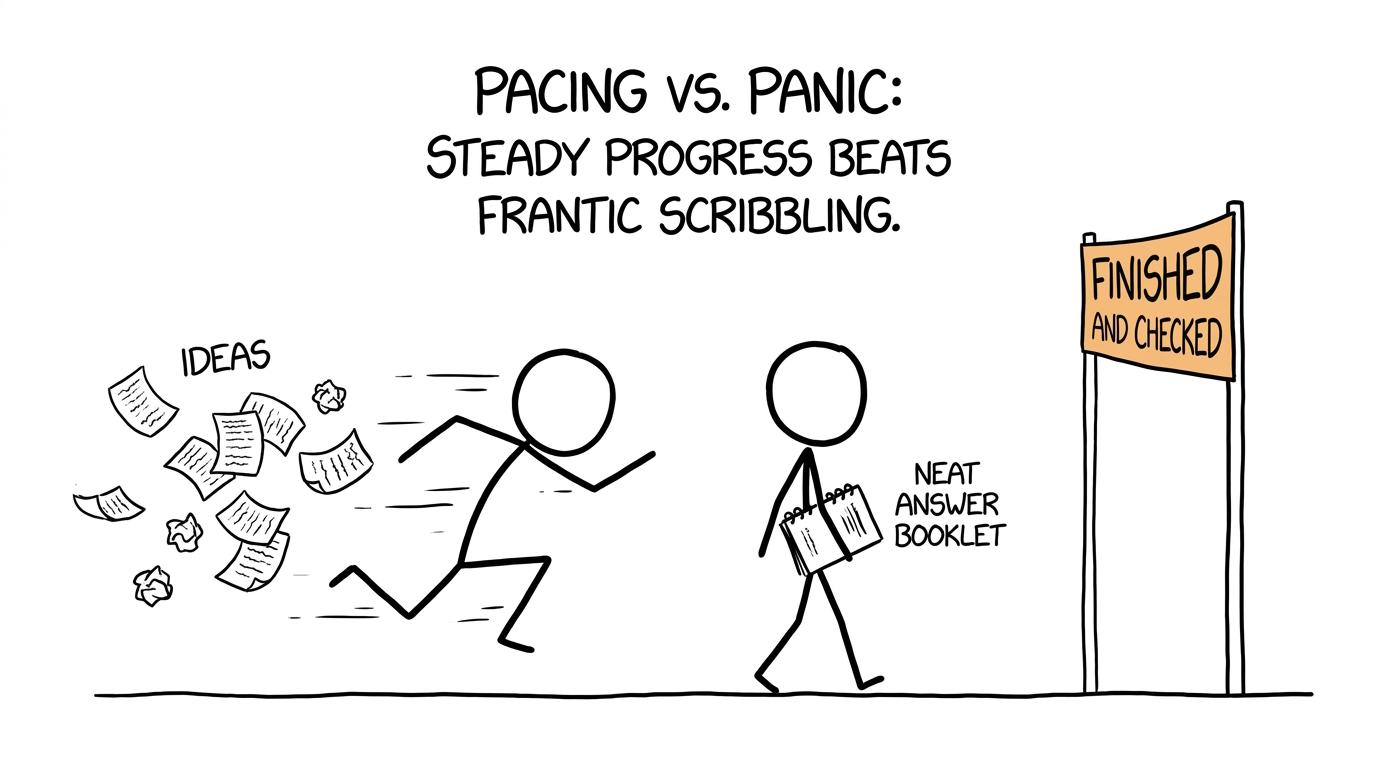 One student rushes while dropping ideas, while another carries a complete answer booklet steadily towards the finish
When to ask about access arrangements
If slow or painful writing is persistent and substantial, tell your teacher, SENCO or examinations officer early. Do not wait until the morning of the examination.
JCQ rules govern access arrangements for many UK qualifications. Arrangements are designed to remove a demonstrated barrier without changing what the assessment tests. They are not automatically awarded because a student prefers typing or feels generally slow.
Current JCQ guidance allows writing speed to contribute to the evidence considered for extra time when a candidate writes by hand. A school may also provide a word processor where this is appropriate to the candidate's needs and reflects their normal way of working. Spellcheck, grammar checking and predictive text are normally disabled unless specific permission applies.
Evidence, assessment requirements and approval processes depend on the arrangement and the individual circumstances. Your school must apply the current rules. A student should not diagnose their own entitlement from an online checklist.
Raise the concern early enough for staff to examine classwork, timed assessments and mock papers, trial suitable support and establish a normal way of working. Mention pain, a medical condition, a physical difficulty or a known learning need rather than treating it as something to hide.
Common mistakes when trying to write faster
Sacrificing readability
A completed answer cannot earn its intended marks if crucial words are indecipherable. Sustainable clarity beats a frantic final page.
Writing everything you remember
A question rewards relevant content, not a memory dump. Read the command word and select material that answers it.
Spending equal time on every question
Questions carry different marks and demand different depth. Let marks guide your time rather than the amount you happen to remember.
Mistaking weak recall for slow handwriting
If most time disappears while you search your memory, more handwriting drills will not fix the cause. Use active recall and exam questions instead.
Seeking support too late
Access arrangements require school involvement and appropriate evidence. Speak up during the course, particularly if writing causes pain or repeatedly prevents completion.
Practising speed without reviewing quality
A faster response is not better if it loses application, evaluation or accuracy. Review timed work against the mark scheme and ask your teacher whether the argument remains clear.
A calmer way to finish the paper
GCSE psychology handwriting speed matters when it stops your knowledge from becoming readable, relevant evidence on the page. It does not mean that the fastest writer wins. The stronger goal is controlled completion: understand the question, plan briefly, write only what earns marks and preserve legibility until the end.
Gather evidence from timed practice. If the issue is recall, strengthen revision. If it is pacing, use mark-based checkpoints. If it is a persistent physical or learning barrier, speak to your school early about an appropriate assessment and support.
The same habits will strengthen your maths exams. Start with MathsGenie's free GCSE Statistics revision resources, then use revision lessons and practice questions to repair weak skills. Build speed through mini tests, move to past papers and predicted papers, and learn from mark schemes and video solutions. Exam confidence rarely comes from rushing. It comes from having practised the right process often enough that the clock no longer controls your thinking.