GCSE Psychology Group Chat Study Tips That Work
GCSE psychology group chat study tips that turn noisy messages into focused quizzes, exam practice and useful feedback while keeping revision social.
A class group chat can become useful revision surprisingly quickly. It needs a clear purpose, short retrieval questions, firm boundaries and regular independent exam practice. Without those things, the chat usually becomes an archive of memes, unanswered requests and photographs of notes nobody reads.
The best GCSE psychology group chat study approach is simple: use the chat to test what you can remember, compare explanations and organise practice. Do not use it as a substitute for learning the content yourself.
That distinction matters. Reading somebody else's answer can feel productive because it looks familiar. In an exam, however, you must retrieve ideas without the comforting trail of messages above them. Your group chat should prepare you for that moment rather than protect you from it.
The group chat revision checklist
Before the next message disappears beneath an unrelated conversation, agree on a few rules:
- Choose one specification topic at a time.
- Post questions before answers.
- Give everyone time to respond from memory.
- Label material clearly by topic and exam board.
- Explain corrections rather than merely posting the right answer.
- Keep social conversation within agreed limits.
- Complete timed questions independently before comparing responses.
- Check disputed claims against your current specification, textbook or teacher.
- Use a separate revision plan to track your own weaknesses.
A group chat works best as a small revision system. It should tell everyone what to do, when to do it and how to check whether it worked.
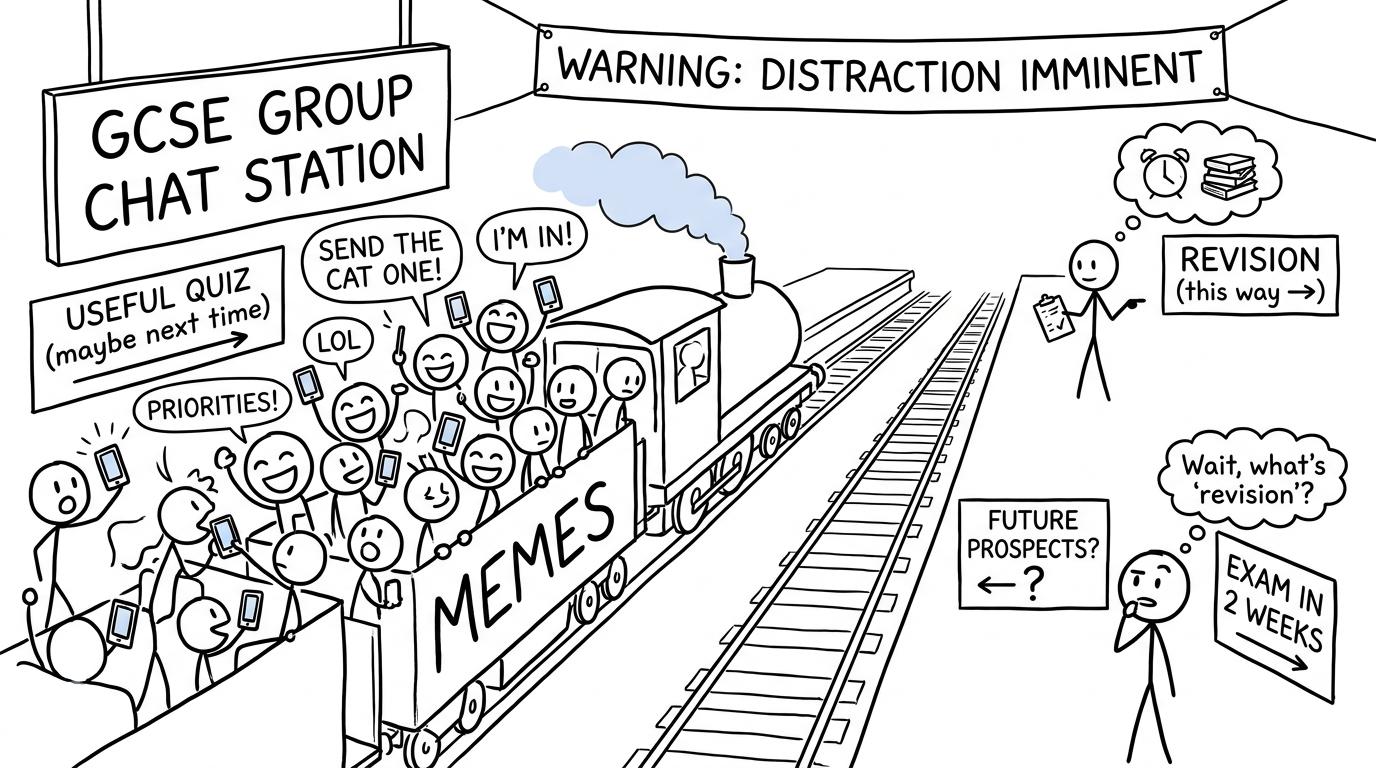 A noisy group chat choosing between revision and memes
Give the GCSE psychology group chat study sessions a structure
Group chats drift because they have no natural finishing line. Someone writes "Shall we revise memory?" and receives three thumbs-up reactions. Nothing difficult has happened, so nothing memorable has been learned.
Replace vague intentions with a compact session format:
Choose one narrow focus
"Memory" is too broad for one conversation. A named theory, study, method or evaluative issue gives the group a manageable target. Use the exact language found in your course materials.
GCSE Psychology content is not identical across exam boards. AQA and Pearson Edexcel specifications, for example, organise and assess material differently. Check the current specification followed by your school rather than assuming that a friend's topic list applies to you.
Set a short active task
Ask each person to answer a small set of questions without opening their notes. Questions might request a definition, an outline of a process, an application to a scenario or an evaluation point.
This is retrieval practice: trying to bring information to mind rather than simply seeing it again. The attempt matters, including when the first answer is incomplete. It exposes the difference between recognition and recall.
Review and record
Compare answers only after everyone has attempted the task. Resolve disagreements using an authoritative course source. Each person should then record their own weak areas outside the chat.
The same principle supports maths revision. MathsGenie's GCSE revision resources organise topics into lessons, questions and solutions, but progress comes from attempting the questions before checking the method.
Turn messages into retrieval practice
The most useful message in a revision chat is often a question with no immediate answer underneath it.
If an answer appears straight away, other students can mistake recognition for knowledge. Instead, nominate a question setter and agree on an answer time. Members can respond privately on paper first, then post a concise answer when time is called.
Useful prompt types include:
- Define: state the precise meaning of a key term.
- Outline: give the important features of a theory, process or study.
- Apply: connect psychological knowledge to a new scenario.
- Compare: identify a meaningful similarity or difference.
- Evaluate: develop a strength or limitation and explain why it matters.
- Plan: organise the main content for a longer response without writing it collaboratively.
Where your exam board uses assessment objectives such as AO1, AO2 and AO3, label prompts accordingly. Always follow the wording and demands of your own specification and mark schemes.
The group can also use delayed retrieval. Return to a question several days later without warning. A correct answer immediately after reading notes may reflect short-term familiarity; retrieving it after a gap is a more demanding check.
Make explanation the price of an answer
A bare correction tells somebody that they were wrong. An explanation helps them avoid the same error next time.
Ask members to use a simple feedback pattern:
- identify what is accurate;
- locate the missing or incorrect idea;
- explain the relevant psychological concept;
- suggest one precise improvement.
This keeps feedback constructive and prevents the fastest typist from dominating. It also encourages elaboration: connecting a fact to its meaning, evidence or consequence.
Do not let the chat manufacture certainty. If two people remember a study differently, mark the question as unresolved and check it. Group confidence is not the same as accuracy.
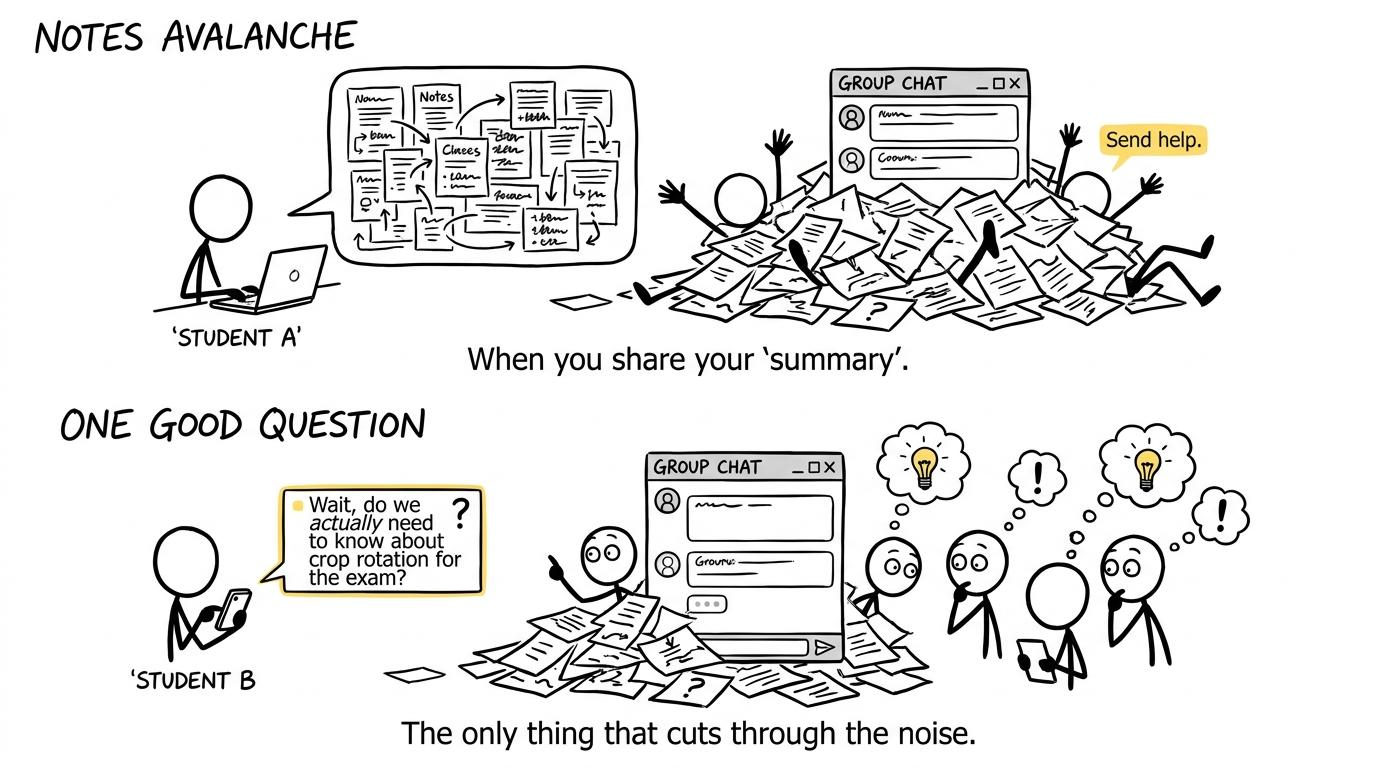 A useful question survives a group chat notes avalanche
Use roles without creating extra work
A little organisation reduces the number of messages needed. Roles can rotate so that no student becomes the unpaid administrator of everyone else's revision.
Possible roles include:
- Topic setter: selects a small area from the specification.
- Quiz writer: prepares retrieval prompts.
- Timekeeper: closes discussion and starts independent practice.
- Checker: verifies disputed content against approved materials.
- Summariser: posts the final list of corrected ideas and remaining gaps.
The summariser should not rewrite the whole lesson. A short list of misconceptions is more useful than another enormous set of notes.
Maths students can use the same structure alongside the MathsGenie scheme of work. One person chooses the topic, everyone attempts the relevant practice independently, and the group discusses only the steps that caused difficulty.
Connect psychology revision with GCSE maths
Psychology includes quantitative skills, particularly within research methods and data interpretation. Depending on the specification and question, students may need to understand tables, graphs, averages, percentages or conclusions drawn from data.
That makes a psychology group chat useful for identifying mathematical gaps, but those gaps still need deliberate practice. If a member is uncertain about probability or interpreting numerical information, direct them towards free GCSE maths revision rather than trying to teach an entire topic through hurried messages.
Keep psychology and maths resources labelled separately. A statistical term may have a particular purpose within a research context, while the underlying calculation must still be mathematically correct. Always check what the psychology question is asking before selecting or interpreting a measure.
Students preparing for both subjects can reserve different sessions for them. MathsGenie's GCSE exam papers provide full-paper practice, while a psychology session can focus on retrieving studies, applying theories and planning evaluative responses.
Protect independent exam practice
Collaboration is useful during revision. The examination is individual.
At least once each week, move away from the group chat and attempt questions under controlled conditions. Put the phone out of reach, follow the permitted time and avoid notes. Afterwards, use the relevant mark scheme carefully and return to the chat only to discuss specific uncertainties.
This avoids a subtle trap: a student can become excellent at recognising the best answer in a conversation while remaining unable to construct it alone.
For maths preparation, students can combine past-paper practice with MathsGenie predicted papers. Predicted papers are practice resources, not claims about the exact questions that will appear. Past papers remain essential for understanding genuine exam style and demand.
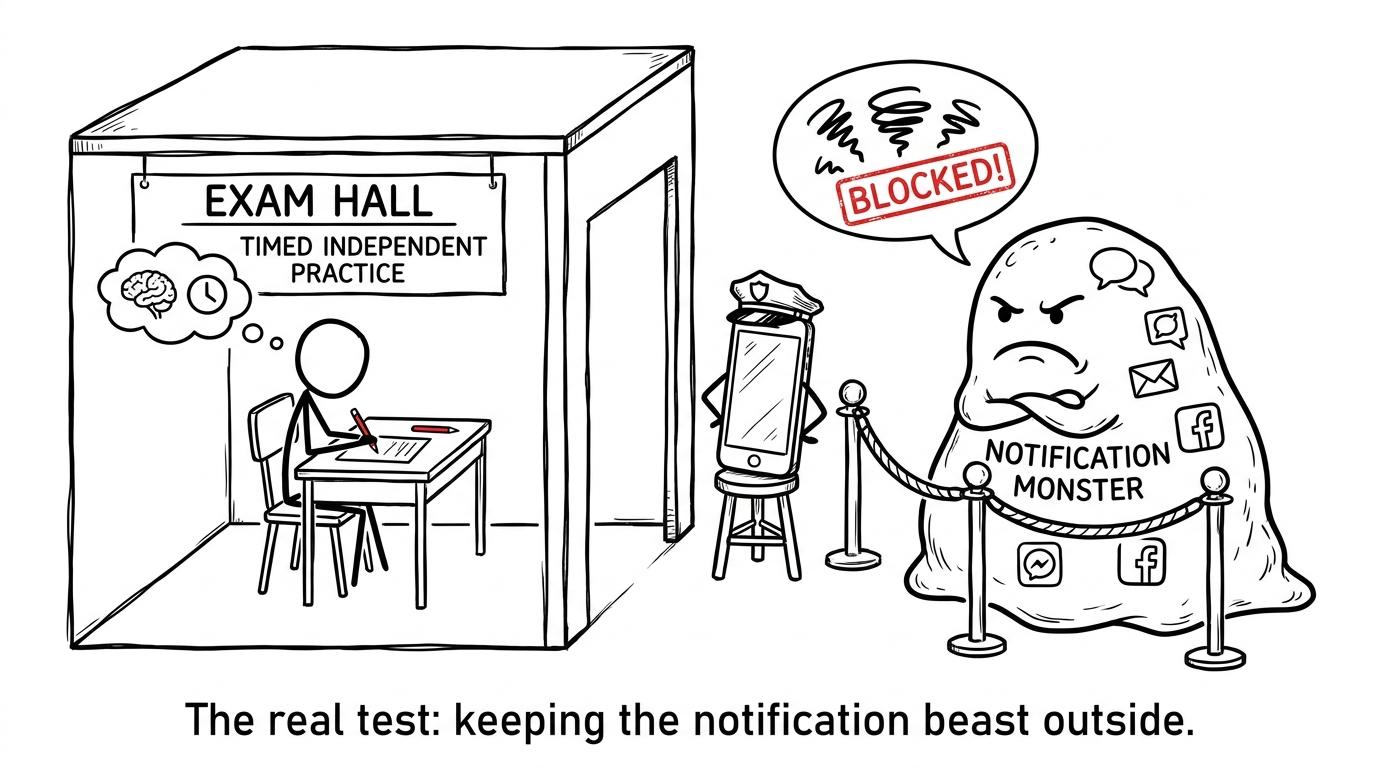 A notification monster kept outside independent exam practice
Keep the chat calm, safe and searchable
A useful group does not need constant activity. Notifications can fragment attention, while late-night messages can create pressure to remain available.
Agree on practical boundaries:
- use a recognisable topic label at the beginning of revision posts;
- avoid posting during agreed quiet hours;
- pin the weekly plan and essential links;
- use reactions for simple acknowledgements;
- move unrelated conversation elsewhere;
- never share personal information, private messages or photographs without permission;
- share legitimate resource links rather than redistributing restricted material.
Nobody should be penalised socially for muting the chat. Revision should support concentration, not compete with it.
A separate planner also protects students from following the group's priorities blindly. Your classmates may be revising a topic you already understand while your own weakest area remains untouched. MathsGenie's topic structure, mini tests and video solutions can help build an individual plan from the main MathsGenie revision hub.
Common mistakes in group chat revision
Posting photographs instead of testing recall
A photograph of a completed page stores information but does not prove that anyone can retrieve it. Turn the material into questions and hide the answers until everyone has attempted them.
Copying a polished response
Copying creates a clean notebook and a misleading feeling of progress. Write independently first, compare second and then improve your own response.
Trusting the most confident person
Confident messages can still be inaccurate. Verify contested details against the current specification, teacher guidance and official assessment materials.
Revising only favourite topics
Groups naturally return to subjects they enjoy discussing. Use a topic checklist or revision planner so less comfortable areas receive attention too.
Discussing marks without discussing reasons
A mark total alone gives limited guidance. Look at which requirement was missed and what change would make the response more precise.
Remaining online for the whole session
The chat should trigger revision, not become the revision environment for every task. Build in quiet periods for recall, planning and timed writing.
Make the chat a doorway, not a destination
A good revision group does not produce the most messages. It produces better independent answers.
Keep sessions narrow. Test memory before revealing information. Explain corrections. Verify uncertainty. Then leave the conversation and practise under exam conditions.
For your maths exams, make MathsGenie the next step after the chat. Choose a revision lesson, attempt the practice questions, use mini tests to find gaps and check video solutions only after trying. As exams approach, add past papers, mark schemes and predicted papers to your revision planner.
Memes can stay. They may even make a difficult week feel lighter. They just should not be the only messages anyone remembers.