GCSE Portuguese Last-Minute Revision: 3-Day Plan
GCSE Portuguese last-minute revision plan for three calm, focused days covering vocabulary, listening, reading, speaking and writing without cramming.
The exam has been on the timetable for months. Yet somehow it now feels as if it arrived overnight.
If that is where you are, this GCSE Portuguese last minute revision plan gives you a clear answer: spend the first day diagnosing gaps and rebuilding core language, the second practising the skill that will be examined, and the third improving accuracy without exhausting yourself. You cannot revise everything in three days. You can still make those days count.
The aim is not frantic cramming. It is to recover the vocabulary you already know, practise retrieving it under pressure and reduce avoidable mistakes. If Portuguese is competing with GCSE maths for your attention, use MathsGenie's GCSE revision resources to keep your maths work targeted rather than allowing it to consume the whole evening.
Your calm three-day checklist
Before beginning, check your official exam timetable and statement of entry. Confirm:
- which Portuguese component is next: listening, speaking, reading or writing;
- your exam board and specification;
- whether you are entered for foundation or higher tier, where applicable;
- the paper length and permitted materials;
- your three weakest topic areas;
- when maths and other GCSE exams also need attention.
Current GCSE Portuguese qualifications assess listening, speaking, reading and writing, but arrangements, timings and tier requirements must be checked against your own exam board's current specification. Many candidates take Pearson Edexcel Portuguese, but you should never assume that a classmate's paper details apply to you.
Write your answers on one sheet. That sheet is your plan. Everything else is optional.
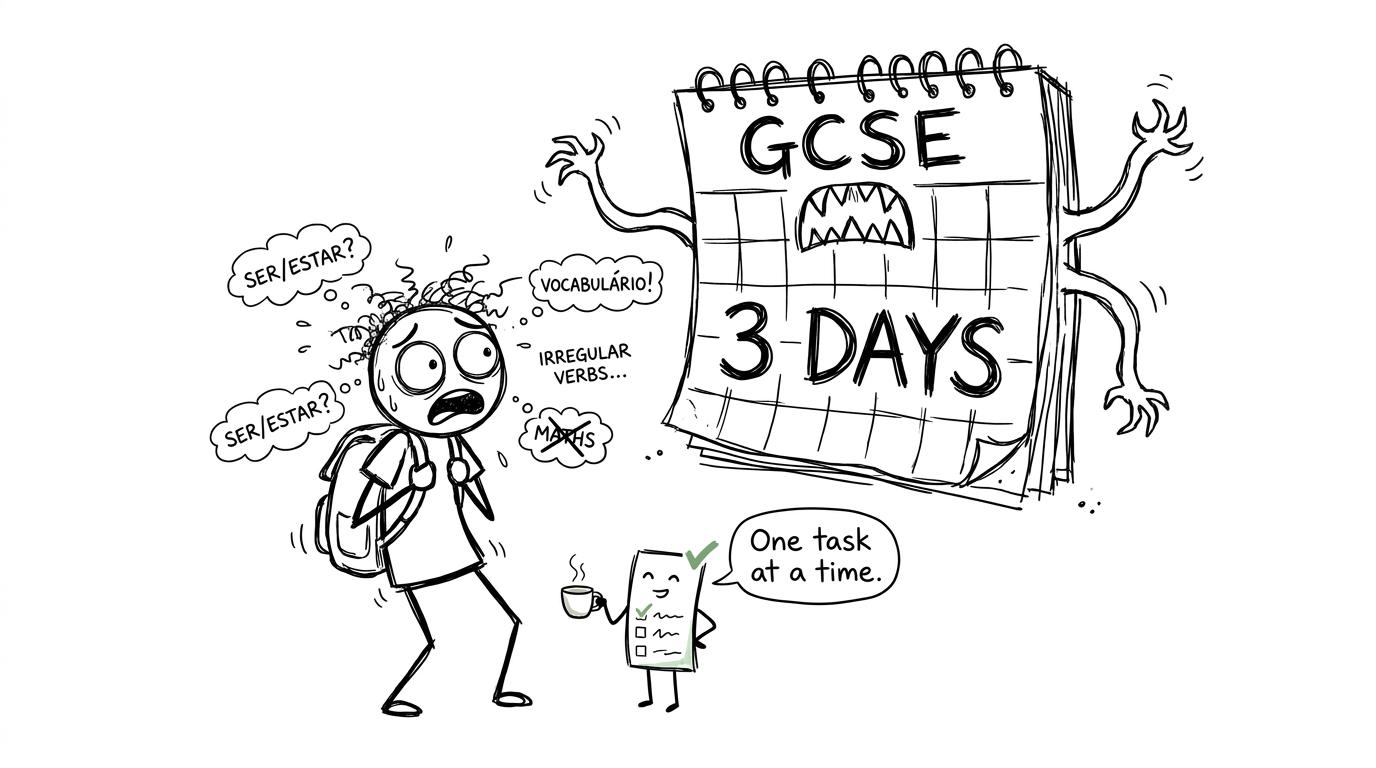 A calm checklist faces the three-day revision monster
Day one: find the gaps and rebuild your core
Panic often creates the urge to begin with the largest vocabulary list available. Resist it. A long list can feel productive while asking very little of your memory.
Start with a short diagnostic task from material supplied by your school or exam board. Choose the same skill as your next examination where possible. Complete it without notes, then separate errors into four groups:
- vocabulary you did not recognise;
- vocabulary you recognised too slowly;
- grammar or verb errors;
- question words and instructions you misunderstood.
This turns a vague fear, “I do not know Portuguese”, into a finite set of problems. Finite problems are easier to revise.
Build a high-value vocabulary bank
Create a compact bank organised by purpose rather than by an enormous alphabetical list. Prioritise:
- opinions and reasons;
- common present, past and future verb forms;
- time expressions;
- negatives and contrasting words;
- people, places and everyday activities;
- vocabulary from your weakest specification themes;
- question words and common exam instructions.
Use active recall. Look at the English meaning, say or write the Portuguese, and then check it. Words answered correctly several times can leave the main pile. Words answered incorrectly should return later.
Include accents when learning spellings. They are part of written Portuguese, not decoration to add at the end. Also notice whether your course teaches European or Brazilian usage and follow the conventions expected by your teacher and specification.
Rehearse flexible language
Your best last-minute material is language that can serve more than one topic: giving an opinion, explaining a reason, describing a past event, stating a future intention and adding a contrast.
Do not memorise a complete answer that only fits one prompt. Learn adaptable sentence structures and accurate verb forms instead. Examiners reward communication that answers the actual task; a polished paragraph on the wrong subject cannot do that.
Finish day one by testing your vocabulary bank again. Then stop at a sensible time. Memory benefits more from spaced retrieval and sleep than from staring at the same page deep into the night.
Day two: practise the skill, not just the language
Day one repairs your toolkit. Day two is about using it under conditions resembling the examination.
Choose one timed task for the component you will sit next. Use an official specimen, past assessment material or a task approved by your teacher. Afterwards, check the mark scheme or assessment criteria where available. Do not simply record a mark. Ask why each mark was lost.
If listening is next
Practise listening without trying to translate every word. Before the recording begins, use the question to predict the type of information required: a person, opinion, place, time, reason or activity.
Listen carefully for negatives, changes of mind and contrasts. A speaker may mention one option before rejecting it. The first familiar word is not automatically the answer.
After marking, replay difficult sections and identify the exact sound, word or phrase you missed. This is more useful than repeatedly completing new recordings without analysing them.
If reading is next
Scan the question before reading the whole text. Underline the information you need, then locate evidence. Watch for cognates, but verify meaning from context rather than guessing from resemblance alone.
For translation, preserve the meaning of the complete sentence. A natural, accurate English sentence is usually better than a rigid word-for-word version that loses the message.
If speaking is next
Practise aloud. Silent rehearsal cannot show whether you can retrieve words, pronounce them clearly or continue after hesitation.
Record short responses, listen once and note only the biggest improvements: answering the exact question, adding a reason, using more than one time frame where relevant and correcting recurring pronunciation problems. If your assessment includes particular task types or preparation rules, follow the current instructions supplied by your school.
If writing is next
Plan briefly around the task's required content. Each bullet point needs a clear response. Build control before complexity: accurate communication is more valuable than an ambitious construction you cannot manage.
Leave time to check verb endings, tense, agreement, negatives, accents and whether every requested detail has been covered. Use the dictionary only if your specific paper permits one; do not assume that it will.
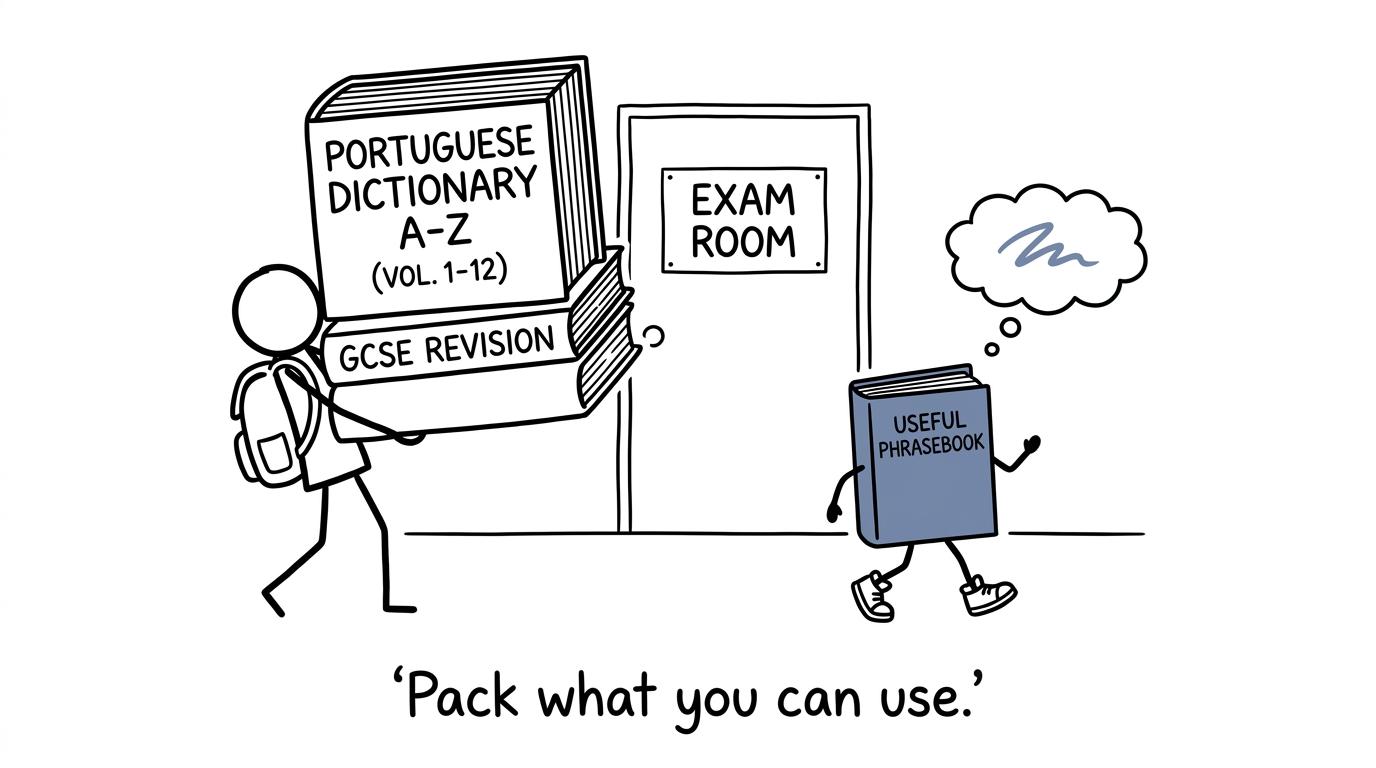 A giant dictionary loses a race to a useful phrasebook
Day three: sharpen accuracy and protect your energy
The final day is not the moment to begin the entire specification. It is a day for consolidation.
Start by retesting the vocabulary and verb forms missed on days one and two. Remove anything now secure. The shrinking list is evidence of progress and leaves more attention for stubborn gaps.
Next, complete a short section rather than another exhausting full paper. Use your marking to create a final error checklist. It might include:
- read every instruction twice;
- listen for negatives;
- answer every bullet point;
- check which time frame is required;
- include accents and agreements;
- do not leave blanks without making a sensible attempt.
Pack what you need, confirm the time and location, and finish intensive revision early enough to sleep properly. Your final evening should make tomorrow easier, not prove how worried you are.
If a maths exam is also close, choose one defined task from the GCSE maths revision planner rather than drifting through several topics. You can also use GCSE mini tests to check a focused area without sacrificing the Portuguese session.
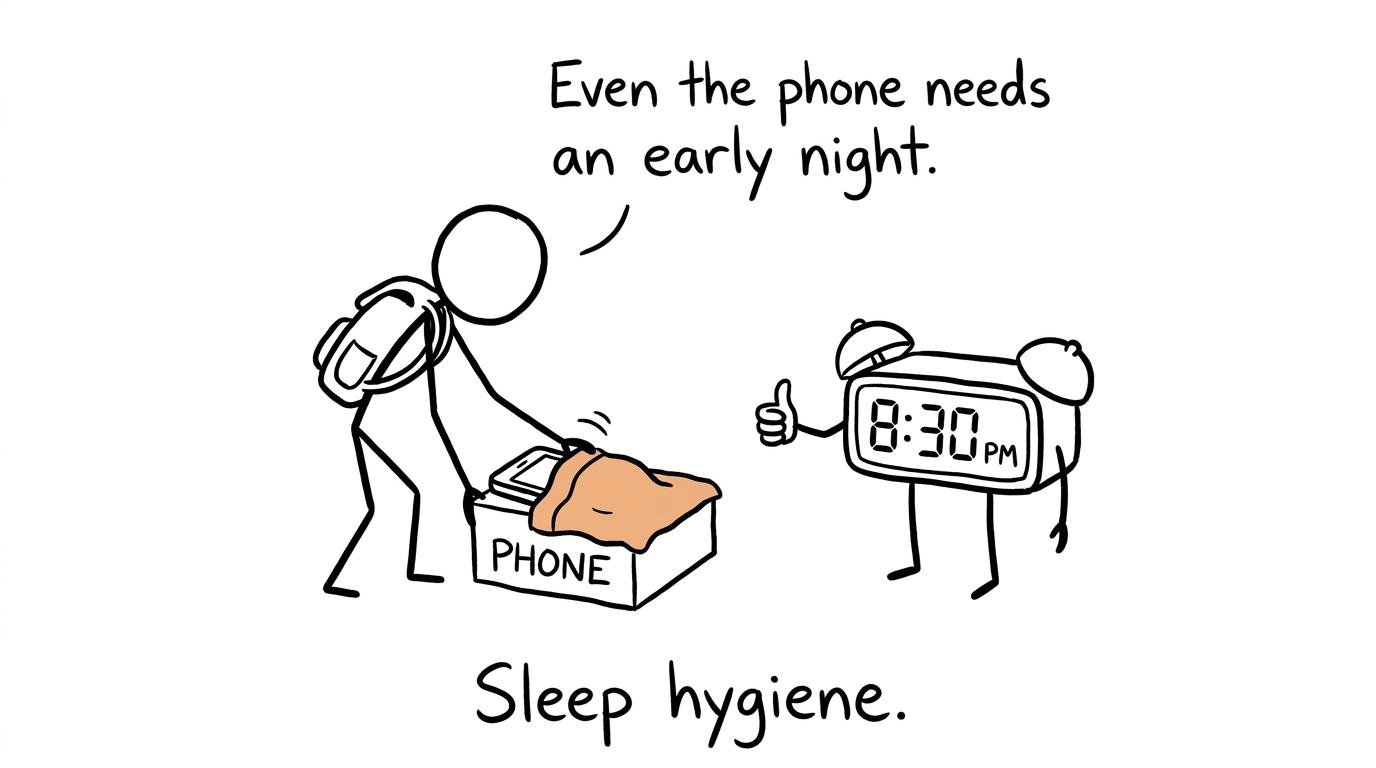 A student thoughtfully puts their phone to bed
How to divide your limited revision time
Give the largest share to the Portuguese component that comes first. A sensible session contains four distinct parts:
- retrieval of vocabulary and verbs;
- one exam-style task;
- careful marking and error analysis;
- a short retest of previous mistakes.
Use focused blocks with genuine breaks. During a break, move away from the desk rather than replacing revision with a stream of notifications. The purpose is to return with attention restored.
Keep maths revision equally deliberate. If you need exam practice, select a paper from the GCSE maths past papers collection, mark it and revise the topics revealed by the result. Near the exam, MathsGenie predicted papers can provide further practice, but they should supplement broad specification coverage rather than become a forecast of exact questions.
Common last-minute revision mistakes
Revising every topic equally
Three days require priorities. Spend more time on recurring weaknesses, high-frequency language and the skill being tested next. Familiar topics need maintenance, not another full afternoon.
Copying vocabulary instead of retrieving it
Neat notes can hide weak memory. Close the book, produce the word from memory and check it immediately. The moment of attempted recall is the useful part.
Memorising one perfect response
A memorised answer may not address the real prompt. Flexible language lets you adapt your knowledge to different people, places, opinions and time frames.
Doing papers without reviewing errors
Practice only helps when it changes what you do next. Mark each task, classify mistakes and retest them later. The same principle applies to maths: MathsGenie target tests are most valuable when chosen in response to a diagnosed gap.
Ignoring the precise question
Students sometimes recognise a topic and unload everything they know. Pause. Identify the person, tense, opinion or detail requested, then answer that question.
Sacrificing sleep for one more session
Late-night revision can feel heroic because effort is visible. The cost is less visible: weaker concentration, slower recall and avoidable misreading the next day. Set a stopping time.
Go into the exam with a recovery routine
A difficult question does not decide the whole paper. If panic rises, put both feet on the floor, breathe slowly and return to the smallest available action: read the instruction, identify what is required and find one piece of information you understand.
In listening, prepare for the next item rather than replaying the previous one mentally. In reading, move on and return later. In writing, begin with the task point you can answer most confidently. In speaking, communicate with language you can control and recover calmly if a word disappears.
Three days cannot create perfection. They can create direction, stronger recall and fewer unforced errors. That is a worthwhile return on limited time.
Once Portuguese is under control, return to maths with the same method: diagnose, practise, mark and revisit. Start with MathsGenie's free GCSE revision resources, then use revision lessons, practice questions, video solutions, mini tests, past papers, predicted papers and mark schemes to turn uncertainty into a specific next step. Calm revision is not about doing less. It is about ensuring that the work you do has a purpose.