GCSE Polish 6 to 9: A Practical Grade Guide
GCSE Polish 6 to 9: discover what separates strong from exceptional responses and improve your speaking, writing, listening and reading skills.
A grade 6 in GCSE Polish already shows good knowledge. You can understand familiar material, communicate ideas and use some complex language. But the journey from GCSE Polish 6 to 9 is not mainly about memorising longer vocabulary lists. It is about becoming more precise, more adaptable and more convincing across listening, speaking, reading and writing.
The biggest change is this: a grade 6 student usually communicates successfully; a grade 9 student controls the language. They infer meaning, develop answers, justify opinions and handle unfamiliar questions without relying entirely on rehearsed material.
There is no single checklist that guarantees a grade because grade boundaries change between exam series. However, the official assessment criteria make the direction clear. To move upwards, you need to replace passive familiarity with deliberate exam practice.
Your GCSE Polish grade improvement checklist
Focus your revision on these changes:
- move from recognising vocabulary to retrieving it independently
- develop answers with reasons, details and different time frames
- improve grammatical accuracy without avoiding ambitious language
- practise inference rather than searching only for repeated words
- respond spontaneously instead of reciting memorised paragraphs
- treat translation as communication, not word replacement
- mark every task and keep an error log
- revisit recurring errors until they disappear under timed conditions
Because grades 6 to 9 are available only through Higher Tier, confirm your entry with your school. Under the current AQA GCSE Polish specification, listening, speaking, reading and writing are each worth 25%25\%25%, and all four components must be taken at the same tier. A large weakness in one skill therefore cannot simply be ignored.
What separates a grade 6 from a grade 9 in GCSE Polish?
Official modern foreign language descriptors do not define every individual grade as a rigid checklist. They describe performance around key grade levels, while grade 9 represents stronger and more secure performance across the highest descriptor.
In practical terms, the differences tend to look like this:
| Grade 6 tendency | Grade 9 tendency |
|---|---|
| Understands key messages and relevant details | Understands details, opinions, implications and less familiar language |
| Gives clear but sometimes predictable answers | Develops convincing, coherent and responsive answers |
| Uses some complex structures | Manipulates a broad range of structures confidently |
| Communicates despite noticeable errors | Maintains high accuracy while attempting ambitious language |
| Relies heavily on prepared material | Adapts prepared language to unexpected questions |
| Gives opinions with occasional reasons | Explains and justifies viewpoints in depth |
| Translates individual phrases | Preserves the meaning, tense and tone of the complete message |
The distinction is not perfection. Even an exceptional response may contain an error. What matters is whether errors are occasional or whether they repeatedly weaken meaning.
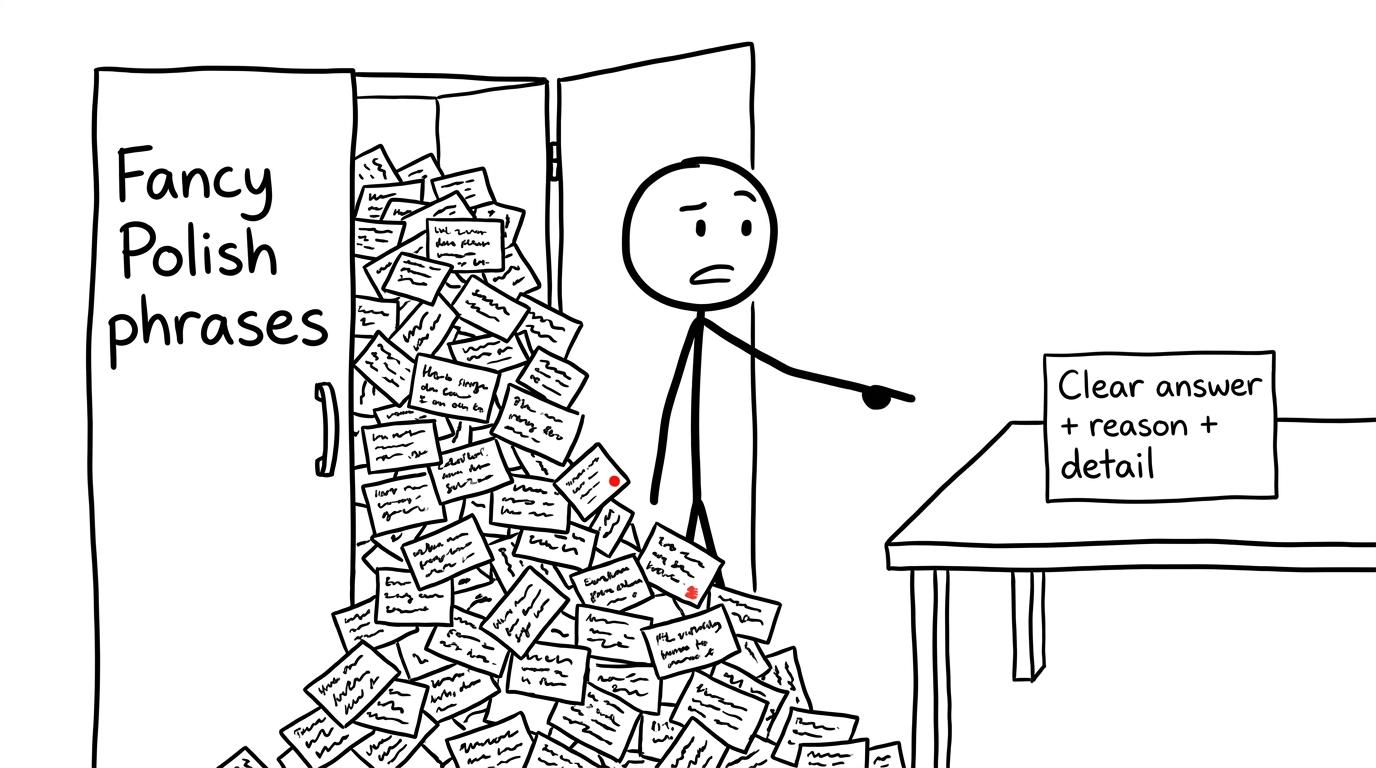 A cupboard of fancy Polish phrases collapses while one clear answer remains neatly on the desk
Turn fluent Polish into examination Polish
Some students taking GCSE Polish already speak the language at home. That is a valuable foundation, but conversational fluency and examination performance are not identical.
Everyday speech may contain shortened sentences, informal expressions or grammatical habits that feel natural within a family. The examination also requires accurate spelling, appropriate register, controlled written grammar, translation and responses shaped around precise task instructions.
Do not ask only, “Does this sound Polish?” Ask:
- Is the noun in the correct case?
- Does the adjective agree with it?
- Is the verb form appropriate for the subject and time frame?
- Have I used the correct formal or informal register?
- Are the spelling and Polish diacritics accurate?
- Have I answered every part of the question?
Students who speak Polish confidently should spend less time proving that they can hold a conversation and more time identifying the small, repeated errors that cost marks.
Improve GCSE Polish writing through control
At Higher Tier, the AQA writing paper includes an approximately 90-word structured task, an approximately 150-word open-ended task and translation from English into Polish. The longer task rewards content, range and accuracy.
Cover the task before displaying your vocabulary
A sophisticated paragraph cannot recover information that was never included. Underline each compulsory bullet point and make a brief plan before writing. During your final check, match every paragraph back to the task.
Grade 9 writing is detailed but relevant. It does not wander into a memorised section simply because that section contains impressive phrases.
Build depth into each idea
A useful answer pattern is:
- make the point
- give a reason
- add a consequence, contrast or example
- connect it to another time frame where appropriate
This produces natural development. It is more effective than attaching several learned connectives to an idea that remains shallow.
Make complexity reliable
Range matters, but complexity must serve meaning. Practise accurate use of:
- past, present and future references
- conditional constructions
- subordinate clauses
- comparative language
- justified opinions
- negative forms
- less common vocabulary suited to the topic
Keep an error log organised by pattern, such as cases, agreement, verb aspect, word order or spelling. That is more useful than copying out an entire corrected response.
The same feedback principle works in maths: identify the precise error, repair the method and retest it. MathsGenie's guide to finding your weakest GCSE topics explains how to turn lost marks into a focused revision list.
Make speaking spontaneous, not improvised
Higher Tier speaking contains a role-play, photo card and general conversation. The general conversation assesses communication, range and accuracy, pronunciation and intonation, and spontaneity and fluency.
A memorised answer can sound impressive until the teacher changes one word in the question. Grade 9 preparation therefore involves flexible building blocks rather than complete scripts.
Prepare adaptable language for:
- giving and explaining opinions
- describing past experiences
- discussing future plans
- comparing alternatives
- expressing advantages and disadvantages
- clarifying a question when necessary
Then practise unpredictable follow-up questions. Record your answers and listen for hesitation, repeated vocabulary and sentences that stop before an idea has been developed.
Do not confuse speed with fluency. A measured answer with clear intonation and well-connected ideas is stronger than a rapid recital that does not genuinely respond.
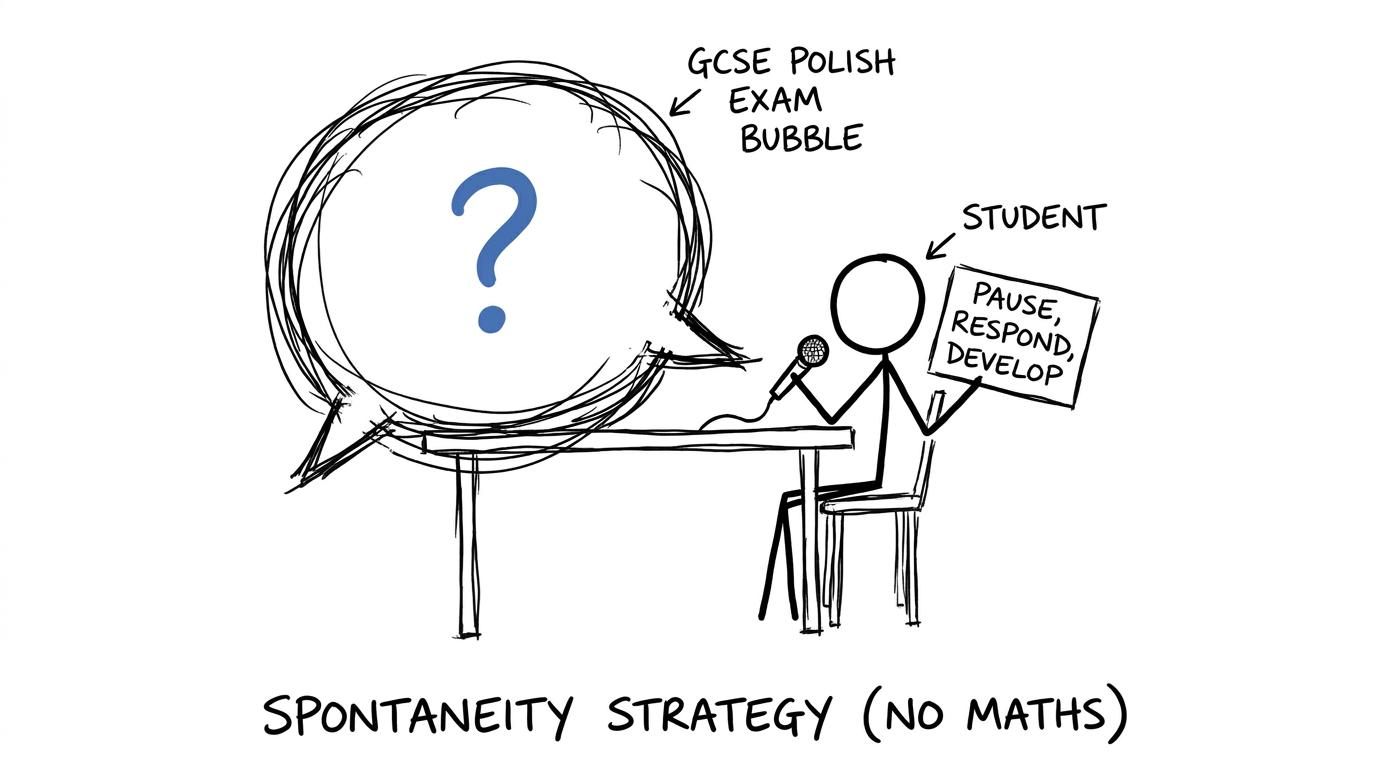 A student calmly responds when a speech bubble asks an unexpected GCSE Polish question
Train listening and reading for inference
At grade 6, students often locate explicit details successfully. The higher grades demand more confidence with extended material, opinions, conclusions, unfamiliar contexts and implied meaning.
Stop waiting for an exact word match
Examiners may express an idea through a synonym, contrast or paraphrase. Build vocabulary in families rather than as isolated Polish-English pairs. Include related verbs, nouns, adjectives, opposites and common collocations.
In listening practice, read the question first and predict the type of information required. While listening, notice negatives, changes of opinion and time references. These small signals often determine the answer.
Separate false information from missing information
In reading tasks, a statement may contradict the passage or may simply not be mentioned. Those are different conclusions. Base your answer on evidence from the text rather than what seems likely in real life.
For both skills, maintain a short record of why an answer was wrong: unknown vocabulary, missed negative, misunderstood instruction, inference error or lost concentration. Patterns become visible surprisingly quickly when mistakes are named accurately.
Treat translation as reconstruction
Word-for-word translation is fragile because Polish and English organise meaning differently. First identify the complete message, then reconstruct it naturally in the target language.
Check:
- who is performing the action
- when the action happens
- whether the statement is positive, negative or conditional
- what register is required
- which case follows the verb or preposition
- whether every key message has survived
If an exact word disappears from memory, communicate the idea using language you control. A clear paraphrase is usually safer than an invented word or a sentence abandoned halfway through.
Use a revision system that exposes weak points
Improvement rarely comes from reading notes for longer. It comes from producing an answer, receiving evidence and changing the next attempt.
Use this weekly cycle:
- complete one timed task from a past paper
- mark it against the official mark scheme or teacher feedback
- classify each lost mark
- correct only the weakest patterns
- produce a fresh response without copying the correction
- retest the same skill several days later
Past papers should match your current Polish specification. MathsGenie's article on using GCSE past papers properly gives a useful paper, mark, fix and retest routine that transfers well to language revision.
If you are balancing Polish with GCSE maths, use a realistic timetable rather than allowing the subject with the nearest deadline to consume every evening. The GCSE maths revision timetable shows how to combine short topic sessions with longer timed practice. For an urgent final week, adapt the structure in the GCSE one-week revision plan.
Common mistakes that keep students at grade 6
Memorising impressive paragraphs
Prepared material is useful, but only if it can be reshaped. Learn flexible structures and topic vocabulary, then practise applying them to unfamiliar prompts.
Adding complexity without checking accuracy
An ambitious sentence earns little if its meaning collapses. Improve one structure at a time until you can use it confidently under pressure.
Ignoring task instructions
Missing a bullet point, answering in the wrong language or giving fewer details than requested can waste accessible marks. Learn the common Polish examination instructions as carefully as topic vocabulary.
Revising only preferred skills
Confident speakers may avoid writing; strong readers may neglect listening. Because each AQA component contributes 25%25\%25%, your revision time should reflect evidence from marked tasks, not personal preference.
Counting practice instead of corrections
Completing five papers is not automatically better than completing two. The value lies in what changes afterwards. Use the official criteria and mark schemes to identify what the examiner rewards.
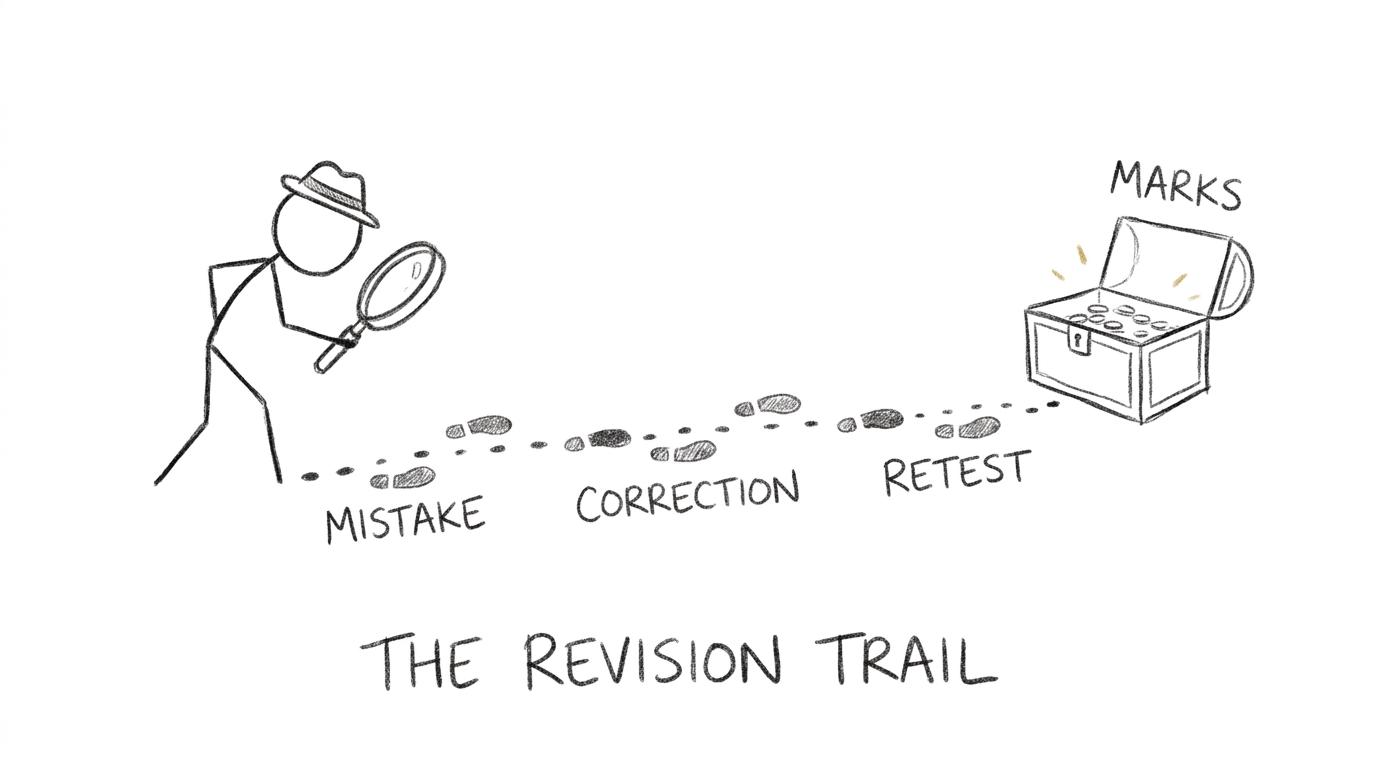 A revision detective follows mistakes, corrections and retests towards a chest of marks
Build a grade 9 routine one response at a time
The move from GCSE Polish 6 to 9 is not a leap from “good” to “perfect”. It is a series of smaller changes: one answer developed further, one recurring case error corrected, one listening inference noticed and one unexpected speaking question handled calmly.
Use official Polish past papers and mark schemes for subject-specific practice. Then apply the same disciplined cycle across your wider revision. MathsGenie can support your GCSE maths preparation with free GCSE past papers, predicted papers, revision lessons, practice questions, mark schemes, video solutions and shorter mini tests.
Start with one timed Polish task and one timed maths task. Mark both honestly. The next session should be chosen by the mistakes you find, because the paper does not merely measure your level. Used properly, it tells you what to do next.