GCSE Media Studies Grade 7 Meaning Explained
GCSE media studies grade 7 meaning explained: discover the skills it reflects, how it compares with an old A, and how to revise with purpose.
A single number on a results page can feel strangely final. Yet it compresses months of essays, textual analysis, contextual knowledge and creative production into one character. The GCSE media studies grade 7 meaning is straightforward at first: it represents a strong performance, with the lower boundary of grade 7 comparable to the lower boundary of the old grade A. It is not an exact conversion, and it does not mean every part of your course was completed at precisely the same level.
More usefully, a grade 7 suggests that you can do more than remember media terminology. You can usually apply ideas to unfamiliar products, support interpretations with evidence, make reasoned judgements and communicate meaning through your non-exam assessment.
Grade 7 at a glance
Here is the practical interpretation:
- Old-grade comparison: the bottom of grade 7 is comparable to the bottom of the former grade A.
- Position on the scale: grade 7 is a high GCSE result, below grades 8 and 9 but above grades 1 to 6.
- What it reflects: secure knowledge, developed analysis, purposeful judgement and effective creative application.
- How it is awarded: your weighted marks across written examinations and non-exam assessment are combined, then compared with that examination series's grade boundaries.
- What it does not mean: there is no permanent percentage that always guarantees a grade 7.
It is better to think of a grade as a threshold crossed than a personality revealed. Your result records performance in a particular qualification at a particular time. It does not set a ceiling on what you can learn next.
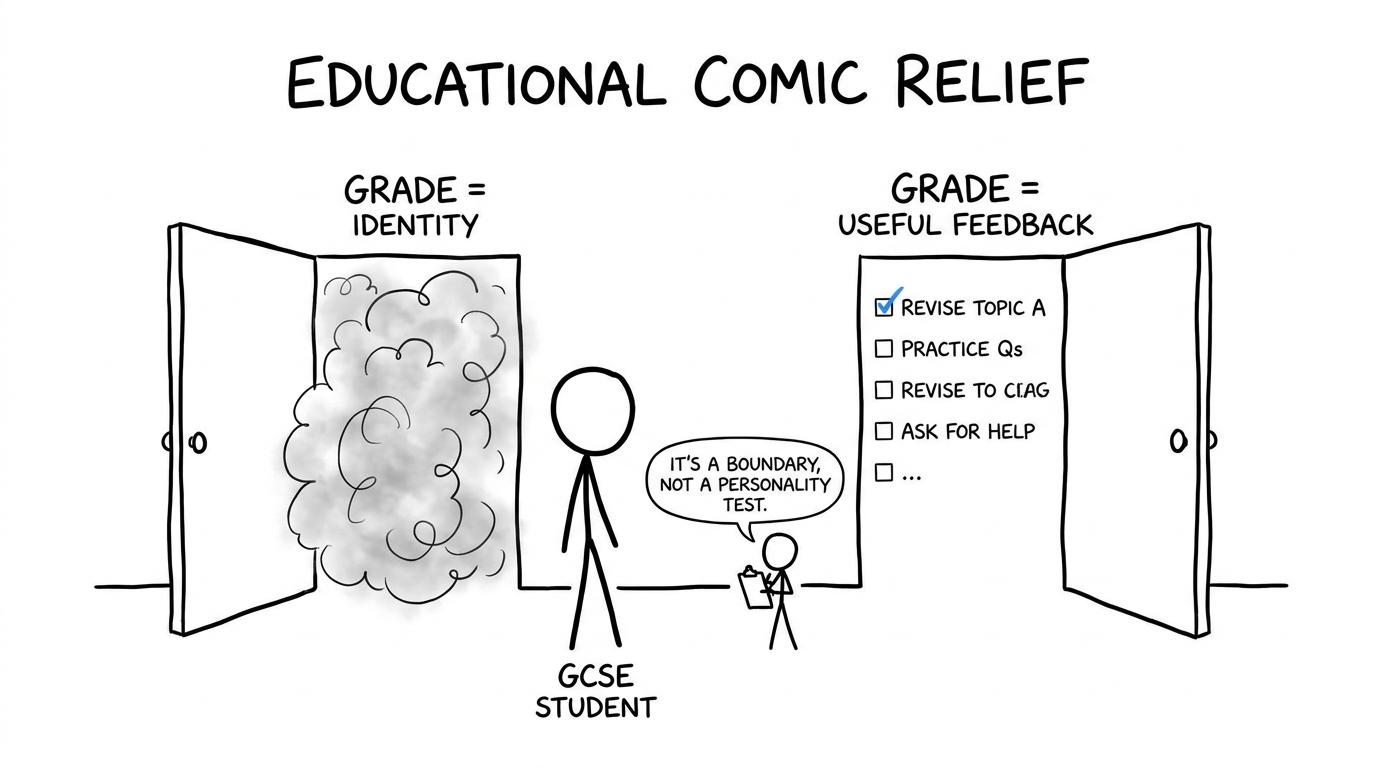 A student choosing between treating a grade as an identity or useful feedback
How does grade 7 compare with the old letter grades?
England's reformed GCSEs use grades 9 to 1, with 9 as the highest grade. The numbered scale was designed with more differentiation at the top than the former A* to G system.
There are official comparison points, but not a complete one-to-one conversion table:
| Current GCSE point | Comparison with the former scale |
|---|---|
| Bottom of grade 7 | Comparable to the bottom of grade A |
| Bottom of grade 4 | Comparable to the bottom of grade C |
| Bottom of grade 1 | Comparable to the bottom of grade G |
This wording matters. Saying that grade 7 is simply “an A” is convenient, but slightly too neat. Grades 7, 8 and 9 collectively provide greater distinction across the performance previously covered by A and A*. Grade 9 was created to identify the very highest performance and is not merely a renamed A*.
For students familiar with maths grading, the comparison works in the same broad way. The meaning of a grade 7 in GCSE Maths uses the same national grade scale, although the knowledge and skills being assessed are naturally different.
What ability does a grade 7 represent in Media Studies?
A grade 7 is an overall qualification result, not a separate official checklist of behaviours. Nevertheless, the assessment objectives reveal what strong performance looks like.
Across regulated GCSE Media Studies specifications, including AQA, OCR, Eduqas and Edexcel, assessment focuses on three objectives:
- AO1: knowledge and understanding of the theoretical framework, relevant contexts and their influence on media products and processes.
- AO2: analysis of media products through that framework, including making judgements and drawing conclusions.
- AO3: creating media products for an intended audience by applying knowledge and understanding to communicate meaning.
The national weighting is:
| Assessment objective | Overall weighting |
|---|---|
| AO1: knowledge and understanding | 30%30\%30% |
| AO2: analysis and judgement | 40%40\%40% |
| AO3: media production | 30%30\%30% |
A student performing around grade 7 standard will commonly show the following qualities.
Secure knowledge rather than isolated facts
You should understand the course's theoretical framework: media language, representation, audiences and media industries. Strong knowledge is connected. For example, you recognise that a production decision may shape representation, target an audience and reflect an industrial context at the same time.
Terminology matters, but accuracy matters more than quantity. Dropping technical words into an answer without explaining their significance rarely produces convincing analysis.
Analysis supported by precise evidence
At this level, responses move beyond identifying features. You select relevant details from a media product and explain how they construct meaning.
That distinction is small on the page but large in the mark scheme. Description tells an examiner what is present. Analysis explains how and why it matters. Stronger responses also consider context, compare products when required and avoid treating one interpretation as automatically certain.
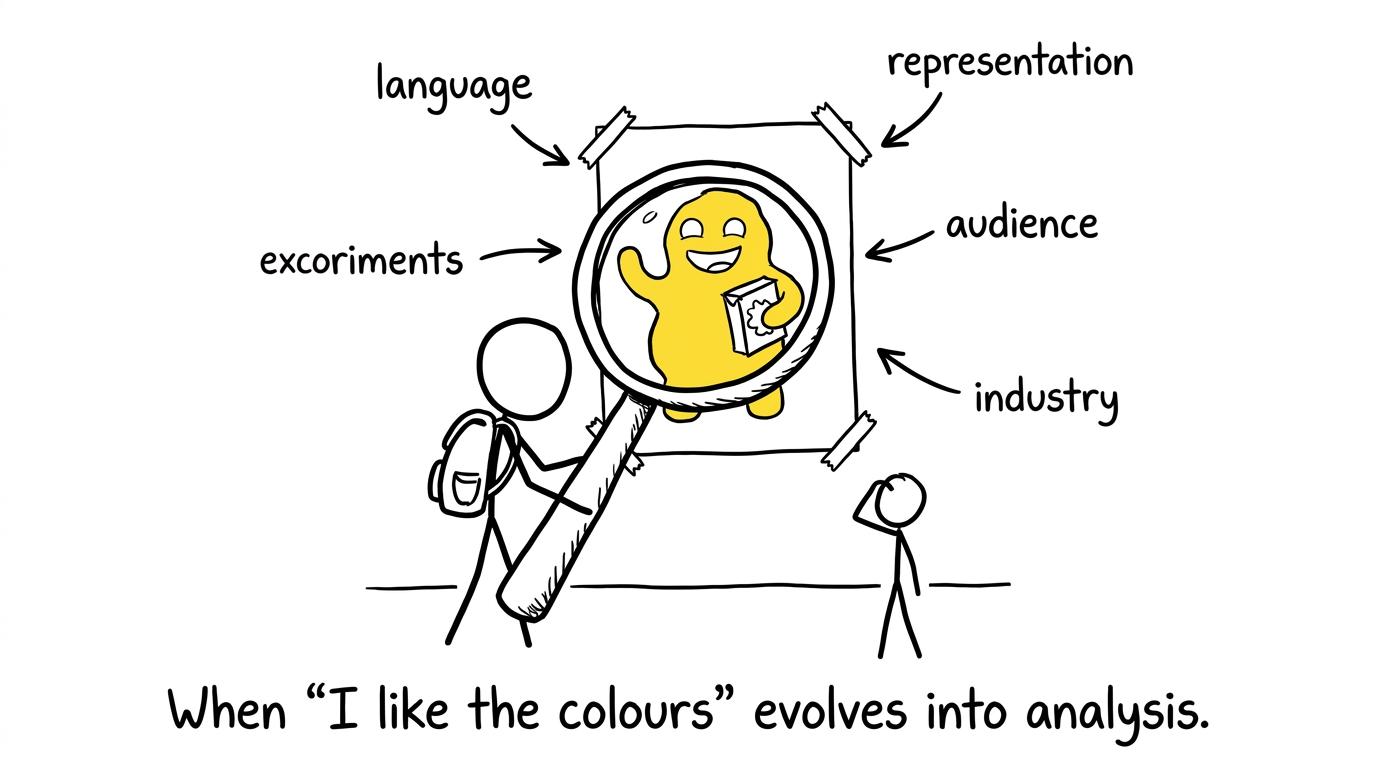 A student using an oversized magnifying glass to move beyond comments about colour
Reasoned judgements and conclusions
Grade 7 performance is not just a longer answer. It is a better-controlled one. Arguments remain focused on the question, evidence is chosen deliberately, and conclusions follow from the analysis rather than repeating the introduction.
Command words are important here. “Analyse”, “compare” and “evaluate” ask for different kinds of thinking. Before writing, identify the task and make every paragraph earn its place.
Purposeful creative production
The non-exam assessment is not an artistic bonus added to the written course. It assesses whether you can apply the theoretical framework to create meaning for an intended audience.
A strong production usually demonstrates control of form, genre, representation and mode of address while meeting the set brief. Technical polish helps, but decisions must be purposeful. A visually impressive product that overlooks the audience or requirements of the brief can leave marks behind.
How is the final grade calculated?
Under the current regulated structure, GCSE Media Studies allocates 70%70\%70% of the qualification to examinations and 30%30\%30% to non-exam assessment. Exam boards can organise that examined portion differently. For example, some divide it equally between two papers, while others use different component weightings.
At a simplified weighting level, the relationship is:
overall result=0.70(exam performance)+0.30(NEA performance)\text{overall result} = 0.70(\text{exam performance}) + 0.30(\text{NEA performance})overall result=0.70(exam performance)+0.30(NEA performance)Your board combines or scales the component marks according to its specification. The total is then compared with the grade boundaries for that series.
This has two important consequences. First, grade 7 does not mean you achieved grade 7 quality in every component. A stronger production can sit alongside a weaker paper, or vice versa. Secondly, one raw mark target cannot be applied to every board and every year. Boundaries are set after the assessments have been taken and can change to account for differences in paper demand.
Always check boundaries for your exact exam board, specification and examination series. A boundary from a previous year is useful for orientation, not a promise.
Media Studies grade 7 and GCSE Maths grade 7
Both subjects use the same 9 to 1 reporting scale, but they measure different performances. Unlike GCSE Maths, Media Studies is not divided into foundation and higher tiers. In maths, foundation tier is limited to grades 1 to 5, so students aiming for grade 7 take higher tier. Media Studies candidates follow one untiered qualification route.
The revision habits still transfer remarkably well. Both subjects reward accurate vocabulary, careful interpretation of the question, evidence of method and practice under timed conditions. In maths, that method might be an algebraic sequence of steps. In Media Studies, it may be a chain from evidence to technique, meaning, context and judgement.
Students balancing several subjects can use the GCSE Maths revision hub to keep their mathematical revision organised while protecting focused time for Media Studies. The goal is not to revise every subject identically. It is to give each one a clear routine.
How to turn a grade 7 target into a revision plan
A target grade becomes useful only when translated into actions you can repeat.
Learn the products and framework together
Avoid revising a set product as a list of disconnected facts. Organise notes under media language, representation, industry, audience and context. Then practise making links between those areas.
Use active recall before checking notes. Retrieve key facts, terminology and contextual details from memory, then correct omissions. The same principle sits behind MathsGenie's 20-minute GCSE revision routine: short retrieval, focused practice and immediate correction.
Practise planning before writing everything
Full answers build stamina, but concise plans allow you to rehearse more questions. For each prompt, identify the command word, central judgement, relevant evidence and paragraph order. Then select some plans to develop under timed conditions.
Use mark schemes as maps
Do not read a mark scheme only to decide whether an answer was “good”. Look for the difference between bands. Ask whether your response demonstrates knowledge, performs analysis and reaches a substantiated conclusion.
Maths students can develop the same habit through Edexcel GCSE Maths mini tests, where short practice followed by careful marking makes gaps visible quickly.
Build towards timed papers
Begin with individual questions, progress to sections, and then complete papers under realistic conditions. Review should take as seriously as the attempt itself. MathsGenie's guide to when to start GCSE past papers explains this gradual approach.
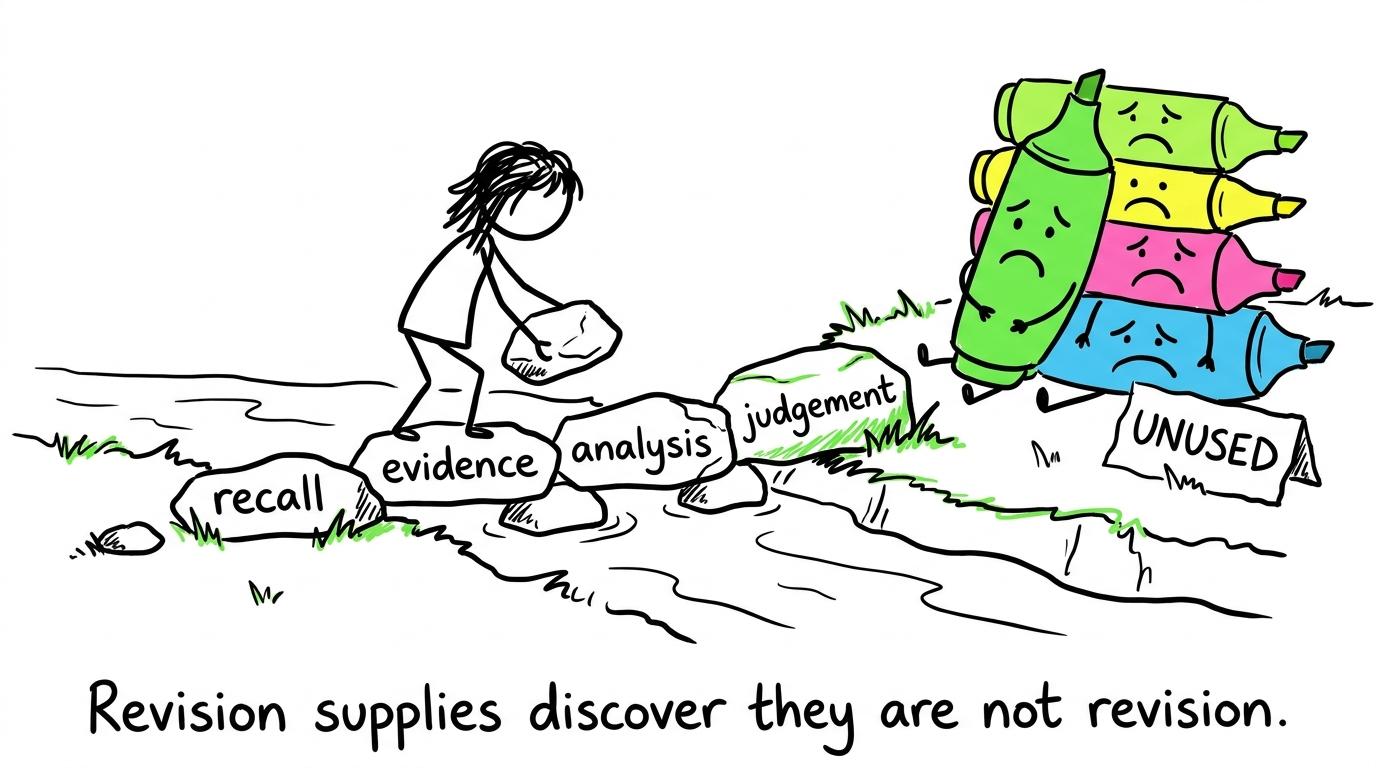 Revision stepping stones succeed while unused highlighters watch from the bank
Common mistakes when interpreting or targeting grade 7
Treating grade 7 as a fixed percentage
There is no universal permanent percentage for grade 7. Use recent boundaries cautiously and concentrate on improving the quality of your answers rather than chasing an assumed raw mark.
Calling it exactly the same as an old A
The accurate statement is that the bottom of grade 7 is comparable to the bottom of the former grade A. The numbered and letter scales do not match grade by grade.
Describing instead of analysing
Naming camera work, layout, typography or language is only a beginning. Explain how the choice constructs meaning, shapes representation or addresses an audience.
Memorising essays
A memorised response may not answer the question set. Build adaptable knowledge and practise responding to different command words, unseen products and comparison requirements.
Neglecting the NEA or relying on it too heavily
The NEA contributes 30%30\%30%, so it matters substantially, but the examinations contribute the remaining 70%70\%70%. Prepare for both rather than assuming one component will rescue the other.
Confusing activity with revision
Highlighting, copying and rereading can feel productive because they are easy to measure. Retrieval, timed answers and honest marking are less comfortable, but they reveal what you can actually do.
A grade is information, not a verdict
A grade 7 in GCSE Media Studies represents a strong command of the course: secure knowledge, developed analysis, reasoned conclusions and purposeful creative application. Its lower boundary is comparable to the lower boundary of the old grade A, but the relationship is a comparison point rather than an exact conversion.
If your exams also include GCSE Maths, let MathsGenie remove some of the planning burden. Begin with the free MathsGenie home page, choose specification-aligned revision lessons and practice questions, and then test your understanding with mark schemes, video solutions and mini tests. As the exams approach, use GCSE predicted papers alongside past papers, not as forecasts of certainty, but as structured opportunities to practise.
The number at the end matters. The habits built on the way there matter for longer.