

GCSE Media Studies Coursework Deadlines: Stay Calm
GCSE media studies coursework deadlines feel manageable with a clear weekly plan. Finish your NEA early while protecting time for focused maths revision too.
The night before coursework is due has a particular kind of pressure. A nearly finished production can suddenly feel unfinished, every technical problem feels larger, and the maths revision you intended to do quietly disappears from the evening.
The simplest way to manage GCSE media studies coursework deadlines is to treat your teacher's deadline as final, set a personal completion date at least one week earlier, and divide the non-exam assessment into small weekly outcomes. Your first step is not to create the perfect product. It is to confirm the correct brief, exam board requirements and internal deadline with your teacher.
That early personal deadline creates something students often overlook: room. Room for feedback, exporting files, correcting mistakes and continuing your GCSE maths revision without trying to manage two emergencies at once.
Your coursework deadline checklist
Before planning anything, confirm these details:
- your exam board: AQA, OCR or Eduqas
- the exact NEA brief for your year of assessment
- your school's internal deadline
- any interim deadlines set by your teacher
- the required production, statement and supporting documents
- when supervised or controlled work must happen
- how and where files should be saved
- what teacher feedback is permitted
- your personal completion date
- the maths sessions that must remain protected each week
Schools deliberately set internal deadlines before awarding-body submission dates. This gives teachers time to mark work, complete administration, conduct any required internal marking reviews and prepare work for moderation. JCQ guidance tells candidates that they must meet the deadlines given by their teacher, so a later date found online does not replace your school's date.
Understand which deadline actually applies
Students often search for a national coursework deadline and assume there is one universal date. There is not.
Exam boards publish deadlines for centres to submit marks or moderation samples. Your school then sets an earlier deadline for students. In the 2026 series, for example, published centre deadlines differed between AQA, OCR and Eduqas. These dates also concerned centre administration rather than necessarily being the day on which an individual student could finish working.
For that reason, use this order of authority:
- the deadline given directly by your teacher
- written information from your school or department
- the current specification and NEA instructions for your board
- the awarding body's administrative deadline for context only
Do not rely on an old classroom slide, a date from another school or a search result referring to a previous exam series. Media Studies briefs can change annually. Completing the wrong year's brief carefully is still completing the wrong brief.
The qualification structure also explains why this matters. For the current AQA, OCR and Eduqas GCSE Media Studies specifications, the NEA contributes 30%30\%30% of the qualification. It is substantial, but it is not the whole GCSE. A sensible plan gives it enough attention without allowing it to consume every evening needed for exam preparation.
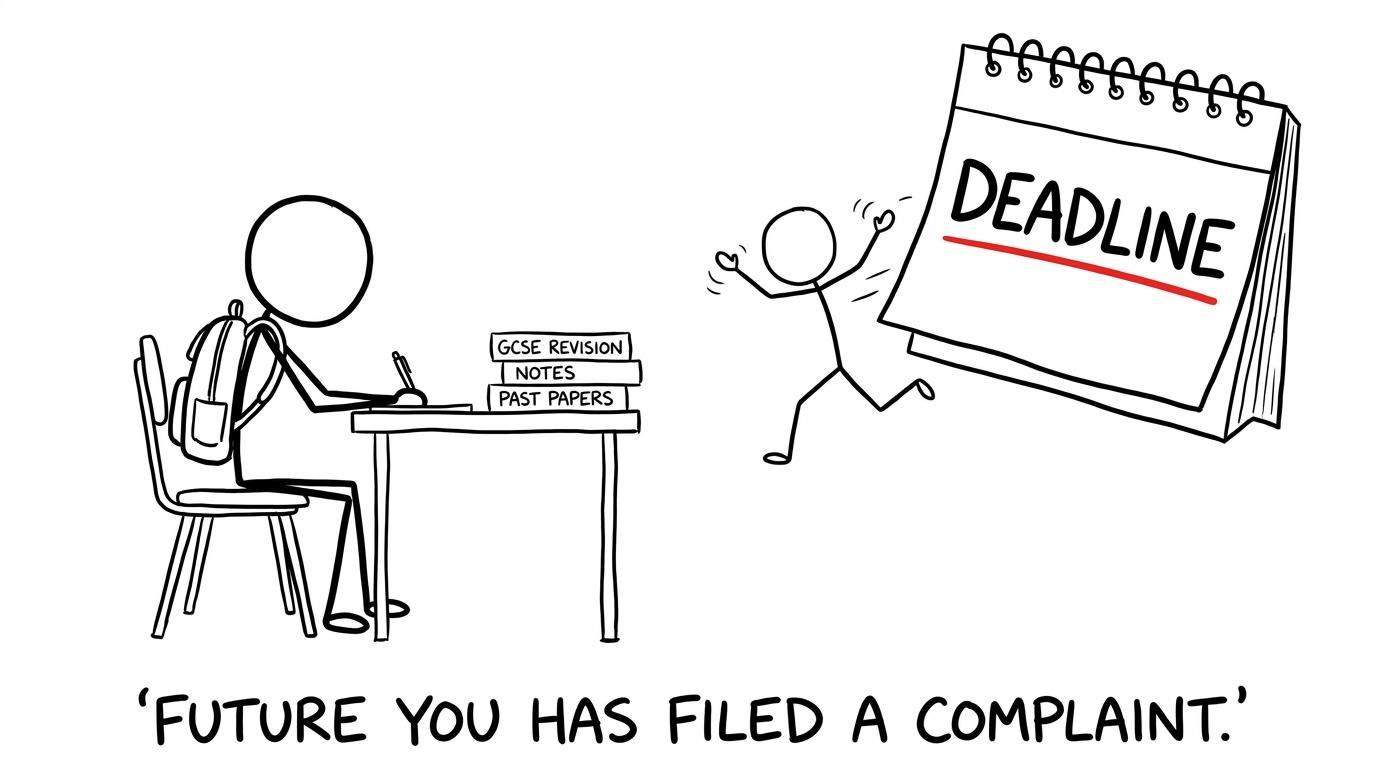 A calm student works while another is chased by a deadline calendar
Turn one large project into visible stages
A distant deadline is vague. A weekly outcome is concrete.
Start by working backwards from your teacher's deadline. Reserve the final week as a buffer rather than treating it as production time. Before that buffer, schedule separate stages for understanding the brief, research, planning, production, editing, checking the statement and preparing the final files.
Brief and requirement check
Read the brief slowly and highlight every required element. Identify the intended audience, media form, purpose and any specified content. Ask your teacher about anything ambiguous before production begins.
This stage can feel unproductive because you have not made anything yet. In reality, it prevents the most expensive kind of mistake: producing polished work that does not answer the brief.
Research and planning
Gather only the research needed to make informed creative decisions. Then turn those decisions into a usable plan, such as a storyboard, draft layout, shot list or production schedule, depending on the task.
Planning should reduce uncertainty. If it becomes endless collecting, it is no longer doing its job. Give it a stopping point and move forward.
First complete version
Aim for a complete version before aiming for an excellent one. A full rough production reveals missing assets, weak sections and technical problems more clearly than disconnected fragments do.
The word complete matters. You need something that can be reviewed from beginning to end, even if some details still need improvement.
Refinement and technical checks
Use the criteria and permitted feedback to decide what deserves attention. Prioritise changes that improve communication with the intended audience and strengthen the response to the brief. Avoid spending an entire session adjusting a tiny visual feature while a required element remains missing.
Check file names, formats, links, sound, image quality and playback on the equipment your school will use. Leave enough time for exports and uploads. Technology often works perfectly until it becomes urgent.
Build a personal deadline before the real one
Your personal completion date should sit comfortably before the school deadline. The space between the two dates is not spare time to fill with extra ideas. It is protection against predictable uncertainty.
A useful buffer can absorb:
- absence or illness
- unavailable equipment
- corrupted or missing files
- a slow export or upload
- a production session taking longer than expected
- a required correction identified during final checks
This approach changes the emotional meaning of the final week. Instead of asking, “Can I finish?”, you are asking, “Is everything complete, compliant and safely submitted?” That is a calmer question.
Tell someone your personal date. A teacher, parent, carer or revision partner can help you treat it as real rather than optional.
Protect maths revision while coursework is active
Coursework expands to occupy the time around it. GCSE maths behaves differently: improvement usually comes from repeated contact with methods and questions. Losing several weeks of practice can make familiar topics feel unexpectedly fragile.
Keep a small non-negotiable maths routine throughout the project. The GCSE maths revision hub lets you choose your exam board and move between lessons, questions and papers without wasting time searching for resources.
On busy production days, use the 20-minute maths revision routine. One focused topic, a few questions and immediate checking are more useful than postponing all maths until the coursework has gone.
Once a week, use an Edexcel GCSE maths mini test, if appropriate for your course, or select equivalent practice from your board's area. This preserves retrieval and gives you evidence about which skills need attention.
Your weekly plan therefore needs two kinds of session:
- coursework sessions, each ending with a visible output
- maths sessions, each ending with marked questions and a specific correction
Do not write “work on Media” or “revise maths”. Those are intentions, not tasks. Name the output: complete a storyboard section, edit a sequence, answer a topic question set or mark a timed test.
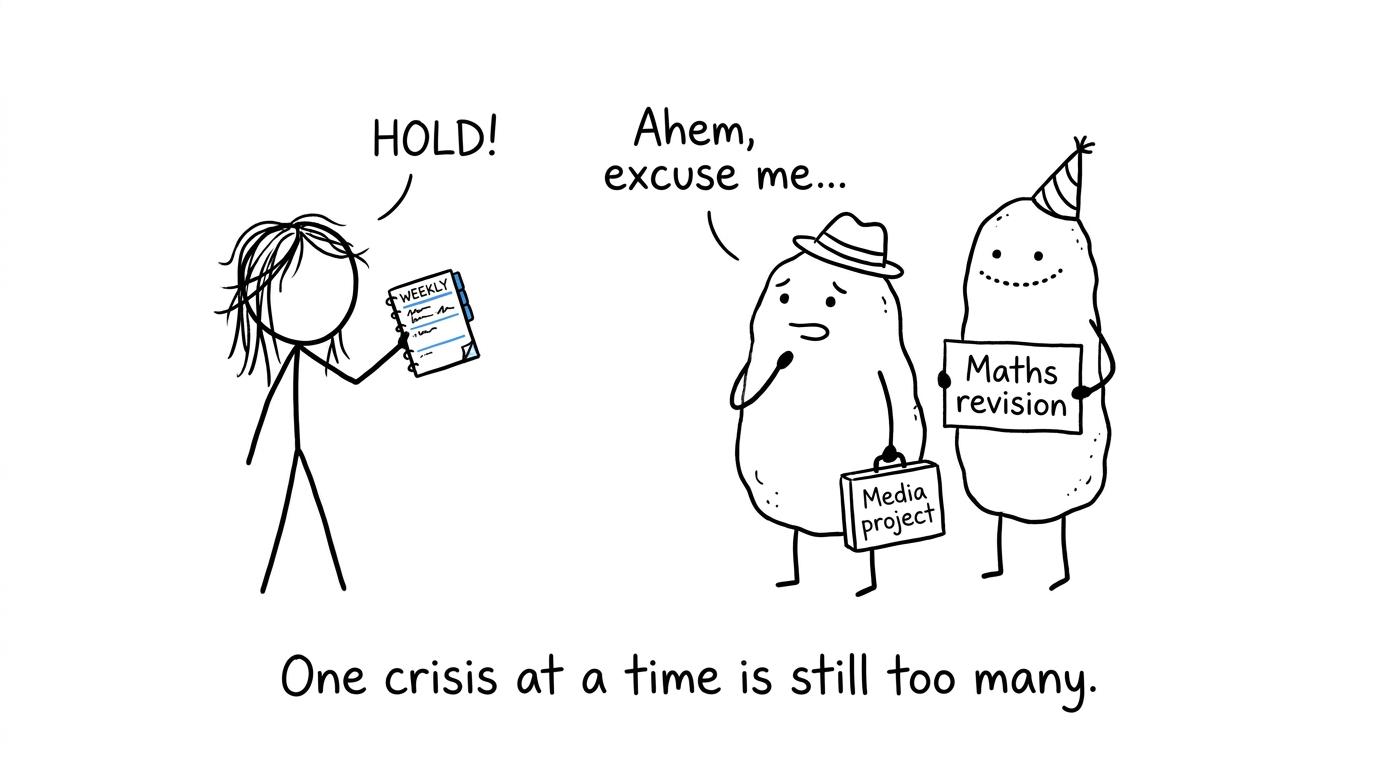 Media coursework and maths revision wait while a student directs traffic
Use short sessions to keep both subjects moving
Long sessions are sometimes necessary for filming, recording or specialist software. Not every task needs one.
Reserve longer blocks for work that genuinely depends on equipment, other people or sustained production. Use shorter sessions for checking the brief, organising files, refining text, listing required shots and reviewing teacher instructions.
Apply the same distinction to maths. A short weekday session can repair one weak method. A longer weekend session can be used for timed work. The GCSE maths revision timetable guide explains how to combine topic practice, marking and paper sessions without creating an unrealistic schedule.
When coursework pressure falls, increase exam practice gradually. The MathsGenie past-paper library provides papers with official mark schemes, while the guide to using GCSE past papers properly shows how to turn mistakes into useful revision targets.
Predicted papers can be valuable nearer the exam, but they should supplement rather than replace official past papers. Use them after rebuilding weak topics, not as a shortcut around the specification.
Keep files, evidence and versions under control
A good schedule can still fail if the work itself is difficult to find.
Use clear folders for research, planning, original assets, drafts and final exports. Give files meaningful names and add version dates where appropriate. Keep backups in locations permitted by your school, and follow your teacher's instructions about storage and access during controlled work.
Save during every session, not merely at the end. Open exported files after saving them. A file existing is not proof that it plays, displays or contains the latest version.
Keep evidence of your process where required, and make sure submitted work is genuinely your own. Rules about assistance, collaboration and artificial intelligence must be followed. If you are unsure whether a tool or type of help is allowed, stop and ask your teacher before using it.
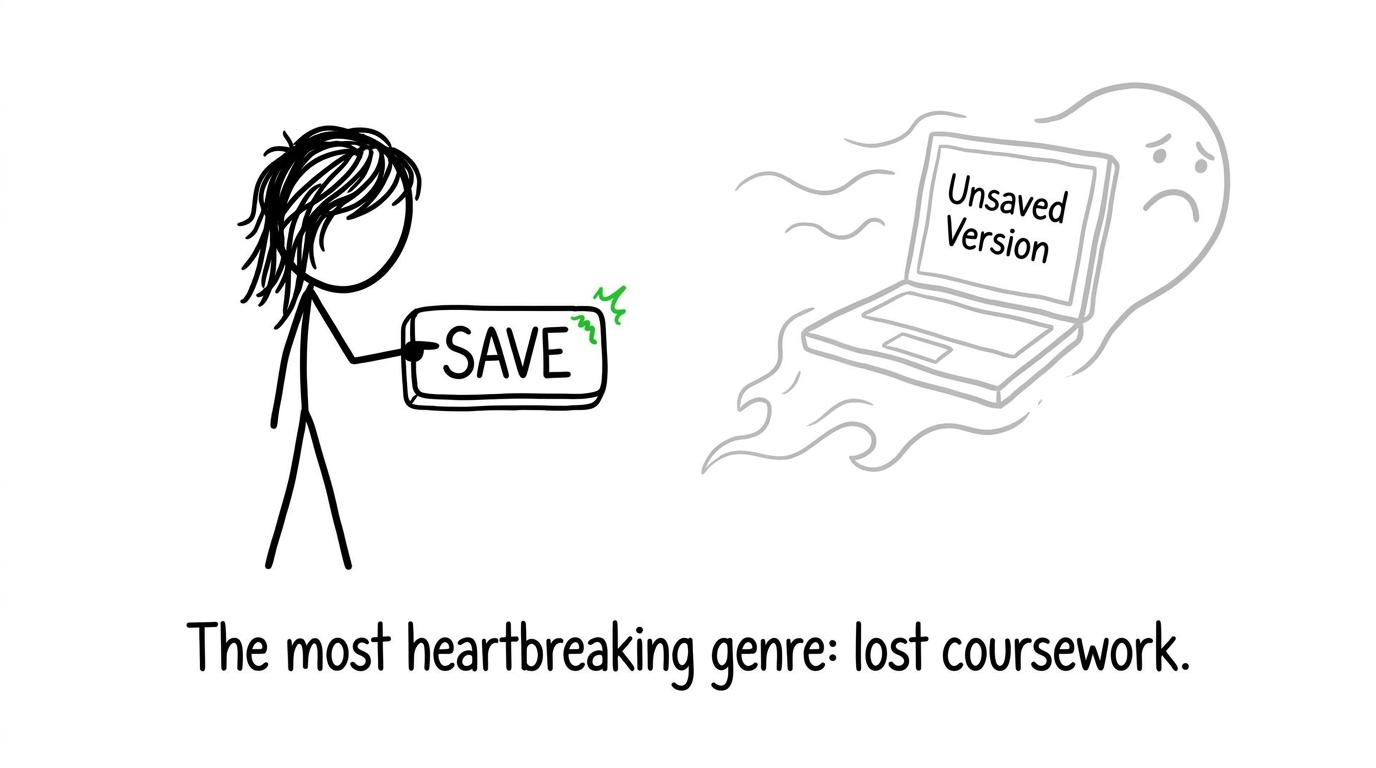 A student saves work as the ghost of an unsaved version floats away
Common mistakes that create last-minute panic
Treating the awarding-body date as your deadline
The published date is usually for the centre. Your teacher's earlier internal deadline is the one you must meet.
Waiting for a large empty weekend
A perfect free weekend may never appear. Small scheduled outputs create progress even during busy weeks.
Polishing before completing
Refining one section can feel safe, but it hides missing work elsewhere. Build a complete first version, then improve it.
Ignoring export and submission time
Rendering, uploading and checking files are part of the task. Schedule them rather than assuming they will be instant.
Keeping only one copy
One damaged device or overwritten file can remove hours of work. Follow school rules and maintain permitted backups.
Abandoning maths until the NEA is finished
This converts one deadline into another problem. Maintain short, regular practice and use the one-month GCSE maths revision plan when you are ready to increase exam preparation.
Finish early enough to finish well
The goal is not to rush your Media Studies NEA. It is to pace it so that quality does not depend on a final night of exhausted decisions.
Confirm the correct brief and school deadline. Work backwards. Complete a full version early. Protect a buffer. Keep your files organised and preserve a small maths routine throughout.
Then, as coursework pressure recedes, return to MathsGenie with a clear sequence: use revision lessons to rebuild weak methods, practise with topic questions and mini tests, and test your progress with past papers and predicted papers. Mark everything with the available mark schemes and use video solutions when you need to see a method explained.
Start now by opening the free GCSE maths revision hub and scheduling one short maths session beside your next coursework milestone. Calm rarely arrives by accident. More often, it is built a week at a time.










