GCSE Maths Results Day: WJEC vs CCEA Boundaries
GCSE maths WJEC vs CCEA grade boundaries explained. Compare grading scales, raw marks and UMS, then know what to check on GCSE results day 2026.
Results morning can make one number feel as though it contains your entire future. It does not. Yet understanding that number still matters. The key fact about GCSE maths WJEC vs CCEA grade boundaries is that they cannot be compared mark for mark: WJEC and CCEA use different assessment structures, tier arrangements and methods for reporting marks.
For GCSE maths results day in 2026, candidates receive results on Thursday 20 August 2026. The boundaries for that examination series are confirmed only after marking and awarding, so previous boundaries are useful context rather than predictions.
WJEC vs CCEA grade boundaries at a glance
Before looking at any figures, check these four details:
- your examination board;
- your exact specification and examination series;
- your tier or unit combination;
- whether the table shows raw marks or Uniform Mark Scale marks.
| Feature | WJEC GCSE Mathematics | CCEA GCSE Mathematics |
|---|---|---|
| Main region | Wales | Northern Ireland |
| Grade scale | A∗A^*A∗ to GGG | A∗A^*A∗ to GGG, including C∗C^*C∗ |
| Assessment model in the boundaries below | Foundation, Intermediate or Higher tier | Unitised pathways using one unit from M1 to M4 and one completion unit from M5 to M8 |
| How results are combined | Raw marks across the relevant papers | Raw unit marks converted to UMS and aggregated |
| Overall UMS total | Not applicable to the raw-mark table below | 400400400 |
| Can past boundaries predict 2026? | No | No; raw unit boundaries can change |
The practical lesson is simple: do not place a WJEC raw mark beside a CCEA UMS mark and assume the larger figure represents a harder standard. They are different measuring systems.
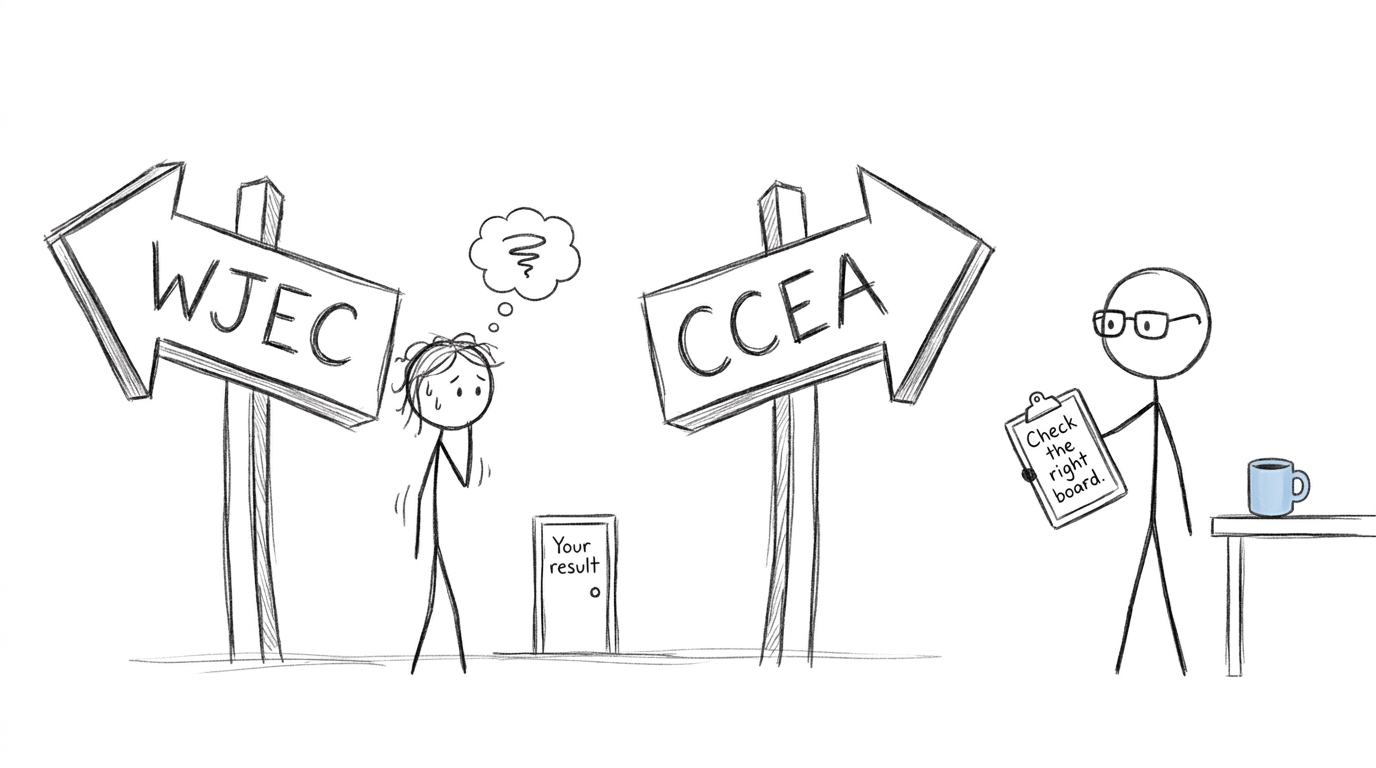 A student checks the correct exam board before opening a result
Comparing the latest useful boundary figures
At the time of writing, summer 2026 grade boundaries have not been published. The WJEC figures below are confirmed raw boundaries from June 2025. CCEA's subject-level UMS boundaries are stable for grades AAA to GGG across the lifetime of the specification, while the raw marks needed within individual units can vary by series. The CCEA A∗A^*A∗ boundary is set separately during each awarding series, so it is deliberately not treated as fixed here.
| Grade or pathway | WJEC June 2025 raw boundary | CCEA overall UMS boundary |
|---|---|---|
| A∗A^*A∗ | Higher: 122122122 out of 160160160 | Set separately for the examination series |
| AAA | Higher: 929292 out of 160160160 | 320320320 out of 400400400 |
| BBB | Higher: 606060 out of 160160160; Intermediate: 106106106 out of 160160160 | 292292292 out of 400400400 |
| C∗C^*C∗ | Not used as a WJEC grade | 268268268 out of 400400400 |
| CCC | Higher: 292929 out of 160160160; Intermediate: 696969 out of 160160160 | 240240240 out of 400400400 |
| DDD | Intermediate: 424242 out of 160160160; Foundation: 656565 out of 130130130 | 200200200 out of 400400400 |
| EEE | Intermediate: 212121 out of 160160160; Foundation: 484848 out of 130130130 | 160160160 out of 400400400 |
| FFF | Foundation: 323232 out of 130130130 | 120120120 out of 400400400 |
| GGG | Foundation: 161616 out of 130130130 | 808080 out of 400400400 |
These figures describe different systems, not a contest between boards. WJEC grade boundaries show the minimum combined raw mark for a particular tier in that series. CCEA combines units with different weightings through UMS, allowing marks from separate assessment series to contribute consistently to the final award.
You can inspect the complete historical figures on the WJEC GCSE grade boundaries page or begin with MathsGenie's GCSE and A Level grade boundaries hub.
Why CCEA boundaries look more complicated
CCEA GCSE Mathematics is unitised. Students take one unit from M1, M2, M3 or M4 and one completion unit from M5, M6, M7 or M8. The normal paired pathways are:
- M1 with M5, offering final grades DDD to GGG;
- M2 with M6, offering final grades C∗C^*C∗ to GGG;
- M3 with M7, offering final grades BBB to EEE;
- M4 with M8, offering final grades A∗A^*A∗ to DDD.
The first unit contributes 45%45\%45% and the completion assessment contributes 55%55\%55%. Raw marks are converted to UMS before aggregation. That is why adding raw marks from two CCEA units and comparing the result with the 400400400-UMS subject boundary may produce a misleading conclusion.
Use the CCEA GCSE Maths revision hub to confirm your pathway and find the correct papers, rather than relying on a boundary screenshot without unit codes.
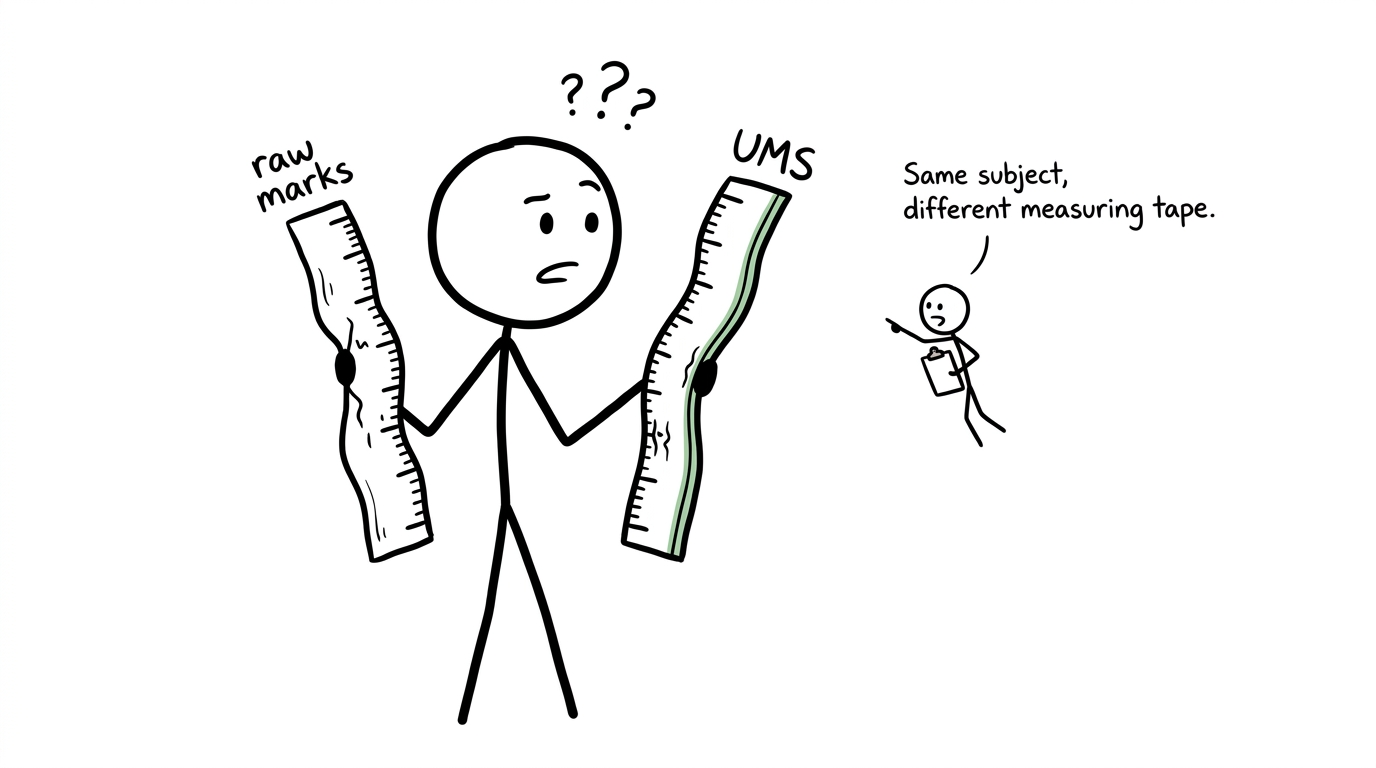 A student discovers that raw marks and UMS use different measuring tapes
What WJEC students should check
WJEC grade boundaries depend on the tier, examination series and specification. In the June 2025 figures above, Foundation had a maximum of 130130130 raw marks, while Intermediate and Higher each had a maximum of 160160160.
That difference makes percentages more meaningful than raw totals when comparing tiers historically. Even then, percentages should not be used to predict a future boundary because paper demand changes from one series to another.
For preparation, use the WJEC GCSE Maths revision hub and complete WJEC GCSE Maths past papers from the correct specification. Mark schemes tell you how marks were earned; boundaries only tell you where grades were placed afterwards.
Common mistakes when comparing results
Treating old boundaries as targets
A previous boundary is evidence from a completed series, not a promise. Build a safety margin into mock targets instead of revising towards the minimum historical mark.
Comparing raw marks with UMS
A CCEA UMS total is a converted mark. It is not directly equivalent to the raw total printed on a WJEC paper.
Ignoring tiers and unit combinations
A WJEC Foundation boundary cannot be compared sensibly with a Higher boundary. Likewise, a CCEA M2/M6 candidate should not use the grade range for M4/M8.
Looking at individual papers as final grades
A paper-level or unit-level boundary does not necessarily represent the final qualification grade. Always check the overall result and the rules for aggregation.
Assuming a near-boundary result must be wrong
If a result is below expectation, speak to your school or college. Staff can review the component marks and advise whether access to scripts, a clerical check or a review of marking is appropriate.
Takeaway for GCSE maths results day
WJEC and CCEA both use boundaries to maintain standards when paper difficulty varies, but they reach the final grade differently. WJEC students should check the correct tier and raw-mark table. CCEA students need their unit combination, raw-to-UMS conversion and overall UMS result.
Before the next examination, turn boundaries into perspective rather than pressure. Use CCEA GCSE Maths past papers or the WJEC paper collection, mark every attempt carefully and repair the topics costing you marks. Nearer the examination, add focused practice from the GCSE predicted papers collection.
MathsGenie brings the whole process together for free: revision lessons, practice questions, past papers, predicted papers, mini tests, mark schemes and video solutions. Start with your board-specific revision page, then use the grade boundary pages on results day to interpret the result accurately, using the right measuring tape.