

GCSE Maths Reform Myths: A Parent's Guide
GCSE maths reform myths explained for parents, including current exams, formula sheets, grades and what planned curriculum changes mean for pupils.
Updated: 3 November 2026
Pupils taking GCSE Maths now should continue preparing for their current specification. Planned reforms do not mean that today's course, tier structure or revision materials have suddenly become obsolete.
That distinction explains many GCSE maths reform myths. A parent hears that GCSEs will change from 2029 onwards and understandably wonders whether their child is learning the wrong material. The missing detail is timing: plans for future qualifications do not automatically change examinations already being taught.
This guide concerns GCSEs regulated in England, drawing on the government's response to the Curriculum and Assessment Review and subsequent examination arrangements. Wales and Northern Ireland have separate qualification policies and reform timetables.
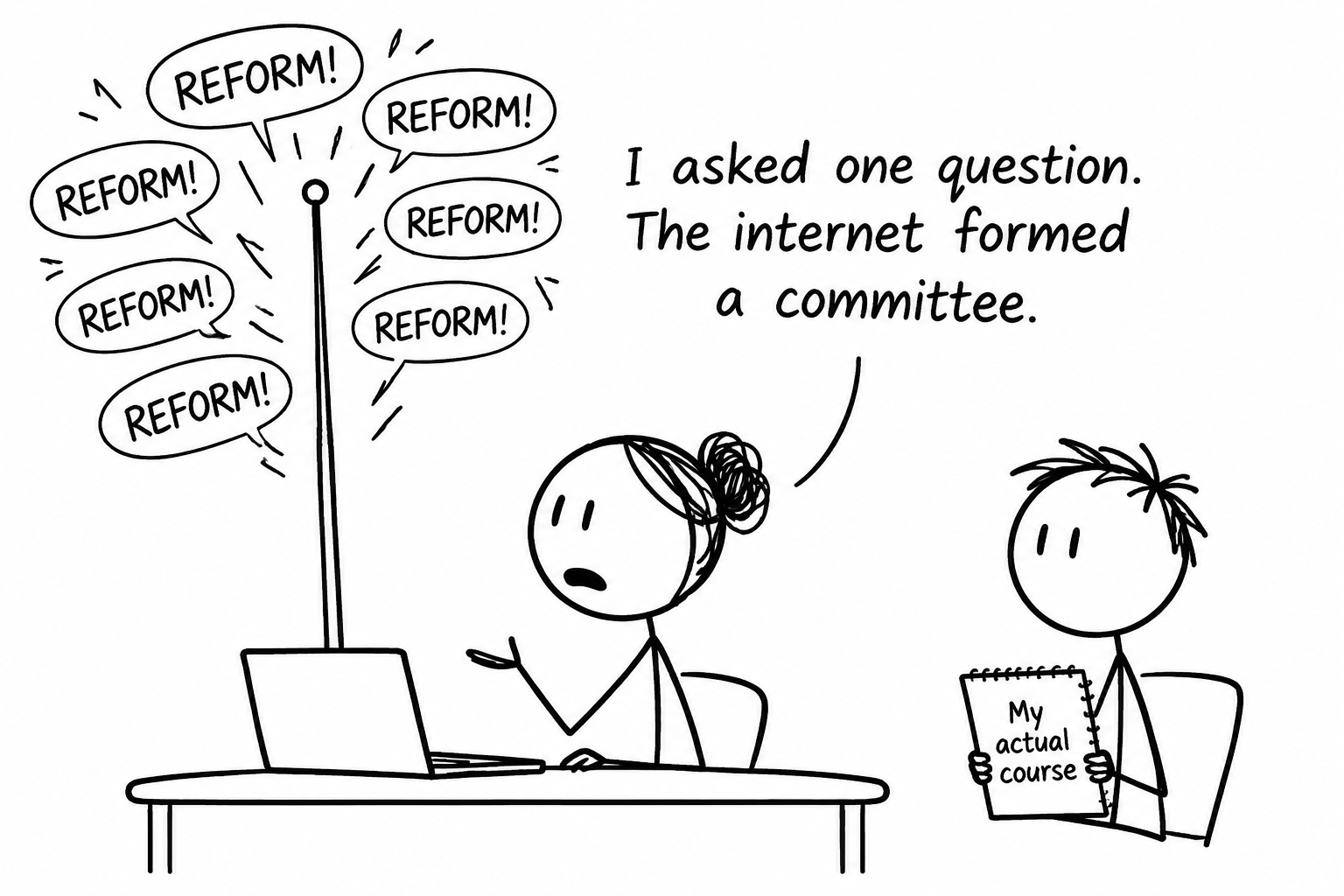 A parent asks the internet one question about GCSE reform and receives a committee of answers
GCSE maths reform myths: the essential checklist
If your child is already following a GCSE course:
- Confirm their exam board and tier with the school.
- Choose resources matching the current specification.
- Check which pupil cohort any announcement affects.
- Distinguish confirmed arrangements from proposals and recommendations.
- Continue revising the course being taught.
The government's response sets out a revised national curriculum intended for first teaching from September 2028, followed by phased GCSE updates from 2029 onwards. Those dates do not mean every subject changes simultaneously.
Use Maths Genie Lessons for the current GCSE specification to find the relevant board and revision material.
Myth: a new GCSE Maths has already replaced the course
The Curriculum and Assessment Review's final report and the government's response, published in November 2025, set a direction for reform. They do not replace an examination specification overnight.
Changes require detailed subject content, regulatory arrangements, approved exam-board specifications and preparation time for schools. Pupils should follow the specification their school identifies for their examinations.
Search results can blur together earlier reforms, future policy announcements and annual examination arrangements. England's current numbered GCSE Maths grading system was introduced in 2017, so references to the “new GCSE” may describe an existing qualification rather than an upcoming one.
Compare your child's course with GCSE Maths topics organised by exam board and tier before drawing conclusions from a headline.
Myth: current past papers are no longer useful
Past papers remain relevant when they match the pupil's exam board, tier and specification. They develop familiarity with question wording, timing and problems combining several skills.
Future reforms do not remove that value for pupils taking current examinations. The useful distinction is between current-specification papers and superseded qualifications.
Maths Genie's old GCSE Maths archive keeps older material separate. Individual questions may still offer useful practice, but an old paper is not necessarily an accurate model of today's examination.
Check the specification, rather than relying on “GCSE Maths” in the title. After attempting a suitable paper, use its mark scheme to identify where understanding or written working needs attention.
Myth: formula sheets are disappearing immediately
For England's current specifications, this claim is outdated. In February 2026, the Department for Education changed its subject-content expectations to allow formula sheets throughout the remaining lifetime of those specifications. Ofqual subsequently confirmed that exam boards would be required to provide them.
A formula sheet supplies information, but pupils must still recognise which formula applies, substitute accurately and interpret the result. Revision should therefore include using the supplied sheet while answering relevant questions.
Check the sheet issued for the examination being taken. An old guide's memorisation advice may reflect different arrangements, while assuming that every useful relationship is supplied can also leave gaps.
Myth: grades and tiers have already changed
Current GCSE Maths qualifications in England retain numbered grades and foundation and higher tiers. Foundation tier offers grades 111-555; higher tier provides access to the upper grades, with detailed award arrangements set by the qualification rules.
Tier choice should reflect the pupil's attainment, target grade and the school's professional judgement. Ask: “Which tier is my child preparing for, and what evidence supports that choice?”
Resources such as Edexcel GCSE Maths lessons and the OCR GCSE Maths revision area help families keep preparation aligned with the relevant board.
Myth: future examination details are already settled
A recommendation is not a finished specification. Proposals about assessment time or curriculum content still require detailed decisions before families can know exactly which papers or topics will change.
Use three categories when reading announcements:
| Status | What it means for your child |
|---|---|
| Current rule | Follow it for the examination being taken |
| Confirmed future implementation | Check whether your child's cohort is affected |
| Recommendation or consultation | Monitor it without rebuilding revision around it |
Look for the first-teaching date, the first examination date and the subject concerned. A report's publication date alone does not establish whether your child is affected.
Common mistakes parents can avoid
Treating all UK GCSEs as one system causes confusion. The review discussed here concerns England; Eduqas qualifications offered in England and WJEC qualifications in Wales should not be assumed to share reform timetables.
Choosing resources solely by publication date is another trap. An older current-specification paper may remain useful, while a recently uploaded worksheet may target superseded content. Check the board, tier and specification.
Finally, avoid turning uncertainty into pressure. Hearing that “everything is changing” can make pupils question the value of their work. Secure understanding of number, algebra, ratio, geometry, probability and statistics remains valuable through curriculum reviews.
Keep revision connected to the examination ahead
When another headline appears, check its source, date and affected cohort, then ask the school whether it changes your child's course.
Meanwhile, keep revision practical: identify a weak topic, revisit the lesson, attempt questions independently and review mistakes. Maths Genie's free lessons, practice questions and examination resources support that routine. Choose your child's board in the current GCSE revision hub and begin with the next topic they need to strengthen.















