GCSE Latin Revision Bootcamp: Is It Worth It?
GCSE Latin revision bootcamp costs can vary widely. Learn what courses offer, when paying is worthwhile and how to protect your GCSE maths revision.
A revision course can look most attractive when time feels least manageable. Latin vocabulary is slipping away, an unseen translation takes too long, and the maths paper waiting on your desk has not disappeared. Paying for a GCSE Latin revision bootcamp may seem like the quickest route back to control.
The short answer is that a bootcamp can be worth paying for when it targets a clearly identified weakness, matches your exact exam board and includes substantial individual feedback. It is less likely to be good value if it offers broad teaching you could already access at school, uses the wrong set texts, or consumes time needed for maths and other GCSE subjects.
The fee is only one part of the decision. The better question is: what will this course enable you to do differently in the exam?
A quick bootcamp value checklist
Before booking, look for clear answers to these questions:
- Is the course designed for OCR or Eduqas GCSE Latin?
- Does it cover your correct specification, component choices and prescribed material?
- Will you complete exam-style work rather than simply listen to lectures?
- Will a teacher mark your translations or written responses individually?
- Is the class small enough for questions and useful feedback?
- Are materials, recordings, travel or accommodation included?
- Does the timetable leave enough energy for GCSE maths and other subjects?
- Are the cancellation, refund and safeguarding arrangements stated clearly?
If a provider cannot answer these questions before receiving payment, that uncertainty is part of the cost.
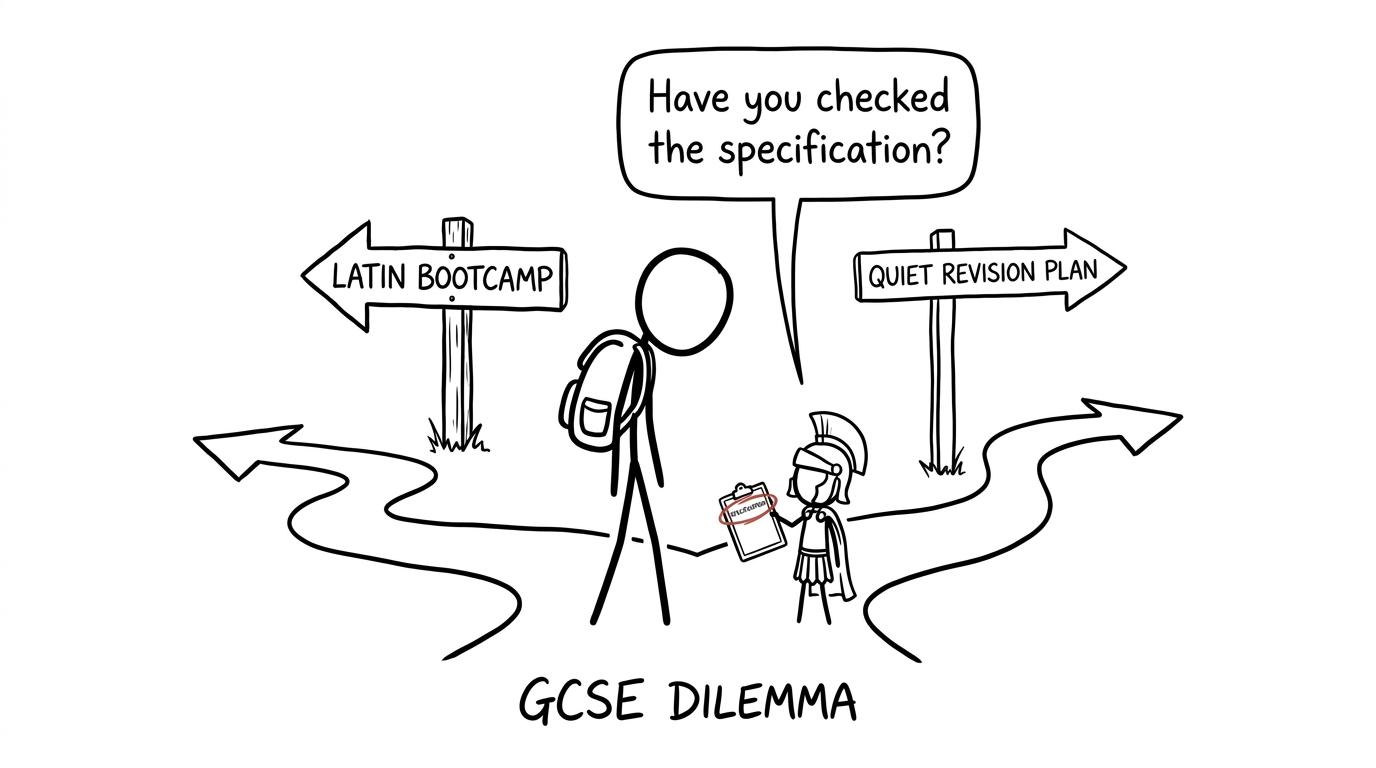 A student choosing between a Latin bootcamp and a quiet revision plan while a tiny Roman checks the specification
What GCSE Latin revision bootcamps actually offer
“Bootcamp” is not a qualification category. Providers use the term for several different formats, from a single online revision day to an intensive holiday week. Some residential summer schools offer a broader experience of classical languages and culture, while Easter courses are more likely to concentrate on the approaching examinations.
A useful course normally combines several of the following.
Language and translation practice
GCSE Latin requires more than memorising vocabulary. Students must recognise accidence and syntax, follow the structure of a sentence and produce accurate English. An intensive course may revisit noun and adjective endings, verb forms, participles, pronouns, subordinate clauses and common constructions before applying them to unseen passages.
This matters because language carries substantial assessment weight. Under the current OCR J282 structure, the compulsory Language component is worth 50%50\%50% of the qualification. Students then take two optional components, each worth 25%25\%25%. For Eduqas, Latin Language is worth 50%50\%50%, Latin Literature and Sources is worth 30%30\%30%, and the final literature or Roman civilisation option is worth 20%20\%20%.
Those structures are not interchangeable. A course that merely says “suitable for GCSE Latin” is not specific enough.
Prescribed literature and civilisation
Holiday courses may review set texts, literary techniques, cultural context and extended responses. Some also cover Roman civilisation sources. This can be valuable when a student knows the narrative but struggles to explain how an author creates an effect or how evidence supports an interpretation.
However, prescribed texts and topics can change between examination cycles. Confirm the year, exam board and component code in writing. A polished lesson on the wrong text remains the wrong lesson.
Exam technique and marked work
The strongest feature of a paid course is often not more content. It is faster diagnosis.
A knowledgeable teacher can notice that a student is ignoring case endings, translating in Latin word order or describing a quotation without analysing it. That kind of precise feedback can shorten weeks of uncertain independent revision.
Ask whether feedback is spoken to the whole class, written on individual work, or both. “Past-paper practice included” may mean completing questions without receiving any personal marking.
Structure and accountability
A fixed timetable can help students who repeatedly postpone difficult work. Turning up at a set time, attempting a passage and receiving feedback creates a useful constraint.
But structure should not be confused with intensity. A long day is not automatically an effective day. Check how much time is spent teaching, practising independently, reviewing mistakes and taking breaks.
Bootcamp, holiday course or ongoing tuition?
These services solve different problems.
| Option | Most suitable when | Important limitation |
|---|---|---|
| Short bootcamp | You need a focused final review of known content | It cannot rebuild an entire course in a day |
| Holiday revision course | You have several connected gaps and can manage intensive sessions | It may reduce revision time for other GCSEs |
| Ongoing small-group tuition | You need regular teaching, testing and accountability | The total commitment can become substantial |
| One-to-one tuition | Your difficulties are specific and require individual diagnosis | It is commonly the most expensive hourly option |
| Independent revision | You know what to practise and can mark work honestly | Feedback may be slower or less precise |
Course prices vary widely because the products are not directly comparable. An online recording library, a live small group and a residential course with food and accommodation should not be judged by the headline fee alone.
A sensible comparison is:
Value=relevant teaching+useful feedback+accountabilityfee+travel+materials+time cost\text{Value} = \frac{\text{relevant teaching} + \text{useful feedback} + \text{accountability}}{\text{fee} + \text{travel} + \text{materials} + \text{time cost}}Value=fee+travel+materials+time costrelevant teaching+useful feedback+accountabilityThis is not a promise that learning can be reduced to a perfect number. It is a reminder to include everything you are giving up.
When paying is genuinely worthwhile
A GCSE Latin revision bootcamp is most defensible when four conditions are present.
You can name the problem
“I am bad at Latin” is too broad. “I cannot identify participles reliably in unseen translation” or “my literature answers lack close analysis” gives a course something concrete to improve.
Use marked school assessments, teacher comments and official-style questions to identify the gap before choosing the solution.
The teaching matches your examination route
For OCR, check that the provider understands J282 and your selected optional components. For Eduqas, check the language, themes and final option being taught. Confirm that any prescribed literature is correct for your examination year.
Good providers make alignment easy to verify. They should not rely on phrases such as “covers everything you need” without showing a syllabus.
Feedback is central rather than optional
Recorded explanations can be useful, but they are rarely the main reason to pay a premium. Individual marking, teacher questioning and corrections connected to your own work are harder to reproduce alone.
Imagine two courses with identical teaching hours. One provides general slides. The other marks a translation, identifies recurring errors and tells you what to practise next. Their advertised duration is the same, but their practical value is not.
You can protect your wider revision plan
For students also preparing for GCSE maths, the course must fit into a balanced timetable. Maths performance depends on repeated practice over time, not one heroic session after Latin has taken the entire holiday.
Use a realistic GCSE maths revision timetable before booking. Put the Latin course into the calendar, including travel and recovery time, then check whether your planned maths sessions still fit.
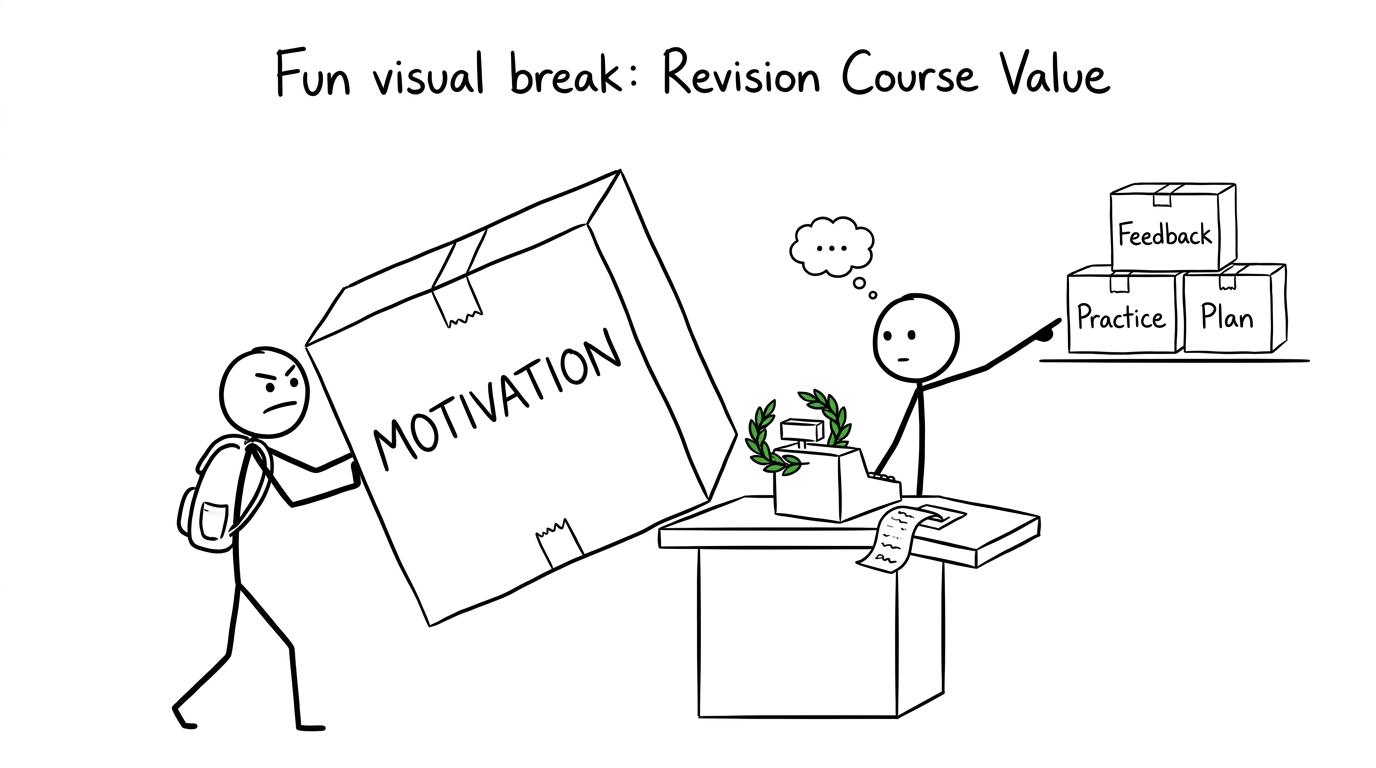 A shop selling feedback, practice and planning instead of an oversized box of motivation
When a Latin holiday course is probably not worth it
A course is unlikely to solve the problem if you have not yet established which paper, component or skill is causing difficulty. In that situation, diagnosis should come before spending.
Be cautious when:
- the course promises a particular grade or guaranteed improvement;
- the description does not identify the exam board;
- set texts and examination years are missing;
- most of the day consists of passive presentations;
- class size and teacher access are unclear;
- individual work will not be marked;
- the course attempts to cover the full specification extremely quickly;
- extra costs only appear late in the booking process;
- attendance would create financial pressure or displace essential revision elsewhere.
A student who already understands the content but avoids independent practice may gain more from a simple routine than another set of notes. This principle applies to maths too: use the best order for learning GCSE maths topics, complete focused questions, mark them and revisit errors.
How to compare a course before paying
Ask the provider for a sample timetable and answer these questions with evidence rather than impressions.
Check the teaching credentials
Find out who will teach the course and whether they have recent experience with your specification. A strong academic background is useful, but exam-board familiarity matters when the purpose is examination revision.
Calculate the real cost
Include tuition, booking charges, textbooks, meals, travel, accommodation and any required technology. Check whether recordings or materials remain available afterwards and whether instalments increase the final amount.
Examine the student-to-teacher ratio
A large lecture can explain content efficiently, but it offers fewer opportunities for personal correction. If individual feedback is the main reason for enrolling, ask exactly how it is delivered.
Read the practical policies
Check cancellation terms, missed-session arrangements, accessibility and safeguarding information. For online courses, confirm whether sessions are live, recorded or both.
Speak to your school teacher
Your Latin teacher may know whether the proposed content matches your needs. They may also suggest a narrower intervention, such as practising language papers or improving one type of literature response.
Protecting maths revision during a Latin course
The smartest reason to pay for a specialist course is to remove a bottleneck, not to create another one.
MathsGenie cannot replace specialist Latin teaching, but it can keep your maths revision structured and free while you decide where paid support adds the most value. Begin at the MathsGenie GCSE and A Level maths revision hub, choose topics at your tier and use short sessions around the course timetable.
During a busy holiday, a manageable pattern is:
- one focused maths topic session on lighter course days;
- a short timed assessment rather than an entire paper when energy is limited;
- marking and correction on the same day;
- a return to the weakest topic after the Latin course ends.
The Edexcel GCSE maths mini tests are useful when a full paper feels unrealistic. As the exams approach, follow the guidance on when to start GCSE past papers, then use Edexcel GCSE maths past papers with mark schemes and worked solutions where available.
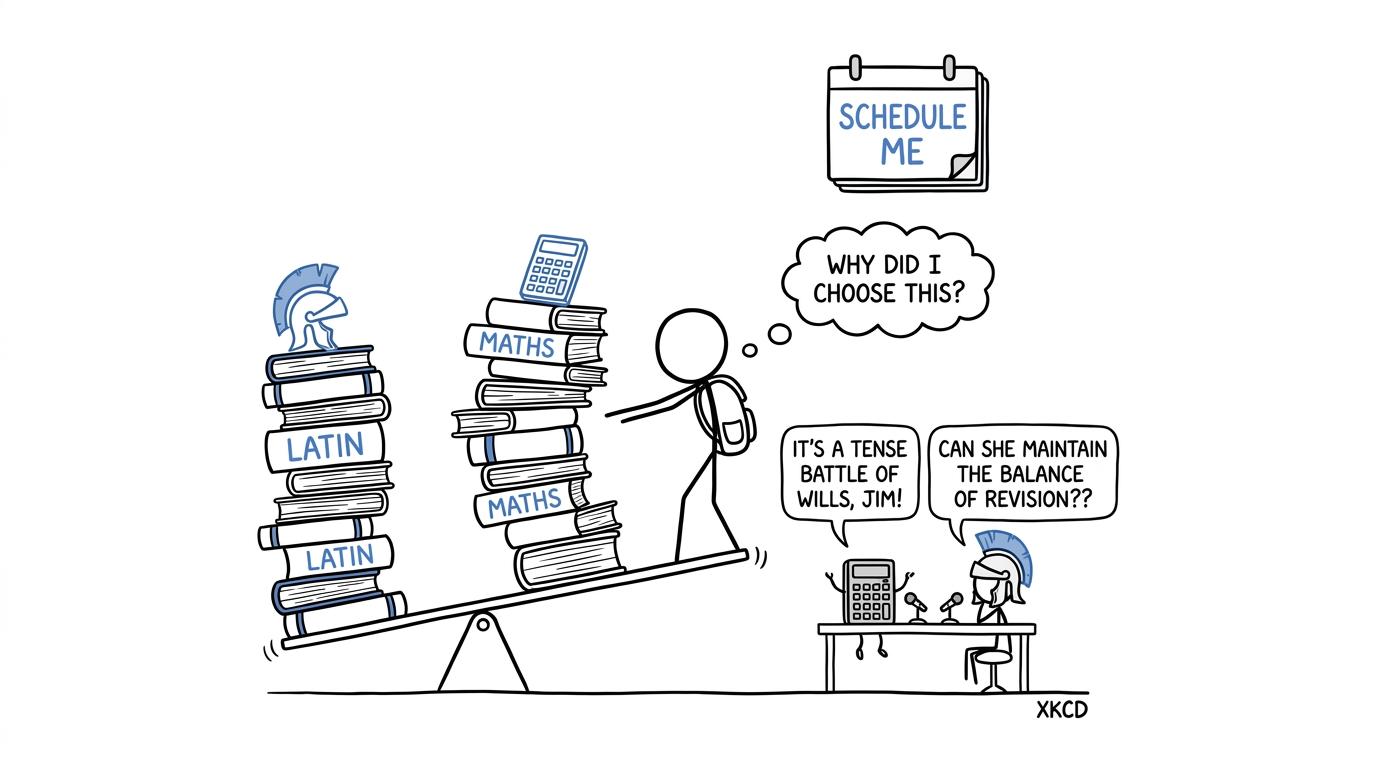 A student balancing Latin and maths revision while a calendar asks to be scheduled
Common mistakes when choosing a revision bootcamp
Buying before diagnosing
Urgency encourages action, but not always the right action. Identify whether the weakness is vocabulary, grammar, translation, literature knowledge, analysis, timing or confidence under exam conditions.
Assuming expensive means personalised
A high fee may reflect location, accommodation or brand positioning rather than individual feedback. Compare what happens during the teaching hours.
Ignoring the exact specification
OCR and Eduqas assess Latin through different component structures. Prescribed content also changes. Never book from the course title alone.
Treating attendance as revision completed
Learning happens when you retrieve knowledge, attempt questions, receive correction and try again. Notes carried home in a folder are not evidence of improvement.
Sacrificing every other subject
A demanding course can produce a false sense that the holiday has been academically productive while leaving maths untouched. Preserve regular practice, then build towards Edexcel GCSE predicted papers once your topic knowledge is secure.
The decision that matters
A GCSE Latin revision bootcamp is worth the cost when it is aligned, targeted and feedback-rich. It should solve a problem you can name and fit within a revision plan you can sustain. If its value rests mainly on urgency, prestige or a vague promise to “cover everything”, pause before paying.
Spend money where specialist human feedback genuinely changes what you can do. Use free resources where they already provide the lessons, practice and assessment you need.
For maths, make MathsGenie your revision base: work through free revision lessons and practice questions, use mini tests to expose gaps, then complete past papers and predicted papers under timed conditions. Mark every attempt carefully, use video solutions when a method is unclear, and let each mistake decide your next session. That is how revision becomes more than time spent; it becomes progress you can see.