GCSE Latin Exam-Day Kit: Night-Before Checklist
GCSE Latin exam-day kit: pack the right pens, permitted essentials and exam details the night before, with a calm checklist for a confident exam morning.
The night before an exam is a poor time to discover that your only black pen has stopped working. It is also when ordinary questions can suddenly feel urgent: do you need a Latin dictionary, can you wear a watch, and should you take the text you have studied?
A sensible GCSE Latin exam day kit is reassuringly small. In most cases, you need working black pens in a transparent pencil case, your confirmed exam details and any permitted personal essentials. You should not take revision notes, your own set text, a phone, a watch or unapproved reference materials into the exam room.
Your school or exam centre's current instructions always take priority. Check them carefully because arrangements can vary between centres and papers.
Your GCSE Latin exam day kit at a glance
Prepare these items the night before:
- At least two working black pens
- A simple transparent pencil case
- A pencil and eraser, if your school recommends them
- Your exam timetable or a photograph of it stored away from the exam room
- Any candidate card or identification requested by your centre
- A transparent, unlabelled water bottle, if your centre allows one
- Approved medication arranged according to your school's procedure
- Glasses or other everyday accessibility items you need
- Your journey plan and the time you need to leave
Leave these items at home or hand them in as directed:
- Mobile phones and other communication devices
- Watches, including ordinary analogue watches
- Earphones, earbuds and smart glasses
- Revision notes, vocabulary sheets and flashcards
- Your own copy of a Latin set text
- A Latin dictionary unless your official paper and centre instructions expressly permit one
- Calculator, geometry equipment and other items that the paper does not require
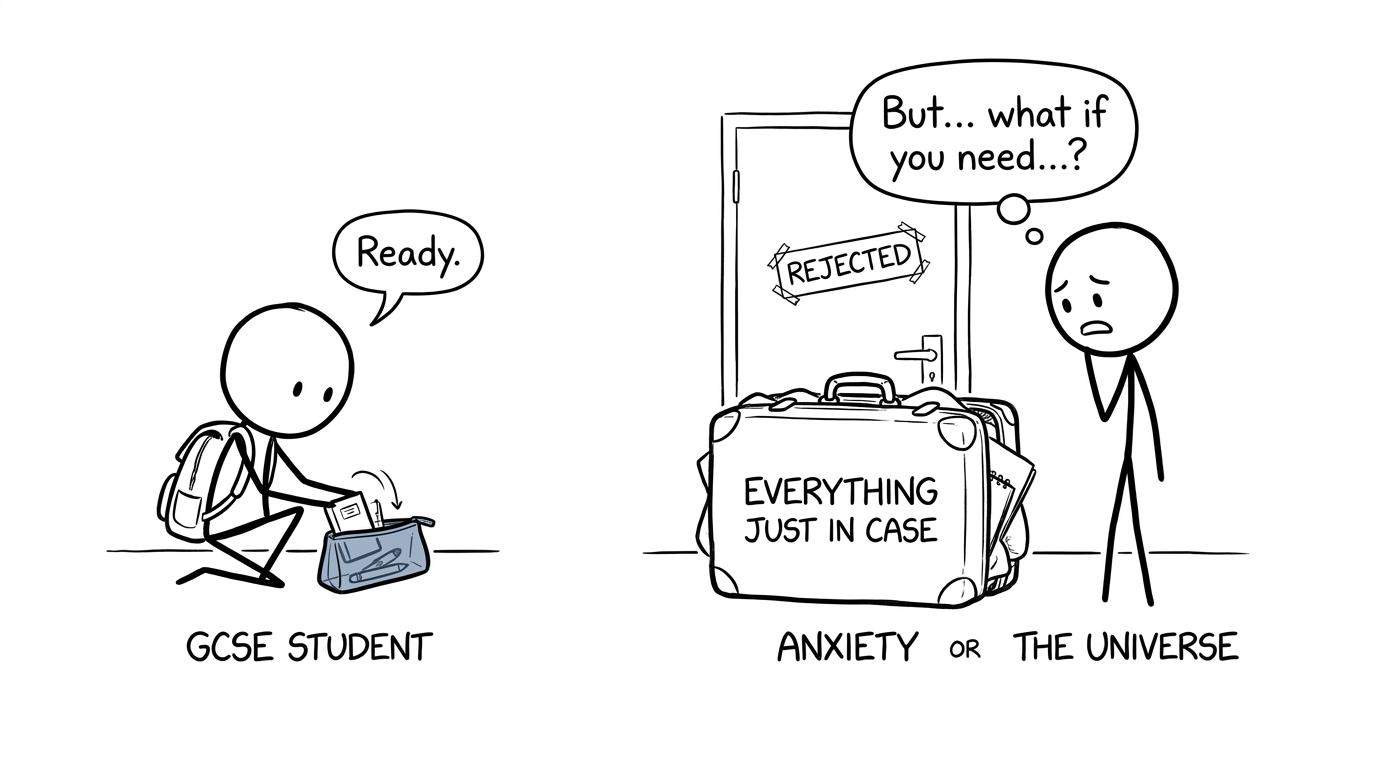 A student rejects an enormous suitcase and packs a tiny clear exam pencil case
What you will actually need
Reliable black pens
Black ink is the standard requirement for written exam answers because scripts may be scanned for marking. Take at least two pens and test both before packing them. A third spare is reasonable if it fits comfortably in your pencil case.
Choose pens you already use confidently. Exam morning is not the moment to experiment with an unfamiliar pen that smudges, scratches the paper or becomes uncomfortable after several pages.
Latin papers can involve extended translation, comprehension or literary analysis. A reliable pen therefore matters more than an elaborate collection of stationery. If you make an error, cross it out neatly and continue unless the invigilator gives different instructions. Correction fluid and erasable pens are best avoided.
A transparent pencil case
Put your stationery in a clear pencil case so invigilators can see its contents. Remove scraps of paper, revision cards and packaging carrying notes.
A pencil may be useful if your school specifically advises you to bring one, but your final written answers should follow the instructions printed on the paper. Coloured pens, highlighters and an extensive geometry set are not normally necessary for a Latin exam.
The aim is not to pack for every imaginable event. It is to make the permitted essentials easy to find.
Confirmed exam information
Check your timetable for:
- The subject and paper title
- The date
- The morning or afternoon session
- Your required arrival time
- The room or meeting point
- Your candidate number, if your school expects you to know it
Do not rely on a friend's timetable. Students taking the same subject can be entered for different components, and a message in a group chat is not an official exam instruction.
Your school may give you a candidate card or ask for identification. Pack whatever it has specifically requested, but do not assume that every centre follows the same procedure.
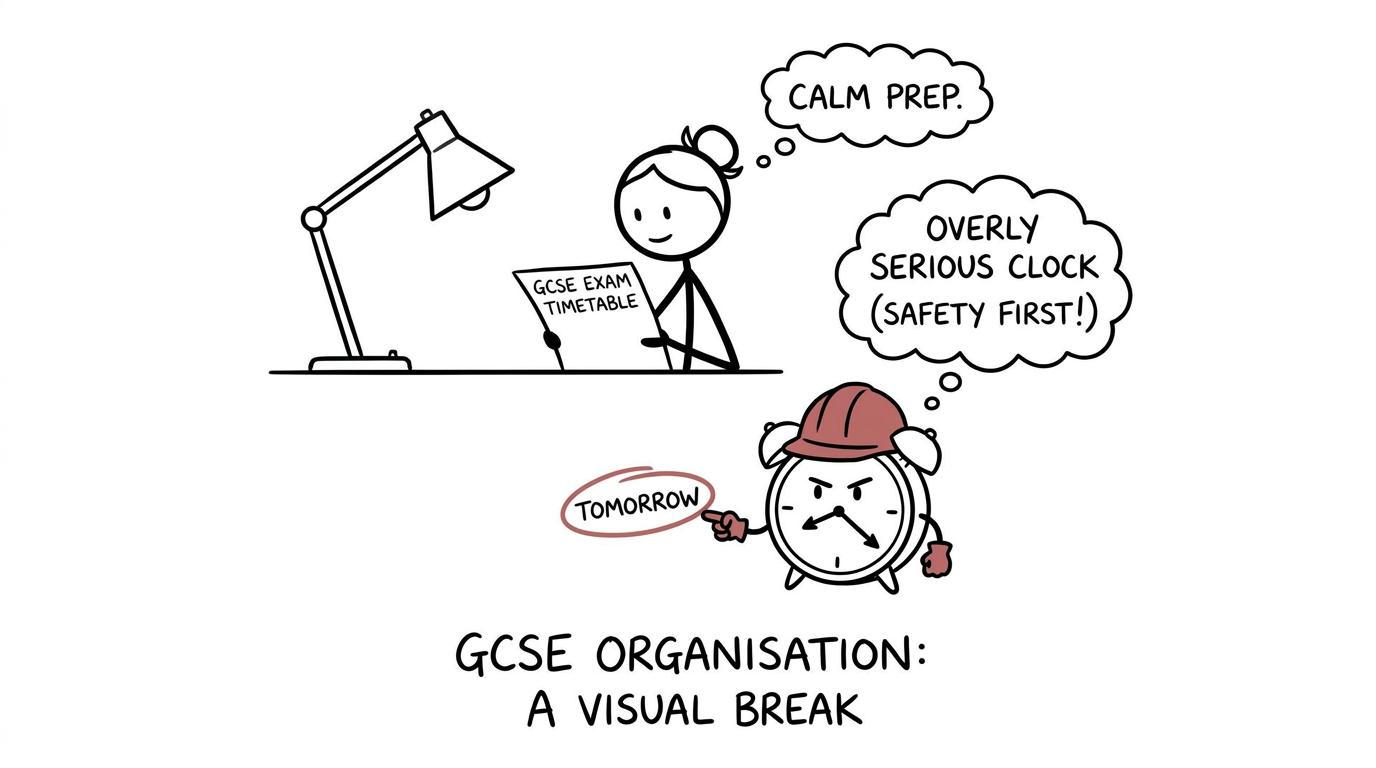 A calm student checks an exam timetable while an alarm clock wears a safety helmet
What not to bring into the Latin exam
Phones, watches and connected devices
Phones must not be in your possession during the examination. The safest approach is to leave yours at home or hand it in through your school's stated procedure. Turning a phone to silent does not make it acceptable.
Watches are also prohibited in exam rooms under current examination arrangements. This includes a traditional watch as well as a smartwatch. The room should have an official clock, and invigilators can help if you cannot see it clearly.
Check bags and pockets for earbuds, music players and other electronic devices. A forgotten device can still create a serious problem even if you did not intend to use it.
Notes, texts and dictionaries
Do not carry vocabulary lists, grammar summaries, annotations or flashcards into the exam room. Check blazer pockets and the inside of your pencil case, particularly if you revised at school earlier in the day.
You should not assume that a dictionary is permitted just because the examination is in Latin. The permitted materials depend on the specification and component. For many papers, any required source material or vocabulary support is provided as part of the examination materials.
Similarly, do not take your annotated classroom copy of a literature text. If a paper requires a source booklet, the exam centre will normally issue the official version. Follow the front of the question paper and your invigilator's instructions rather than informal online advice.
Unnecessary maths equipment
A calculator, ruler, protractor and compass belong in some maths examinations, not automatically in a Latin paper. Extra objects create clutter and give you more things to check.
This distinction is worth remembering if you have Latin and maths examinations close together. Repack your pencil case for the paper you are actually sitting. For maths, use MathsGenie's GCSE revision resources to check the knowledge and equipment relevant to your preparation.
Check your exam board and component
GCSE Latin arrangements are not interchangeable with those for every other language qualification. Your entry may follow an OCR or Eduqas specification, and the materials required can differ by component.
Look at your official timetable, the qualification title and any instructions issued by your exams officer. Pay particular attention to whether you are sitting a language, literature, civilisation or combined component. Never infer the rules from a past paper belonging to another exam board.
The front cover of the question paper will list the materials candidates may use. Invigilators will also announce important instructions before the examination begins. If you are unsure about an item, ask your teacher or exams officer before exam day rather than making a guess at the desk.
Personal essentials without overpacking
A transparent water bottle may be allowed, usually with labels removed, but confirm your centre's rules. Pack it the night before and check that it does not leak.
If you need prescribed medication, medical equipment or an access arrangement, follow the process agreed with your school. Do not hide medication in your pencil case or decide on a new arrangement on exam morning. Speak to the exams officer early if anything is unclear.
Wear the clothing required by your school and bring glasses if you use them for reading. Tissues may be supplied by the centre or checked by an invigilator, so ask rather than placing a packet on your desk without permission.
These details seem small. That is precisely why preparing them helps: small decisions consume attention when they are postponed.
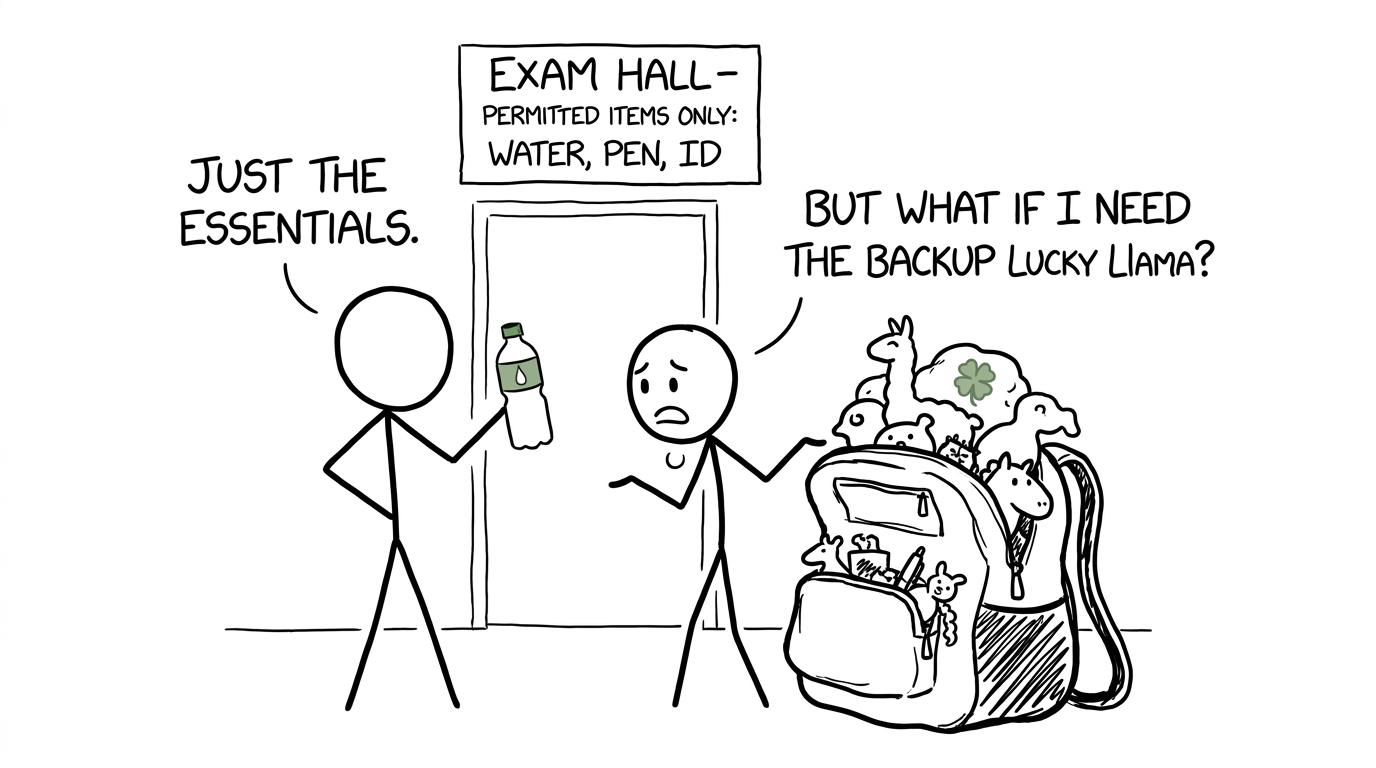 One student carries a clear bottle while another struggles with a backpack full of lucky mascots
A calm night-before routine
Packing should take only a few minutes. The useful part is removing uncertainty.
First, place your transparent pencil case and approved essentials beside your bag. Test each pen on scrap paper. Then check the official timetable and set an alarm with enough time for breakfast, travel and your centre's required arrival period.
Plan for an ordinary delay rather than a perfect journey. If somebody else is taking you to school, confirm the leaving time with them. If you use public transport, identify the service you intend to catch and a reasonable alternative.
After that, stop reorganising. Last-minute revision can feel productive because it is active, but sleep and a settled morning are often more valuable than repeatedly checking material you already know.
The same principle helps with maths revision. Use the GCSE maths past papers before exam night, not as a source of panic during it. Students rebuilding core knowledge can work through grade 1 revision topics or grade 4 revision topics, while higher-tier students can target grade 6 revision and grade 9 revision topics.
The morning of the exam
Use the checklist once, then leave it alone. Eat and drink as you normally would, collect your prepared kit and arrive at the time set by your school.
Before entering the exam room:
- Check every pocket for a phone, watch, notes or earbuds
- Hand prohibited belongings in using the school's system
- Listen to the invigilator rather than continuing a conversation
- Check that the paper on your desk is the correct subject and component
- Raise your hand immediately if anything appears wrong
Do not open the paper until instructed. Once the examination starts, read the printed directions carefully. They are part of the task, not background decoration.
Common GCSE Latin exam-day mistakes
Packing a dictionary automatically
Latin is a language subject, but that does not mean your own dictionary is allowed. Check the precise paper instructions. If it is not expressly permitted, do not bring it to your desk.
Keeping a phone switched off in a pocket
A switched-off phone is still a prohibited item if it remains in your possession. Follow your centre's collection or storage arrangements.
Wearing an ordinary watch
The rule is not limited to smartwatches. Remove all watches before entering the examination room.
Bringing annotated literature texts
Your classroom text may contain notes and is not a substitute for official examination material. The centre supplies any required question paper or source booklet.
Checking the date but not the component
Knowing that you have Latin is not enough. Confirm the paper, session, room and arrival time from your official timetable.
Turning preparation into late-night revision
Packing a pen should not become an excuse to reopen every folder. Prepare the kit, check the timetable and finish for the evening.
Go in prepared, not overloaded
The best GCSE Latin exam day kit is simple: dependable black pens, a transparent pencil case, confirmed exam information and any approved personal essentials. Everything else should earn its place through the official instructions.
That approach carries over to every GCSE. Prepare early, practise under realistic conditions and keep exam morning for calm execution. For your maths papers, MathsGenie brings together free GCSE revision lessons, past papers and mark schemes, practice questions, video solutions, mini tests and predicted-paper support.
Pack tonight. Check once. Then give tomorrow's paper your full attention.