GCSE Latin Busy Schedule: A Survival Guide
GCSE Latin busy schedule advice for fitting vocabulary, translation and set texts around sport, work, maths revision and other demanding subjects.
There is a particular kind of panic that arrives when Latin homework is open on your desk, maths revision is waiting, and training starts in twenty minutes. The problem is not laziness. It is arithmetic: there are more demands on the evening than useful hours available.
If you are managing GCSE Latin with a busy schedule, the answer is not to manufacture an ambitious timetable you cannot sustain. Protect a small daily minimum, divide Latin into language and literature tasks, and use longer sessions only for translation or exam practice. Ten focused minutes completed regularly will do more than an imaginary free evening that never arrives.
This guide shows you how to keep Latin moving while sport, a part-time job, maths and other GCSE subjects compete for your attention.
The survival checklist
When time is tight, start here:
- Confirm your exam board, components and current prescribed texts.
- Set a Latin minimum that fits even your busiest school day.
- Retrieve vocabulary rather than repeatedly reading it.
- Separate grammar, translation and literature revision.
- Use short gaps for recall and protect longer blocks for written work.
- Keep an error log based on actual questions.
- Ask your teacher early when you fall behind.
- Plan Latin alongside maths rather than pretending the subjects have separate calendars.
The aim is not to cover everything every evening. It is to make sure the important knowledge keeps returning before it is forgotten.
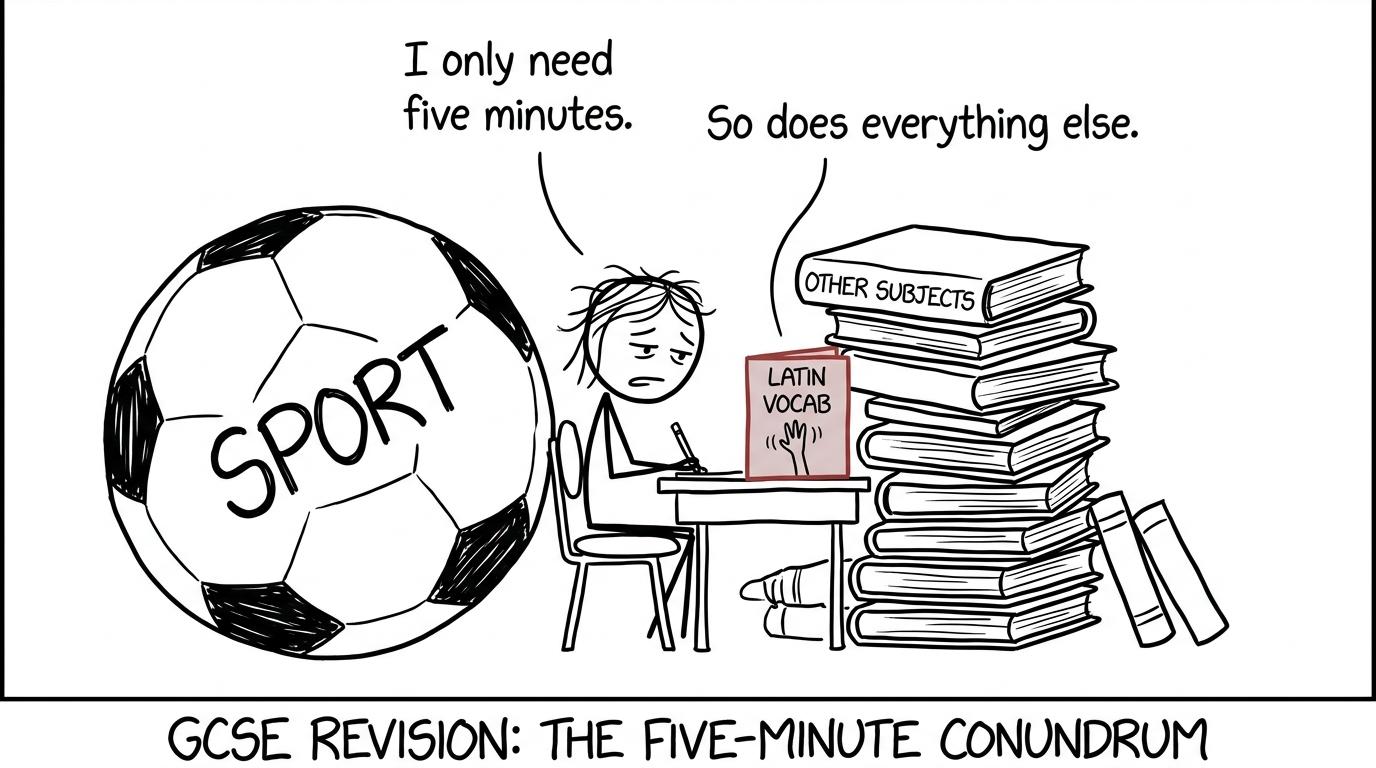 A GCSE student squeezed between sport, other subjects and a Latin vocabulary card
Know what your Latin course actually assesses
Scarce time becomes more valuable when you know where it should go. Do not revise from a generic online checklist without checking it against your own specification and teacher's instructions.
GCSE Latin is commonly offered through OCR or Eduqas. This differs from GCSE maths, where students may encounter Edexcel, AQA, OCR or Eduqas and must also know whether they are entered for foundation or higher tier. Latin is not divided into foundation and higher tiers in the same way.
Under both the OCR and Eduqas specifications, language accounts for 50%50\%50% of the qualification. The national assessment objectives also divide the qualification into 50%50\%50% language knowledge, 25%25\%25% knowledge and understanding of literature or other ancient sources, and 25%25\%25% analysis, evaluation and response.
That does not mean spending every spare minute on vocabulary. It means language cannot safely be abandoned while you concentrate on a set text.
OCR students take the compulsory Language component and two permitted optional components from prose literature, verse literature, and literature and culture. Eduqas students take Latin Language, Latin Literature and Sources, and either a narrative literature or Roman civilisation option. Exact prescriptions and arrangements can change between examination cycles, so use the specification and materials for your own exam year.
Write your components on one page. Beside each one, list what the paper requires: vocabulary, accidence, syntax, unseen translation, textual knowledge, stylistic analysis or source evaluation. That page is your boundary. It prevents revision from expanding into everything anyone has ever known about Rome.
Build a minimum you can keep on busy days
A useful minimum is small enough to survive late training, a work shift or a difficult homework evening. For many students, that might be ten minutes of Latin rather than an hour.
A short session can contain:
- four minutes of vocabulary retrieval;
- three minutes recalling one grammar pattern;
- three minutes reviewing a set-text section or correcting an old error.
This is not a complete revision programme. It is the floor that stops contact with the subject disappearing. On quieter days, add a longer translation or literature session.
Think in terms of two schedules:
The floor schedule
Use this on crowded days. Complete one tiny, defined task with your phone out of reach. Finishing is more important than variety.
The growth schedule
Use this once or twice a week when you have a longer block. Translate an unseen passage, plan a literature response, complete exam questions or mark previous work carefully.
This approach also protects maths. MathsGenie's 20-minute GCSE maths revision routine uses the same principle: choose a precise task, practise actively and record the next action. A repeatable routine reduces the time lost deciding where to begin.
Match the Latin task to the time available
Not all revision tasks need the same conditions. Trying to translate a substantial passage on a noisy bus is frustrating. Reviewing vocabulary there may be ideal.
Five spare minutes
Test vocabulary from English to Latin and Latin to English. Recite endings. Recall the meaning and function of one construction. Cover the answer before attempting it.
Fifteen spare minutes
Parse several forms, translate a few connected clauses, retrieve quotations or annotate one short section of a prescribed text from memory.
Thirty to forty-five minutes
Complete a meaningful passage or exam section. Work without interruptions, mark it and identify the precise cause of each error.
A good rule is to put portable tasks into unpredictable gaps and written tasks into protected blocks. That makes your plan flexible without making it vague.
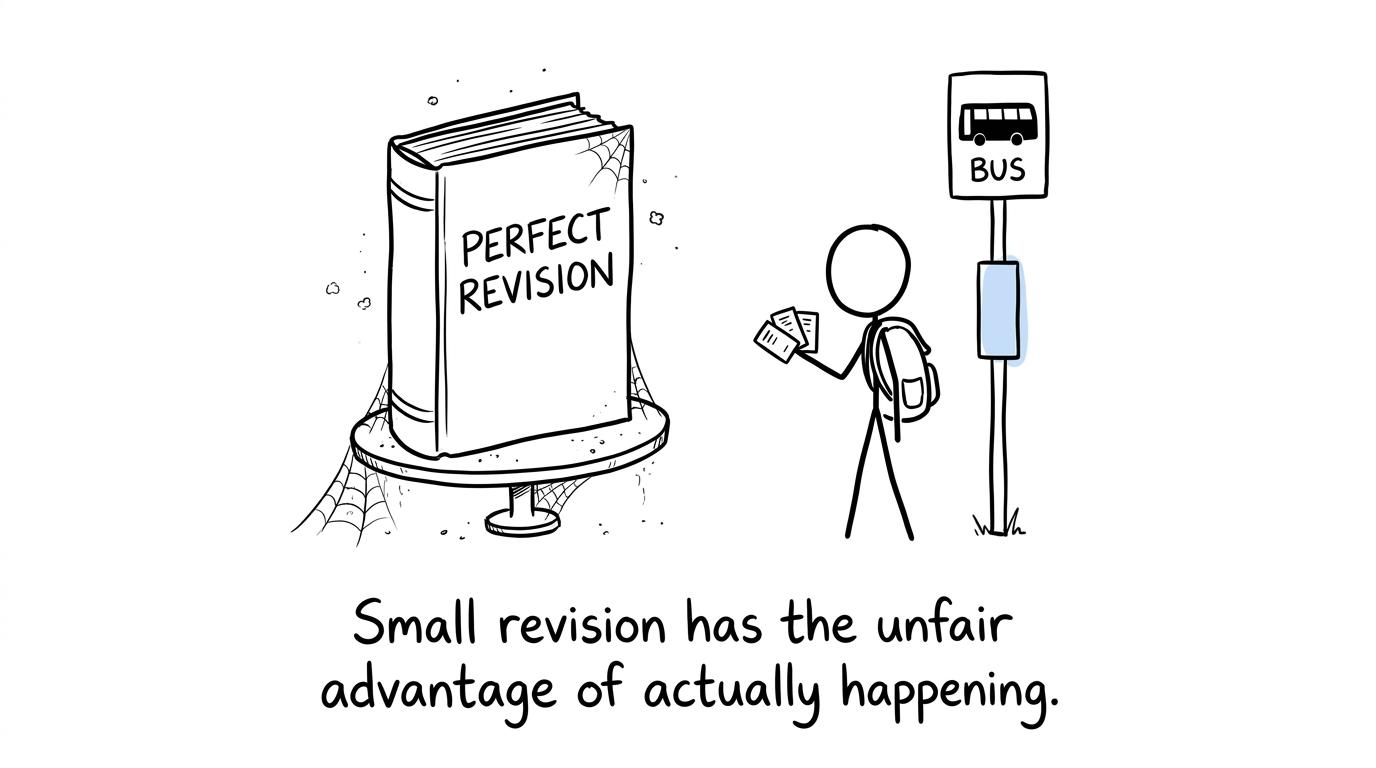 A student using tiny flashcards while a perfect revision book gathers dust
Revise vocabulary through retrieval
Vocabulary revision often feels productive because the words look familiar. Recognition, however, is not the same as recall. The examination asks you to produce meaning while reading an unfamiliar passage.
Start by testing yourself without looking. Sort words into three groups:
- secure;
- slow but correct;
- unknown or repeatedly confused.
Spend most of the next session on the final two groups. Include principal parts, irregular forms and easily confused words where required by your course. Then revisit the troublesome items on later days rather than exhausting them in one sitting.
The same principle works in maths: evidence should decide what you practise. MathsGenie's guide to finding your weakest GCSE topics explains how errors can become a short, practical priority list instead of a reason to restart the whole course.
Keep grammar and translation connected
A declension recalled in isolation is useful. Recognising what that ending is doing inside a sentence is better.
When reviewing grammar, ask three questions:
- What form am I looking at?
- What jobs could that form perform?
- Which reading makes sense in this sentence?
During translation, mark the main verb, identify likely subjects and objects, and notice connecting words before trying to produce polished English. Translate what the Latin supports, not the story you expect it to tell.
Keep a translation error log with narrow labels such as "missed indirect statement", "confused tense" or "guessed vocabulary from appearance". Broad labels like "bad grammar" do not tell you what to practise next.
Make literature revision active
Reading a translation repeatedly can create confidence without reliable recall. Literature revision needs several layers: what happens, how the Latin expresses it, which techniques matter, and how those choices affect meaning or the reader.
Divide each prescribed text into manageable sections. For each section, retrieve:
- the place in the narrative or argument;
- the essential content;
- significant Latin words or phrases;
- literary techniques;
- an explanation connecting evidence to effect.
Do not collect every possible technique. A smaller bank of evidence you can explain accurately is more useful than a long list of labels. If your component includes sources or Roman civilisation, practise linking a source to a precise claim and consider what the source can and cannot establish.
Fit Latin around maths and other GCSEs
A crowded timetable fails when every subject is assigned equal time regardless of need. Instead, look at the whole week.
Start with fixed commitments: lessons, travel, sport, work, meals and sleep. Add immovable deadlines and upcoming assessments. Only then allocate revision blocks. MathsGenie's GCSE maths revision timetable guide offers a useful model for building revision around real life rather than an idealised week.
Use short Latin retrieval on days containing substantial maths practice. On another day, give Latin the longer written block and keep maths alive with a focused mini test. The MathsGenie GCSE maths hub lets you select board-specific revision lessons, questions and papers without spending your limited time hunting for materials.
If you follow Edexcel maths, short GCSE maths mini tests can fit around Latin translation sessions. When you have more time, Edexcel GCSE maths past papers provide longer timed practice with mark schemes and solutions.
The principle is simple: preserve continuity in both subjects, then rotate which one receives the deeper session.
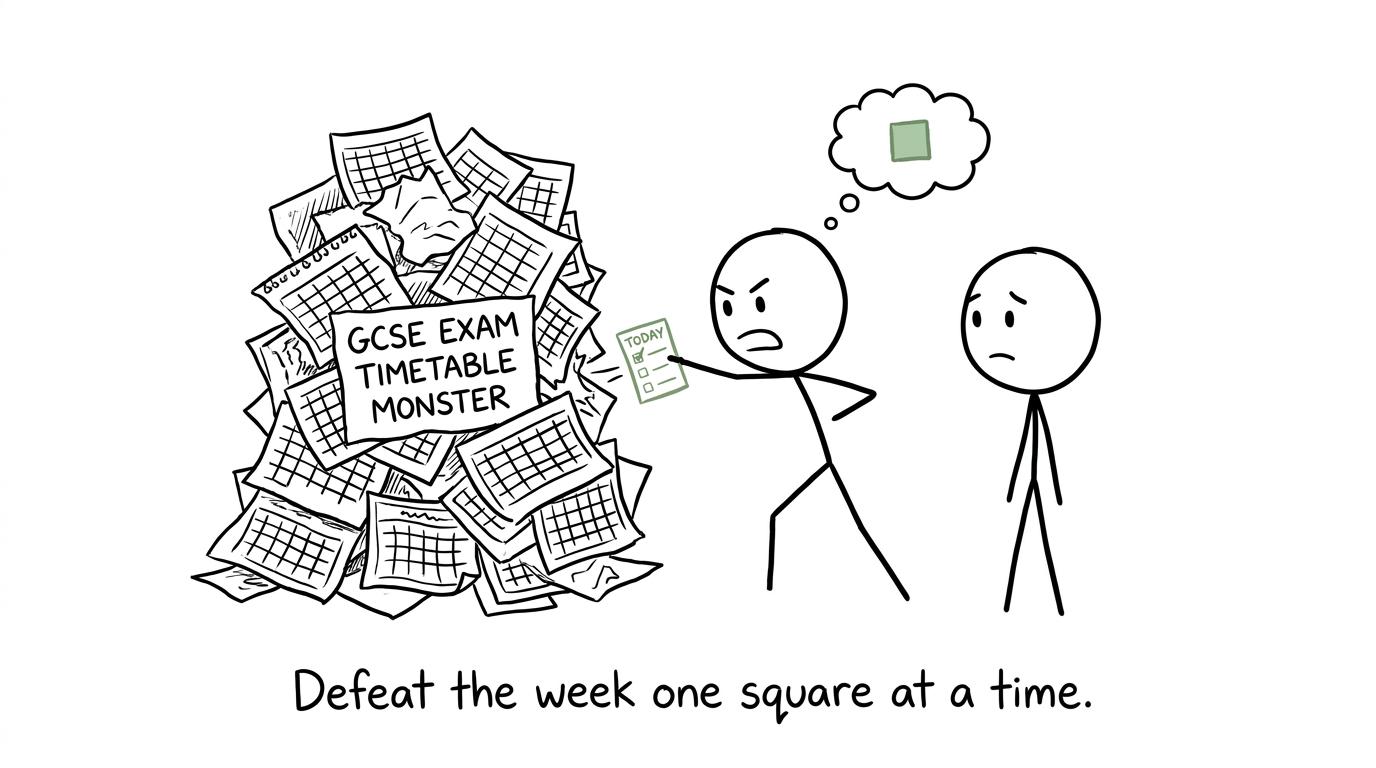 Students confronting an exam timetable monster with a tiny daily checklist
Use past questions without wasting them
Do not wait until you feel fully prepared before looking at examination material. A short section can reveal whether your problem is recall, interpretation, written analysis or timing.
After completing a question:
- mark it using the available mark scheme or teacher guidance;
- record why marks were lost;
- repair one weakness;
- attempt a comparable task later without notes.
Avoid consuming all the newest material too early. Your teacher may want to reserve certain papers for mocks. Ask before using them, particularly where current prescribed literature differs from older papers.
The same measured progression is useful for maths. MathsGenie's guide to when to start GCSE past papers moves from shorter diagnostic work towards full timed papers. This matters when Latin and maths are sharing the same limited weekends.
Common mistakes when revision time is scarce
Making a heroic timetable
A plan requiring long sessions every night usually collapses after one late fixture or shift. Build around a minimum you can genuinely repeat.
Revising only vocabulary
Vocabulary is central, but language papers also require grammar, comprehension and translation. Literature or source components demand separate knowledge and analytical practice.
Reading instead of retrieving
Looking over notes feels smoother than testing yourself. Close the book first. Attempt recall, then check.
Treating every weakness equally
Repeated errors deserve more time than isolated slips. Let marked work determine your priorities.
Ignoring the exact prescription
Set texts and topics can change. Confirm your board, component codes and examination year with your teacher and current official documents.
Sacrificing sleep to rescue one evening
Revision completed while exhausted is often slow and inaccurate. Protecting tomorrow's concentration is part of today's plan, not an interruption to it.
A calm plan is still a serious plan
A busy schedule does not require you to stop caring about Latin. It requires you to define what progress looks like on an ordinary Tuesday: a handful of words accurately retrieved, one construction understood or one paragraph analysed properly.
Keep the Latin minimum small. Use longer sessions deliberately. Let errors choose the next task. Then make your maths revision equally efficient through MathsGenie's free revision lessons, practice questions, mini tests, past papers, predicted papers, mark schemes and video solutions.
Start by opening the GCSE maths revision hub, choosing your exam board and identifying one task for today. Latin does not need your entire evening, and neither does maths. Each subject needs the next focused action that is completed often enough to matter.