GCSE ICT Grade Boundaries Explained: Raw Marks
GCSE ICT grade boundaries explained: see why raw marks, UMS, paper difficulty and exam series can change the grade attached to your score at results time.
A mark can look wonderfully certain. It sits on the page, neat and final, inviting you to turn it into a percentage and declare a grade. But qualifications do not always work that way. GCSE ICT grade boundaries explained simply means understanding that your raw mark is only the beginning: the exam board must connect that mark to the standard represented by each grade.
That connection can change between examination series because papers vary in difficulty. Older and unitised ICT qualifications may also convert raw marks into Uniform Mark Scale, or UMS, marks before producing the final result. So the same raw mark can lead to a different outcome in another year, unit or specification.
One important clarification comes first. GCSE ICT was discontinued in England during the qualification reforms and should not be confused with the current GCSE Computer Science qualification. ICT qualifications and results may still appear in historical boundary documents, while WJEC qualifications in Wales follow their own specifications and transition arrangements. Always check the exact qualification title, board and examination series shown on your paperwork.
GCSE ICT grade boundaries at a glance
Before interpreting any result, check:
- the full qualification title and specification code;
- whether it is GCSE ICT, Digital Technology or Computer Science;
- the exam board, such as WJEC, AQA, Edexcel or OCR;
- the country in which the qualification is regulated;
- the examination series and year;
- whether the document shows raw marks, UMS marks or both;
- whether the boundary applies to one unit or the whole qualification;
- whether coursework or controlled assessment contributes to the total.
A boundary is the minimum mark required for a particular grade. It is not automatically a familiar percentage such as 70%70\%70%, and it should never be borrowed from another board or year.
Why your raw mark is not automatically your grade
A raw mark is the number of marks awarded directly from the mark scheme. If a paper has a maximum mark of MMM and you receive a raw mark of RRR, its raw percentage is:
Raw percentage=RM×100\text{Raw percentage}=\frac{R}{M}\times 100Raw percentage=MR×100That calculation describes the share of available marks you earned. It does not decide what standard the paper represented or where an exam board should place a grade boundary.
Exam papers are designed to be comparable, but they cannot be perfectly identical in difficulty. One series may contain a particularly accessible extended question. Another may include a task whose wording or context makes it more demanding than expected. If students generally find a paper harder, the raw boundary may be lower. If the paper proves more accessible, it may be higher.
The aim is not to make the same percentage produce the same grade every year. The aim is to keep the quality of performance represented by the grade broadly consistent.
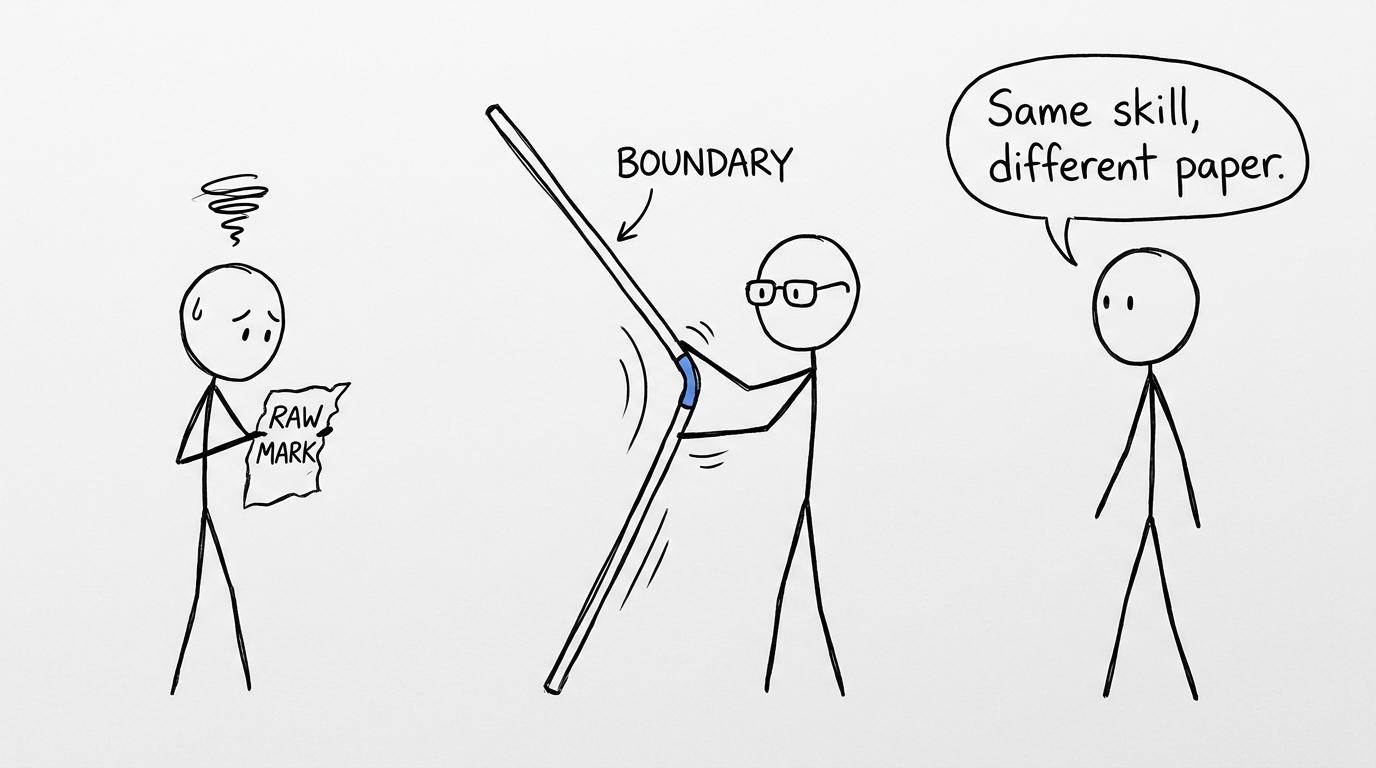 A student watches an examiner adjust a grade boundary
This principle applies beyond ICT. The movement shown on MathsGenie's AQA GCSE Maths grade boundaries and OCR GCSE Maths grade boundaries pages demonstrates why a past boundary is evidence, not a permanent pass mark.
How GCSE grade boundaries are actually set
Grade boundaries are normally set after enough work has been marked for exam boards to understand how the assessment performed. Senior examiners and assessment specialists use both quantitative and qualitative evidence.
The statistical evidence
Awarding teams can consider the distribution and spread of marks, how individual questions performed, patterns across components and information about the overall cohort. Prior-attainment evidence may be used at cohort level to help maintain standards between years.
This does not mean your own earlier results secretly alter your grade. Once a boundary has been confirmed, everyone taking that qualification in that series is judged against the same relevant boundary.
The judgement of student work
Numbers cannot show everything. Senior examiners may review scripts around possible boundary positions and compare their quality with work representing the expected standard. They can consider the question paper, final mark scheme, examiner reports and archived work from earlier series.
The eventual boundary therefore reflects evidence about both the assessment and the quality of students' responses. MathsGenie's broader guide to how GCSE grade boundaries work explains the same process for current GCSE maths qualifications.
Why the boundary cannot be known beforehand
Until the assessment has been taken and marked, nobody can know precisely how demanding it proved in practice. A predicted boundary circulating before results are released is therefore an estimate, not an official decision.
This is why trying to forecast one exact cut-off is rarely a productive revision strategy. You control the marks you earn, not the number eventually printed in the boundary document.
Raw marks, UMS and weighted units in GCSE ICT
Many historical GCSE ICT specifications were unitised. Students completed separate examinations, practical tasks or controlled assessments, and their marks were combined to produce the qualification result.
In some unitised qualifications, the exam board converted raw marks onto a Uniform Mark Scale. A raw mark and a UMS mark are different quantities:
- Raw mark: the mark awarded directly for one assessment.
- UMS mark: a standardised mark used to combine units across series.
- Qualification result: the final grade after the required units have been combined correctly.
A fixed UMS boundary did not mean the raw boundary was fixed. The raw mark needed to reach a particular UMS value could change when the difficulty of a unit changed. This is one reason an old ICT results document may show two rows for the same component.
Weighting matters too. If a component contributes a proportion www of the qualification, its contribution cannot always be found by simply adding its raw mark to every other raw mark. The specification may require scaling or conversion:
Weighted contribution=RM×w\text{Weighted contribution}=\frac{R}{M}\times wWeighted contribution=MR×wThat formula expresses the basic idea, but students should use the board's published rules rather than reconstructing a final result from memory. Different ICT specifications used different unit structures, assessment models and grading scales.
Why GCSE ICT may use letters rather than grades 9-1
Current GCSEs in England commonly use grades 999-111, including GCSE Mathematics and GCSE Computer Science. Legacy GCSE ICT documents often use grades A∗A^*A∗-GGG because those qualifications belong to the earlier grading system.
Wales also has its own qualification and reform arrangements, so a WJEC ICT or Digital Technology result must be interpreted using the specification and grading scale attached to that particular qualification.
Do not translate a historical grade CCC into a modern numbered grade by matching percentages. Although grade comparisons are sometimes discussed in broad terms, they come from different qualification structures and should not be treated as interchangeable mark conversions.
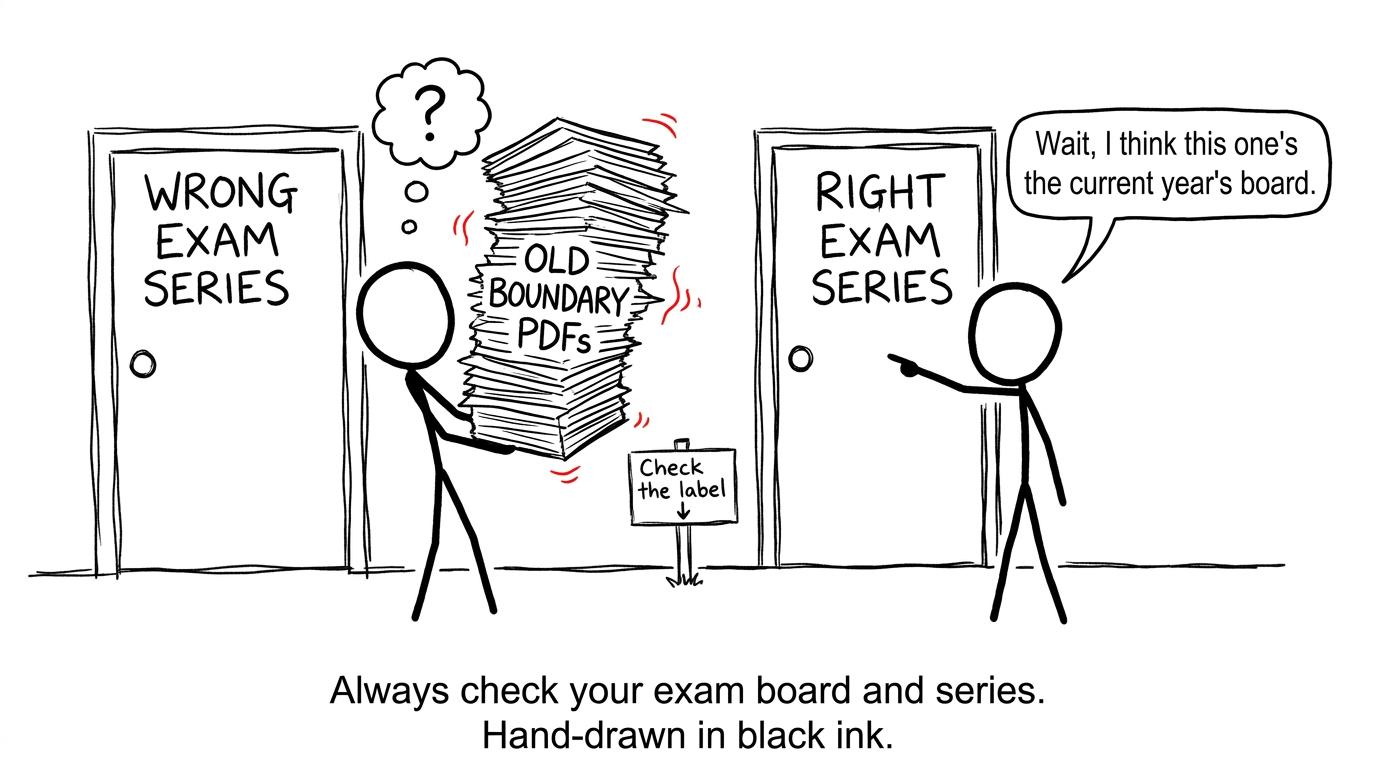 Students choose between the correct and incorrect exam-series documents
How to check an ICT grade boundary correctly
Start with the result document, entry confirmation or front cover of the paper. Record the exact board, specification, unit code and series. A single letter or digit can distinguish a different component.
Then follow this order:
- Find the exam board's official boundary archive.
- Select the correct qualification level and examination series.
- Search for the precise subject and specification code.
- Identify whether the table reports raw or UMS boundaries.
- Check whether you need a component boundary or the overall qualification boundary.
- Confirm how controlled assessment, coursework or non-exam assessment is included.
For a linear qualification, an individual paper boundary may be described as notional. It can help explain performance, but the official grade is based on the overall subject mark. In a unitised qualification, the unit result may instead be converted and combined according to the specification.
The safest habit is the same one used when comparing Edexcel and OCR GCSE Maths boundaries: match the board, tier or route, maximum mark and series before drawing a conclusion.
What this means for your GCSE maths revision
ICT boundaries may be your immediate question, but the underlying lesson is especially useful for GCSE maths students. A boundary tells you how a completed assessment was graded. It does not teach you the topics responsible for your lost marks.
Use historical boundaries to set a broad target, then leave a margin above it. If an old boundary suggests that your target grade began at a particular total, aiming for that exact mark makes every small slip dangerous. A safer plan is to improve the methods and exam habits that produce repeatable marks.
Start in the GCSE Maths revision hub, choosing your board and foundation or higher tier. Use revision lessons and practice questions to repair specific gaps. Then introduce timed papers, mark schemes and video solutions so that your score becomes reliable under exam conditions.
The advice in when to start GCSE past papers is useful here: papers are most valuable when there is still time to respond to what they reveal. A low mark is not merely a prediction. It is a map of what to revise next.
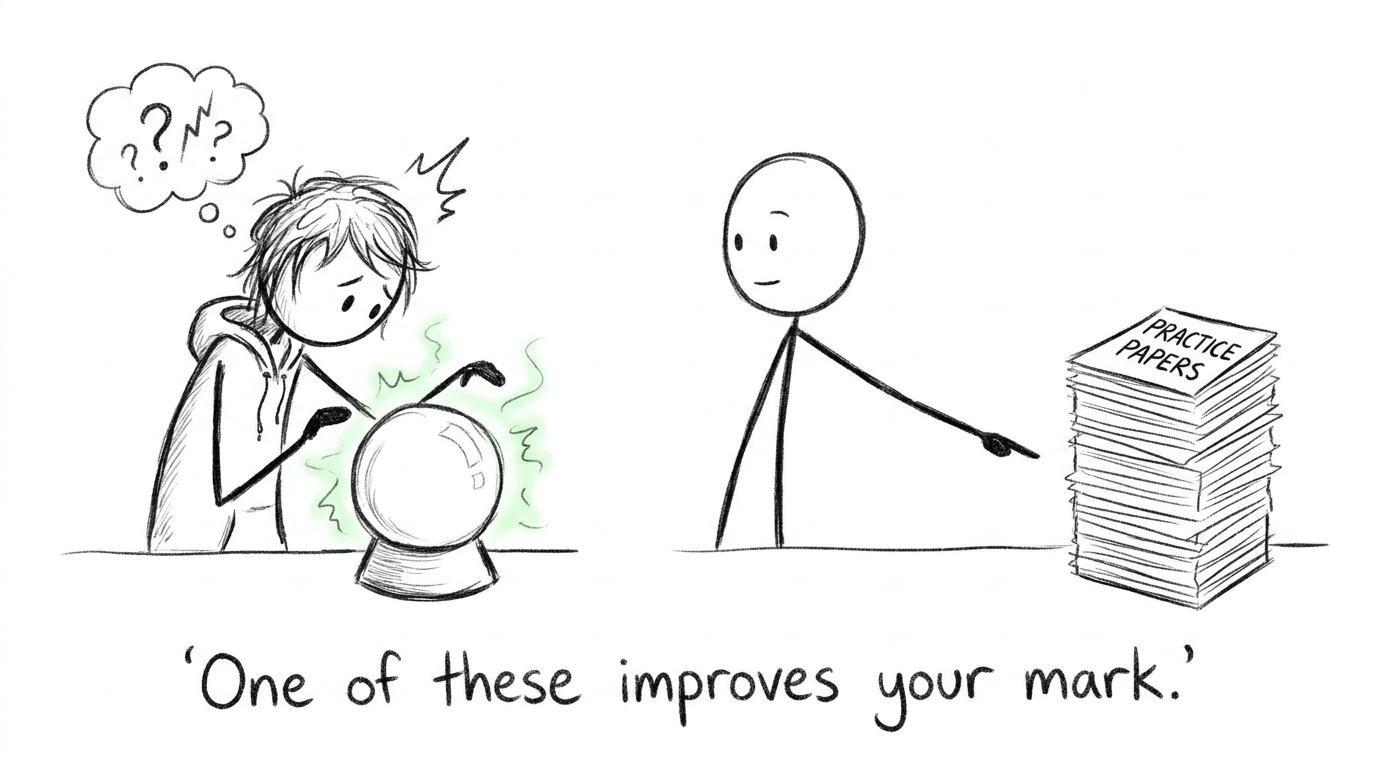 A crystal ball competes with a useful stack of practice papers
Common mistakes when reading GCSE ICT boundaries
Treating every mark as a percentage grade
A raw percentage is only a calculation. It does not carry a universal grade across subjects, boards or years.
Using the wrong examination series
Boundaries can change between summer and other available series. The year and series must match the assessment actually taken.
Confusing ICT with Computer Science
They are distinct subjects with different specifications, content and assessment structures. In England, historical GCSE ICT boundaries should not be used for a current GCSE Computer Science paper.
Mixing raw marks and UMS marks
A raw boundary and a UMS boundary may sit in the same document, but they are not interchangeable. Read the table headings carefully.
Adding unit marks without checking the rules
Different units may have different maximum marks, weightings or conversion arrangements. Follow the specification rather than assuming that every raw mark contributes equally.
Revising to the boundary
Past boundaries move. More importantly, they cannot reveal which questions will appear. MathsGenie's guide to revising GCSE maths efficiently offers a stronger cycle: diagnose, learn, practise, mark and retest.
Turn boundary knowledge into better preparation
A grade boundary is a line drawn after the evidence is available. It is not a judgement made from a simple percentage rule, and it is not something you need to predict perfectly before the exam.
For an ICT result, check the precise qualification, board, series, unit structure and mark scale. For GCSE maths revision, use the same attention to detail but focus your energy where it can change the outcome: earning more secure marks.
Visit MathsGenie's GCSE Maths revision resources to combine free revision lessons, practice questions and mini tests with past papers, predicted papers, mark schemes and video solutions. Boundaries may move. Better methods move your mark, and that is the part of the process you can control.