

GCSE Trigonometry: How to Get Better Fast
GCSE trigonometry made simple: master SOHCAHTOA, exact values, and triangle problems with worked examples, mistakes to avoid and Maths Genie links.

Trigonometry has a particular way of making sensible students feel silly. One minute you’re fine with angles in triangles, the next you’re staring at a diagram thinking, “Which side is opposite again?” If you’re revising for GCSE, that wobble can feel expensive: trig questions are often low-hanging marks, but only if your method is calm and repeatable. The good news is that getting better at trigonometry isn’t about being “a trig person”. It’s about building a tiny routine you can trust under pressure, then practising it until your brain stops negotiating.
 A GCSE student meets SOHCAHTOA calmness
A quick checklist to get better at trigonometry (GCSE and A Level)
Use this as your five-minute warm-up before you do any trig practice:
- Label the triangle: right angle, hypotenuse, opposite, adjacent.
- Decide which trig ratio you need: sin\sinsin, cos\coscos, or tan\tantan.
- Write the ratio as a fraction with your labelled sides.
- Rearrange carefully (one line at a time).
- Use the calculator in degrees for GCSE (check the mode).
- Round appropriately: often 3 s.f. or 1 d.p. depending on the question.
For GCSE Higher, add:
- Know the exact values for 0∘,30∘,45∘,60∘,90∘0^\circ, 30^\circ, 45^\circ, 60^\circ, 90^\circ0∘,30∘,45∘,60∘,90∘.
- Be fluent moving between Pythagoras and trig.
For A Level, add:
- Sine/cosine rules and area of a triangle.
- Solving trig equations and using identities.
You can practise these in Maths Genie’s SOHCAHTOA revision and exam questions: SOHCAHTOA (Trigonometry): Grade 5 and the matching booklet-style questions: SOHCAHTOA Exam Booklet.
Why trigonometry feels hard (and why it’s usually fixable)
Trigonometry is less “one topic” and more a junction. It connects geometry, algebra, calculator skills, rounding, and reading diagrams. In GCSE papers (Edexcel, AQA, OCR, Eduqas), trig often appears as a short question early on, then returns later hidden inside a longer problem (bearings, 3D shapes, compound shapes). That’s why it can feel like it comes “out of nowhere”.
But here’s the upside: because trig is method-heavy, it’s one of the easiest areas to improve quickly. If you can standardise your thinking, you can standardise your marks.
GCSE trigonometry basics: the triangle labelling habit
Before you touch sin\sinsin, cos\coscos, or tan\tantan, you must label the sides relative to the angle you are using.
- Hypotenuse: the side opposite the right angle (always the longest side in the right-angled triangle).
- Opposite: the side opposite the angle you’re working with.
- Adjacent: the side next to the angle you’re working with (but not the hypotenuse).
If that sounds basic, good. GCSE trig rewards basics done correctly.
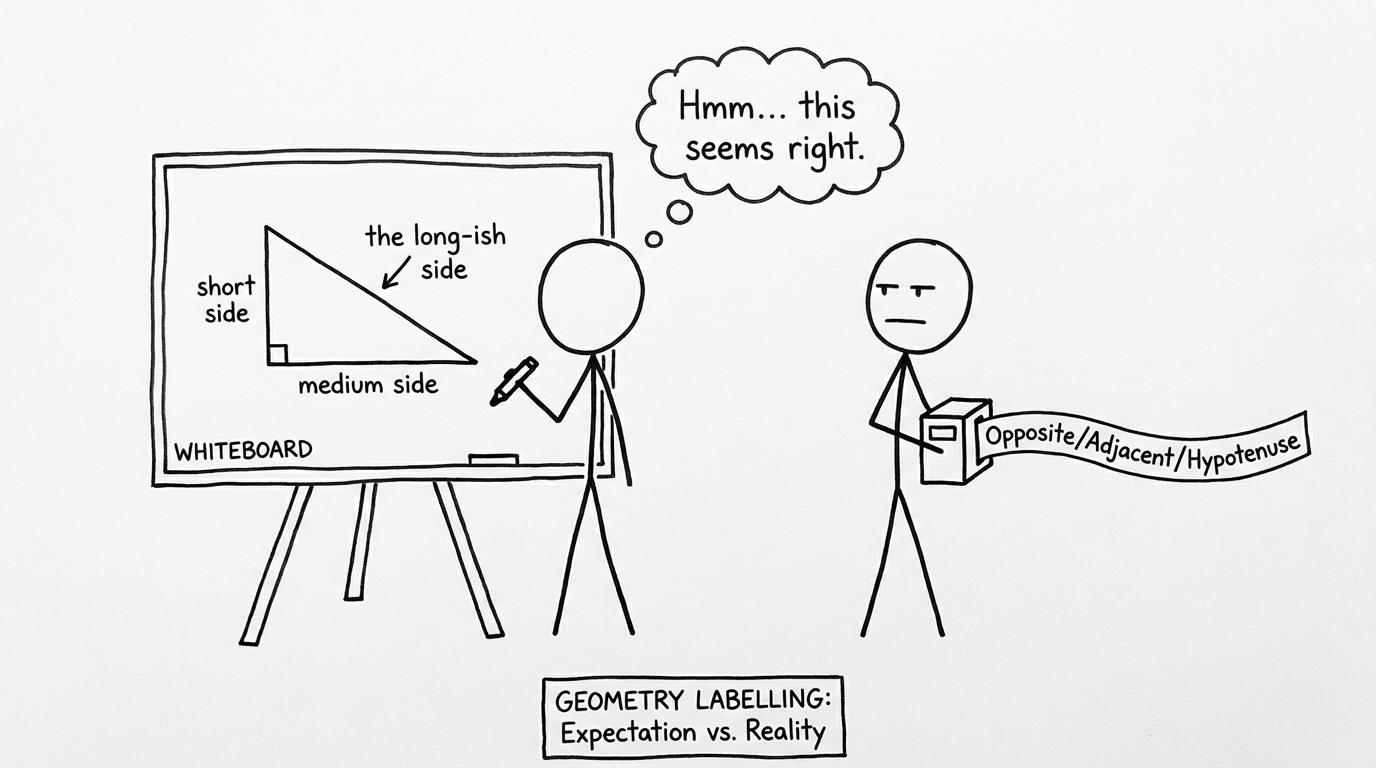 Label the sides properly, not “long-ish side”
The SOHCAHTOA anchor
sin(θ)=oppositehypotenuse,cos(θ)=adjacenthypotenuse,tan(θ)=oppositeadjacent\sin(\theta)=\frac{\text{opposite}}{\text{hypotenuse}},\qquad \cos(\theta)=\frac{\text{adjacent}}{\text{hypotenuse}},\qquad \tan(\theta)=\frac{\text{opposite}}{\text{adjacent}}sin(θ)=hypotenuseopposite,cos(θ)=hypotenuseadjacent,tan(θ)=adjacentoppositeTo consolidate, use the focused Maths Genie practice: SOHCAHTOA GCSE exam questions (PDF).
Worked example: finding a missing side (GCSE)
Question: In a right-angled triangle, the angle is 35∘35^\circ35∘ and the hypotenuse is 20 cm20\text{ cm}20 cm. Find the length of the opposite side xxx.
Step 1: choose the ratio
We have opposite and hypotenuse, so use sine:
sin(35∘)=x20\sin(35^\circ)=\frac{x}{20}sin(35∘)=20xStep 2: rearrange
x=20sin(35∘)x=20\sin(35^\circ)x=20sin(35∘)Step 3: calculate
x≈20×0.5736=11.472…x\approx 20\times 0.5736=11.472\ldotsx≈20×0.5736=11.472…So, to 3 s.f.3\text{ s.f.}3 s.f.,
x≈11.5 cmx\approx 11.5\text{ cm}x≈11.5 cmThis style is extremely common in GCSE, and it’s exactly what the Maths Genie topic and booklet questions are designed to drill.
Worked example: finding an angle (GCSE)
Question: In a right-angled triangle, the opposite side is 9 cm9\text{ cm}9 cm and the adjacent side is 16 cm16\text{ cm}16 cm. Find the angle θ\thetaθ.
Step 1: choose the ratio
Opposite and adjacent suggests tangent:
tan(θ)=916\tan(\theta)=\frac{9}{16}tan(θ)=169Step 2: inverse trig
θ=tan−1(916)\theta=\tan^{-1}\left(\frac{9}{16}\right)θ=tan−1(169)Step 3: calculate
θ≈tan−1(0.5625)≈29.36∘\theta\approx \tan^{-1}(0.5625)\approx 29.36^\circθ≈tan−1(0.5625)≈29.36∘So, to 1 d.p.1\text{ d.p.}1 d.p.,
θ≈29.4∘\theta\approx 29.4^\circθ≈29.4∘GCSE mark schemes love seeing the ratio written first. It proves you understood the triangle, not just the calculator.
Exact trig values: the GCSE Higher advantage
Exact values can feel like pure memorisation. But you can reduce the memory load by remembering two triangles:
- The 45∘45^\circ45∘-45∘45^\circ45∘-90∘90^\circ90∘ triangle.
- The 30∘30^\circ30∘-60∘60^\circ60∘-90∘90^\circ90∘ triangle.
From these, most “exact value” questions follow.
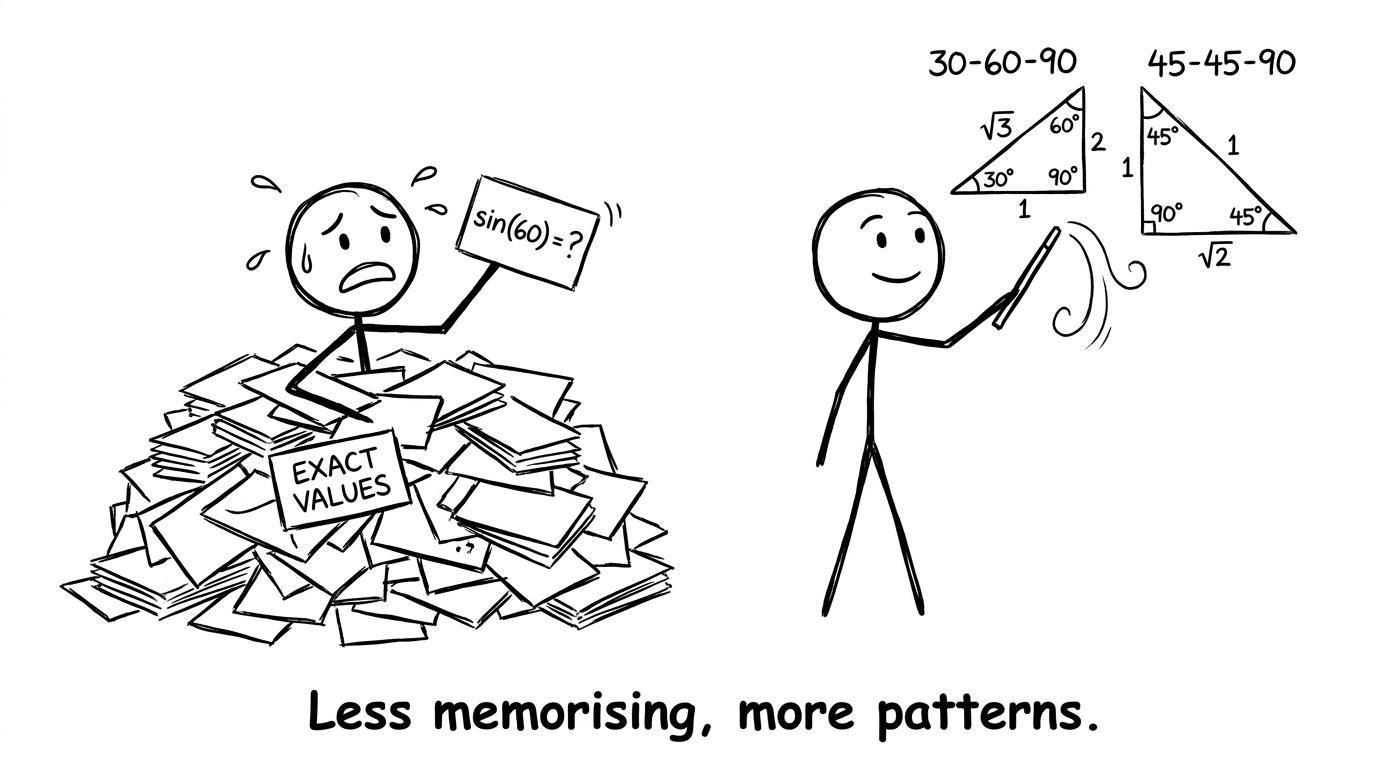 Less memorising, more patterns
For practice aligned to GCSE expectations, use: Exact Trig Values exam questions (PDF).
Key exact values to know (GCSE)
sin(30∘)=12,cos(30∘)=32,tan(30∘)=13\sin(30^\circ)=\frac{1}{2},\quad \cos(30^\circ)=\frac{\sqrt{3}}{2},\quad \tan(30^\circ)=\frac{1}{\sqrt{3}}sin(30∘)=21,cos(30∘)=23,tan(30∘)=31 sin(45∘)=22,cos(45∘)=22,tan(45∘)=1\sin(45^\circ)=\frac{\sqrt{2}}{2},\quad \cos(45^\circ)=\frac{\sqrt{2}}{2},\quad \tan(45^\circ)=1sin(45∘)=22,cos(45∘)=22,tan(45∘)=1 sin(60∘)=32,cos(60∘)=12,tan(60∘)=3\sin(60^\circ)=\frac{\sqrt{3}}{2},\quad \cos(60^\circ)=\frac{1}{2},\quad \tan(60^\circ)=\sqrt{3}sin(60∘)=23,cos(60∘)=21,tan(60∘)=3Also:
sin(0∘)=0, cos(0∘)=1, tan(0∘)=0\sin(0^\circ)=0,\ \cos(0^\circ)=1,\ \tan(0^\circ)=0sin(0∘)=0, cos(0∘)=1, tan(0∘)=0 sin(90∘)=1, cos(90∘)=0\sin(90^\circ)=1,\ \cos(90^\circ)=0sin(90∘)=1, cos(90∘)=0Mixing Pythagoras and trigonometry (where GCSE marks hide)
A lot of “harder” GCSE trig is just two steps: Pythagoras to find a missing side, then trig to find an angle (or vice versa). If you only practise single-step SOHCAHTOA, this is where you start bleeding marks.
Maths Genie has targeted questions for this exact blend: 3D Pythagoras and Trigonometry exam questions (PDF).
Worked example: two-step trig with Pythagoras (GCSE Higher)
Question: A right-angled triangle has hypotenuse 13 cm13\text{ cm}13 cm and one other side 5 cm5\text{ cm}5 cm. Find the angle θ\thetaθ opposite the 5 cm5\text{ cm}5 cm side.
Step 1: find the missing side using Pythagoras
Let the other non-hypotenuse side be bbb.
52+b2=1325^2+b^2=13^252+b2=132 25+b2=16925+b^2=16925+b2=169 b2=144⇒b=12b^2=144 \Rightarrow b=12b2=144⇒b=12Step 2: choose trig ratio
Opposite is 555, adjacent is 121212, so:
tan(θ)=512\tan(\theta)=\frac{5}{12}tan(θ)=125 θ=tan−1(512)≈22.62∘\theta=\tan^{-1}\left(\frac{5}{12}\right)\approx 22.62^\circθ=tan−1(125)≈22.62∘To 1 d.p.1\text{ d.p.}1 d.p.:
θ≈22.6∘\theta\approx 22.6^\circθ≈22.6∘That’s a very “GCSE Higher” feeling question, but the method is still just calm labelling plus two clean steps.
A Level trigonometry: what changes (and what doesn’t)
At A Level, the triangles don’t disappear, but the questions become more flexible: you’ll use trig ratios inside algebra, and you’ll meet trigonometric ratios beyond right-angled triangles.
Two particularly common A Level directions are:
- Using trigonometric ratios in more involved contexts: A Level Year 1 Trigonometric Ratios questions
- Using sine rule, cosine rule, and triangle area formulae: Sine and Cosine Rules & Area of Triangles (PDF)
Worked example: cosine rule (A Level and also GCSE extension)
Question: In triangle ABCABCABC, AB=15 cmAB=15\text{ cm}AB=15 cm, AC=12 cmAC=12\text{ cm}AC=12 cm, and ∠A=60∘\angle A=60^\circ∠A=60∘. Find BCBCBC.
Cosine rule (side opposite ∠A\angle A∠A is BCBCBC):
BC2=AB2+AC2−2(AB)(AC)cos(A)BC^2=AB^2+AC^2-2(AB)(AC)\cos(A)BC2=AB2+AC2−2(AB)(AC)cos(A) BC2=152+122−2⋅15⋅12⋅cos(60∘)BC^2=15^2+12^2-2\cdot 15\cdot 12\cdot \cos(60^\circ)BC2=152+122−2⋅15⋅12⋅cos(60∘)Since cos(60∘)=12\cos(60^\circ)=\frac{1}{2}cos(60∘)=21:
BC2=225+144−360⋅12=369−180=189BC^2=225+144-360\cdot \frac{1}{2}=369-180=189BC2=225+144−360⋅21=369−180=189 BC=189=321≈13.747…BC=\sqrt{189}=3\sqrt{21}\approx 13.747\ldotsBC=189=321≈13.747…So BC≈13.7 cmBC\approx 13.7\text{ cm}BC≈13.7 cm to 3 s.f.3\text{ s.f.}3 s.f.
Common GCSE trigonometry mistakes (and how to stop making them)
Mixing up opposite and adjacent
Opposite and adjacent swap depending on the angle you’re using. The triangle hasn’t changed, but your viewpoint has. Fix: put a small dot at the angle and label from that dot every time.
Using the wrong trig ratio
Students often see “angle and side” and press random buttons. Fix: say the sides out loud in your head: “I have opposite and hypotenuse, so sine.” Then write the fraction before any rearranging.
Calculator in radians
GCSE trig questions assume degrees. If your answer is nonsense, check the mode. Fix: make “DEG” part of your exam start-up ritual.
Rounding too early
If you round sin(35∘)\sin(35^\circ)sin(35∘) too early, your final answer drifts. Fix: keep full calculator precision, round at the end, and follow the question’s instruction.
Forgetting units and context
Lengths need units, angles need the degree symbol. In multi-step problems, the final line often needs a sentence. Fix: treat the last line as the “mark-buying line”.
How to practise trigonometry effectively for GCSE (without burning out)
A good GCSE revision plan is rarely heroic. It’s consistent.
- Start with one focused topic at a time: SOHCAHTOA (Trigonometry) then Exact Trig Values questions (PDF).
- Move quickly to exam-style sets rather than endless notes: SOHCAHTOA exam questions (PDF).
- Then test the skill in real context using papers: GCSE Predicted Papers (Edexcel) and broader revision lists via GCSE revision resources.
When trig appears inside mixed topics, use the mark scheme to learn what examiners reward: clear labelling, correct ratio, sensible rounding.
 A triangle just wants you to label it properly
Closing: your trigonometry improvement plan (built for GCSE)
Trigonometry gets better the moment you stop treating it like a memory test and start treating it like a routine. Label. Choose. Write the ratio. Rearrange. Calculate. Round. Repeat. That’s how GCSE marks are quietly collected.
If you want a simple path, use Maths Genie as your structure: start with the SOHCAHTOA (Trigonometry) revision topic, practise using the SOHCAHTOA exam questions (PDF), add confidence with Exact Trig Values questions (PDF), then pressure-test yourself using GCSE Predicted Papers and wider GCSE revision resources. Keep the mark schemes close, use video solutions when you get stuck, and let your revision planner do the heavy lifting of consistency.
Do that, and trigonometry stops being the topic that “turns up”. It becomes the topic you’re quietly hoping turns up, because it’s yours.










