GCSE History 4 to 7: How to Raise Your Grade
GCSE History 4 to 7 guidance: strengthen recall, analyse evidence, answer each command word and use past papers to turn knowledge into marks.

A grade 4 answer often shows that you know the story. A grade 7 answer uses carefully selected knowledge to answer the precise question being asked.
That is the central idea behind moving from GCSE History 4 to 7. You do not need to memorise every sentence in your textbook. You need secure factual knowledge, accurate evidence, developed explanations and a reliable method for sources, interpretations and judgements. Then you must reproduce those skills under timed conditions.
The exact papers and assessment language vary across Edexcel, AQA, OCR and Eduqas specifications, so always check your own exam board's current specification and mark schemes. But the improvement process is remarkably consistent: diagnose where marks disappear, practise one skill at a time and use feedback to change the next answer.
Your grade 4 to grade 7 checklist
A student working towards grade 7 should aim to:
- recall accurate dates, people, events and consequences without relying on notes;
- select evidence that directly addresses the question;
- explain links rather than list facts;
- analyse provenance and content together when evaluating sources;
- compare historical interpretations precisely;
- reach supported judgements using clear criteria;
- recognise the demands of different command words;
- complete whole papers within the available time;
- review answers against official mark schemes and examiner guidance.
Grade boundaries are set for particular exam series and can change with the difficulty of the papers. There is therefore no permanent raw mark that always guarantees a grade 7. Focus on producing stronger responses consistently rather than chasing a supposedly universal percentage.
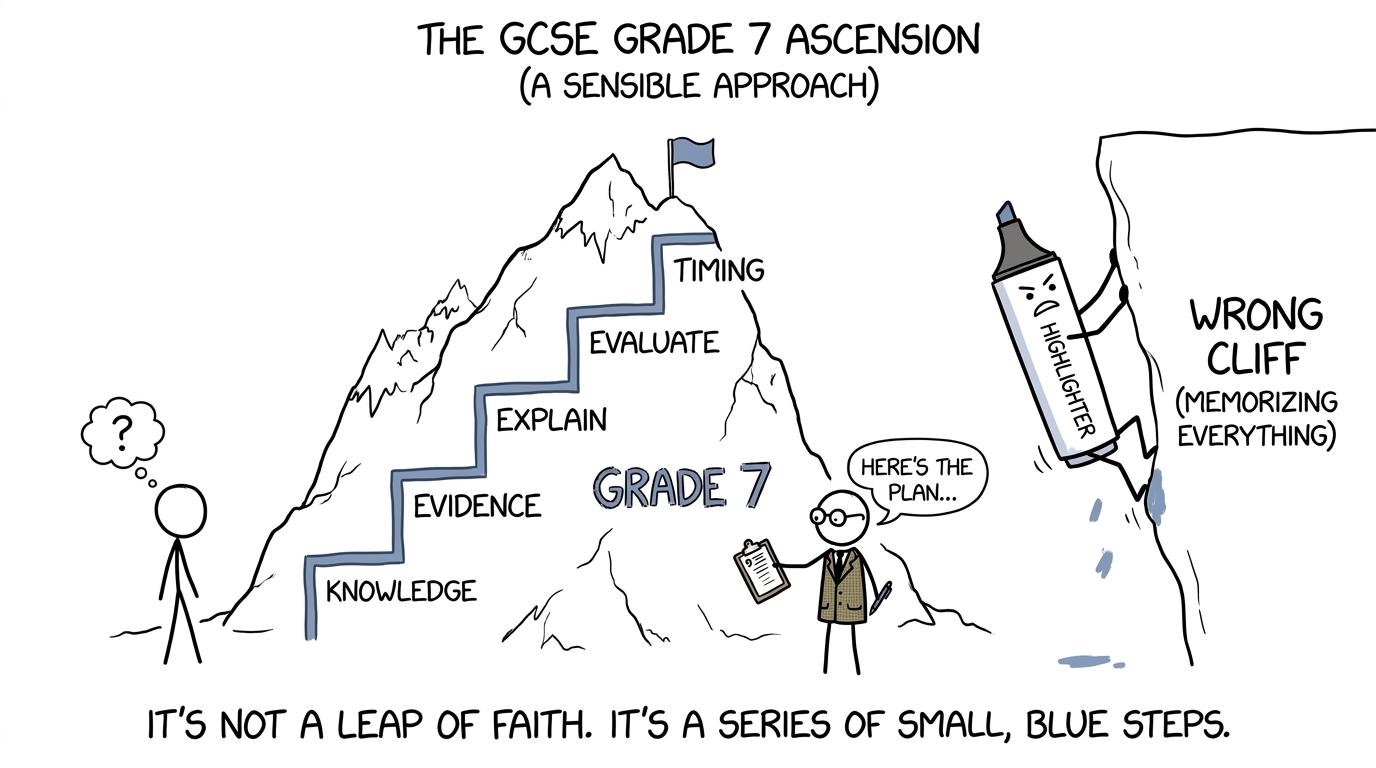 A student discovers that the climb to grade 7 is a staircase of manageable skills
What separates a grade 4 from a grade 7 in GCSE History?
The difference is not simply the number of facts remembered. Knowledge matters, but examiners reward what you do with it.
| Developing around grade 4 | Moving towards grade 7 |
|---|---|
| Describes events in sequence | Selects events because they support an argument |
| Includes broadly relevant knowledge | Uses precise, accurate and question-specific evidence |
| States that something was important | Explains how and why it produced an outcome |
| Treats a source as useful or useless | Evaluates content and provenance in historical context |
| Describes two interpretations separately | Identifies and explains a meaningful difference |
| Gives an opinion at the end | Builds a judgement from stated criteria and evidence |
| Uses one structure for every question | Adapts the response to the command word and mark tariff |
A grade 4 response may say that one factor caused an event and then provide some information about it. A stronger response makes the causal chain explicit: the factor changed a particular condition, which affected the actions or choices of relevant people, contributing to the stated outcome. That final connection is where explanation replaces description.
Build precise knowledge that you can retrieve
Rereading feels productive because the page becomes familiar. Unfortunately, recognition is weaker than recall. In an examination, you must retrieve evidence without the page in front of you.
Organise each History topic around a limited set of useful categories:
- chronology and turning points;
- causes and consequences;
- change and continuity;
- similarity and difference;
- individuals, groups and institutions;
- precise supporting evidence;
- relevant historical context for sources and interpretations.
Create short retrieval questions, close your notes and answer from memory. Then check immediately. Dates are useful when they anchor chronology or sharpen an argument, but an unexplained date earns little by itself. Pair each fact with its significance: what changed, why it mattered and which type of question it could support.
A weekly topic grid can expose weak areas quickly. Mark each subtopic as secure, partly secure or insecure, then spend most of your time on the gaps. This is more effective than repeatedly revising the topic you already enjoy.
Maths revision has the same memory problem. The MathsGenie GCSE revision resources divide a large course into manageable topics, illustrating a useful principle for History too: break the specification down, retrieve one section and revisit it before it fades.
Turn description into explanation
“Explain” questions are often where a student can make the fastest improvement. The weak pattern is a list of relevant statements. The stronger pattern is a connected argument.
Each paragraph should perform four jobs:
- make a claim that answers the question;
- provide precise historical evidence;
- explain the mechanism linking the evidence to the outcome;
- connect the reasoning back to the wording of the question.
The mechanism is crucial. If the question concerns importance, explain what became possible or different because of the factor. If it concerns causation, show how one development contributed to the result. If it concerns change, identify the position before and after, then explain the extent or pace of the shift.
Do not force every paragraph into a memorised acronym. Structures are useful scaffolds, but examiners reward relevant historical reasoning, not the labels in your plan. Ask a simpler question after every piece of evidence: “So what did this cause, prevent or change?”
Answer the command word, not the topic
Students sometimes see a familiar topic and write everything they know. The result can be accurate but poorly rewarded because it does not satisfy the task.
Before writing, identify:
- the command word;
- the time period;
- the named factor or issue;
- whether you must use supplied material;
- whether the question requires a judgement;
- the number of marks and sensible time allocation.
“Describe”, “explain”, “compare”, “how useful”, “how convincing” and “how far do you agree” are different tasks. Their precise treatment depends on the exam board and paper, so learn the question types from your specification rather than relying on generic online templates.
Planning need not become a second essay. A few claims, supporting details and a tentative judgement are enough. The purpose is to prevent repetition and keep each paragraph attached to the question.
Improve source and interpretation analysis
Sources and interpretations are not interchangeable. A source is surviving material from the period or connected to it; an interpretation is a later representation or explanation of the past. Your paper may assess them differently.
Evaluate sources in context
Avoid declaring that a source is biased and therefore useless. A source can be partial, persuasive or limited while still being valuable evidence about attitudes, priorities or methods.
Consider its content alongside its provenance:
- Who produced it?
- When and in what circumstances?
- Who was the intended audience?
- What was its purpose?
- What does your contextual knowledge confirm, challenge or qualify?
- What can the source genuinely help a historian investigate?
The goal is not to prosecute the source for being imperfect. It is to define what it can and cannot reveal.
Compare interpretations directly
When comparing interpretations, identify the precise difference in their claims. Then use details from each interpretation and relevant contextual knowledge where the question requires it. Explaining why interpretations differ may involve their evidence, emphasis, purpose or approach, but you should not guess about an author's motives without support.
Build judgements throughout the answer
A judgement is not a final sentence beginning with “Overall”. It is a reasoned decision supported by the body of the response.
Choose criteria suited to the question. A factor might be judged by:
- how directly it influenced events;
- how widely its effects were felt;
- how long its impact lasted;
- whether it enabled other factors;
- whether events would probably have developed differently without it.
Use the same criteria when comparing factors. This makes the conclusion analytical rather than personal. A balanced answer does not have to claim that every factor was equally important. It should recognise complexity while still deciding which explanation is most convincing.
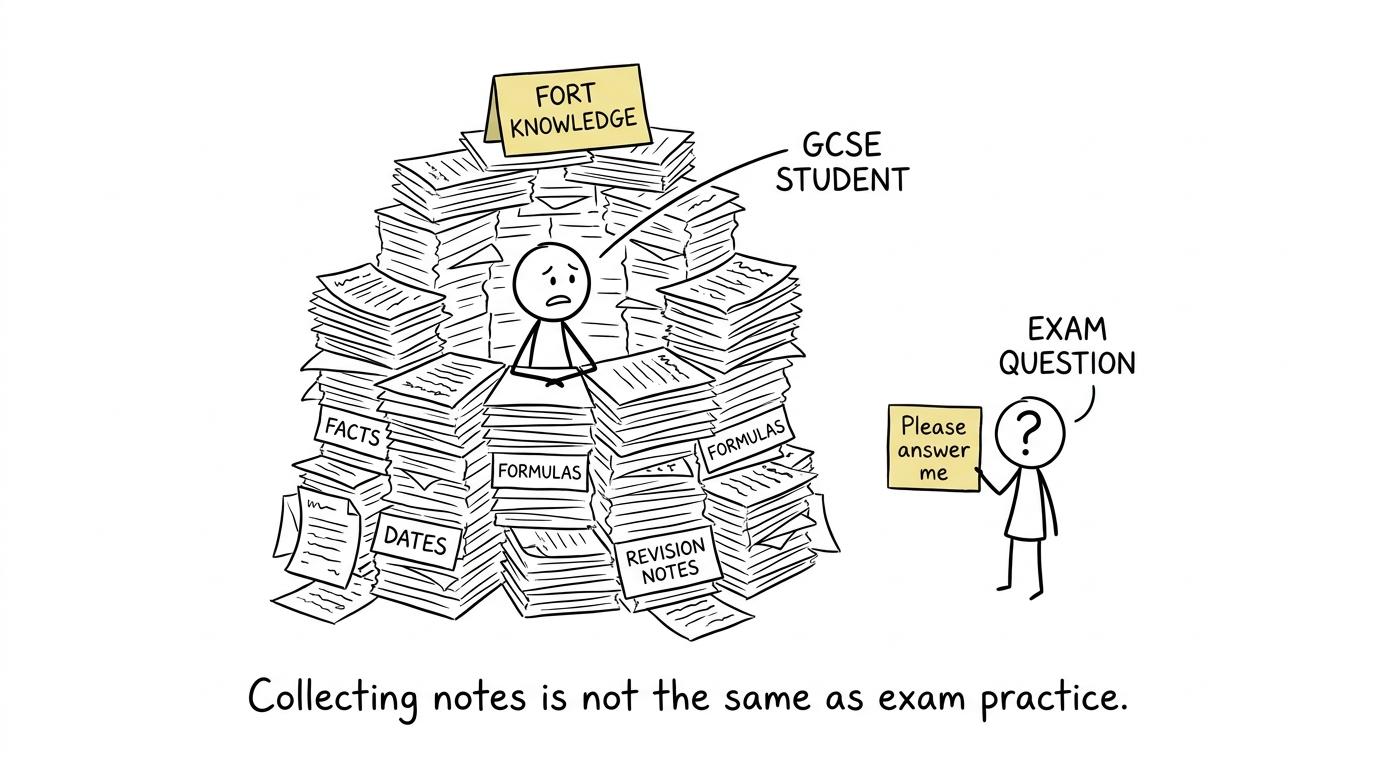 A fortress of notes fails to answer the small exam question waiting outside
Practise in a way that changes your answers
Completing more questions helps only when the feedback changes what you do next. Use a short improvement cycle:
- answer one question without notes;
- mark it using the official mark scheme and any examiner guidance;
- identify the main reason marks were lost;
- rewrite only the weakest section;
- attempt a similar question several days later;
- record whether the weakness returned.
Keep an error log with categories such as imprecise knowledge, description instead of explanation, weak source evaluation, unsupported judgement and poor timing. The pattern matters more than one disappointing mark.
This mirrors the method behind MathsGenie practice questions, where revision is followed by a test of application. The GCSE maths past papers collection is also a useful model for using full papers only after topic-level weaknesses have been addressed. If you also take GCSE Maths, MathsGenie predicted papers can provide further practice in unfamiliar combinations of skills. Predicted papers are practice resources, not forecasts of exact examination questions.
Make timing part of your revision
Knowing what to write is not enough if the final question remains unfinished. Begin by timing individual questions. Once your structure becomes reliable, combine several questions and eventually complete a full paper under your board's published conditions.
Use the marks and official guidance for your paper to make a time plan. Leave a small checking allowance, but do not sacrifice a substantial final answer to perfect an earlier paragraph. If you are stuck, write a brief plan, move on and return later.
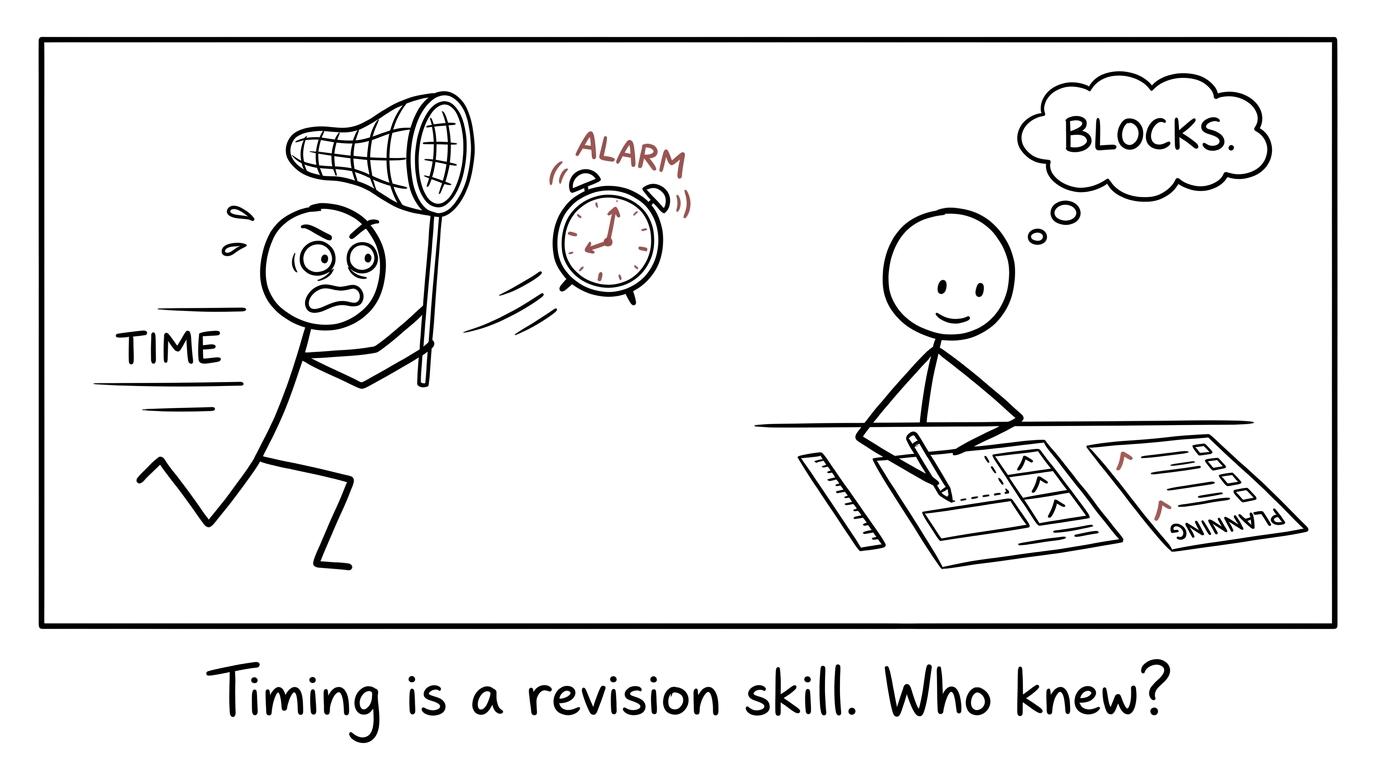 One student chases the clock while another treats timing as a practised skill
Common mistakes that keep students near grade 4
Revising content without answering questions
Knowledge is necessary, but the examination assesses its use. Include question practice every week rather than saving it until the course feels “finished”.
Writing everything remembered
More information is not automatically more relevant. Select the evidence that advances your answer and explain it fully.
Using vague evidence
Phrases such as “many people were unhappy” rarely carry an argument far. Replace vague claims with accurate groups, policies, developments, dates or consequences from your specification.
Treating provenance as a checklist
Comments about author, date and purpose must affect your evaluation. Explain why that feature strengthens or limits the source for the specific enquiry.
Leaving judgement until the conclusion
Signal comparisons throughout. If one factor was more direct, widespread or lasting, explain that while discussing it.
Ignoring the exact paper format
Question styles differ between boards and sometimes between components. Practise with materials for your specification and use current official instructions.
Your next step from grade 4 to grade 7
The jump is not one dramatic leap. It is a collection of smaller changes: retrieving rather than rereading, explaining rather than listing, evaluating rather than labelling, and reviewing mistakes rather than merely counting marks.
Choose one recent History answer today. Find the weakest paragraph and diagnose why it lost marks. Then rewrite it with more precise evidence and a clearer connection to the question. That small act is what meaningful grade improvement looks like.
For your maths exams, make the same process systematic with MathsGenie's free revision lessons, videos and practice questions. Use past papers and mark schemes to diagnose gaps, add predicted papers when appropriate, and return to weaker topics until the method holds under pressure. Whether the subject is History or Maths, progress begins when revision stops being something you have covered and becomes something you can successfully do.