GCSE German Predicted Grade Process Explained
GCSE German predicted grade process explained: learn how teachers weigh mocks, speaking, classwork and progress, and what you can do before exams.
A predicted grade can feel strangely permanent. One number appears on a report, and suddenly it seems to describe everything you know, everything you have forgotten and everything you might achieve.
But the GCSE German predicted grade process is not supposed to be a verdict. Teachers usually arrive at a grade by combining evidence from mock exams, topic tests, speaking assessments, classwork and your recent progress. They then compare that evidence with the demands of your exam board and, often, discuss judgements within the languages department.
There is no single national formula used by every school. Your school's assessment policy matters, so your teacher is the best person to explain exactly what your prediction represents.
The predicted grade checklist
A teacher will commonly consider:
- performance in formal mock examinations;
- evidence across listening, speaking, reading and writing;
- marks from recent assessments and common departmental tests;
- how consistently you perform under controlled conditions;
- whether your work matches the relevant GCSE assessment criteria;
- your rate of progress and the time remaining before the exams;
- your foundation or higher tier entry;
- moderation or standardisation with other teachers.
The important idea is that good predictions use a body of evidence. One disappointing vocabulary test should not outweigh months of stronger work, although a major mock will usually carry more influence than an ordinary homework task.
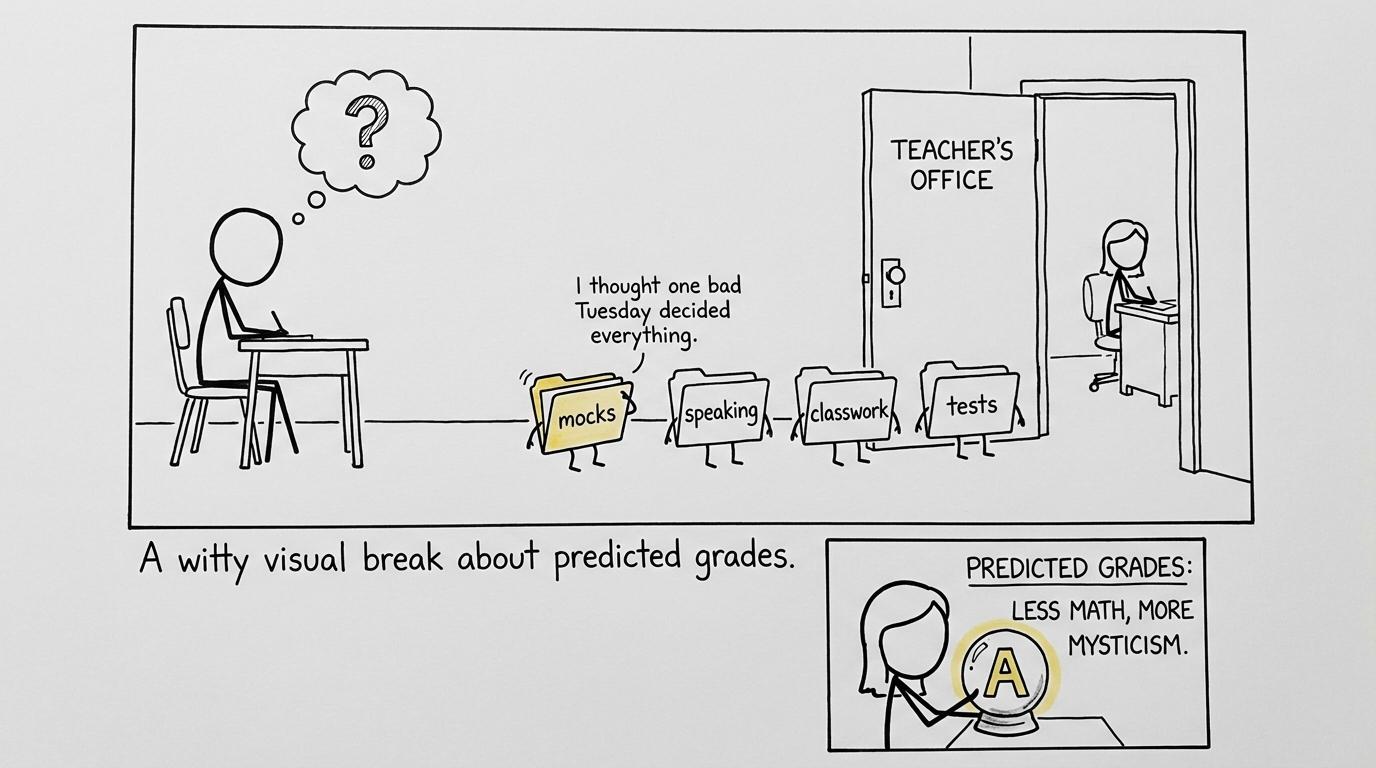 Student watches evidence folders queue outside a teacher's office
What is a GCSE German predicted grade?
A predicted grade is a teacher's informed estimate of the grade you are likely to achieve by the end of the course. It is not awarded by AQA, Pearson Edexcel, OCR or Eduqas, and it is not your final GCSE result.
Schools use predictions for different purposes. A grade on a progress report may describe your most likely outcome if your present pattern continues. A prediction supplied for a sixth-form application may be based on what teachers reasonably expect you to achieve after the remaining teaching and revision. Some schools also record separate current, target and predicted grades.
That distinction matters. A current grade asks, "What standard does the evidence show now?" A predicted grade asks, "Where is this student likely to finish?" A target may be deliberately more ambitious.
If the label is unclear, ask what it means. Two numbers that look identical can have been designed to answer different questions.
How teachers decide a GCSE German predicted grade
Mock examinations usually provide the strongest evidence
Mocks are valuable because they reproduce several features of the real examination: limited time, unfamiliar questions, independent work and exam-board-style marking. A full mock can therefore reveal more than a short classroom task.
Teachers may use official specimen materials, secure assessments or papers constructed from suitable questions. They mark the work using the relevant criteria and compare the result with available grade information. Previous grade boundaries can provide context, but they cannot reveal a future boundary exactly. Ofqual explains that final boundaries are set after students have taken the examinations because the difficulty of the completed papers and evidence of national performance must be considered.
This is why a teacher should not treat an old boundary as an eternal conversion table. A mock mark is useful evidence, not a guaranteed final grade.
The same principle applies in maths. Completing GCSE maths past papers under timed conditions produces clearer evidence than simply reading solutions.
All four language skills matter
GCSE German assesses listening, speaking, reading and writing. For the reformed AQA and Pearson Edexcel specifications first awarded in summer 202620262026, each of these four components contributes 25%25\%25% of the qualification. Students enter all components at the same tier.
A sensible prediction therefore looks beyond the easiest or most memorable skill. Strong writing cannot completely hide weak listening, while fluent speaking does not remove the need to understand written German accurately.
Teachers may consider evidence such as:
- listening tests, including comprehension and dictation where required;
- prepared and unprepared speaking tasks;
- reading comprehension and translation;
- extended and shorter writing assessments;
- accuracy in vocabulary, grammar and pronunciation;
- the ability to communicate meaning when a question is unfamiliar.
The exact task formats depend on the specification and examination series. Students should check the current materials for their own board rather than assuming that an older sibling's GCSE worked in precisely the same way.
Recent performance and consistency add context
Prediction is partly about direction. If your early assessments were weak but your recent mock, speaking work and topic tests are consistently stronger, a teacher may judge that the newer evidence better represents your likely outcome.
The reverse can also be true. One unusually high test may not justify a higher prediction if several later assessments do not support it. Teachers are looking for evidence that can be repeated.
This does not mean every mark is averaged mechanically. A controlled assessment completed independently may deserve more weight than homework completed with notes, online tools or help. Missing assessments can also leave a teacher with less evidence, although attendance or behaviour should not be mistaken for a direct measure of German ability.
Teachers compare work with assessment criteria
A raw total only tells part of the story. Teachers also examine what produced it.
In speaking and writing, for instance, they may look at communication, accuracy, range, pronunciation, fluency and the successful use of required vocabulary and grammar, according to the board's current mark scheme. In reading and listening, they consider whether errors come from vocabulary gaps, misunderstanding the question or difficulty processing language under time pressure.
That diagnostic view helps a teacher decide whether an assessment reflects a stable standard or a temporary weakness that can realistically improve.
Departments may moderate their judgements
Prediction should not depend entirely on whether one teacher marks generously or cautiously. Schools often use common assessments, shared mark schemes and departmental discussions to make judgements more consistent.
This process is usually called moderation or standardisation. Teachers might compare anonymised work, discuss borderline responses and agree how the published criteria should be applied. Schools can also review previous predictions against final results to improve future decisions.
There is still professional judgement involved. Prediction is an estimate about future performance, not a calculation with a uniquely correct answer.
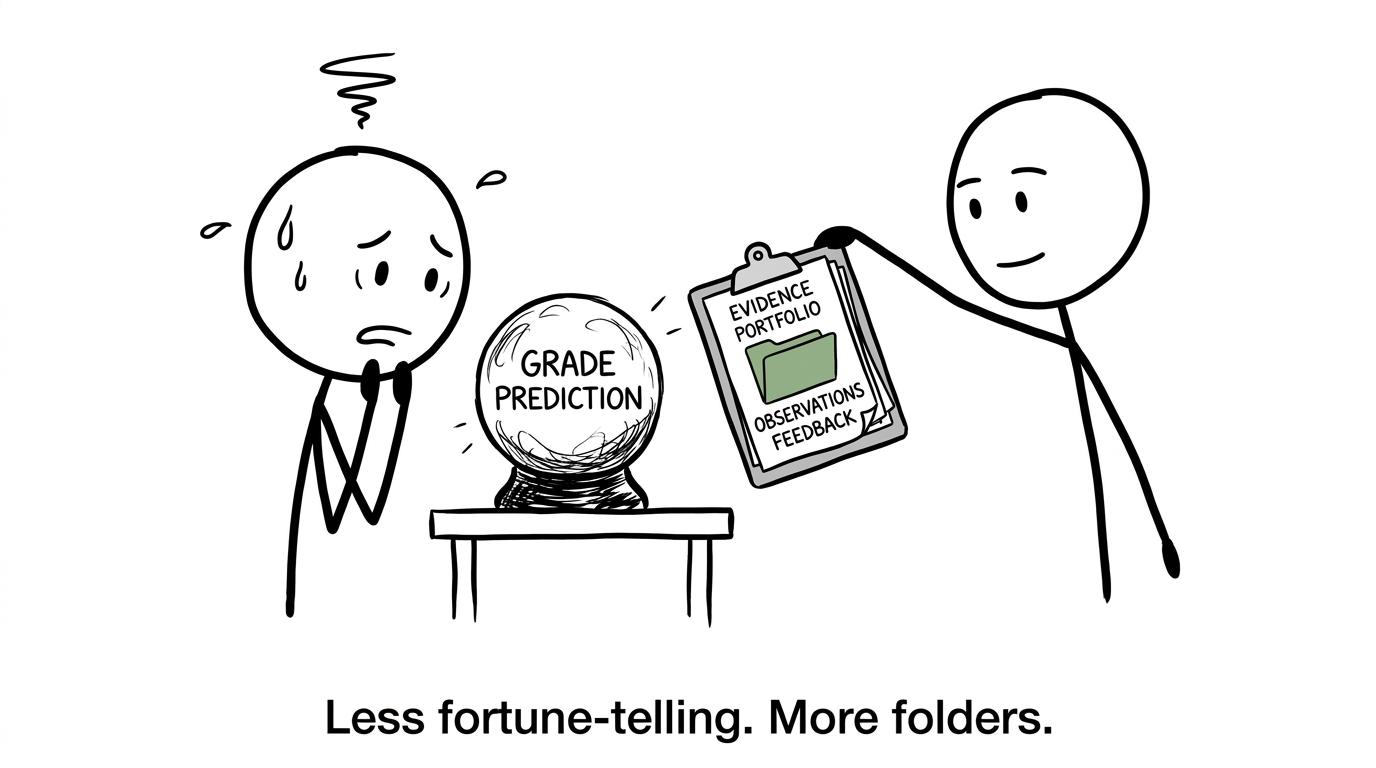 Teacher replaces a predicted-grade crystal ball with an evidence clipboard
How tier entry affects the prediction
GCSE German is tiered. Under the current reformed specifications, foundation tier normally makes grades 111 to 555 available, while higher tier normally makes grades 444 to 999 available. Higher-tier students who narrowly miss the usual grade 444 boundary may receive an allowed grade 333, subject to the awarding rules.
Tier decisions are therefore significant, but higher is not automatically better. The right tier is the one that gives you a suitable level of demand and a secure route to the grade range you are working towards.
Teachers may consider your performance on questions at different levels of demand, your consistency across all four skills and the risk attached to each entry. Because all German components are entered at the same tier, a student cannot normally choose foundation listening and higher writing.
Ask your teacher when tier decisions are reviewed and what evidence would support a change. Policies and entry deadlines vary between schools and exam boards.
How to respond if your predicted grade feels too low
Start with evidence rather than argument. A useful conversation sounds less like "I deserve a higher grade" and more like "Which parts of my evidence are keeping the prediction here, and what would demonstrate the next grade securely?"
Ask for three things:
- the assessments carrying the most weight;
- the weakest skill or assessment objective;
- the next opportunity to provide stronger evidence.
Then turn the answer into a short plan. If listening is the problem, regular retrieval of core vocabulary and timed comprehension may be more useful than rewriting polished speaking answers. If writing lacks accuracy, focus on the recurring grammatical errors identified by your teacher rather than attempting to memorise an entire model response.
Protect time for your other GCSEs too. MathsGenie's GCSE revision resources organise topics by grade and include videos and exam-style practice. You can use GCSE predicted papers alongside official past papers once you have repaired the underlying topic gaps.
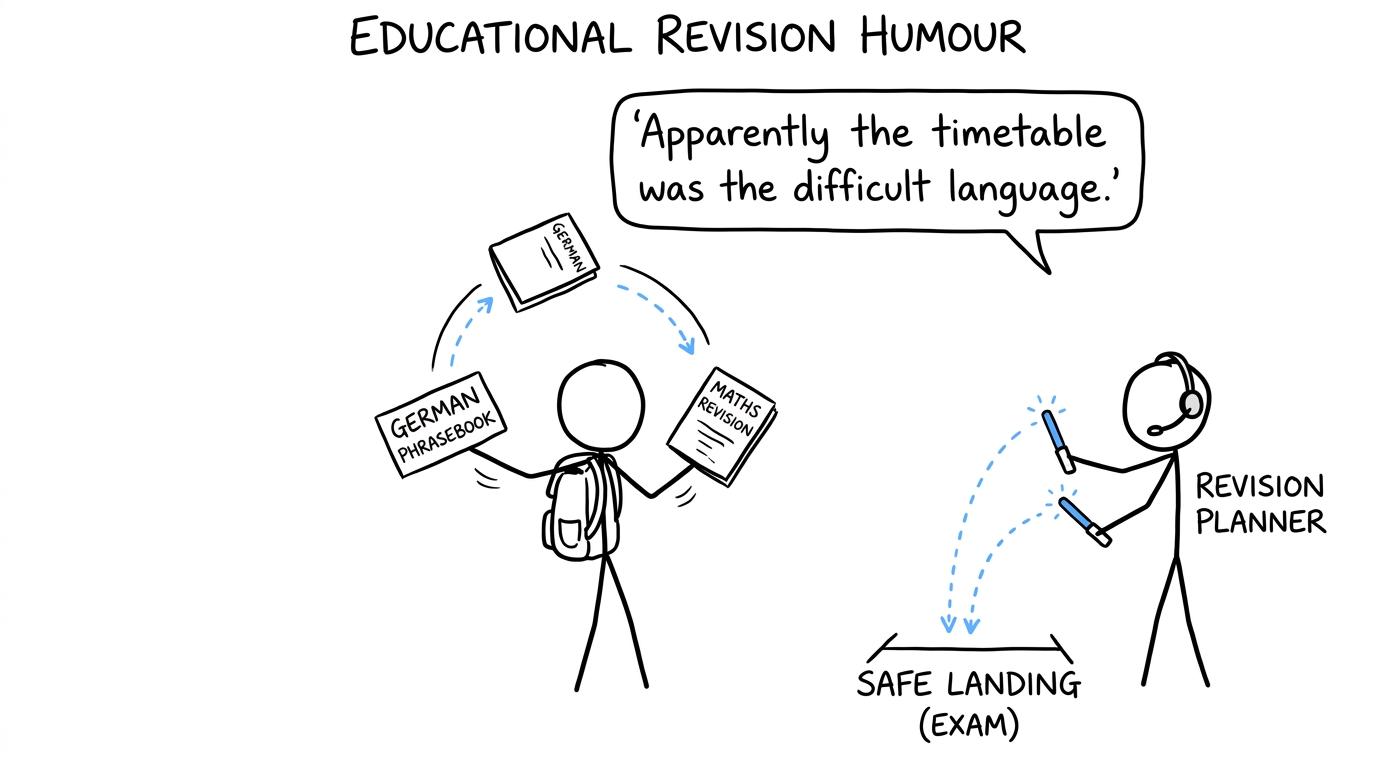 A revision planner guides German and maths books towards a safe landing
What your German prediction cannot tell you
A prediction cannot know which questions will appear, how you will feel on the day or where the final grade boundaries will be set. It also cannot replace the result issued by the awarding organisation.
This uncertainty is not a flaw unique to your teacher. It is part of forecasting. The best prediction says, in effect, "Given the evidence currently available, this is the most defensible estimate."
Your actual result comes from the total assessed performance under your specification's rules. Individual components may have notional boundaries for analysis, but the qualification grade is based on the overall subject mark. A weaker component can therefore be balanced by stronger performance elsewhere, although neglecting one quarter of the course remains risky.
Common mistakes when interpreting predicted grades
Treating the grade as a limit
A prediction describes likely performance at a particular moment. It does not impose a ceiling. New evidence can justify a revised judgement, and final examinations decide the awarded result.
Assuming one mock is everything
A formal mock is influential, but teachers may also have speaking evidence, common tests and months of class assessment. Ask how your school weights each source instead of guessing.
Comparing predictions between schools
Schools can use different assessment calendars, definitions and policies. A prediction of grade 666 in one school may not have been produced in exactly the same way as a grade 666 elsewhere.
Chasing marks without reading feedback
The mark shows where you finished. Feedback shows where the next improvement may come from. In German, recurring errors in tense, word order or question comprehension are often more actionable than the headline grade.
The same habit improves maths revision. Use focused lessons such as solving equations, fractions revision and quadratic equations when a paper exposes a specific weakness.
Believing future grade boundaries are already known
They are not. Final boundaries are determined after the examinations have been completed and marked. Teachers may use previous boundaries or board guidance to inform a prediction, but responsible forecasting leaves room for uncertainty.
A grade is evidence, not identity
Predicted grades are useful when they lead to a better question. Not "Am I a grade 555 student?" but "What evidence currently supports grade 555, and what would stronger evidence look like?"
That shift restores control. You cannot select the summer paper or fix its eventual boundaries. You can practise under timed conditions, use feedback, strengthen weak skills and create evidence that is harder to misunderstand.
Apply the same approach across your timetable. Begin with the MathsGenie GCSE revision hub, complete targeted practice questions, then move to full GCSE past papers and predicted papers. Mark the work carefully, watch the video solutions and return to any topic that costs you marks.
A predicted grade is a snapshot. Thoughtful revision changes what the next snapshot can show.