GCSE German Group Chat Study: Tips That Work
GCSE German group chat study tips for focused vocabulary, speaking and grammar revision, with simple rules that stop useful sessions becoming meme feeds.

The class chat begins with good intentions. Someone asks about German vocabulary. Another person posts a joke about the speaking exam. Ten minutes later, everyone is discussing lunch and nobody has revised a verb.
Effective GCSE German group chat study needs more than a collection of classmates and a stream of notifications. It needs a clear task, a short time limit and a way to check answers. Used properly, the chat can support vocabulary retrieval, speaking practice, dictation and grammar. Used without structure, it becomes another place to avoid the work.
The answer is not to ban the memes. It is to give revision a protected space before they arrive.
The quick group chat revision checklist
Before your next session, agree to these rules:
- Choose one small German topic or skill.
- Set a start and finish time.
- Ask questions before revealing answers.
- Give everyone time to respond independently.
- Check vocabulary and grammar against a trusted source.
- Correct mistakes clearly and kindly.
- Include listening, speaking, reading and writing across the week.
- Finish by identifying what each person needs to revisit.
- Keep exam materials secure and follow your school’s online-safety rules.
This is the same principle behind effective maths revision: attempt, check, correct and return. MathsGenie’s GCSE maths revision hub organises revision around that cycle with lessons, exam questions, mini tests and papers.
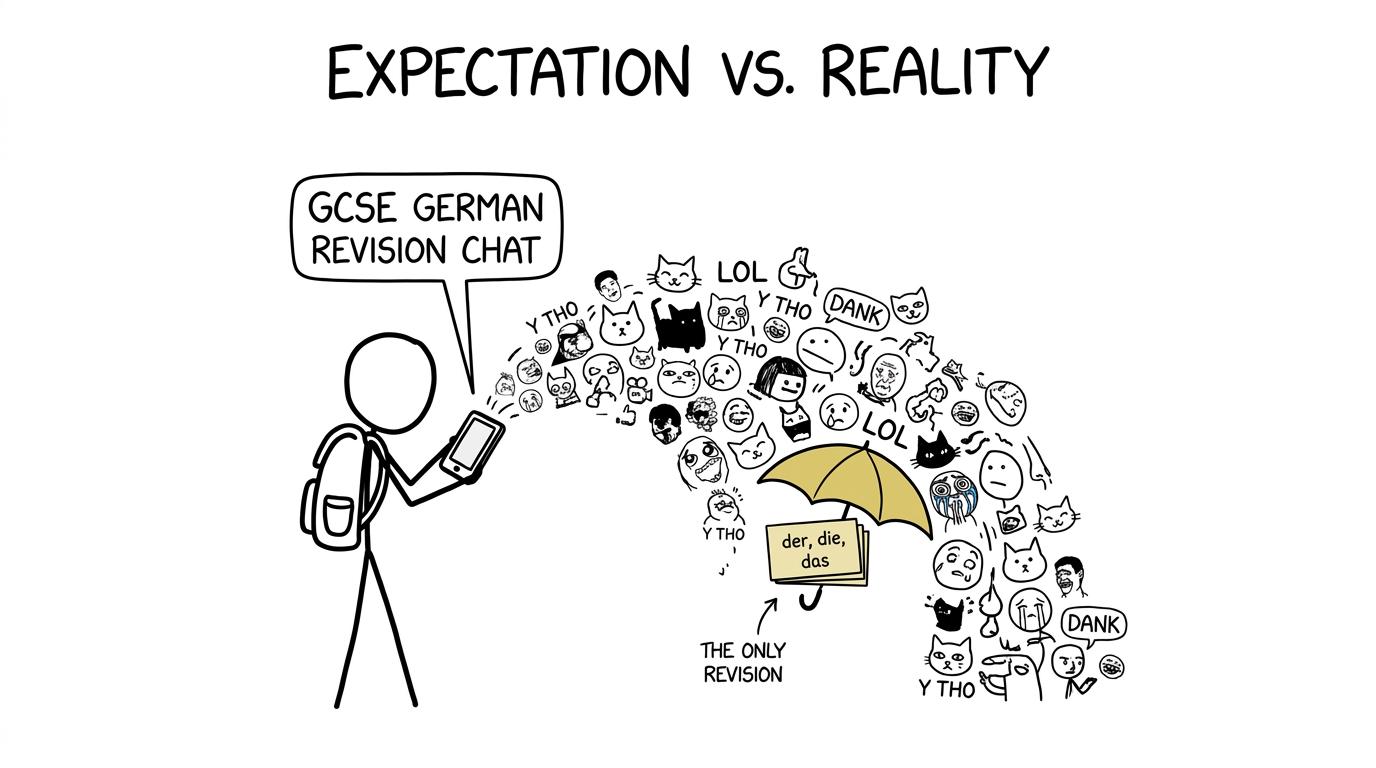 A student faces an avalanche of memes while one German flashcard tries to stay useful
Give the group chat one clear purpose
A large class chat usually has several jobs. It carries homework reminders, timetable questions, jokes and last-minute panic. Revision struggles because it must compete with all of them.
Create a separate thread or smaller revision group if your platform and school rules allow it. Evidence-informed guidance on collaborative learning suggests that small groups tend to work best when everyone participates and shares a specific outcome. In practice, a focused team of around three to five students is easier to organise than an entire class.
Write the group’s purpose in the description. For example:
- short German retrieval sessions;
- checked corrections rather than guesses;
- no unrelated posts during a scheduled session;
- no expectation that anyone replies late at night.
A purpose changes the atmosphere. The chat no longer asks, “Who is online?” It asks, “What are we practising?”
Assign light roles rather than relying on enthusiasm
Roles prevent one confident student from doing everything while everyone else watches. Rotate these jobs:
- Quizmaster: posts the prompts without answers.
- Checker: compares responses with the specification vocabulary, class materials or teacher guidance.
- Speaker: starts the voice-note task.
- Timekeeper: closes the session when the agreed time ends.
The roles should be light. This is revision, not committee administration. Their purpose is to make participation normal and reduce the decisions required to begin.
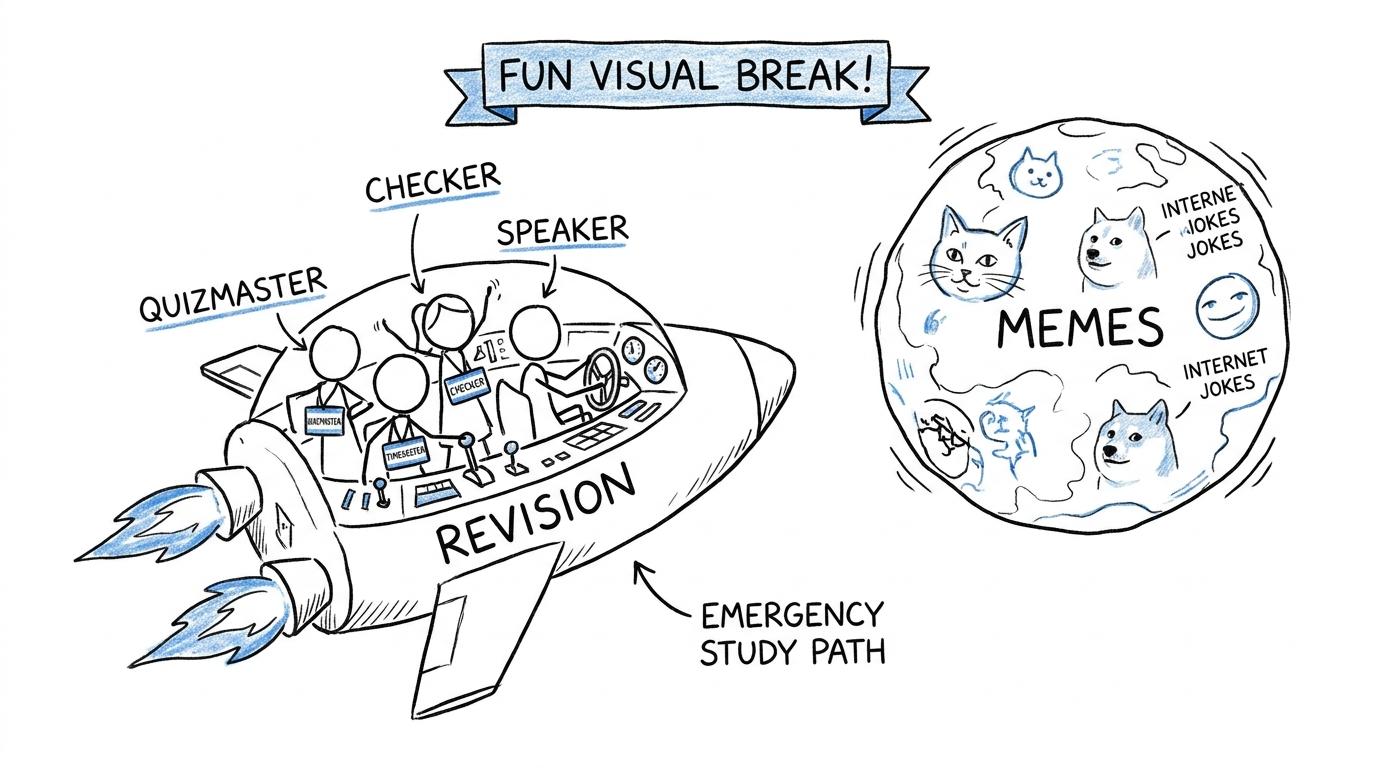 Four students steer their revision chat away from the planet of memes
Use retrieval instead of copying notes into the chat
Posting a vocabulary list may look productive, but the person who uploads it does most of the work. Everyone else scrolls past words they vaguely recognise.
Retrieval is different. It requires each student to attempt to recall previously learnt material before checking notes. Educational evidence supports retrieval practice when it provides suitable challenge, happens repeatedly after a delay and includes feedback. Without feedback, a confidently repeated error can become harder to remove.
Use a simple sequence:
- Post a prompt only.
- Ask everyone to answer privately on paper first.
- Send responses at the same agreed time.
- Reveal and discuss the checked answer.
- Record difficult items for a later session.
Writing privately first matters. Otherwise, the fastest response becomes a model that everyone copies, and the activity stops testing individual memory.
This approach also works for maths. The MathsGenie guide to finding your weakest GCSE topics explains how attempts, marking and an error log can turn vague revision into a specific plan.
Build activities around the four German skills
Current GCSE German courses assess listening, speaking, reading and writing. Exact tasks and timings depend on your exam board and specification, so check whether you take AQA, Edexcel, OCR or Eduqas and follow your teacher’s instructions. For the current AQA and Edexcel specifications first examined in 2026, the four broad skills each contribute a quarter of the qualification.
A useful chat should therefore do more than test English-to-German vocabulary.
Vocabulary and grammar retrieval
The quizmaster can post meanings, sentence gaps, infinitives or prompts requiring a particular tense. Keep each set narrow enough to check properly.
Useful formats include:
- German to English and English to German recall;
- noun gender and plural checks;
- verb forms in a named tense;
- adjective endings within familiar phrases;
- time phrases followed by an appropriate sentence;
- correcting one deliberately flawed sentence.
Do not let the group settle grammatical disagreements by voting. A popular answer can still be wrong. Use your teacher’s resources and the official vocabulary and grammar required by your exam board.
Speaking through short voice notes
Voice notes can make speaking practice easier to repeat, but keep them short and focused. One person posts an approved prompt. Everyone prepares independently, records a response and listens back before sending it.
Feedback should address one or two features rather than everything at once. Check whether the response answers the question, communicates clearly and uses the intended language. Pronunciation feedback should be respectful and based on a reliable model from your course resources.
Students should also remember that sending a prepared recording is not identical to responding live. Pair it with occasional teacher-led or in-person practice where follow-up questions cannot be edited away.
Listening and dictation
For a low-stakes dictation activity, one student can record a short sentence taken from permitted class material while the others transcribe it independently. The checked version should appear only after everyone has attempted it.
Rotate the reader so that the group does not become familiar with only one voice. However, group recordings cannot replace the variety and conditions found in official listening materials. Use them for regular sound-spelling practice, not as your only listening revision.
Reading and writing
Post a short permitted text or teacher-approved prompt, then ask focused questions. Avoid turning every reading task into translation. Students also need to identify details, understand opinions and infer meaning from context.
For writing, set a small constraint such as using a past reference, an opinion with justification or a future intention. Group members can highlight where the requirement has been met, but substantial answers should still receive teacher feedback when possible.
Follow a short session routine
Long chat sessions create more opportunity for distraction. A repeatable routine is usually more useful than an ambitious revision event that happens once.
Try this structure:
- Opening: the timekeeper states the topic and task.
- Retrieval: everyone attempts a short set without notes.
- Check: the checker reveals verified answers and resolves uncertainties.
- Production: students send one original sentence or short voice note.
- Close: each person names one item to revisit.
Stop when the session ends. A defined finish protects sleep and makes it easier to return tomorrow.
If your German session sits alongside maths revision, use the same compact rhythm. The 20-minute GCSE maths revision routine offers a practical model for fitting retrieval, questions and correction into a busy school day. For a broader weekly structure, use the GCSE maths revision timetable.
 A phone rests after completing its revision shift
Make corrections more valuable than scores
A quiz score tells you what happened. A correction helps change what happens next.
Keep a shared list of troublesome items, but let each student maintain a personal error log too. Divide errors into useful categories:
- vocabulary not remembered;
- gender or plural error;
- verb form or word-order error;
- spelling or sound-symbol confusion;
- misunderstood question;
- speaking hesitation;
- answer copied before an independent attempt.
Revisit the difficult material after a gap. The goal is not to preserve an impressive first score. It is to make the next attempt more accurate.
MathsGenie applies the same logic to exam practice. Students can attempt Edexcel GCSE maths past papers or AQA GCSE maths past papers, mark them and turn every dropped mark into a future revision target. The subject changes; the learning loop does not.
Protect privacy, sleep and exam security
A useful revision group must also be a safe one. Follow your school’s rules about messaging platforms, accounts and contact between students. Do not add people without permission, share private information or repost someone’s voice recording outside the group.
Agree on quiet hours and remove pressure to answer instantly. Muting notifications during independent work is not antisocial. It protects concentration.
Never share confidential assessment content or discuss a live paper in a way that could give another candidate an unfair advantage. Phones, watches, earbuds and other unauthorised smart devices must not be in a candidate’s possession in the exam room. Follow your centre’s instructions for handing devices in before the examination begins.
Common mistakes in GCSE German group chat study
Letting one student supply every answer
The group may look active while most members remain passive. Require an independent attempt before responses are revealed.
Correcting by confidence rather than evidence
Fluent-sounding German is not automatically accurate German. Check disputed vocabulary and grammar using teacher-approved or official course resources.
Revising vocabulary but ignoring skills
Word knowledge matters, but GCSE German also requires students to understand and produce language through listening, speaking, reading and writing. Plan across all four.
Making sessions too broad
“Revise German tonight” is not a workable task. Choose something precise, such as vocabulary from one theme, one grammar feature or a short speaking prompt.
Turning revision into constant availability
More notifications do not mean more learning. Use scheduled sessions, quiet hours and a clear finish.
Treating the chat as a replacement for exam practice
A group chat supports recall and explanation. It cannot reproduce every timed paper, listening task or speaking assessment. Combine it with official materials, class teaching and independent practice.
Turn the chat into a revision tool, not another distraction
The best group chat is not the busiest one. It is the one that makes everybody think before somebody posts the answer.
Choose a small task. Attempt it independently. Check it carefully. Correct what went wrong. Return to it later. That routine works for German vocabulary, and it works when you move back to the maths exams your timetable also demands.
For maths, begin with MathsGenie’s free revision resources. Use revision lessons to understand a method, practice questions and mini tests to retrieve it, then past papers, predicted papers, mark schemes and video solutions to test it under pressure. If exams are approaching, the one-month GCSE maths revision plan can turn those resources into a manageable schedule.
Keep the memes. Just make them wait until the retrieval round is finished.