GCSE German Flashcards Quizlet: Best Decks
GCSE German flashcards Quizlet guide: choose reliable exam-board decks, avoid weak sets, and build useful cards for active recall with confidence.
A flashcard deck can look impressive and still waste your time. It may contain hundreds of terms, colourful diagrams and a reassuring progress bar, yet be based on an old specification or miss the vocabulary your exam board expects.
The best GCSE German flashcards Quizlet sets are current, matched to your exam board and tier, divided into manageable topics, and accurate about gender, plural forms and verb patterns. Teacher-created or school-approved sets are usually the safest starting point. However, you should still compare every deck with your specification and class vocabulary list.
This matters particularly when German is competing with maths, science and every other GCSE subject for space in your revision week. You do not need the biggest deck. You need a dependable one that makes you retrieve the right language repeatedly.
A quick checklist for choosing German flashcards
Before learning a public Quizlet set, check whether it:
- names the exam board and specification clearly
- matches your Foundation or Higher tier requirements
- has been updated for the qualification you are taking
- divides vocabulary into sensible themes or short groups
- includes German noun genders and useful plural forms
- gives complete, accurate meanings rather than vague translations
- includes important verbs, connectives and opinion phrases
- lets you test German to English and English to German
- agrees with vocabulary supplied by your teacher or exam board
If several of these details are missing, treat the deck as a source to inspect rather than a course to follow.
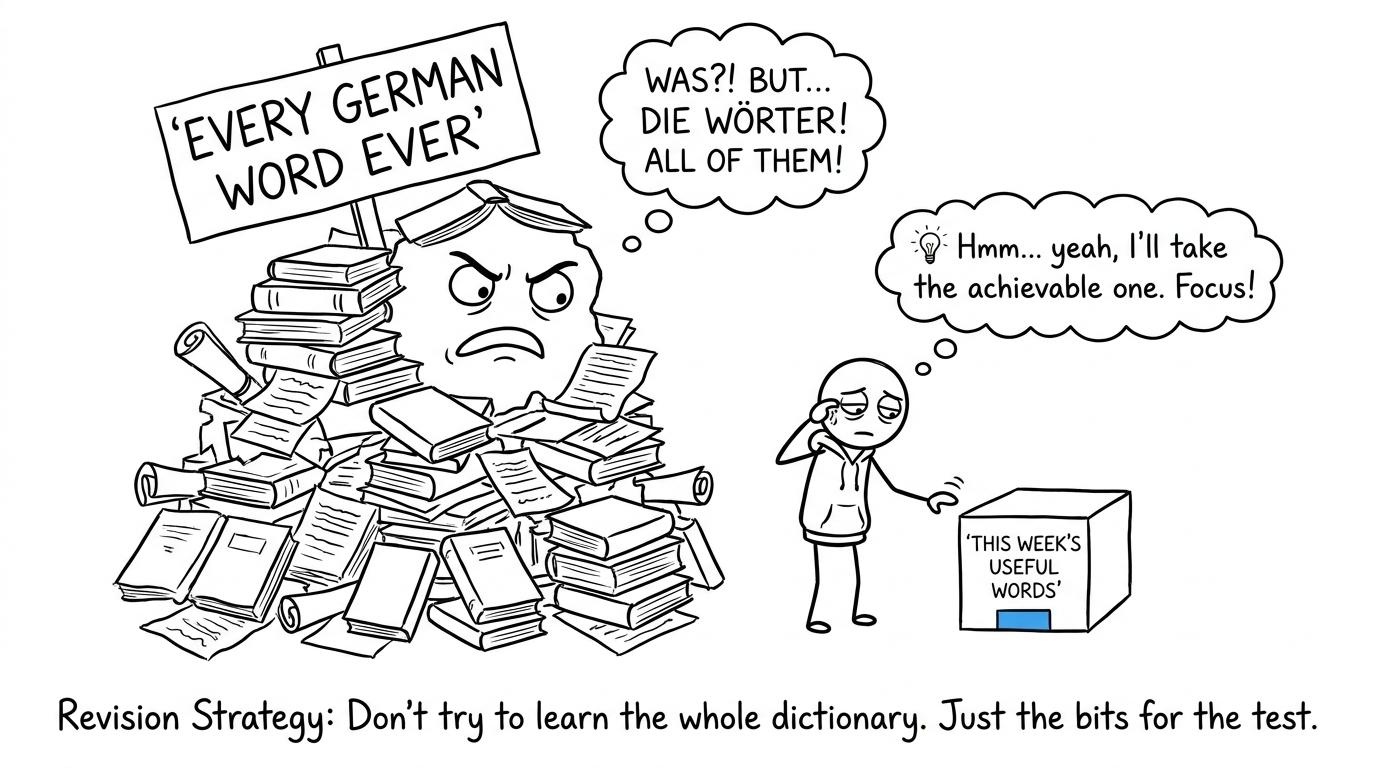 A student choosing a focused German vocabulary deck instead of every word ever written
Which GCSE German Quizlet decks are worth using?
Public sets can change, disappear or contain unnoticed errors. For that reason, it is more useful to identify reliable types of deck than to recommend one user-created set as permanently definitive.
Your teacher's specification-matched sets
Start with a deck shared by your German department. A teacher can align it with the order in which your class covers topics, correct ambiguous translations and include language from recent lessons.
Check that the set matches the specification used for your exam. A deck labelled only “GCSE German vocabulary” tells you very little. A useful title should identify details such as AQA or Pearson Edexcel, the current qualification, the topic and, where relevant, the tier.
Students sitting current reformed AQA and Pearson Edexcel GCSE German qualifications should be especially careful not to rely automatically on decks made for older specifications. The current AQA and Pearson materials organise defined vocabulary around a core of 1,2001{,}2001,200 lexical items at Foundation tier and a further 500500500 at Higher tier, alongside specified phrases and cultural or geographical items. That does not mean every deck should contain all 1,7001{,}7001,700 items. Smaller, well-labelled sets are usually easier to review accurately.
OCR and Eduqas students must use resources matched to their own specifications. Exam boards do not necessarily organise themes, vocabulary and assessment in identical ways.
Official-list decks divided by topic
A deck built carefully from the current official vocabulary list can provide excellent coverage. Look for separate sets covering areas such as:
- identity, relationships and daily life
- school and future plans
- free time, media and technology
- travel and tourism
- local area and the environment
- health and lifestyle
- high-frequency verbs and adjectives
- question words, time phrases and connectives
Topic decks make gaps visible. If travel vocabulary is secure but school language keeps causing mistakes, you know where the next short revision session belongs.
Whole-specification decks can still be useful as a final checklist. They are less effective as the first place to learn unfamiliar words because a very large queue encourages recognition and guessing rather than careful recall.
High-frequency language decks
Not every valuable card belongs to one neat theme. Common verbs, adjectives, connectives, negatives and time expressions appear across listening, speaking, reading and writing.
A compact high-frequency deck deserves regular attention because these words help you understand relationships inside a sentence. Knowing a rare noun may solve one question. Recognising a tense marker, negative or question word can unlock the meaning of an entire passage.
Personal error decks
The highest-value deck is often the smallest: a collection of words and phrases you have actually forgotten, confused or misspelt.
Add vocabulary from marked assessments, listening transcripts, reading tasks and speaking feedback. Remove or pause cards once recall has remained secure over several reviews. This turns the deck into a changing record of weakness rather than a museum of everything you have ever encountered.
The same principle improves maths revision. A targeted list of errors is more useful than repeatedly completing comfortable questions. MathsGenie's GCSE maths revision lessons let you choose a specific topic, while the Grade 4 revision resources and Grade 7 revision resources help you focus work around an appropriate level.
How to judge a public Quizlet set quickly
You can inspect a deck in a few minutes before committing revision time to it.
| Check | What a strong deck looks like |
|---|---|
| Specification | The current exam board or qualification is named |
| Scope | One clear topic, skill or defined vocabulary group |
| Accuracy | Meanings agree with your official list and class materials |
| Nouns | Gender is included, with a plural where it is useful |
| Verbs | Infinitives are clear and irregular forms are not misleading |
| Direction | You can practise both German to English and English to German |
| Context | Ambiguous words have a short phrase or clarification |
| Size | The set is short enough to review without rushing |
Preview at least 101010 cards from different parts of the set. One mistake does not prove that every card is wrong, but it does show that the deck needs checking before you trust it.
Be cautious with star ratings and popularity. They indicate that people have used a set, not that a teacher has verified its spelling, specification or translations.
How to build your own GCSE German flashcards fast
Building a deck should not consume the time intended for learning it. Use the official vocabulary file, your teacher's list or a checked spreadsheet as the source. Importing a clean list can be quicker than typing every item individually, but inspect the result after importing.
Keep each card responsible for one decision
The front of a card should ask a clear question. If one side contains a paragraph with six facts, it becomes difficult to tell what you remembered.
For nouns, record the article with the word rather than treating gender as an optional extra. Add a plural where your course expects it or where the form is unpredictable. For verbs, begin with the infinitive and add only the genuinely useful irregular information. For phrases, preserve enough context to prevent an inaccurate one-word translation.
Separate recognition from production
German-to-English cards test whether you can recognise meaning. English-to-German cards test whether you can produce the language accurately. Both matter, but production is usually harder.
Do not count a vague answer as correct. If the card requires an exact noun with its gender, or a precise phrase, judge yourself against that target. Honest marking keeps the easy-looking progress score from hiding weak recall.
Build in short batches
Create one small batch, test it, correct it and only then add more. A sensible routine might involve creating cards for 101010 minutes and recalling them for another 101010 minutes. The exact duration is less important than keeping card creation subordinate to retrieval.
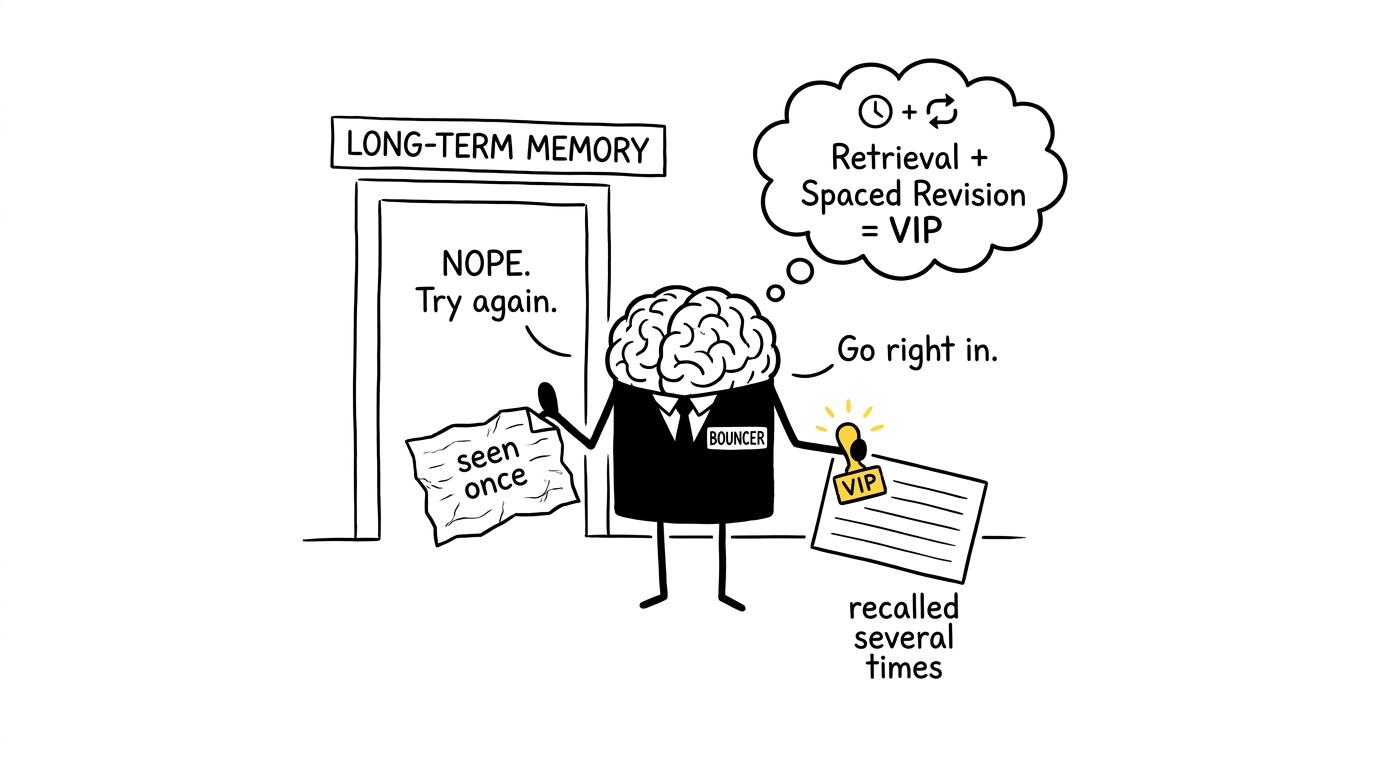 A brain bouncer allowing repeatedly recalled flashcards into memory
How to use flashcards so the words remain available
Reading a card is exposure. Trying to answer before turning it over is retrieval. That moment of effort is the useful part.
Say the answer aloud, type it or write it from memory. Then check every important detail. Review missed cards sooner and secure cards after a longer interval. Quizlet's available modes and features can vary by account and change over time, so the essential habit should not depend on one button: attempt, reveal, correct and revisit.
Mix flashcards with exam-style language. Vocabulary recall cannot by itself develop listening under time pressure, extended writing or spontaneous speaking. After reviewing a topic deck, use the words in a listening task, a short written response or answers to likely speaking questions.
Maths needs the same movement from knowledge to application. Use MathsGenie GCSE past papers to practise selecting methods under exam conditions, then return to the relevant lesson when a question exposes a gap. Students beginning with core skills can also use the Grade 1 revision resources.
Fitting German cards around maths revision
Flashcards work well in short sessions, but they should not quietly occupy every available revision slot. German vocabulary and maths problem-solving make different demands.
Give each task a clear purpose. A short German recall session can sit beside a longer block of maths questions, marking and corrections. Near the exams, use MathsGenie predicted papers alongside past papers and topic practice rather than replacing them. Predicted papers are revision resources, not a promise of what will appear.
If you continue with maths after GCSE, MathsGenie's free A Level maths revision provides lessons and exam practice for the next stage.
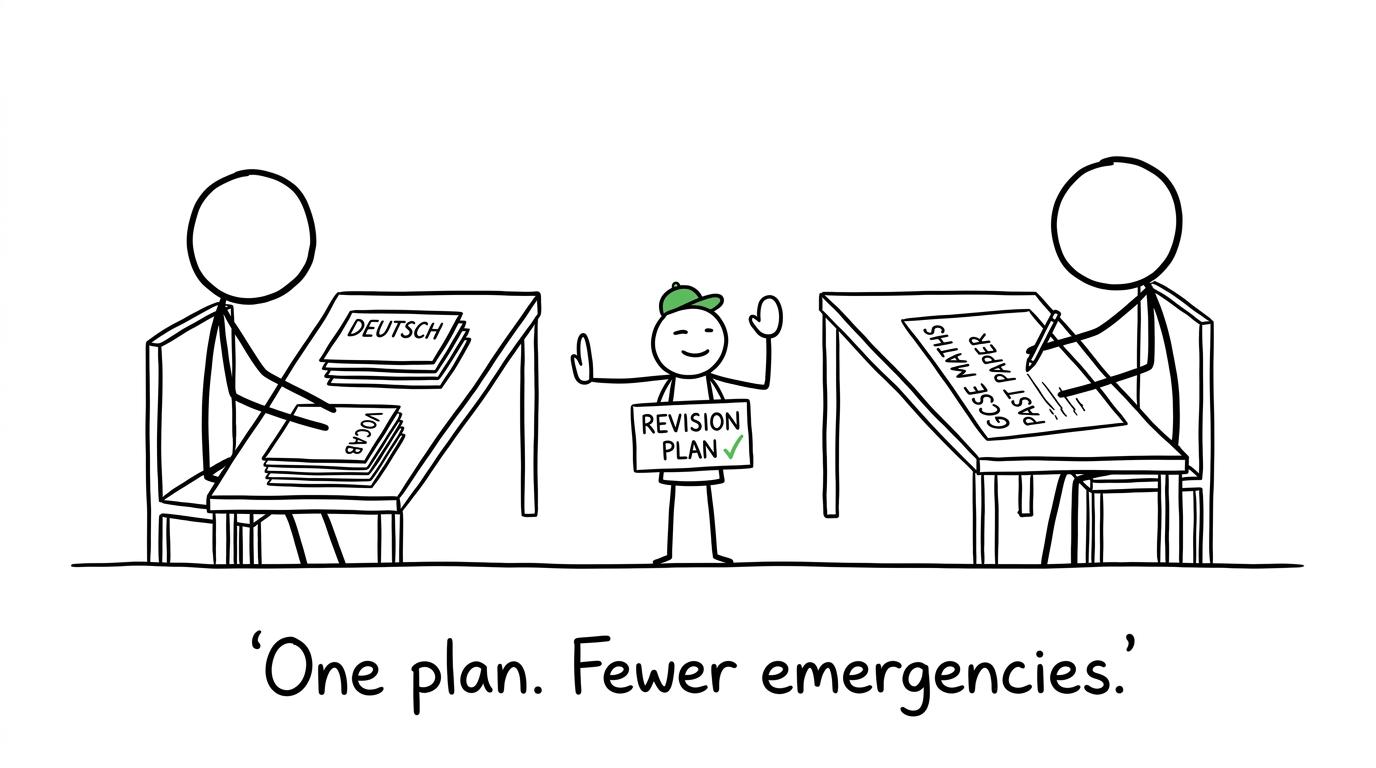 A revision timetable calmly separating German flashcards and a maths past paper
Common GCSE German flashcard mistakes
Choosing a deck because it is large
Coverage matters, but an enormous unstructured deck can conceal what you do not know. Begin with small topic sets and use a full list later for checking coverage.
Using an old specification unknowingly
Do not assume that a highly viewed set is current. Check its exam board, qualification and vocabulary against the materials given by your school.
Omitting gender and plurals
Learning a bare noun can create extra work later. Store the noun with its article and any plural information you genuinely need.
Only recognising German
Seeing a German word and recognising its English meaning can feel fluent. Reverse the direction regularly so that you also practise producing German.
Editing cards without checking the source
Automatic translations can miss context or offer an unsuitable meaning. Verify additions against your specification, teacher resources or a reliable dictionary approved by your department.
Replacing exam practice with flashcards
Flashcards support vocabulary. They do not reproduce a complete listening, speaking, reading or writing assessment. In maths, knowing a formula is similarly different from identifying when and how to use it in an unfamiliar question.
Choose accuracy before abundance
A useful GCSE German deck is not the one with the most cards. It is the one you can trust, retrieve and connect to real exam tasks. Start with teacher-approved, current exam-board vocabulary; divide it into short topic sets; then create a personal error deck from the language that repeatedly escapes you.
Keep the rest of your revision equally deliberate. Use MathsGenie's free revision lessons and video solutions to rebuild understanding, practice questions and mini tests to strengthen individual skills, and past papers, mark schemes and predicted papers to rehearse decisions under exam conditions. Open the GCSE maths revision hub, choose the next genuine weakness, and give it the same focused attention as your best flashcard deck.