GCSE German Examiner Reports: What They Really Say
GCSE German examiner reports reveal recurring mistakes in listening, speaking, reading and writing. Learn how to turn examiner feedback into smarter revision.
There is a peculiar kind of frustration in revising German: you can know hundreds of words, complete several papers and still lose marks for reasons that feel avoidable. You misread a time frame. You add one unnecessary detail. You answer three bullet points well and quietly forget the fourth.
That is where GCSE German examiner reports become useful. Their message is rarely that students need more impressive language. Across published reports and assessment guidance, the recurring advice is simpler: know theme-specific vocabulary, answer the precise task, recognise grammatical clues, communicate clearly and check that extra information does not contradict the correct part of your answer.
The reports are not predictions. They are records of where marks were gained and lost in a completed exam series. Read properly, they can turn vague revision into a practical plan.
The examiner-report checklist
The exact assessment differs by exam board and specification, so always use the materials for your own course. However, the most useful recurring messages can be reduced to this checklist:
- Build vocabulary across every specification theme, not only familiar topics.
- Listen for negatives, opinions, time references and changes of direction.
- Read the whole question before selecting evidence from a text.
- Give only information that answers what has been asked.
- Cover every bullet point in speaking and writing tasks.
- Control common verbs, word order and the required tense.
- Prefer clear communication to memorised language that does not fit.
- Check for contradictions before finishing.
- Practise with real questions, then use the mark scheme and examiner feedback together.
That final habit matters in every subject. Maths students can apply the same evidence-led process through the GCSE Maths revision hub, where lessons, practice questions and papers are organised by board and tier.
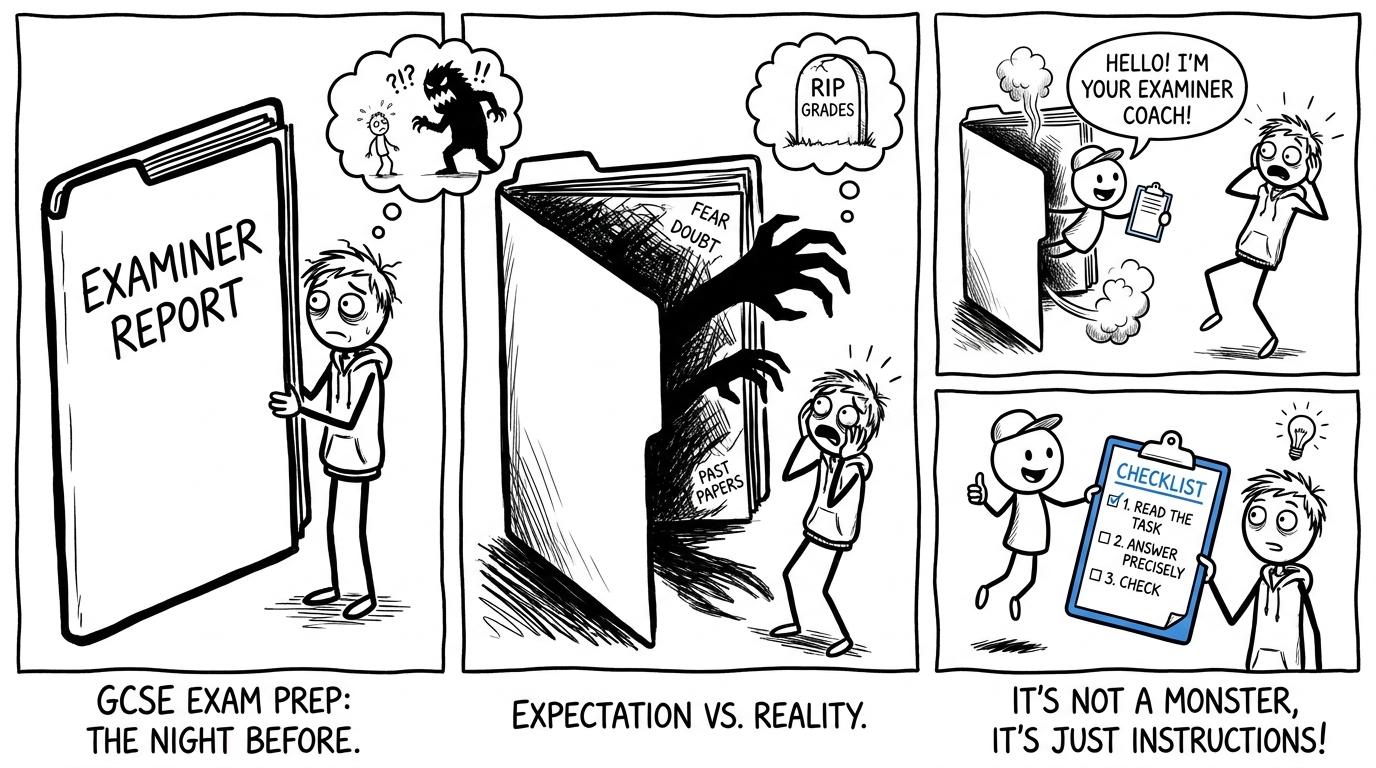 A student discovers that an examiner report is a helpful checklist rather than a monster
What examiner reports are actually telling you
An examiner report is not a secret list of next year's questions. It is written after marking and describes how candidates approached particular tasks, what successful responses did and where improvement was needed.
Reports are also selective. If a question was generally answered well and produced nothing notable, an examiner may have little to say about it. A long paragraph about one mistake therefore does not prove that the same feature will dominate the next paper. It tells you that the mistake was important enough to discuss.
There is another reason to be careful: GCSE language specifications are changing. The newest AQA and Pearson Edexcel German courses have revised vocabulary, grammar and assessment arrangements. Older reports remain useful for broad habits such as precision, tense control and task fulfilment, but your current specification, sample assessment materials and teacher guidance must decide the exact format you practise.
The safest approach is to read reports for patterns rather than predictions.
Vocabulary gaps affect every paper
One of the clearest messages in the Eduqas Summer 2024 GCSE German report was that theme-specific vocabulary remained a recurring area for improvement. Vocabulary gaps affected comprehension in listening and reading, while also limiting how far some candidates could develop answers in speaking and writing.
This is an important distinction. Vocabulary is not a separate revision unit that can be completed and forgotten. It is the raw material of all four skills.
Smarter vocabulary revision should therefore include:
- nouns with their gender and plural;
- verbs in useful tense forms;
- adjectives and opinion phrases in context;
- negatives and qualifiers;
- words that are easily confused;
- short audio retrieval, not recognition from a written list alone.
Revise across the whole specification rather than repeatedly returning to comfortable themes such as family or school. A small, secure vocabulary across every theme is more useful than an elaborate prepared paragraph that only fits one question.
Listening rewards precision, not general understanding
Students often leave a listening paper feeling that they understood the recording. Examiner feedback shows why that feeling is not always enough. A mark may depend on one detail: who performed an action, whether something happened in the past or will happen later, or whether a speaker corrected an earlier opinion.
Published marking guidance also makes clear that an understandable answer can receive credit even when minor language errors are present. The problem begins when spelling, grammar or additional information makes the intended answer ambiguous.
A stronger listening routine is to:
- read the question and options before the recording begins;
- predict whether the missing idea is likely to be a person, reason, opinion or time;
- listen for contrast words and negatives;
- avoid choosing an answer because it contains the first familiar word you hear;
- use the repeat to verify, not merely repeat, your first guess;
- reread the completed response for internal contradictions.
The Eduqas report specifically warned that candidates sometimes introduced information that was not required and then contradicted an otherwise creditworthy answer. More words do not automatically create a safer answer.
Reading questions test selection as well as translation
Reading is not simply a test of how many German words you can convert into English. It also tests whether you can select the detail that answers the question.
Unfamiliar words can attract too much attention. Meanwhile, familiar grammatical clues are missed: a negative, a pronoun, a comparative, a past-tense verb or the ending that shows which noun an adjective describes.
When practising reading, annotate lightly. Identify the subject, verb, time frame and any word that reverses or qualifies the meaning. Then return to the question. Your answer should match its scope exactly.
This is similar to analysing a maths question before calculating. The MathsGenie guide to using past papers properly recommends turning each error into a specific correction rather than merely recording the final mark. In German, the correction might be "missed the negative" or "answered why instead of what happened". That description is far more useful than "reading is weak".
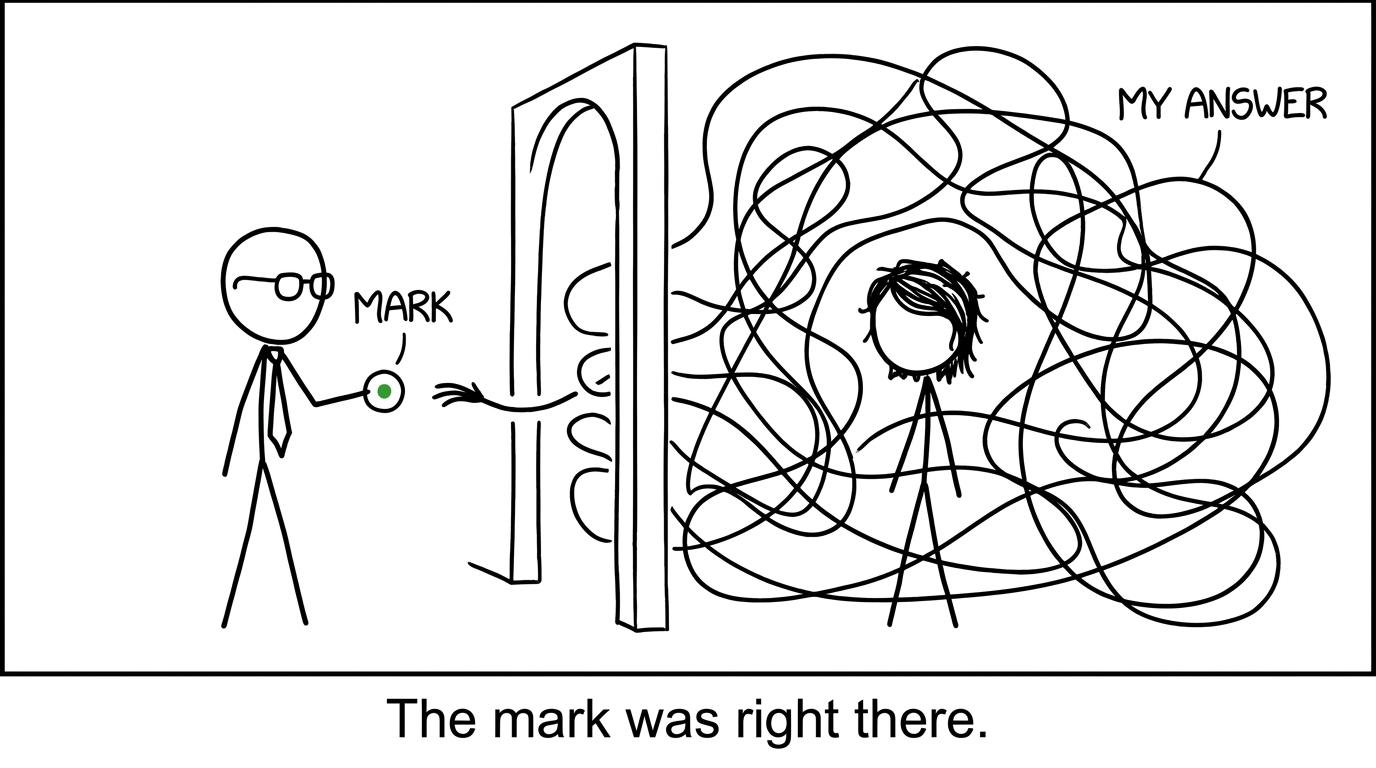 A wandering answer accidentally blocks an examiner who is trying to award a mark
Speaking marks depend on responding to the task
Speaking can feel less controllable because another person is involved. Yet examiner feedback repeatedly points towards trainable habits.
In role plays, candidates may ignore the setting, miss a required tense or fail to notice that they need to ask a question. In longer responses, prepared material can become a trap when it does not answer the prompt. Pronunciation matters chiefly because it supports communication; errors become more serious when they prevent the message being understood.
Useful speaking practice should include:
- reacting to unfamiliar prompts rather than reciting one script;
- giving a direct answer before adding a reason or detail;
- recognising whether the task requires past, present or future reference;
- forming questions accurately;
- recording yourself and checking whether each word is intelligible;
- practising brief repair phrases for moments when you need clarification.
The goal is not to sound like a native speaker. It is to communicate an appropriate response clearly enough for the examiner to reward it.
Writing needs coverage, control and relevance
A long answer can create the impression of ambition. Examiners, however, mark what the response communicates and how accurately it uses language within the task.
Current Pearson exemplar guidance distinguishes between minor errors that do not prevent meaning and major errors that do. It also explains that language beyond the specification lists can receive equal credit when used correctly, but not extra credit simply because it is unusual. That is a useful warning against collecting ornate phrases for their own sake.
Before writing, turn every bullet point into a small planning prompt. Check the required time frames and decide what you will communicate for each one. During the final check, prioritise high-value features:
- verb position and verb endings;
- subject-verb agreement;
- tense consistency;
- whether every bullet point has been covered;
- whether an attempted complex structure remains understandable;
- whether a memorised sentence has drifted away from the question.
Simple, relevant German can outperform complex language that obscures the message. Complexity should extend a clear answer, not replace one.
How to turn reports into smarter revision
The best use of gcse german examiner reports is not passive reading. Build a feedback loop.
Read the question beside the commentary
Examiner comments make more sense when you can see the original task and mark scheme. Ask what the question demanded, what the mark scheme accepted and why a common response failed.
Create a marks-leak log
Use categories that lead to action:
- vocabulary gap;
- misunderstood instruction;
- wrong person or time frame;
- contradiction;
- missing bullet point;
- verb or word-order error;
- unclear pronunciation;
- irrelevant prepared material.
After several tasks, count which causes recur. Revise the pattern causing the damage, not the paper that exposed it.
This method transfers directly to maths. The guide to finding your weakest GCSE topics explains how to diagnose errors, practise the smallest missing skill and retest it. For quick maths feedback, the Edexcel GCSE Maths mini tests provide shorter sessions than a full paper.
Practise the correction under exam conditions
If you lost marks by missing a negative, complete another listening or reading task focused on precise detail. If you omitted a writing bullet, practise planning all required content before starting. If tense prompts caused difficulty in speaking, rehearse switching time frames in short answers.
The same principle applies when using Edexcel GCSE Maths past papers or AQA GCSE Maths past papers: marking identifies the leak, but targeted practice repairs it.
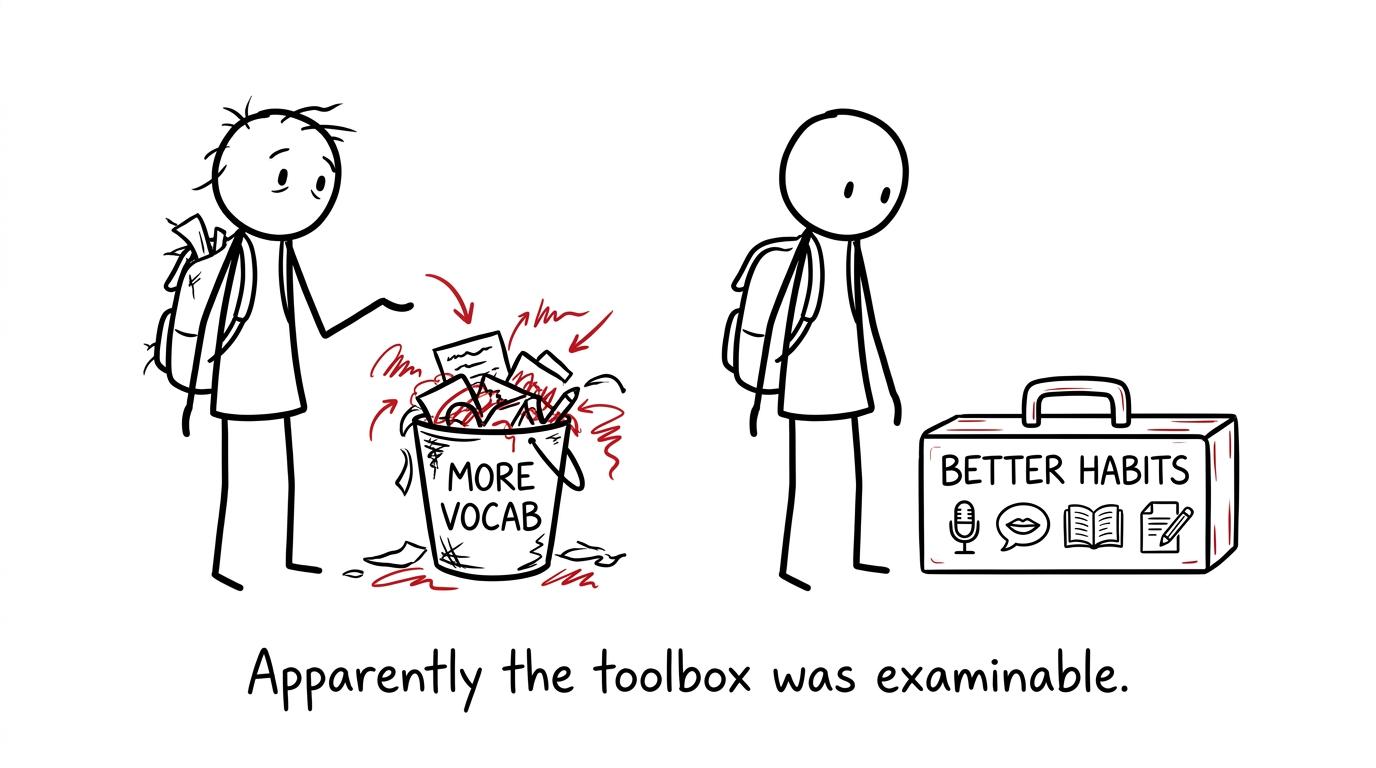 A student chooses a practical revision toolbox instead of simply adding more vocabulary
Common mistakes when using examiner reports
Treating comments as predictions
A report explains a completed series. It cannot tell you exactly which vocabulary or themes will appear next. Use it to improve habits, not to gamble on content.
Reading reports from the wrong specification
Advice about precision may remain valuable, but task formats and assessment objectives can change. Confirm your board, specification and examination year before building revision around an older report.
Writing down advice without changing practice
"Check tenses" is too vague. A useful action is: "Complete three speaking prompts requiring different time frames, record them and correct every verb."
Assuming more language always earns more marks
Extra material can introduce contradictions, irrelevant content and fresh grammatical errors. Answer first. Extend only when the addition is accurate and relevant.
Ignoring what successful candidates did
Reports are not merely catalogues of failure. They also identify effective approaches, such as careful attention to grammatical context, complete task coverage and clear communication. Copy the successful process, not a memorised answer.
Let evidence shape the next revision session
Examiner reports are valuable because they replace a vague fear, "I am bad at German", with smaller, repairable problems. Perhaps you miss negatives. Perhaps your role-play answers ignore the requested tense. Perhaps your writing is accurate but leaves one bullet point unanswered. Each diagnosis suggests a next step.
That is also the principle behind effective maths revision. Use evidence, identify the precise marks leak, practise it and retest. MathsGenie gives you a free place to run that cycle with revision lessons, practice questions, mark schemes, video solutions, mini tests, past papers and predicted papers. If you need a broader structure, follow the GCSE one-month maths revision plan.
Read the report. Find the repeated warning. Then turn it into one action you can complete today. Feedback only becomes valuable when it changes what you do next.