GCSE German Discord Server: Is It Worth Joining?
GCSE German Discord server advice: learn what communities offer, how to judge quality, stay safe and stop online chat replacing effective exam revision.
A revision server can look wonderfully productive at first. There are vocabulary channels, speaking partners and people discussing tomorrow’s mock. Then the notifications multiply. Half an hour disappears into memes, and the German exercise you opened remains untouched.
So, is a GCSE German Discord server worth joining? Potentially, yes, if it is well moderated, matches your exam specification and helps you practise actively. It is not worth relying on as your main revision method. Treat it as a supporting community, not a teacher, textbook or source of authoritative exam guidance.
That distinction matters for students balancing German with GCSE maths. Your attention is limited. Every revision tool should earn its place by helping you understand, practise or check something more effectively.
The quick verdict
A subject Discord server may be useful when it offers:
- structured channels for vocabulary, grammar, speaking and exam questions;
- active and visible moderation;
- discussion separated by exam board, tier or specification;
- opportunities to explain ideas and receive constructive feedback;
- sensible boundaries around direct messages and personal information;
- resources that can be checked against your teacher or exam board.
It becomes less useful when:
- conversation replaces independent practice;
- answers are shared without explanations or sources;
- members confidently teach inaccurate grammar;
- the server is dominated by off-topic chat;
- you feel pressure to reply, compete or remain online;
- strangers encourage private conversations.
The real question is not simply whether the server is good. It is whether your behaviour inside it leads to better revision outside it.
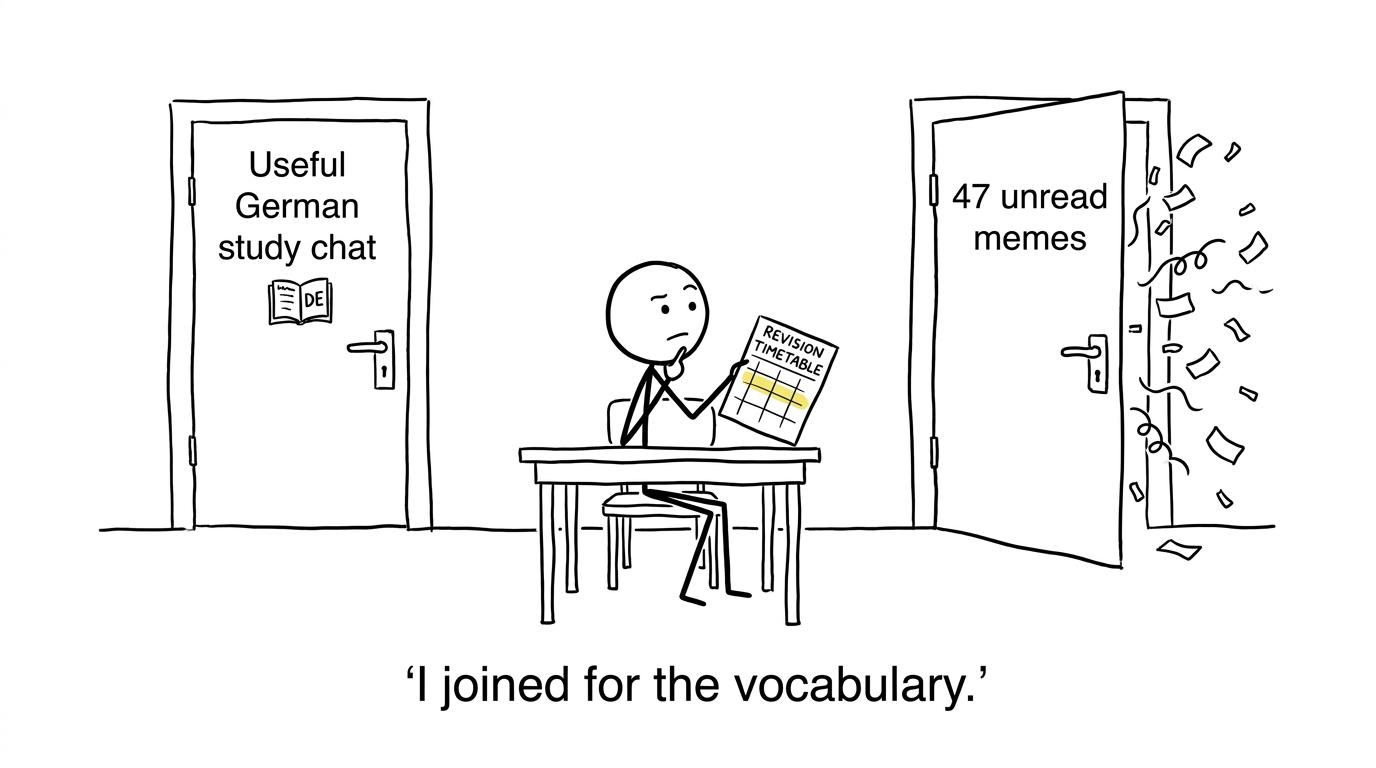 A student choosing between a useful German study chat and an avalanche of unread memes
What you can realistically gain from an online German community
Discord can provide something a revision guide cannot: interaction. Languages are built for communication, so a carefully managed community can support parts of German that are difficult to practise alone.
Quick explanations from other learners
A focused question about word order, adjective endings or the difference between two similar expressions may receive several explanations. Sometimes another student describes an idea in language that feels more accessible than a formal textbook explanation.
That does not make the answer automatically correct. Peer explanations should help you investigate a problem, not settle it beyond question. If an answer affects what you will use in an assessment, verify it with your teacher, approved course materials or the current specification.
Low-pressure language practice
A moderated text channel can encourage you to form short German responses regularly. Voice channels may also provide speaking practice, although students under eighteen should be especially careful about privacy, recording and contact with people they do not know offline.
The most useful practice has a purpose. Asking and answering a question, correcting a sentence or rehearsing a speaking prompt is active. Watching a fast-moving conversation without contributing may feel educational, but it produces little evidence that you can use the language yourself.
Shared motivation
Revision can feel strangely private. A community makes it visible that other students are also forgetting vocabulary, preparing for speaking assessments and trying to manage several subjects at once.
That sense of company can help, particularly when members use quiet revision rooms or short accountability sessions. But motivation should lead to work. A message saying that you plan to revise is not the same as completing the revision.
Exposure to different approaches
You may discover useful ways to organise vocabulary, test recall or prepare responses. This is similar to seeing different solutions to a maths problem: the variety can deepen understanding, provided the methods are accurate.
For maths, you can turn that principle into structured practice through the GCSE Maths revision hub, where lessons, questions and papers are organised around examinable skills rather than an unpredictable chat feed.
Check whether the server matches your GCSE
GCSE German changed for students first taught under the reformed specifications from September 2024, with the first assessments taking place in summer 2026. Current specifications retain foundation and higher tiers and assess listening, speaking, reading and writing, but exact tasks and requirements depend on the exam board.
That creates an obvious risk online: old advice can remain visible long after a specification changes. A polished resource may still describe a legacy speaking task, outdated vocabulary expectation or superseded paper structure.
Before trusting a server, check:
- whether it identifies the current specification;
- whether channels distinguish between AQA, Pearson Edexcel and any other relevant board;
- whether moderators remove or label outdated resources;
- whether members distinguish foundation from higher tier where necessary;
- whether claims about assessment are linked back to official documentation;
- whether teachers or experienced moderators correct misinformation openly.
Do not assume that advice for one board transfers perfectly to another. Your teacher and current exam-board materials should remain the final authority on paper format, timings, prescribed vocabulary and assessment rules.
How to judge a GCSE German Discord server before joining
You can often assess the health of a community within a few minutes.
Look at the moderation, not the member count
A large server is not necessarily a useful one. Look for clear rules, named moderators, visible reporting procedures and consistent action when conversations become hostile or inappropriate.
Notice how mistakes are handled. A strong learning community corrects the idea without humiliating the learner. If members mock basic questions, the server is unlikely to support honest practice.
Inspect the organisation
Useful communities tend to separate revision from general conversation. Dedicated channels for grammar, vocabulary, speaking and exam-board questions make information easier to find and reduce distraction.
Search recent discussions. Are questions answered with explanations, or merely with unsupported corrections? Are resource files labelled by year and specification? Does the server encourage academic honesty rather than distributing material that should not be shared?
Run a short trial
Give the community a limited trial rather than immediately making it part of every evening. After several sessions, ask:
- Did I produce any German?
- Did I resolve a specific misunderstanding?
- Did I verify the advice I received?
- Did I leave at the time I intended?
- Would independent practice have achieved more?
If the honest answer is mostly no, leaving is not failure. It is good revision judgement.
The risks of relying on Discord too much
Misinformation can sound confident
Online communities flatten authority. A correct explanation from a teacher and an inaccurate guess from another student can appear in identical message bubbles. Popularity, confidence and speed do not prove accuracy.
This is especially important around specification changes. Check factual claims before adding them to flashcards or memorising them for an assessment.
Activity can imitate progress
Reading messages, collecting resources and discussing revision plans all create a feeling of movement. Yet exams require retrieval and performance: understanding audio, producing speech, reading accurately and writing under controlled conditions.
The same applies to maths. Browsing explanations is not a substitute for answering questions. Target Tests and GCSE mini tests provide a clearer test of what you can do without help, while GCSE predicted papers let you rehearse mixed exam-style work under timed conditions.
Notifications fragment attention
Discord is designed around continuous conversation. Even a good server can damage revision if every notification interrupts a difficult task. Mute non-essential channels, remove desktop alerts and open the server only for a defined purpose.
A practical boundary is simple: decide the question before opening Discord, find or request the help you need, then close it. Do the actual task away from the chat.
Public communities involve strangers
Discord requires users to be at least thirteen. It has teen safety features, content filtering, message requests and UK age-assurance measures, but settings and automated protections do not remove every risk.
Do not share your full name, school, timetable, location, phone number, personal photographs or exam-centre details. Restrict direct messages and friend requests from unknown members. Never move to a more private platform because somebody pressures you to do so.
If a message feels sexual, threatening, manipulative or simply wrong, stop responding, preserve relevant evidence, block and report the account, and tell a parent, carer, teacher or another trusted adult. Safety matters more than politeness.
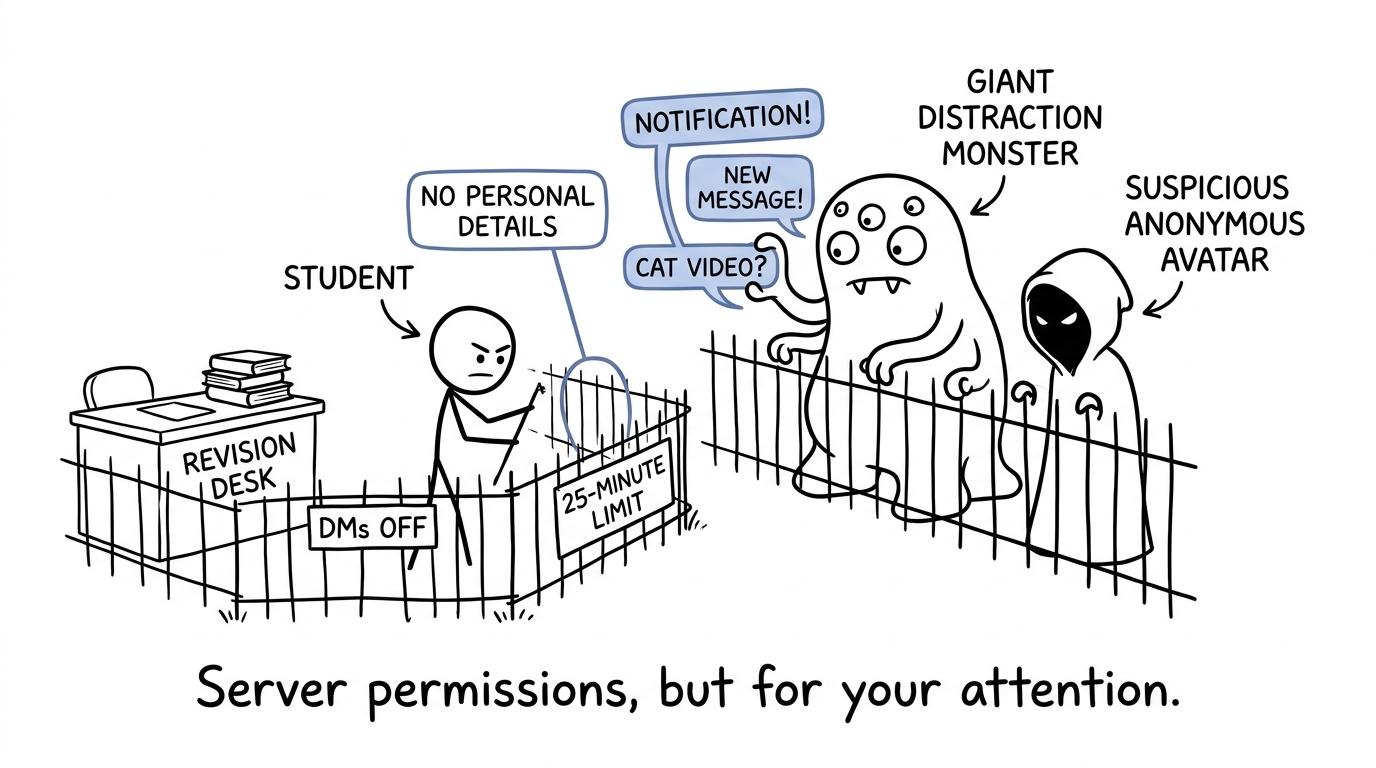 A student protecting a revision desk from notifications and suspicious online distractions
Build a revision system that does not depend on chat
A Discord server works best at the edge of a reliable system. The system itself should still function if the server disappears tomorrow.
For German, that means using your specification, teacher guidance, vocabulary retrieval, grammar practice, listening work, speaking rehearsal and timed reading or writing tasks. Use the community for a narrow purpose such as finding a speaking partner or discussing one difficult sentence.
For maths, use resources that provide a complete feedback loop:
- learn or revisit a method through a focused revision lesson;
- answer questions independently;
- check your work against a mark scheme or video solution;
- record why marks were lost;
- return to the weakness later;
- build towards timed papers.
MathsGenie makes that loop concrete. You can diagnose gaps using the approach in finding your weakest GCSE topics, then build paper experience through Edexcel GCSE Maths past papers. If exams are approaching, the guide to when you should start GCSE past papers helps you choose between topic practice, shorter tests and full papers.
Students balancing several subjects may also benefit from a fixed plan. The GCSE one-month maths revision plan shows how diagnostic work, retrieval and timed practice can fit together without allowing one subject to consume the entire week.
Common mistakes when using subject servers
Joining too many communities
Five servers do not provide five times the value. They usually create repeated resources, competing notifications and more decisions. Keep only the community that reliably improves your work.
Asking before attempting
If you request help immediately, you lose the productive struggle that reveals what you understand. Attempt the task first, identify the exact point of confusion, then ask a precise question.
Copying polished answers
A strong model response can be useful for analysis, but copying it does not develop independent language. Identify the structure or vocabulary that makes it effective, close the model and produce your own response.
Trusting unofficial exam predictions
Students may confidently predict themes, vocabulary or questions. Treat these as conversation, not certainty. Cover the specification broadly and use predicted material only as additional practice. The same discipline applies in maths: efficient GCSE maths revision combines broad topic coverage with practice, marking and correction rather than betting everything on a prediction.
Ignoring how the server affects you
A community can be academically useful but personally draining. Leave if it makes you anxious, distracts you from sleep or creates pressure to compare grades. A revision tool should reduce friction around learning, not add another social obligation.
A useful community should lead you back to practice
A GCSE German Discord server can provide explanations, speaking opportunities and a sense of shared effort. Those are real benefits. Yet the value lies in what happens next: you close the chat, retrieve the vocabulary, produce the sentence or complete the timed task yourself.
Use Discord selectively, verify everything important and keep firm safety boundaries. Then give most of your revision time to methods that produce evidence.
For maths, make MathsGenie that dependable base. Start with free revision lessons and practice questions, test yourself using mini tests, and progress to past papers, predicted papers, mark schemes and video solutions. Communities can encourage you, but deliberate practice is what turns encouragement into marks.