GCSE Geography Resit Entry: Late Entry Guide
GCSE geography resit entry explained: what to do after missing the summer sitting, how late fees work, and what to confirm before booking an exam centre.
Missing a deadline can feel strangely final. One date passes, an online form closes, and suddenly it seems as though an entire qualification has disappeared with it. Usually, it has not.
A GCSE geography resit entry is normally made through your school, college or an approved exam centre. If you missed an entry deadline but the exams have not happened, a late entry may still be possible, although extra fees and centre restrictions can apply. If you missed the actual summer sitting, you will usually need to wait for the next available Geography series rather than use the November GCSE resit window.
The important distinction is simple: missing the entry deadline and missing the exam are different problems. Each has a different next step.
GCSE geography resit entry checklist
Before revising another case study or practising another map skill, establish the administrative facts:
- Ask your former school whether it will enter you as a resit candidate.
- Confirm the exam board and exact specification: AQA, Pearson Edexcel, OCR or Eduqas.
- Check whether that specification will be available in the next exam series.
- Ask whether the centre accepts private candidates for Geography.
- Confirm how the centre will handle fieldwork requirements and declarations.
- Request the centre's own entry deadline and total fee in writing.
- Check every paper date, plus any published contingency arrangements.
- Ask immediately about access arrangements if you previously received support.
- Do not pay until the subject code, specification and candidate details are correct.
This information matters more than a vague promise that a centre “offers Geography”. It must offer your particular qualification and be willing to complete the administration attached to it.
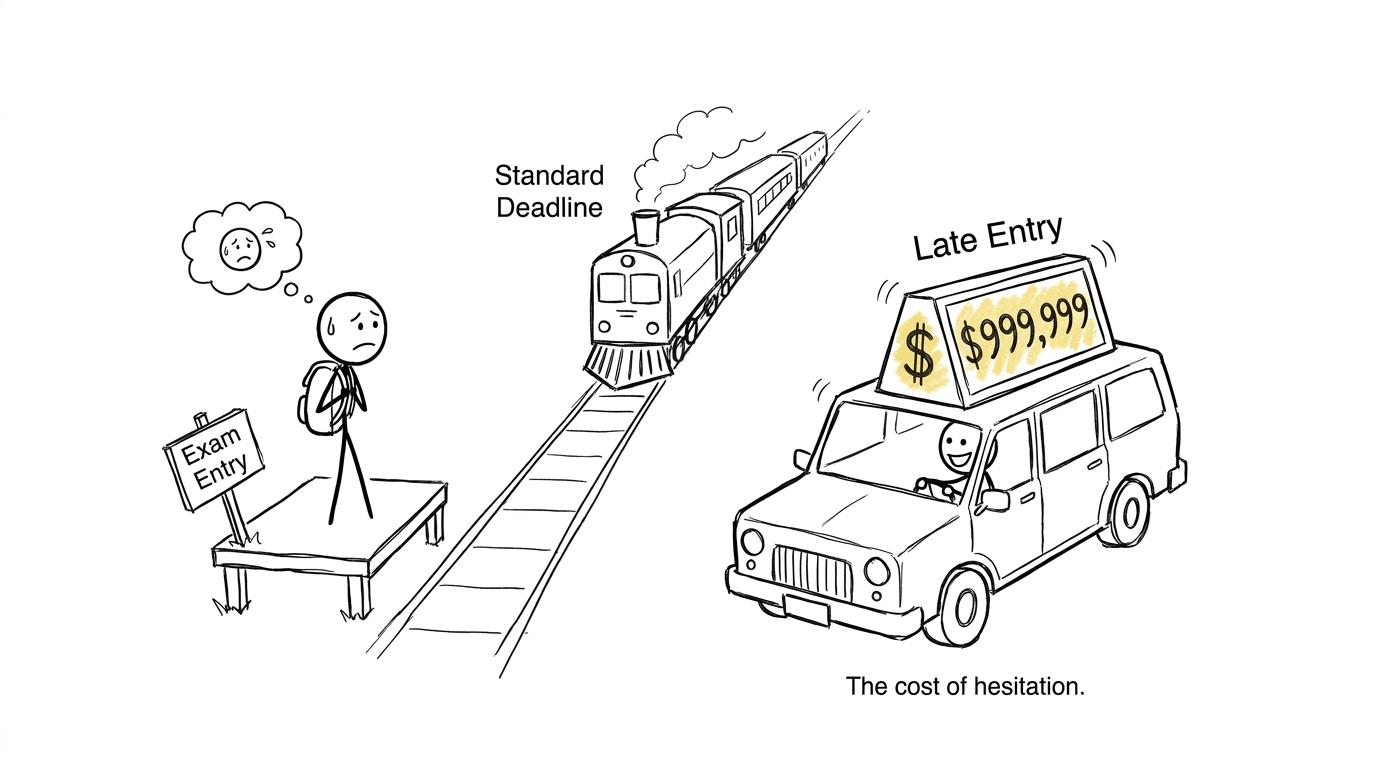 A student watches the standard entry train leave while a late-entry taxi waits
Did you miss the entry deadline or the exam itself?
These situations are often confused, especially when students search for a “late resit”.
You missed the standard entry deadline
If the examination has not yet taken place, contact the exams officer immediately. Awarding organisations usually operate a standard entry period followed by late and higher or very late fee stages. However, this does not guarantee that a centre will accept you.
Schools, colleges and private exam centres set internal deadlines. These may be weeks earlier than the awarding organisation's deadline because the centre needs time to check identification, arrange rooms, order materials and process access arrangements. A centre may also stop accepting candidates when it reaches capacity.
The published dates differ between boards. For the June 2026 series, for example, AQA and Pearson Edexcel listed 21 February 2026 as the standard GCSE entry deadline. AQA listed 21 April as its deadline for very late entries, while Pearson's high late fee stage began on 22 April. Eduqas used a different late-fee timetable. These dates illustrate why you should never assume one deadline applies to every board or future series.
For the next available series, obtain the current dates directly from your centre. Do not rely on a previous year's calendar or an old search result.
You missed one Geography paper
Contact your exams officer on the same day. A contingency session is not a personal catch-up slot; it is reserved for the unlikely event that an examination has to be moved nationally. Your centre must decide what absence reporting or special-consideration process may be relevant under the current JCQ rules.
Do not assume that a doctor's note automatically creates another sitting. Geography papers are scheduled nationally, and an individual candidate cannot normally sit the same paper later after its contents have become known.
You missed the whole summer series
In England, the regular November GCSE series is for English Language and Mathematics, with age restrictions. GCSE Geography is not normally available through that general November resit route. In most cases, somebody who misses the Geography summer examinations must look towards the next summer series.
Availability can change when specifications are being replaced or withdrawn. This is particularly important around qualification reform or a specification's final assessment opportunity. Ask the centre to confirm availability with the awarding organisation rather than assuming that last year's entry code remains valid.
How a GCSE Geography resit works
Most current GCSEs in England are linear qualifications. This means the qualification is assessed as a complete course rather than as separate modules that can be stored indefinitely.
For a Geography resit, you should normally expect to enter the full qualification and take all required examination components in the same series. You generally cannot keep a strong paper from an earlier attempt and replace only the paper with the lowest mark.
There is also no foundation or higher tier for the usual GCSE Geography specifications. That language belongs to subjects such as GCSE Maths. Your crucial Geography decisions are the board, specification and entry code, not a tier.
Pearson Edexcel, for example, has distinct Geography A and Geography B specifications. Their papers cannot simply be mixed. Similar-looking titles across boards can also cover different content, case-study expectations and fieldwork approaches.
Ask the centre to write down:
- the awarding organisation;
- the full qualification title;
- the specification and entry code;
- every component you will sit;
- the examination series;
- the total charge and refund conditions.
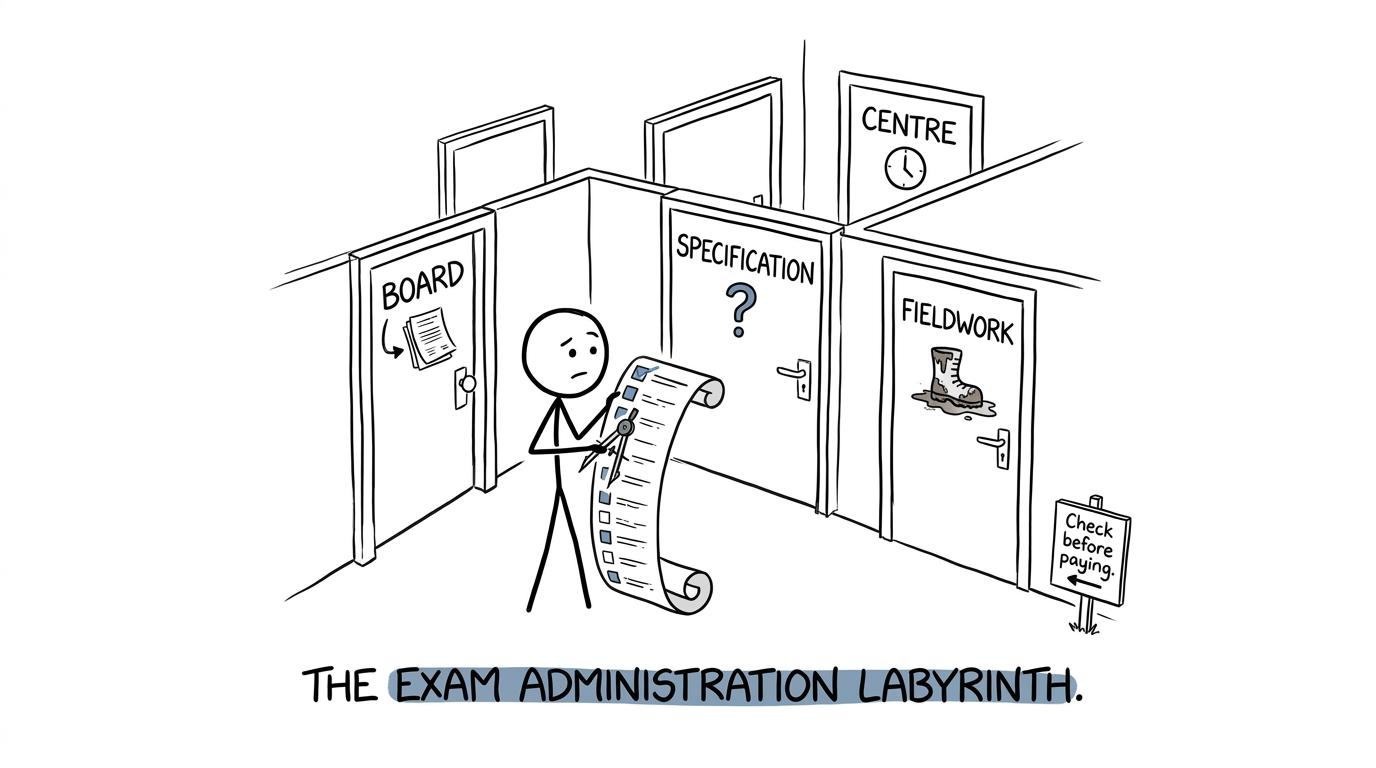 A student navigates doors marked board, specification, centre and fieldwork
Finding an exam centre as a private candidate
A private candidate is someone taking the qualification without being enrolled full-time at the centre making the entry. You cannot enter yourself directly with AQA, Pearson Edexcel, OCR or Eduqas. An approved centre must submit the entry and supervise the examinations.
Begin with your previous school. It already holds much of the information an exams officer may need, such as your candidate history and Unique Candidate Identifier. Some schools support former pupils; others do not have the capacity or policy to accept external entries.
If that route is unavailable, contact local schools, further education colleges and private candidate centres. Ask specific questions rather than sending a general request:
- Do you accept private candidates for my exact GCSE Geography specification?
- Can you meet its fieldwork and declaration requirements?
- What is your internal deadline?
- Does the quotation include awarding-organisation, administration and invigilation fees?
- Can you process my existing access arrangements, and what evidence is required?
- When will I receive a statement of entry?
Contact several centres. A centre's decision not to offer Geography is not evidence that the qualification cannot be taken elsewhere.
Why fieldwork can affect a late Geography entry
Geography is not always as straightforward to administer as an entirely examination-only subject. Although the assessment model varies by specification, fieldwork remains part of GCSE Geography learning and assessment arrangements.
For AQA GCSE Geography, for example, centres accepting private candidates have specific responsibilities connected with fieldwork and the relevant declaration. Other boards have their own requirements. A centre must be satisfied that it can meet the rules; accepting private candidates for GCSE Maths does not automatically mean it can accept them for Geography.
This is why a very late request may fail even when an awarding organisation's electronic entry system is technically open. The obstacle may not be the exam entry itself. It may be the centre's inability to verify fieldwork, process paperwork or provide the correct materials in time.
Tell a prospective centre what fieldwork you previously completed and retain any legitimate records supplied by your former school. Never claim that a requirement has been completed when it has not. Ask the centre what evidence it needs and whether additional arrangements are possible under the current specification.
What late-entry fees actually mean
There is no single national price paid by every private candidate. Your quotation can include the awarding organisation's subject fee, the centre's administration charge, invigilation, venue costs and additional late-entry charges.
Awarding organisations may increase their entry charge after published deadlines. Centres can also impose earlier cut-offs or their own administration fees. Therefore, two centres may quote different totals for the same specification.
Before paying, request an itemised quotation and ask:
- Is this the standard, late or very late price?
- Could the price increase before my entry is submitted?
- What happens if the centre cannot complete the entry?
- Which charges are refundable if I withdraw?
- Is the booking confirmed only after full payment?
A late-entry window is an emergency route, not a planning strategy. Availability becomes less predictable as the examinations approach, particularly where specialist administration is involved.
Build revision around a confirmed entry
Administrative uncertainty consumes attention. Once your entry is confirmed, convert that attention into a routine.
Start by checking the specification and making a topic list. Then complete a timed Geography paper from your board, mark it carefully and classify lost marks: missing knowledge, weak case-study evidence, data interpretation, fieldwork understanding, command words or timing.
For students balancing a Geography resit with GCSE Maths, the free GCSE Maths revision hub keeps board-specific lessons, questions and papers together. The same disciplined feedback loop works in both subjects: attempt, mark, diagnose, repair and retest.
If your maths resit is happening alongside Geography, use the GCSE maths resit revision plan to organise the first weeks. The guide to finding your weakest GCSE topics can help you turn paper results into a manageable priority list.
Do not let revision become a second administrative maze. Use the one-month GCSE revision plan as a model for scheduling focused sessions. For maths practice, combine Edexcel GCSE mini tests with GCSE predicted papers, mark schemes and video solutions.
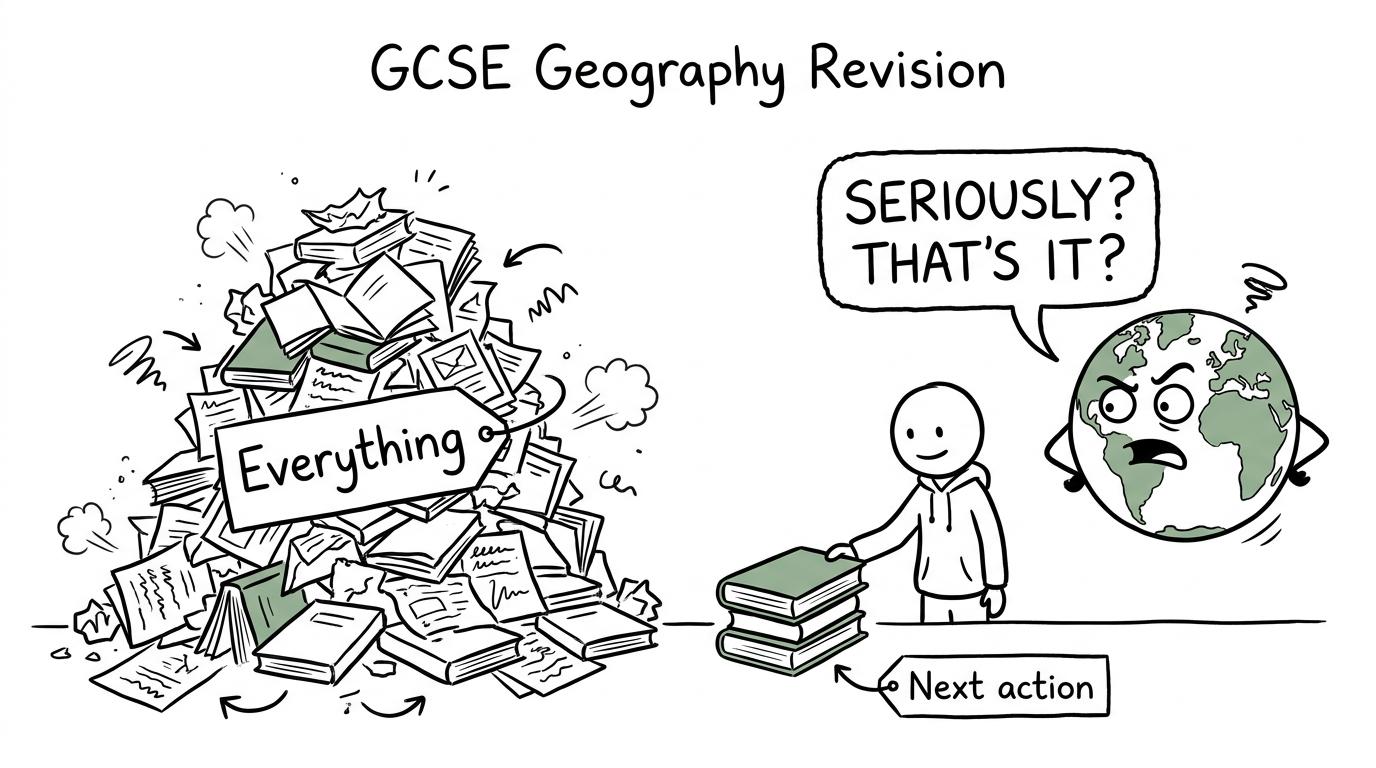 A student chooses a small next-action pile instead of an enormous everything pile
Common mistakes with late and resit entries
Assuming November includes Geography
The familiar November GCSE resit opportunity in England applies to English Language and Mathematics, not Geography generally. Check the next confirmed Geography assessment opportunity before planning around an autumn date.
Revising before confirming the specification
AQA, Edexcel, OCR and Eduqas do not have interchangeable papers. Confirm the board and exact specification before buying materials or learning prescribed case studies.
Confusing an awarding-organisation deadline with a centre deadline
The centre may close entries earlier or stop when it is full. Its internal deadline is the practical deadline that applies to you.
Ignoring fieldwork until payment
Ask about fieldwork and declarations during the first conversation. An exam centre may offer many written GCSEs but be unable to accept private candidates for your Geography specification.
Assuming access arrangements transfer automatically
Previous support does not remove the need for current evidence and centre processing. Raise requirements immediately, because access-arrangement deadlines and procedures may differ from ordinary entry deadlines.
Failing to check the statement of entry
When it arrives, check your legal name, date of birth, candidate details, board, specification and every component. Report an error immediately rather than waiting for exam day.
Turn the missed date into a clear next action
A missed deadline feels large because it is uncertain. The remedy is not to guess harder. It is to reduce the uncertainty one question at a time.
Contact your former school or an approved centre today. Confirm the board, specification, next available series, fieldwork requirements, deadline and complete fee. Once the entry is secure, build a revision plan around the papers you will actually sit.
MathsGenie can support the rest of your GCSE workload with free revision lessons, practice questions, mini tests, past papers, predicted papers, mark schemes and video solutions. Use the revision planner to protect regular sessions, then begin with one diagnostic paper from the GCSE Maths revision area. A missed sitting may change the calendar, but it does not have to decide the outcome.