GCSE Geography Part Time Job Balance: A Real Plan
GCSE geography part time job balance: build a realistic weekly plan around shifts, protect sleep and keep geography and maths revision moving during exams.

A part-time job can make GCSE revision feel like a timetable problem with too many fixed values. School occupies the day. A shift takes the evening. Geography needs case studies, fieldwork and extended answers, while maths improves through regular question practice. Sleep somehow has to fit as well.
The answer to GCSE geography part time job balance is not to revise every subject every night. Build your week around fixed shifts, give geography and maths different types of revision block, and protect a small number of sessions that you can repeat reliably. On workdays, keep revision short. Use non-workdays for deeper tasks and timed practice.
This is not about constructing a perfect colour-coded timetable. It is about creating one that still works when you are tired on a Thursday evening.
Your realistic balance checklist
Start with these principles:
- Put school, shifts, travel, meals and sleep into your timetable first.
- Ask your employer for rotas as early as possible.
- Keep workday revision to one small, specific task.
- Place extended geography answers and maths papers on non-workdays.
- Revise by task rather than writing vague labels such as “Geography”.
- Mark practice promptly and turn mistakes into the next task.
- Reduce commitments before mocks and final examinations where possible.
- Tell an adult if work is damaging your attendance, sleep or wellbeing.
The central idea is simple: your plan should follow your available energy, not merely the empty spaces on a calendar.
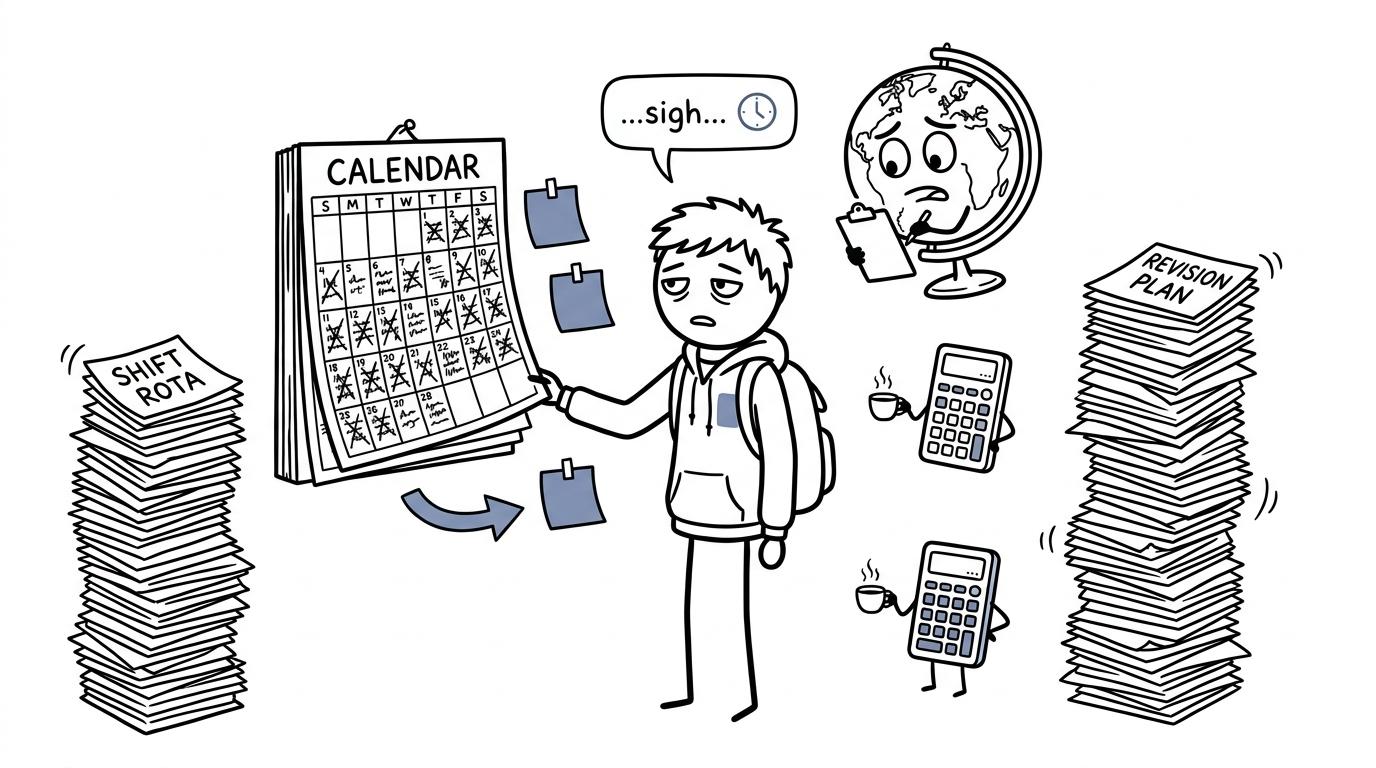 A student replaces an impossible calendar with three manageable revision notes
Build the week around fixed commitments
Begin with what cannot easily move: lessons, shifts, travel and sleep. Revision comes afterwards. This may sound restrictive, but boundaries make planning clearer. A blank timetable encourages optimistic promises; a truthful one reveals what you can actually sustain.
Separate your evenings into three categories:
Shift days
Plan one light task lasting roughly 151515 to 252525 minutes. Suitable geography activities include retrieving a case study from memory, labelling a blank map or planning the structure of an extended response. For maths, use several short practice questions or revisit one error from an earlier paper.
A shift day is usually the wrong place for a full paper or a large new topic. The goal is continuity, not exhaustion.
Non-work school days
Use a focused block of approximately 404040 to 606060 minutes. This is enough time to practise a longer geography response, complete a fieldwork review or work through a defined maths topic.
If maths is the priority, begin at the GCSE maths revision hub, choose one topic and move from the lesson to questions. A named task such as “complete ratio questions and mark them” is far easier to start than “revise maths”.
Weekend or protected days
Reserve one longer block for work requiring sustained attention. This might be a timed geography section, a maths mini test or part of a past paper. Do not automatically fill every free weekend hour. Recovery is part of the plan because tired revision often becomes slow reading without much recall.
Give geography and maths different revision jobs
Geography and maths do not always benefit from identical methods.
GCSE Geography specifications from boards such as AQA, Edexcel, OCR and Eduqas combine physical and human geography with geographical skills and fieldwork. Exact assessment structures vary, so use the specification and advice provided by your school. Effective revision normally needs several distinct activities:
- recalling named facts and case-study evidence;
- interpreting maps, graphs, photographs and unfamiliar resources;
- reviewing fieldwork methods, conclusions and limitations;
- planning and writing responses to command words;
- checking answers against mark schemes.
Maths is more procedural. Reading a method can help, but progress has to be tested through questions. MathsGenie brings together free revision lessons, practice questions, mark schemes and video solutions, making it easier to run a short learn to practise to mark cycle.
If a long shift leaves you mentally tired, use that evening for geography retrieval or a short maths correction task. Save extended writing and timed papers for a day when your attention is stronger.
That is genuine balance. It does not mean giving both subjects equal time every day. It means giving each subject the kind of time it needs across the week.
Use small sessions without making revision superficial
Short revision works only when the task is precise. “Read geography notes for 202020 minutes” can become passive. “Close the notes and write everything remembered about one case study, then check omissions” creates evidence of learning.
The same principle applies to maths. The 20-minute GCSE maths revision routine is useful after a shift because it removes the decision-making: recall, answer questions, mark, and identify the next small task.
A strong short session has three parts:
- Retrieve: begin without notes and recall what you know.
- Apply: answer a question, create a plan or interpret a resource.
- Check: use notes, a solution or a mark scheme to identify the gap.
Do not judge a session by the number of pages covered. Judge it by what you can now retrieve or do unaided.
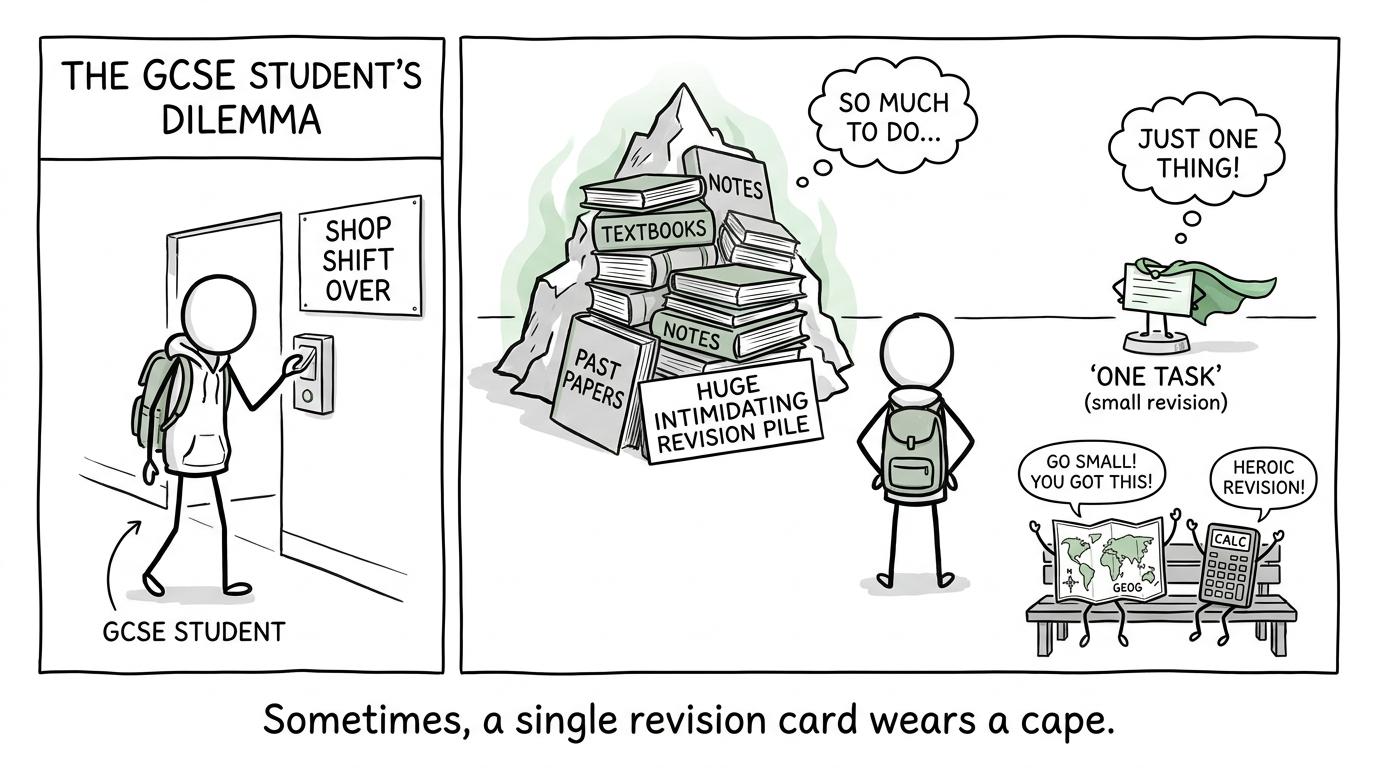 A tiny revision task in a cape defeats an intimidating book mountain
Plan for changing shift patterns
A revision timetable that assumes the same rota every week may fail quickly. Instead, create two versions.
Your normal-week plan
Use this when shifts and school are predictable. Give each non-work evening a subject priority and protect one longer weekend session. Leave at least one evening deliberately light.
Your heavy-work plan
Use this when you receive extra shifts or work runs late. Reduce the length of revision without abandoning it completely. Keep essential deadlines, one geography retrieval task and one short maths practice session. Move lower-priority work rather than trying to compress everything into the next day.
At the start of each week, check:
- confirmed shift times and travel;
- homework and coursework deadlines;
- upcoming geography or maths assessments;
- topics that caused difficulty last week;
- one buffer period for unfinished work.
A buffer matters because plans rarely fail in dramatic ways. They fail when one delayed bus, difficult homework task or changed shift pushes every later task backwards.
Speak to your employer before exam pressure peaks
Do not wait until the evening before a mock to mention that you need fewer hours. As soon as your school confirms important dates, share your availability clearly and politely. Ask how early rotas are normally prepared and whether shifts can be swapped.
You might request:
- no shift on the evening before an examination;
- fewer hours during mocks and the final exam period;
- predictable shifts rather than frequent last-minute changes;
- earlier notice when additional cover is needed.
An employer may not be able to approve every request, but early notice gives everyone more room to plan. Keep the conversation factual: provide dates, explain the temporary change and state the hours you can still work.
There are also legal protections around young people’s employment, although the precise rules depend on age, school-leaving status and where you live in the UK. In England, children below school-leaving age are generally limited to 121212 hours of work during a school week, including no more than 222 hours on a school day. Local council rules and permit requirements may also apply. Young workers above school-leaving age but under 181818 have separate limits and rest entitlements. Check current government and local council guidance with a parent, carer or school if you are unsure.
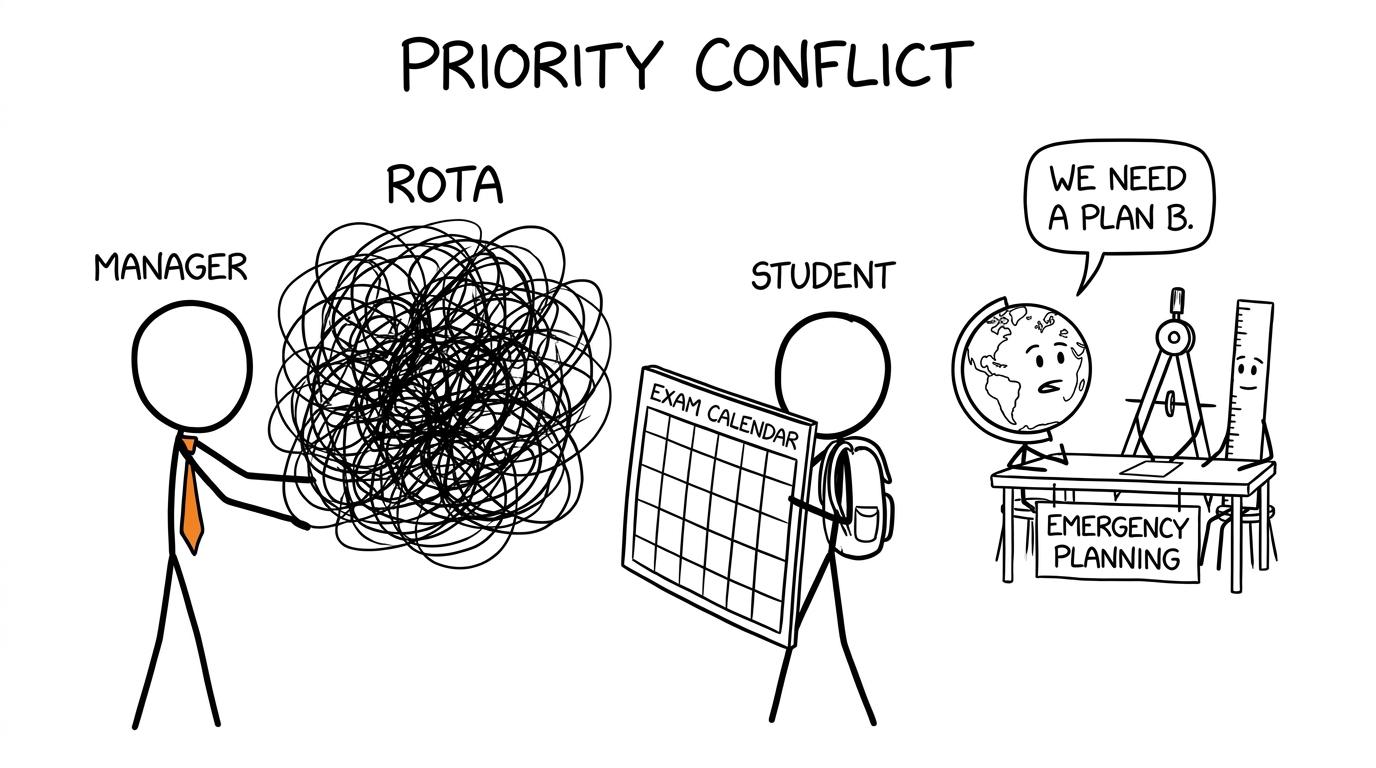 A student uses an exam calendar as a shield against a tangled shift rota
Keep maths moving while geography is the priority
Because geography is the immediate concern, it may be tempting to pause maths completely. That often creates a larger problem later. Maths methods become less familiar when they are not retrieved, so maintain a small weekly thread.
On a busy week, that thread might include one topic session and one timed mini test. Use MathsGenie’s free GCSE maths resources to find revision lessons and exam-style questions. If you take Edexcel, Edexcel GCSE maths past papers include papers and mark schemes for realistic practice.
When time is limited, diagnose before doing more. A short timed set can reveal whether marks are being lost through missing knowledge, weak interpretation or avoidable accuracy errors. The guide to finding your weakest GCSE maths topics explains how to turn paper mistakes into a focused revision list.
Closer to the examinations, follow a clear sequence: learn or refresh a topic, practise it, mark the work, and then test it again. The article on revising Edexcel GCSE maths without wasting time provides a useful structure even if your main revision pressure currently comes from geography.
Know when the balance is no longer working
A part-time job can offer money, responsibility and useful experience. But the arrangement needs reviewing if you are regularly missing homework, arriving at school exhausted or losing the time required for compulsory fieldwork and exam preparation.
Warning signs include:
- relying on late-night revision several times a week;
- repeatedly missing school deadlines because of shifts;
- having no uninterrupted time for timed practice;
- feeling unable to refuse additional shifts;
- watching grades fall without adjusting the rota;
- giving up sleep to recover unfinished work.
Speak to a parent, carer, teacher, head of year or employer early. Asking for help is not evidence that you are failing to manage your time. It is part of managing it.
Common mistakes when balancing work and revision
Planning every available minute
A timetable with no spare space assumes that nothing will run late. Build in a buffer and keep at least one lighter evening.
Treating all revision as equal
Copying notes, completing a timed paper and correcting mistakes demand different levels of concentration. Match harder tasks to your best available time.
Saving everything for days off
A single revision marathon is fragile. Several small weekday sessions preserve recall and make the longer weekend block more productive.
Revising only the subject that feels urgent
Geography may have the next assessment, but abandoning maths for weeks allows methods to fade. Maintain a modest maths routine, then increase it when the exam calendar requires.
Completing papers without reviewing them
A paper only becomes useful when you analyse it. Follow the process in how to use GCSE maths past papers properly: mark carefully, identify the topic behind each lost mark and revisit the hardest questions.
Build a plan that survives real life
The best GCSE geography and part-time job balance is not the timetable containing the most revision. It is the one you can follow through ordinary school weeks, changing rotas and tired evenings.
Place fixed commitments first. Use shift days for small retrieval tasks, non-workdays for deeper geography and maths practice, and protected weekend time for timed work. Review the arrangement whenever your rota or exam calendar changes.
Let MathsGenie carry some of the organisational load for maths. Start with free revision lessons and practice questions, then use mini tests, past papers, predicted papers, mark schemes and video solutions to decide what deserves your next session. When examinations approach, the GCSE maths exam-week checklist can help you stay calm and targeted.
Choose one geography task and one maths task for this week. Put them around your confirmed shifts, not an imaginary empty calendar. A smaller plan you complete is worth far more than a perfect plan you cannot begin.