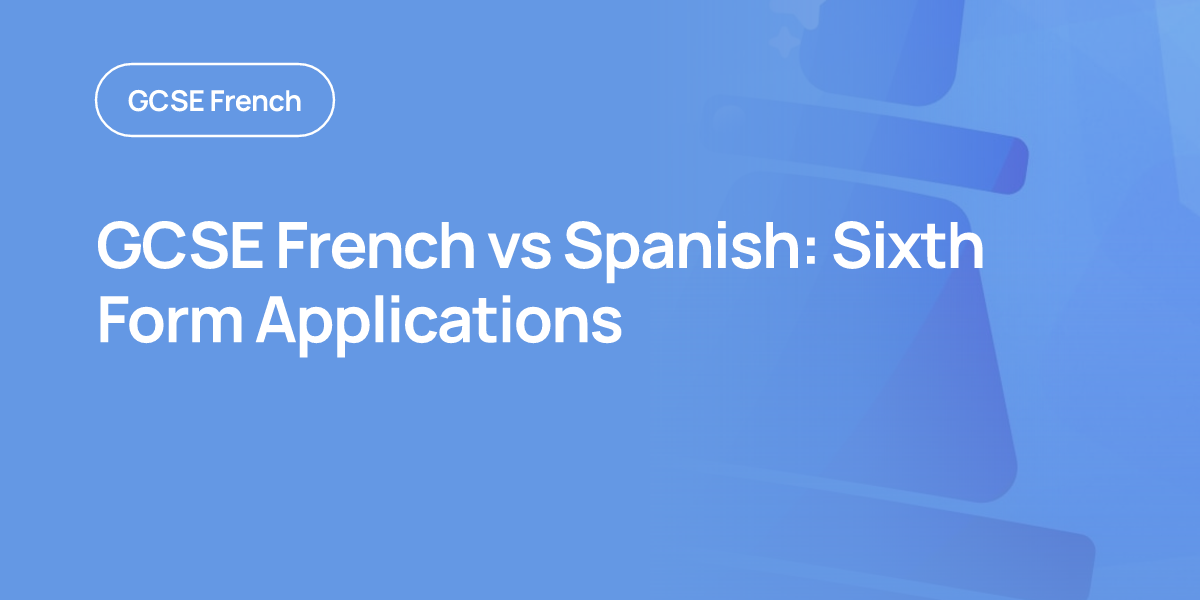
GCSE French vs Spanish: Sixth Form Applications
GCSE French vs Spanish sixth form choices explained: learn what admissions teams value, when your language matters, and how to protect your maths grade.
Choosing GCSE options can feel strangely permanent. French sits in one column, Spanish in another, and suddenly a decision made in Year 999 appears to carry the weight of your entire education.
Here is the direct answer to GCSE French vs Spanish sixth form concerns: sixth forms do not generally consider one of these languages more impressive than the other. Both are established GCSE qualifications. Admissions decisions are much more likely to depend on your overall grades, the entry requirements for your intended A Levels and, where relevant, your result in the language you want to continue.
The better choice is usually the language in which you are most likely to remain motivated and achieve a strong grade. There are exceptions, so checking each sixth form's published requirements remains essential.
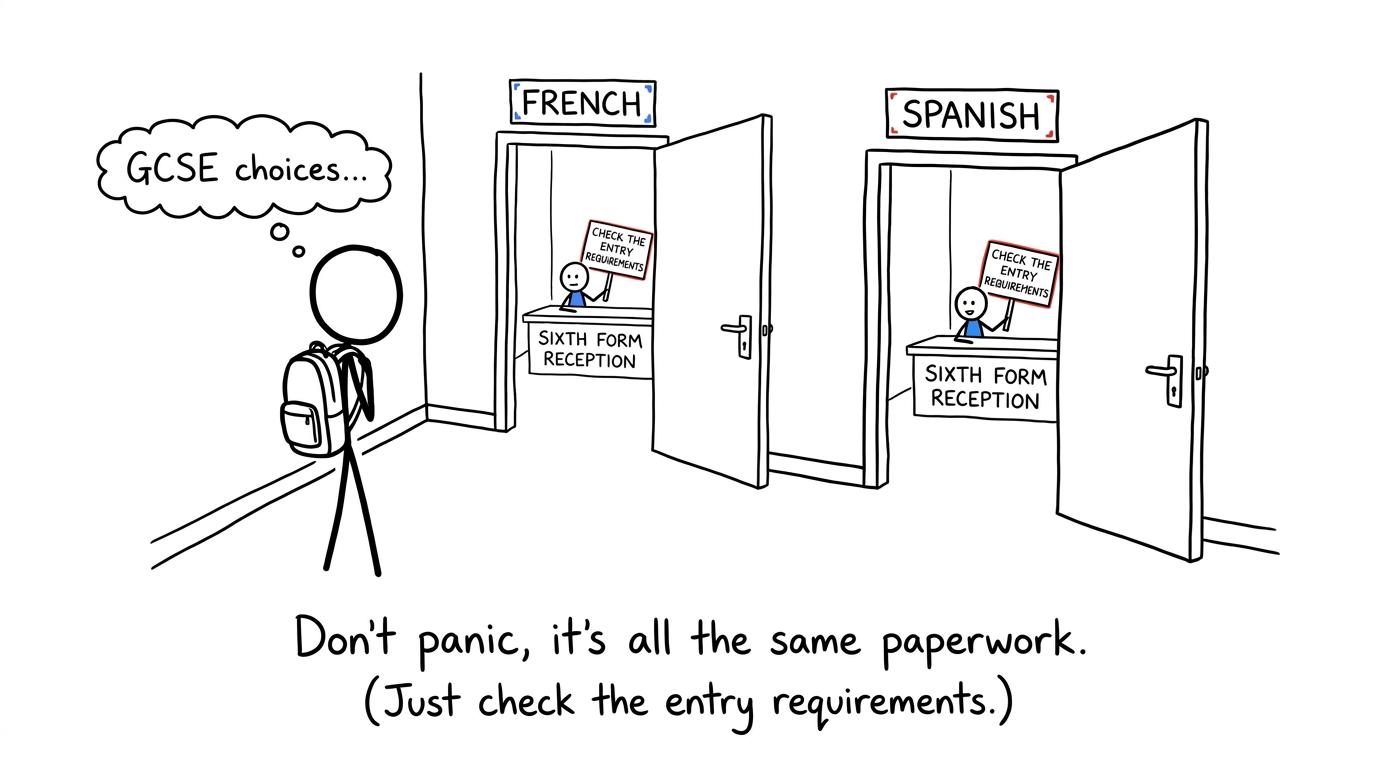 A student discovers that French and Spanish can lead to the same sixth form desk
The short answer: neither language automatically looks better
There is no national sixth form admissions rule that gives GCSE French greater status than GCSE Spanish, or Spanish greater status than French. Both can fulfil the language component of the English Baccalaureate in England, and both are recognised GCSE subjects.
For most applications, admissions teams are looking at questions such as:
- Have you met the sixth form's overall GCSE entry requirements?
- Do you have the required grade in GCSE Maths and English?
- Have you met the subject-specific requirements for your chosen A Levels?
- Does your proposed combination of subjects fit the timetable?
- If you want to take an A Level language, have you studied the relevant language at GCSE?
The name of your GCSE language normally matters less than the grade you earn in it. A strong result can support an application by showing consistency, communication skills and the ability to retain and apply detailed knowledge. However, it does not normally override a missing subject-specific grade elsewhere.
If A Level Maths requires a particular GCSE Maths grade at your chosen sixth form, an excellent French or Spanish result will not replace it. That is why students preparing for maths exams should keep their attention on the requirements that directly affect their intended course.
A practical choice checklist
Before selecting French or Spanish, ask:
- Which language do I currently understand more confidently?
- In which subject am I performing more consistently?
- Which teaching provision is available at my school?
- Which language am I more willing to practise regularly?
- Might I want to continue one language at A Level?
- What do my possible sixth forms actually require?
- Will my choice leave enough revision time for core subjects, including maths?
This checklist is more useful than trying to guess which subject sounds more prestigious. Applications are assessed against published criteria, not against a universal league table of languages.
When your language choice can matter
Although neither GCSE is inherently superior, your decision can matter in a few specific situations.
You want to take French or Spanish at A Level
A sixth form offering A Level French will usually expect applicants to have studied GCSE French. The same principle generally applies to Spanish. The required grade differs between institutions, and some sixth forms may consider individual circumstances, so always read the current admissions policy and course guide.
Choosing Spanish because it seems easier would therefore be unhelpful if your real goal is A Level French. Continuity matters when the later course assumes vocabulary, grammar, speaking and listening experience from the same language.
Availability matters too. Not every sixth form offers both languages every year, and a course may depend on staffing, timetabling or sufficient student demand. Check what is actually available rather than assuming a subject will run.
A particular sixth form has unusual requirements
Sixth forms and colleges set their own admissions criteria within the relevant legal framework. Many publish an overall GCSE threshold alongside separate requirements for subjects such as Maths, Further Maths, sciences and modern foreign languages.
Most will not state a preference between French and Spanish. If an institution does have a course-specific condition, its own published policy is the authority. Requirements can change between admission cycles, so advice from an older sibling or a forum post should not replace the current prospectus.
You are applying with a broad academic profile
A language can contribute to a broad set of GCSEs, but breadth is not the same as prestige. Admissions teams still need evidence that you are prepared for the particular A Levels you selected.
For a student considering A Level Maths, the most relevant evidence is normally GCSE Maths performance. If Further Maths is part of the plan, the expected GCSE Maths grade may be higher. The exact threshold varies, which is another reason to compare local course pages early.
You can use MathsGenie's free GCSE maths revision resources to identify topics that need attention before those grades become urgent.
French or Spanish: how to make the stronger decision
The strongest option is not necessarily the one that initially feels effortless. It is the one you can study consistently enough to understand the specification and perform well across the required skills.
Compare your present evidence
Look beyond one vocabulary test. Review your performance over a term, including reading, writing, listening and speaking tasks. A temporary difficulty with one topic does not make a language the wrong choice, but a consistent pattern can tell you where your foundations are stronger.
Teacher feedback is valuable because your teacher has seen more evidence than a single mark reveals. Ask where you are making progress, what would need to improve and how the GCSE course differs from your current lessons.
Think about motivation after the novelty disappears
Every GCSE subject eventually becomes repetitive. Languages require regular encounters with vocabulary and grammar rather than a last-minute burst of revision. Interest matters because it makes that repetition easier to sustain.
French may appeal because you have studied it for longer. Spanish may feel more engaging because it is newer, or because you are interested in places where it is spoken. Neither reason guarantees a higher grade, but both can influence whether you keep practising when the work becomes demanding.
Consider teaching and support
Your experience depends partly on what your school can provide. Consider teacher continuity, lesson time, available speaking practice and the support offered when you fall behind. This is not about judging individual teachers. It is about understanding the real course available to you rather than an imaginary comparison between two subject names.
The same principle applies to maths. Reliable resources reduce friction when classroom time is not enough. MathsGenie's GCSE revision lessons combine videos with questions and answers, allowing you to revisit a topic at your own pace.
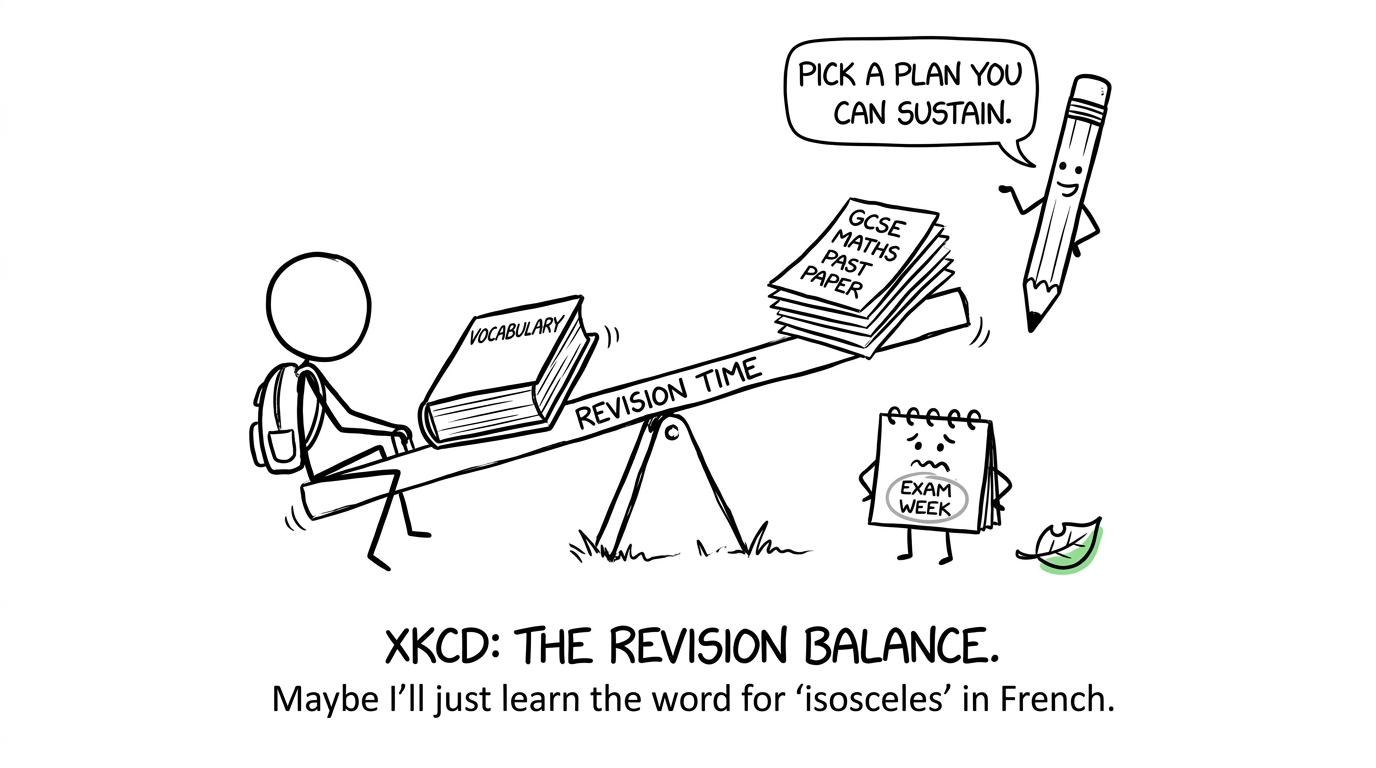 A student tries to balance language learning with a maths past paper
Protecting your maths grade while taking a language
Students rarely struggle because they chose the objectively wrong language. More often, several reasonable subjects begin competing for the same limited evenings.
Maths and language revision benefit from different rhythms. Vocabulary and listening improve through frequent, shorter sessions. Maths also requires regular practice, but those sessions should include complete questions, checking and correction.
A sensible weekly routine might include:
- short language recall sessions spread across the week;
- one or two longer maths practice blocks;
- time to correct errors rather than merely count completed questions;
- a mixed paper or mini test when several topics have been revised;
- protected rest, particularly as exams approach.
Use the MathsGenie revision planner to turn a vague intention to revise into a manageable sequence. Begin with the areas losing you the most marks, then use GCSE maths past papers when you are ready to combine topics under timed conditions.
Past papers answer a different question from revision lessons. A lesson helps you learn a method; a paper tests whether you can recognise when to use it. Mark schemes and video solutions then show whether an error came from knowledge, interpretation or exam technique.
Closer to the exam, MathsGenie predicted papers can provide additional practice in the style of current GCSE assessments. They should supplement specification coverage and past papers, not be treated as a promise of the exact questions that will appear.
What sixth forms are more likely to value
An application is a collection of evidence. One subject title rarely defines it.
Admissions teams are more likely to focus on whether you meet their stated requirements and appear academically prepared for your chosen programme. Strong attendance, a suitable subject combination and any contextual information considered under the institution's policy may also form part of the process.
For maths-related pathways, relevant grades carry particular weight. A student intending to take A Level Maths should therefore prioritise secure algebra, number, geometry, ratio, probability and statistics skills across the appropriate tier. The MathsGenie GCSE maths course organises revision by topic and grade, making it easier to see what has been covered and what remains uncertain.
If you are already looking beyond GCSE, the MathsGenie A Level maths revision section can show how later topics build on GCSE foundations. It is useful for understanding the destination, although your immediate priority should remain mastering the course you are currently taking.
 French and Spanish dictionaries learn that the admissions judge cares about requirements
Common mistakes when choosing between French and Spanish
Assuming one language is universally easier
Difficulty depends on your prior learning, teaching, confidence and willingness to practise. Spanish pronunciation may feel approachable to one student while French familiarity benefits another. Generalisations cannot predict your final grade.
Choosing solely because friends are taking it
Friends can make a class feel comfortable, but classes and timetables may change. You will still complete your own assessments and revision. Use your interests and evidence as the main criteria.
Believing French automatically looks more academic
This is a persistent impression rather than a general admissions rule. French and Spanish are both recognised modern foreign language GCSEs. Check individual requirements instead of relying on perceived prestige.
Ignoring the language needed for A Level
If you may continue a language, investigate the relevant A Level now. Confirm which GCSE is expected and the required grade directly with each prospective sixth form.
Sacrificing core-subject revision
A language GCSE can strengthen a broad academic programme, but it cannot compensate for missing a compulsory Maths or English requirement. Keep your weekly plan balanced and respond early when one subject begins consuming disproportionate time.
Choose evidence over anxiety
For most students, the GCSE French vs Spanish sixth form question has a reassuring answer: neither language automatically looks better. The stronger choice is the one that fits your ability, motivation, school provision and possible A Level plans.
Check current sixth form requirements, speak to your teachers and choose based on evidence rather than rumours. Then return your attention to what you can control: learning consistently and earning the strongest grades you can.
For maths, start with MathsGenie's free revision lessons and practice questions, build confidence with topic practice, and move on to past papers and mark schemes. Add predicted papers, mini tests, video solutions and the revision planner when they serve a clear purpose. A sixth form application is not improved by finding a supposedly perfect option. It is improved by preparing well for the subjects already in front of you.