GCSE French Part Time Job Balance: A Realistic Plan
GCSE French part time job balance: build a flexible weekly plan, protect exam preparation and keep maths revision moving around changing shifts calmly.

A part-time job can make revision feel like a contest between three immovable things: school, shifts and sleep. Add French vocabulary, speaking practice and GCSE maths papers, and even a carefully written timetable can unravel by Tuesday.
The answer to gcse french part time job balance is not to squeeze heroic revision sessions into every free evening. Build a flexible week around confirmed shifts, give French short and frequent slots, reserve longer blocks for exam practice, and protect a small maths minimum. When work changes, move the session rather than abandoning the subject.
That is the central idea: balance does not mean giving everything equal time each day. It means keeping every important commitment alive across the week.
Your quick balance checklist
Before designing a detailed timetable, establish these foundations:
- Put school, confirmed shifts and travel time into one calendar.
- Check your French exam board, specification and tier.
- Give French several short sessions rather than one weekly marathon.
- Keep a minimum maths routine for busy days.
- Match revision tasks to your likely energy level.
- Ask about exam-period availability well before rotas are written.
- Leave one catch-up space empty each week.
- Review the plan weekly rather than rebuilding it every evening.
MathsGenie's free revision planner provides a useful starting point. Add work commitments first, then place revision into the time that genuinely remains.
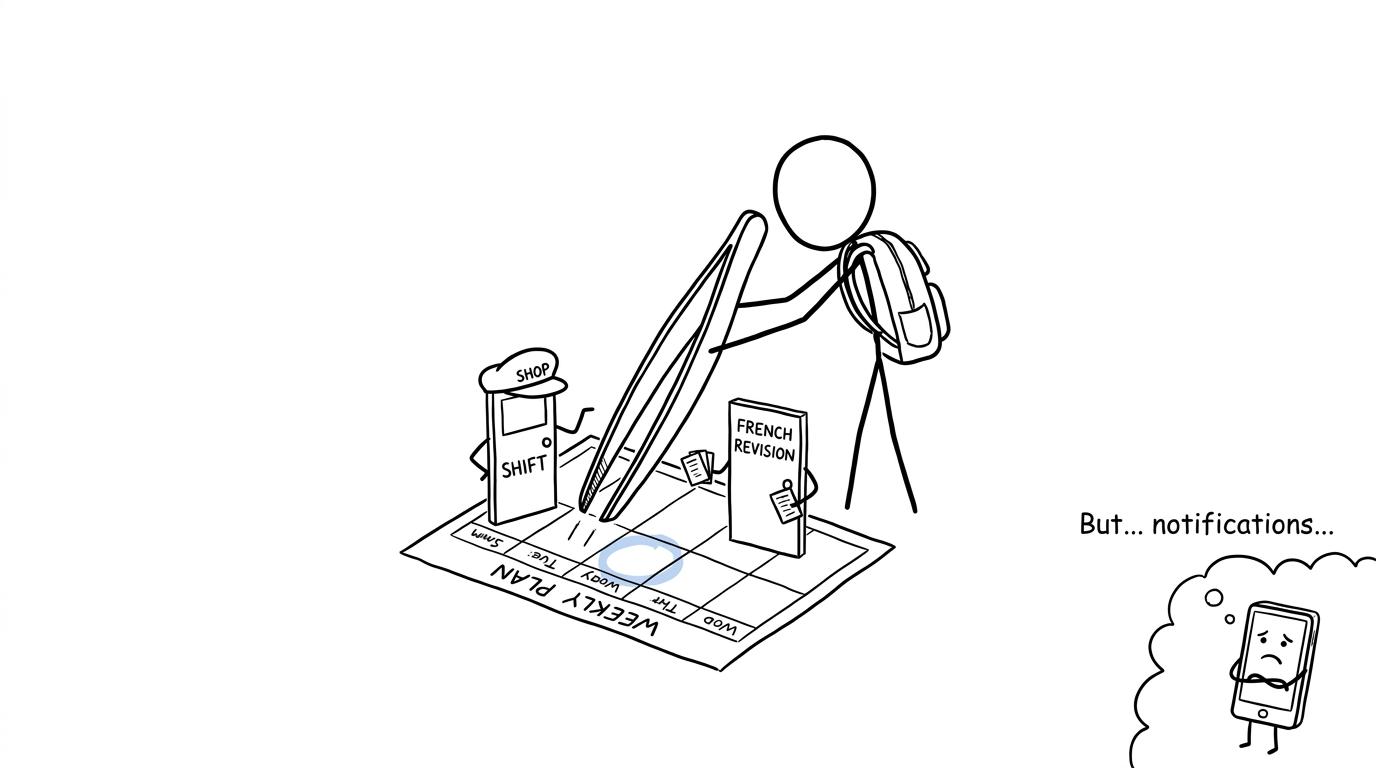 A student calmly fitting work and revision into one calendar
Start with your real week, not your ideal week
An ideal timetable assumes every shift finishes promptly, every bus arrives on time and every evening begins with limitless concentration. A useful timetable assumes ordinary life will intervene.
At the beginning of each week, separate your time into three categories:
- Fixed: school, shifts, travel, meals and regular responsibilities.
- Protected: sleep, important revision blocks and necessary rest.
- Flexible: short tasks that can move between days.
French vocabulary retrieval is flexible. A timed writing task is less flexible because it needs uninterrupted attention. A full maths paper needs even more protection, so it may belong on a non-working weekend morning rather than after a late shift.
You can express the available revision time as:
R=W−F−PR = W - F - PR=W−F−Pwhere RRR is revision time, WWW is the usable time in your week, FFF is fixed time and PPP is protected personal time. This is not an invitation to remove sleep from PPP. It is a reminder that a timetable cannot allocate the same hour twice.
If your rota changes weekly, plan only when it is published. Keep a list of movable tasks so that revision can be rearranged quickly without another long planning session.
Know what GCSE French actually requires
GCSE French is not one skill called “French”. It involves understanding and producing spoken and written language. Your preparation therefore needs to cover listening, speaking, reading, writing, vocabulary and grammar rather than repeatedly choosing the easiest activity.
Reformed French specifications were introduced for first teaching in England from September 202420242024, with first assessments in summer 202620262026. They remain tiered, so students take their assessments at either foundation or higher tier. Exact tasks and timings depend on your exam board, whether that is AQA, Edexcel, OCR or Eduqas, so use the current specification and guidance supplied by your school.
A practical weekly French rotation could include:
| Session type | Suitable task |
|---|---|
| Low-energy session | Retrieve vocabulary or read a short passage |
| Medium-energy session | Complete grammar, translation or listening practice |
| High-energy session | Record speaking answers or complete timed writing |
| Feedback session | Correct errors and rewrite weak answers |
This prevents a common trap: spending every available minute learning isolated words while avoiding the speaking and writing tasks that expose whether you can use them.
Use a two-level revision system
Shift workers need two versions of the plan: the normal version and the tired version.
Your normal session
On a day without work, use a focused block of roughly 303030 to 454545 minutes. Choose one precise outcome, such as improving pronunciation in a speaking theme, completing a listening section or correcting a written response.
The important part is feedback. After the task, identify the vocabulary, grammar or pronunciation that needs another attempt. Revision becomes more efficient when the next session is chosen from evidence rather than mood.
Your minimum session
After a demanding shift, the target might be only 101010 to 151515 minutes. That can still be useful if the task is specific:
- recall a small vocabulary set without notes;
- speak answers to two familiar prompts;
- correct yesterday's errors;
- listen to one short extract;
- review one grammar pattern.
A minimum is not your entire revision strategy. It is the bridge that stops several busy days becoming an abandoned week. Maths students can apply the same principle through the 20-minute maths revision routine.
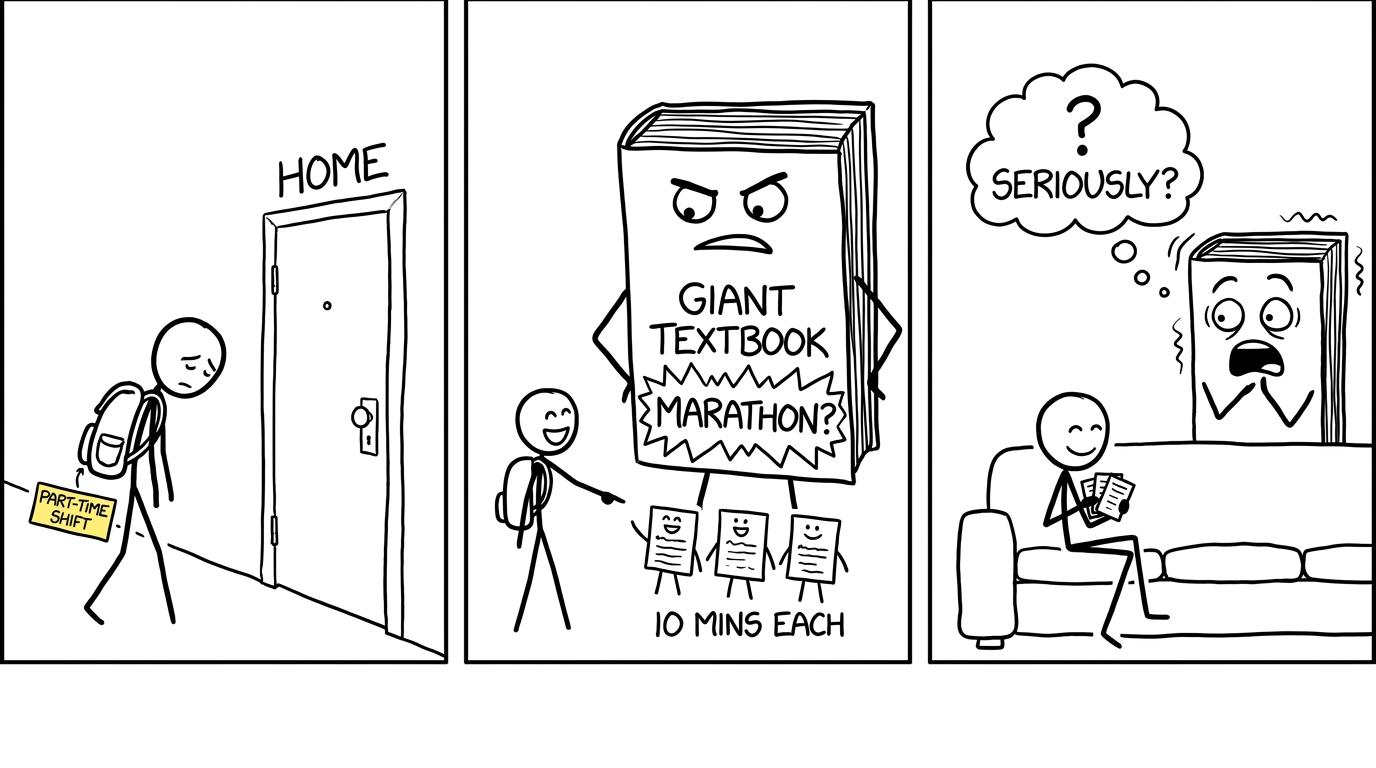 A tired student choosing small revision cards over a marathon textbook
Match the task to your energy
Time is only part of the problem. A free hour after standing at work all evening is not equivalent to a free hour on Saturday morning.
Put demanding tasks into your strongest periods. French speaking, extended writing and unfamiliar listening usually deserve alert attention. Vocabulary retrieval, corrections and reading familiar material can fit around lower-energy moments.
Use the same distinction for maths. Learning a difficult higher-tier method requires more concentration than reviewing an error log. On busy days, visit the GCSE maths revision hub, choose one focused topic and complete a short set of practice questions. Save full papers for protected blocks.
This approach removes the guilt attached to doing a smaller task. The question is no longer, “Can I manage a huge revision session tonight?” It becomes, “Which worthwhile task matches the energy I actually have?”
Protect maths while French needs attention
Although French and work create the immediate scheduling problem, maths cannot disappear until the next mock. Maths methods become easier to recall when you keep using them, so establish a weekly floor.
Your floor might contain:
- two short topic sessions;
- one mini test or timed paper section;
- immediate marking and one correction note per mistake.
Use the GCSE weakest-topics diagnostic to decide where that limited time should go. If you follow Edexcel, the GCSE maths past papers provide papers, mark schemes and worked support. Students following AQA, OCR or Eduqas should select resources that match their board and tier.
A past paper is most valuable when you mark it, classify the lost marks and revisit the relevant topic. MathsGenie's guide to using GCSE past papers properly explains that full cycle.
Near the exams, Edexcel GCSE predicted papers can provide fresh timed practice. Predicted papers are practice tools, not guarantees of future questions, and they should complement rather than replace genuine past papers.
Speak to your employer before pressure builds
Do not wait until the week before an exam to mention that your availability may need to change. Once your school confirms speaking assessments and written exam dates, discuss them with your manager and ask how early availability requests must be submitted.
Be precise. Explain which dates are fixed, which weeks contain several exams and whether you are requesting shorter shifts or fewer working days. A clear early request is easier to consider than a vague last-minute warning.
Employment rules depend on your age, nation and local arrangements. In England, official child-employment guidance says that children below minimum school-leaving age can work no more than 121212 hours during term time, including no more than 222 hours on school days and Sundays. They generally cannot work before 7 am7\text{ am}7 am or after 7 pm7\text{ pm}7 pm, and local bylaws or permits may also apply. Rules differ once you are over school-leaving age and may differ elsewhere in the UK, so check the current government and local council guidance with a parent, carer or school if anything seems unclear.
Most importantly, work should not harm your health, wellbeing or education. If shifts are affecting attendance, sleep or your ability to prepare, speak to a trusted adult at school rather than trying to solve the problem silently.
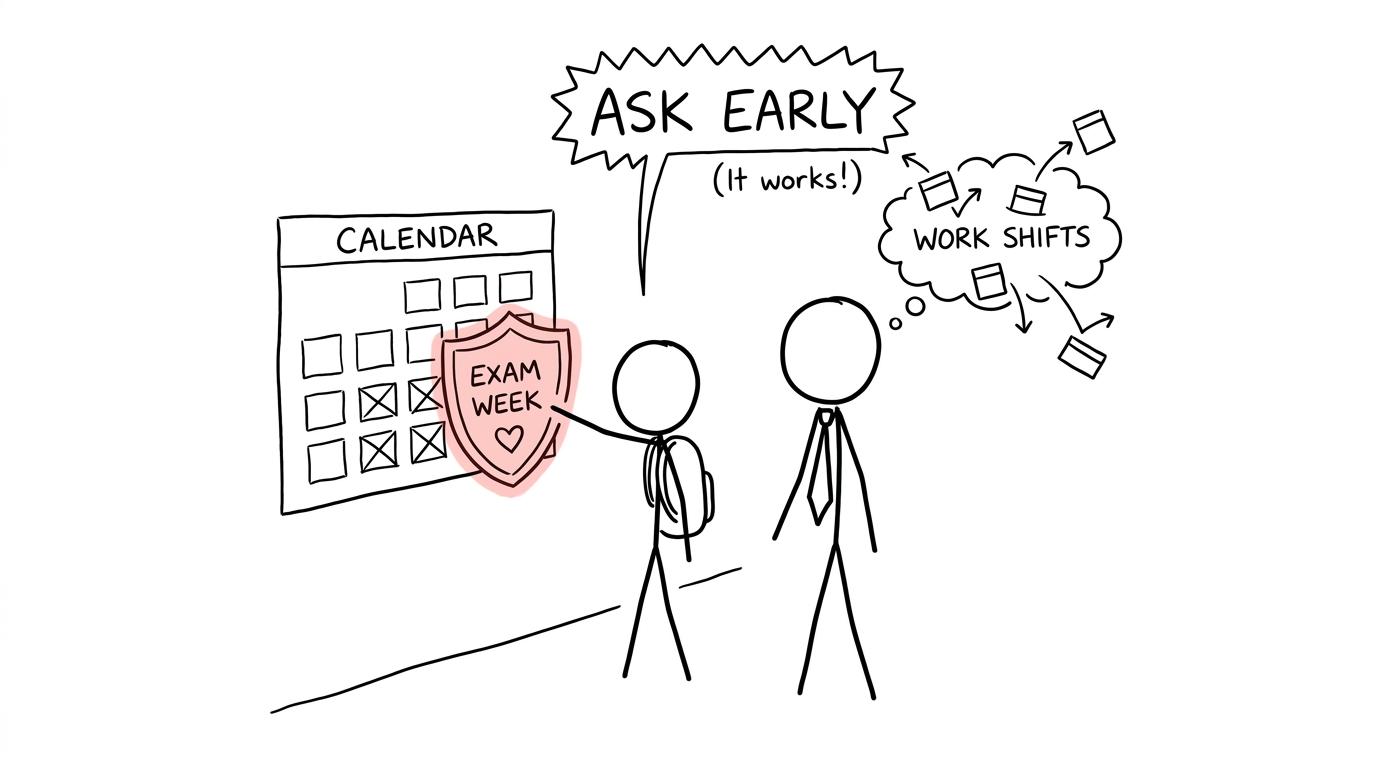 A student protecting exam dates while discussing the rota early
Build a flexible weekly rhythm
A rigid timetable says, “French writing at exactly 6 pm6\text{ pm}6 pm on Tuesday.” A flexible rhythm says, “Complete one writing session before Thursday.” The second survives a changed rota more easily.
Set weekly outputs rather than planning every minute. For example, your French list might require one session for each major skill, plus vocabulary retrieval on several short days. Your maths list might require two weak-topic sessions and one timed test.
Then give every task one of three labels:
- Must: tied to a deadline, mock or assessment.
- Should: important progress for this week.
- Could: useful if time and energy remain.
Keep one block unassigned. If a shift runs late, move a “should” task into that space. If the week goes smoothly, use it to revisit errors. MathsGenie's one-month GCSE revision plan shows how diagnostic work, short practice and timed papers can fit into a wider revision cycle.
Common mistakes when balancing work and revision
Planning from motivation instead of capacity
A timetable containing several long sessions after shifts may look ambitious but fail repeatedly. Plan around your usual energy, then treat extra work as a bonus.
Revising only on days off
This creates long gaps and makes days off feel punishing. Use short maintenance sessions on working days and deeper practice when rested.
Counting passive exposure as revision
Watching French content or reading notes can support learning, but it does not prove that you can retrieve vocabulary, understand an unfamiliar extract or produce an accurate response. Include tasks with a visible result that you can check.
Letting French replace maths completely
Urgent speaking preparation can dominate a week. Keep a modest maths floor so that returning to algebra, geometry or ratio does not feel like starting again.
Filling every empty space
A plan without catch-up time assumes nothing will change. Leave some capacity for delayed transport, homework and unexpected shifts.
Ignoring warning signs
Constant tiredness, missed schoolwork and anxiety about every shift are not timetable failures to hide. Talk to your parent or carer, teacher, pastoral team or employer and ask for practical support.
Make the plan smaller, then make it repeatable
A successful GCSE French part time job balance is rarely a perfect week. It is a system that survives an imperfect one. Put fixed commitments into your calendar, rotate all French skills, maintain a small maths minimum and move flexible tasks when the rota changes.
Then make every session lead somewhere. Learn, practise, check and correct. For maths, start with the free GCSE maths revision hub, use revision lessons and practice questions to repair weak topics, and build confidence with mini tests, past papers, predicted papers, mark schemes and video solutions.
Open the MathsGenie revision planner now and build a week that reflects your actual shifts. A realistic plan may look modest on paper. Its strength is that you can still follow it when life gets busy.