GCSE French and GCSE Spanish Together: Is It Realistic?
GCSE French and GCSE Spanish together: see if it is allowed, how much overlaps, the likely workload and how to protect your GCSE maths revision.
Choosing GCSE options can feel like solving a puzzle before you know all the rules. You may enjoy languages, see the value of learning both, and still wonder whether choosing GCSE French and GCSE Spanish together will leave enough time for maths, English, science and everything else.
The short answer is yes: you can take both GCSE French and GCSE Spanish. They are separate GCSE qualifications, and there is no national rule preventing you from studying both. The practical decision belongs to your school because option blocks, staffing and timetable capacity vary. It is realistic for a motivated student, but the overlap does not make the second language effortless.
A quick decision checklist
Taking both languages may be sensible if you can answer yes to most of these questions:
- Does your school allow French and Spanish to fit into separate option blocks?
- Are you currently secure in both languages, or willing to catch up independently?
- Do you enjoy vocabulary learning, grammar and regular speaking practice?
- Can you revise the languages separately without constantly mixing them up?
- Will you still have protected time for core subjects, particularly GCSE maths?
- Have you checked the exam board, specification and tier for each course?
- Are you choosing both because you value them, rather than because they merely appear similar?
The first step is simple: ask your languages teacher or options lead what your school permits. A course can be nationally available yet impossible within one school’s timetable.
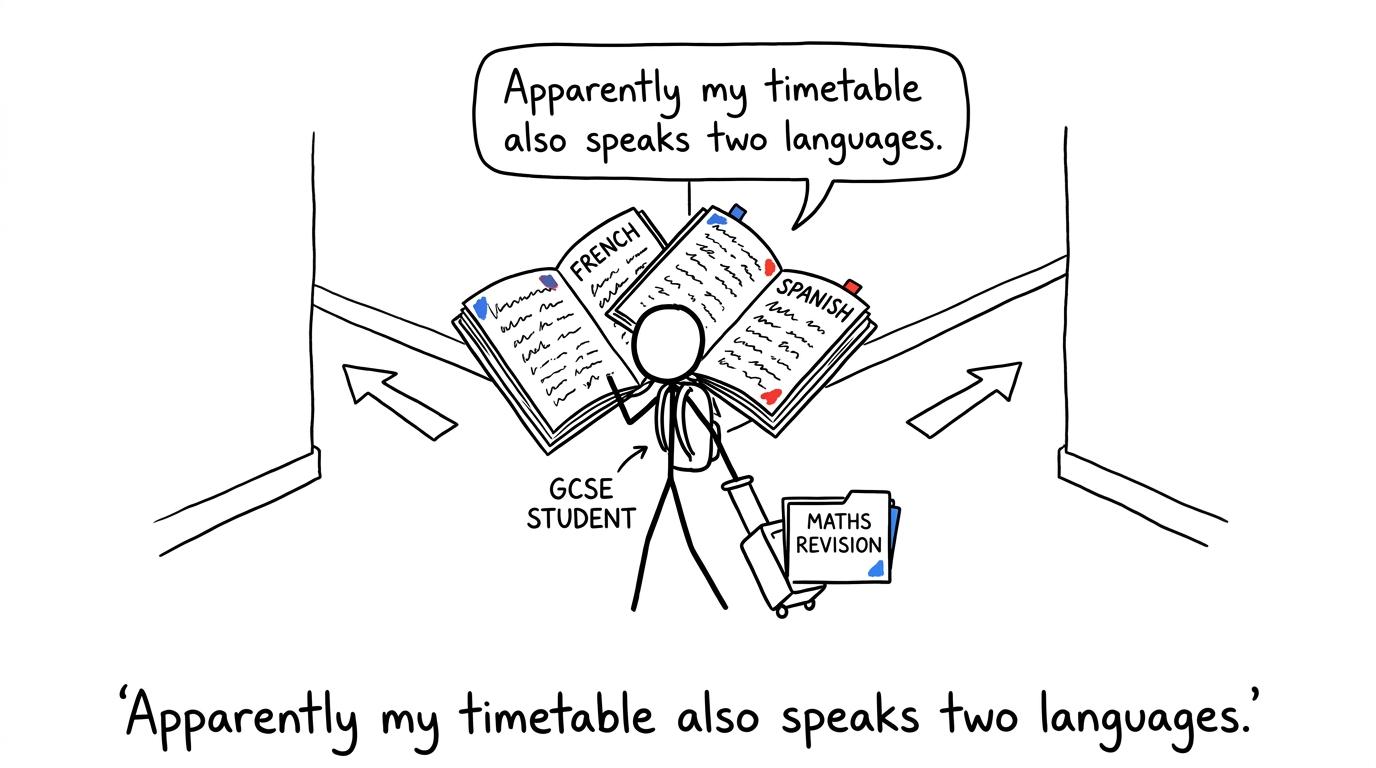 A student carrying French and Spanish phrasebooks while the timetable struggles
Can you officially take French and Spanish at GCSE?
French and Spanish are independent GCSE subjects. A student may receive one grade for French and another for Spanish, provided their school enters them for both qualifications and they complete the required assessments.
Current GCSE French and Spanish specifications introduced for first teaching in September 2024 had their first assessments in summer 2026. They continue to assess the broad language areas of listening, speaking, reading and writing, alongside translation, vocabulary, grammar and knowledge of how written forms correspond to sounds.
Both subjects are tiered. Foundation tier targets grades 111 to 555, while higher tier targets grades 444 to 999. Within each language, students must normally take all assessments at the same tier. Your school could recommend different tiers for the two subjects if your ability differs between them.
The main restriction is therefore logistical rather than regulatory. Some schools:
- place French and Spanish in the same option block;
- ask students to have studied a language before beginning its GCSE;
- limit the number of language classes they can run;
- permit a second language only after discussing workload and prior attainment;
- offer the second GCSE through an after-school or independent arrangement.
Check these details before building a revision plan around two qualifications.
How much overlap is there really?
There is meaningful overlap, but it is mostly overlap in how you learn, not a complete duplication of what you learn.
French and Spanish are Romance languages. This means you will encounter related vocabulary, gendered nouns, adjective agreement, verb conjugation and several recognisable grammatical ideas. Some words are cognates, so their form and meaning may look familiar across English, French and Spanish.
The transferable skills are valuable too. In both courses, you learn to:
- identify tense and time frame;
- infer meaning from context;
- listen for key details;
- construct extended answers;
- translate accurately rather than word for word;
- adapt known language during speaking and writing tasks;
- check agreements, endings and spelling.
Once you understand what a conjugated verb is or why adjective agreement matters, you do not need to rediscover the underlying concept from nothing. Familiar exam routines can also reduce the time needed to understand instructions and task types.
Where the overlap stops
The vocabulary lists are not interchangeable. Pronunciation systems differ, common verbs have different forms, and grammatical structures that look related do not always behave in the same way.
French often requires careful attention to silent letters, liaison and distinctions that may not be obvious from spelling alone. Spanish spelling is generally more directly connected to pronunciation, but students still need to master stress, accents and sounds that differ from English. Each language also has its own irregular verbs, idioms and conventions.
Similar words can occasionally be false friends, while near-identical grammar can encourage you to import an ending or phrase from the wrong language. The resemblance is useful until it creates overconfidence.
A fair summary is this: the second language may feel more approachable because you already understand language-learning habits, but you are still learning a second body of vocabulary, grammar and pronunciation.
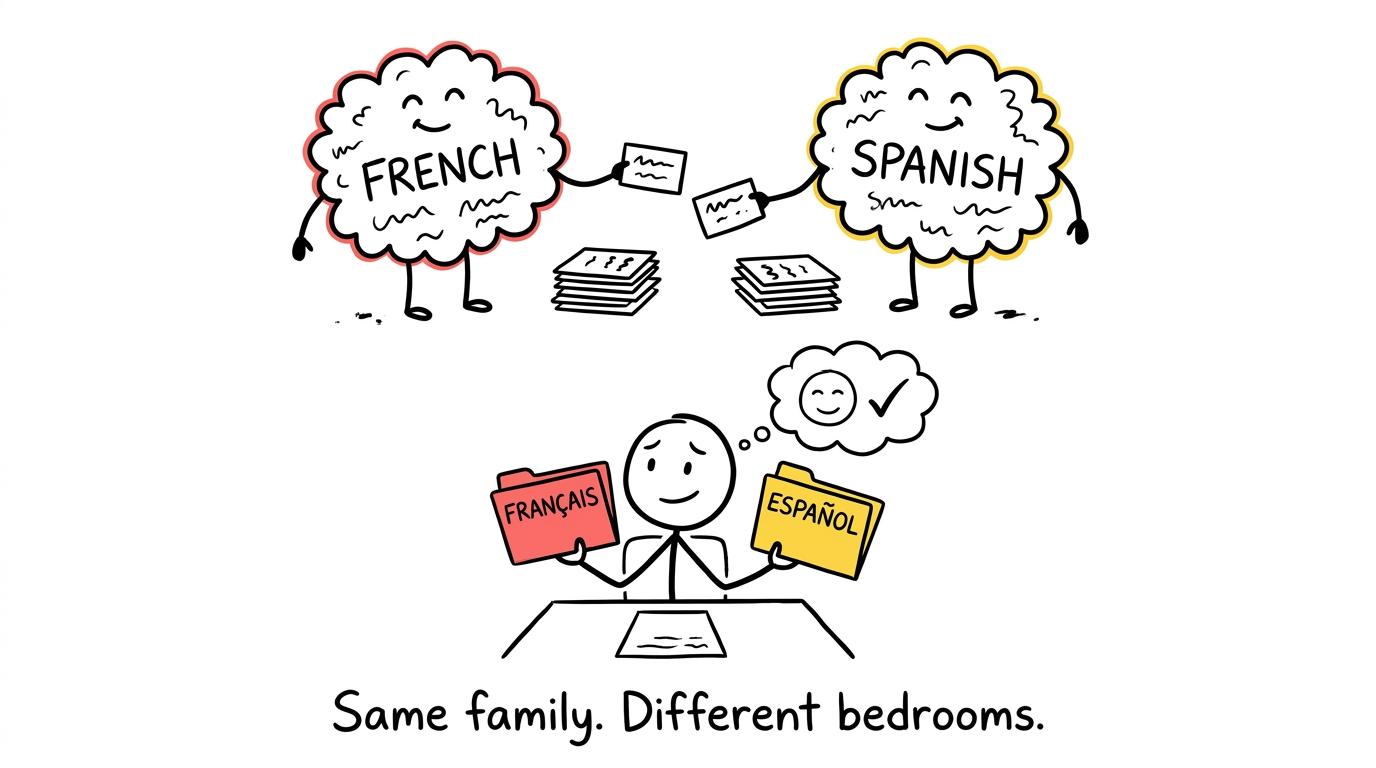 French and Spanish word clouds trying to share vocabulary cards
Is taking both languages realistic?
It is realistic when interest, timetable space and consistent practice meet. It is less realistic when one of those is missing.
Two languages create recurring work rather than one occasional burden. Vocabulary is forgotten unless it is retrieved. Speaking improves through rehearsal. Listening needs exposure. Writing needs feedback. This makes short, frequent sessions more effective than waiting for a long revision day at the weekend.
Before choosing, look at your whole GCSE programme. Maths, English and science are core subjects, and their workload does not shrink because you have selected two languages. If your current maths understanding already has serious gaps, your plan should include time to close them rather than assuming they can wait until Year 11.
Use the GCSE maths revision hub to check the content for your exam board and identify whether your foundations are secure. Students taking Edexcel can also use short GCSE maths mini tests to see whether regular mixed revision fits comfortably alongside two language courses.
A useful workload test
Try a short trial before finalising your options. For two weeks, schedule separate French, Spanish and maths sessions around your normal homework. Include vocabulary retrieval, one listening or reading task, and a focused maths topic session.
Do not judge the trial by whether you completed everything once. Ask whether the routine felt repeatable. A heroic fortnight proves little; a sustainable week is far more informative.
MathsGenie’s GCSE maths revision timetable guidance can help you build a plan based on weak topics rather than dividing time equally without evidence.
How to keep French and Spanish separate
The risk of mixing languages is real, especially when you revise similar themes on the same day. Separation helps your memory recognise which system it should retrieve.
Use distinct revision cues
Give each language a separate notebook, colour and digital folder. Keep vocabulary cards in different decks. If possible, revise them in different places or at different times of day.
These cues may seem small, but they reduce the feeling that every new word belongs in one large, uncertain language pile.
Compare deliberately, not constantly
Comparison is useful when you are studying a defined feature such as adjective agreement or past-time expressions. Write down the precise difference and then practise each language independently.
Avoid switching between French and Spanish sentence by sentence during ordinary vocabulary revision. Constant switching can strengthen the wrong association.
Keep an interference log
Whenever you use a French word in Spanish, or apply a Spanish ending in French, record the pair. This turns a vague problem into a finite revision list.
The same principle works in maths. Instead of writing “bad at algebra”, record the exact error. The guide to finding your weakest GCSE topics explains how specific error tracking leads to more useful practice.
Protecting your GCSE maths revision
The danger is not that languages and maths cannot coexist. It is that subjects with frequent homework consume every visible space in the week, while maths revision is postponed because no task is due tomorrow.
Give maths fixed appointments. A practical weekly structure could contain:
- two focused topic sessions using revision lessons and practice questions;
- one short mini test or timed paper section;
- immediate marking and correction;
- a later attempt at questions where marks were lost.
The 20-minute maths revision routine is particularly useful on language-heavy school days. When you have more time, follow a broader one-month GCSE maths revision plan that combines topic work with exam practice.
Your exam board matters too. Edexcel, AQA, OCR and Eduqas specifications are not identical, so use resources matching your board and foundation or higher tier. This prevents limited revision time being spent on the wrong material.
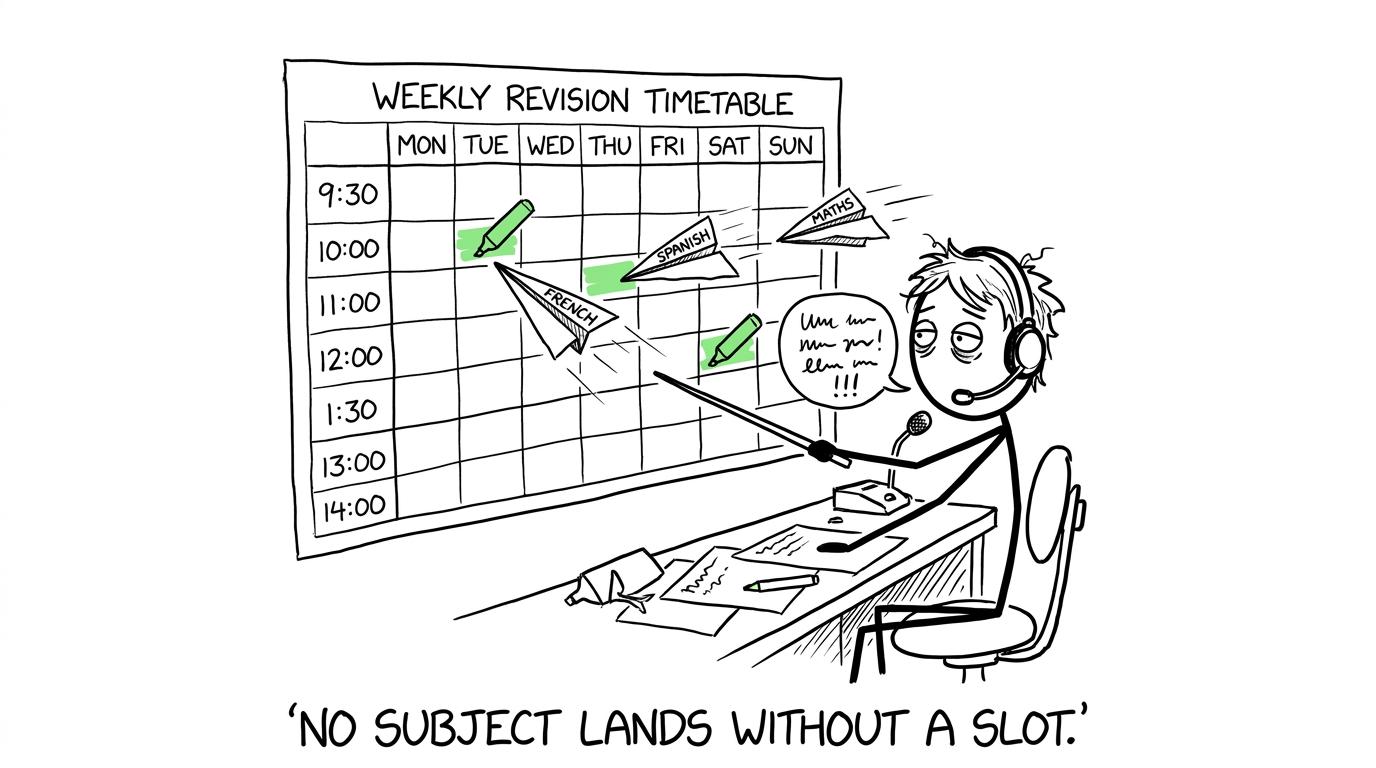 A student directing French, Spanish and maths into separate timetable slots
Does taking two languages help with future choices?
Two language GCSEs can demonstrate sustained interest and may provide a strong base for choosing French, Spanish or both at A Level. They can also be personally useful if you enjoy communication, travel, culture or language-related study.
However, taking two is not automatically more impressive than taking one and achieving a stronger, balanced set of GCSE results. The English Baccalaureate performance measure requires an eligible language subject, not two languages. A second language is an additional GCSE choice rather than an extra EBacc requirement.
Future plans matter, but they should not turn the decision into a status contest. The best option is the one you can engage with seriously while preserving the subjects you need for your next step. If A Level maths might be part of that future, you can explore the A Level maths revision hub to understand how later mathematical study develops.
Common mistakes when choosing both languages
Assuming Spanish will be easy because you know French
Related vocabulary and grammar help, but each GCSE requires independent knowledge and assessment preparation. Treating one as an effortless extra often leads to weak foundations.
Ignoring the timetable until options are submitted
Ask whether the subjects sit in separate option blocks and whether the school has entry requirements. Do not rely on what another school allows.
Revising both languages in one mixed session
Without deliberate separation, similar words and verb forms can interfere with one another. Use distinct resources and alternate subjects rather than blending them continuously.
Sacrificing maths whenever homework increases
Maths skills weaken quietly when practice disappears. Keep small, fixed sessions even during busy weeks, then use past papers to check whether knowledge survives under exam conditions.
Choosing for appearance rather than interest
Two demanding language courses require regular speaking, listening, reading and writing. Genuine interest makes that repetition sustainable; prestige alone rarely does.
Make the decision sustainable
Taking GCSE French and GCSE Spanish together is possible, and for a student who enjoys languages it can be an excellent combination. The overlap in grammar concepts, vocabulary roots and exam skills is helpful. It does not remove the need to learn two distinct systems.
Confirm your school’s option rules, examine your current attainment and trial a realistic weekly routine. Most importantly, protect the core subjects that remain central to your GCSE programme.
MathsGenie can make that part simpler. Start with free revision lessons and practice questions, test your progress with mini tests, then move towards past papers and predicted papers. Mark each attempt with the mark scheme, use video solutions when a method is unclear, and let your mistakes choose the next topic. Two languages may make your timetable fuller, but your maths revision can still remain calm, focused and consistent.