

GCSE English Revision: Silence or Background Noise?
GCSE English Language and Literature revision: learn what evidence says about silence, music and noise, then choose the best setting for focused practice.
There is a familiar revision dilemma. You sit down with an English Language paper or a Literature text, but the room feels too quiet. You play music, feel more settled, then wonder whether you are absorbing the words or merely enjoying the playlist.
The short answer to gcse english language and literature revision silence or noise is this: silence is usually the safest choice for demanding reading, planning and writing, particularly when background sound contains lyrics or speech. However, quiet instrumental music or steady neutral noise may help some students begin work, block unpredictable distractions or remain settled.
The useful question is not, “Does music help revision?” It is, “Which sound environment helps me perform this particular task accurately?”
The revision sound checklist
Use this as your starting point:
- Choose silence for close reading, quotation recall, essay planning and timed answers.
- Avoid songs with lyrics while processing language.
- Use quiet instrumental music only if it genuinely improves concentration rather than mood alone.
- Consider steady neutral sound when unpredictable voices or traffic are the greater distraction.
- Complete regular practice in quiet exam-style conditions.
- Compare your work afterwards using answers, assessment objectives or a mark scheme.
- Protect your hearing by keeping headphone volume low.
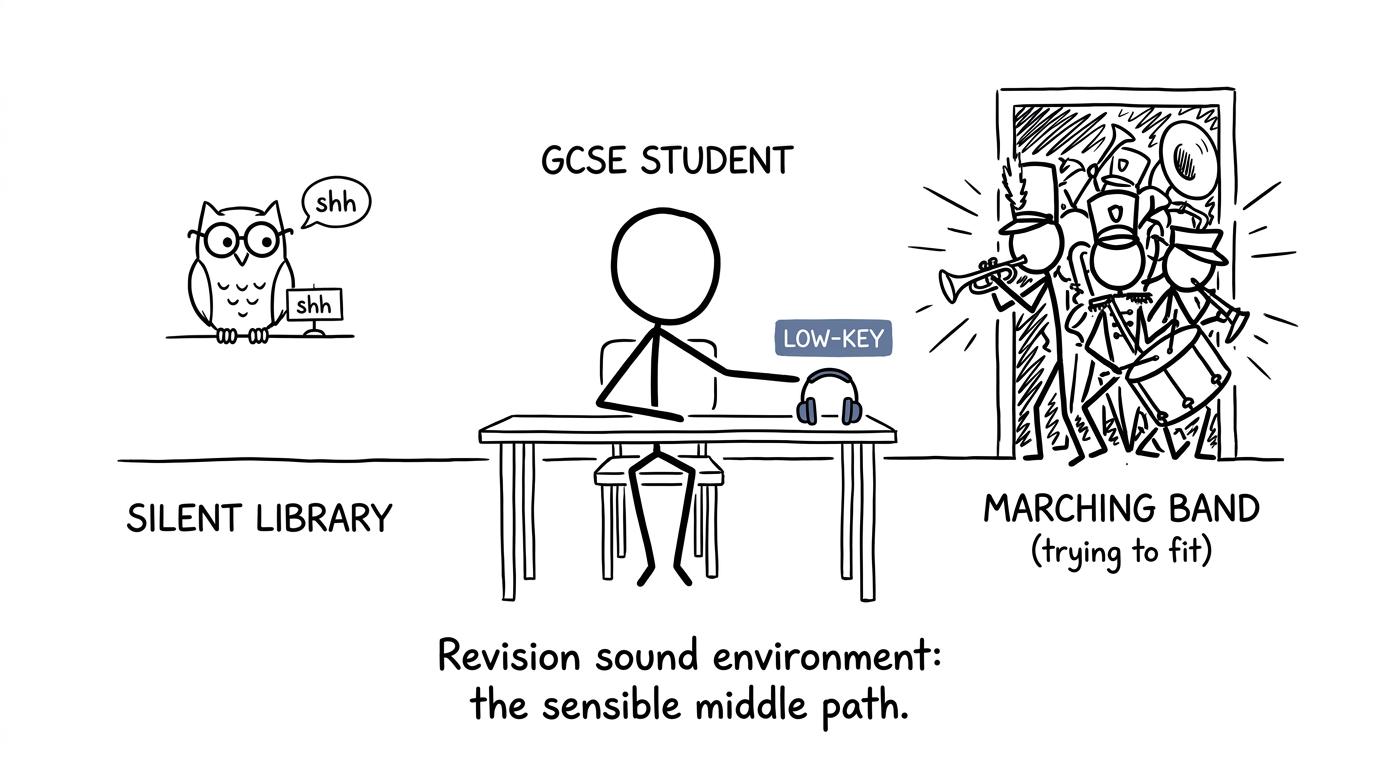 A student choosing between an impossibly silent library and a bedroom marching band
What the evidence says about silence and noise
Research does not identify one perfect sound environment for every person and every task. Results depend on the kind of noise, its volume, the difficulty of the work and individual differences between students.
Even so, several patterns are useful for GCSE revision.
Speech and lyrics can compete with reading
English Language and Literature are highly verbal subjects. You may be reading unfamiliar prose, interpreting a writer’s choice of words, retrieving quotations or constructing a precise argument. Background speech asks the brain to process another stream of meaningful language at the same time.
This is related to the well-established irrelevant speech effect: speech that a person is supposed to ignore can disrupt short-term retention and other tasks involving ordered verbal information. The effect does not require you to be deliberately listening. A conversation nearby can capture attention simply because it changes and carries meaning.
Songs with lyrics create a similar problem. The words in the song may compete with the words on the page, especially during close analysis or extended writing. Familiar lyrics are not automatically harmless. In fact, familiarity can make it tempting to anticipate or mentally sing the next line.
This does not mean every student’s result collapses as soon as music starts. It means lyrics add a plausible source of interference without adding anything necessary to the English task.
Instrumental music produces mixed results
Instrumental music removes the direct competition from lyrics, but it does not become cognitively invisible. Changes in rhythm, volume and melody can still attract attention. Complex or exciting music may be particularly distracting during difficult work.
Some students report better mood, persistence or willingness to begin when quiet music is playing. Those benefits matter. A theoretically perfect silent session is not useful if you never start it.
But feeling productive and performing well are different things. Enjoyable music can make time pass quickly, which may improve your impression of the session without improving recall, interpretation or writing quality. This is why a short comparison using completed work is more reliable than preference alone.
Moderate noise is not a universal creativity tool
You may have encountered the claim that moderate background noise increases creativity. Some experimental research has found benefits on particular creative-thinking tasks under particular conditions. That finding should not be stretched into a rule for revision.
Analysing a Literature extract, recalling quotations and producing a controlled exam response are not identical to generating unusual ideas in a laboratory task. Noise that encourages broad or abstract thought may still make detailed reading less accurate. Evidence about one activity does not automatically transfer to another.
Silence is usually the strongest default
Silence removes avoidable auditory competition. It is therefore the sensible default for tasks requiring sustained verbal attention, including:
- annotating an unseen extract;
- comparing writers’ viewpoints;
- learning and retrieving quotations;
- planning an argument;
- checking sentence structure and punctuation;
- writing a timed essay or transactional response.
That is a default, not a moral rule. Silence does not prove that you are disciplined, and using neutral sound does not prove that you lack concentration. The goal is better work.
Match the sound to the English revision task
A single session often contains several kinds of thinking. Your sound choice can change with them.
| Revision task | Sensible starting condition | Reason |
|---|---|---|
| Organising notes or choosing resources | Quiet instrumental music or silence | The verbal demand is relatively low. |
| Reading a novel, play, poem or extract | Silence | Meaningful sound may compete with comprehension. |
| Memorising quotations | Silence | Accurate verbal retrieval needs focused attention. |
| Planning an essay | Silence or very quiet neutral sound | Planning requires selection, sequencing and judgement. |
| Writing a timed response | Silence | This resembles the conditions in which you must perform. |
| Completing simple administrative tasks | Quiet music may be acceptable | Music may help you begin without heavily interfering. |
| Reviewing feedback | Silence | Mark-scheme language and teacher comments require careful interpretation. |
The same principle transfers to maths. Copying deadlines into a planner is not as mentally demanding as interpreting a multi-step Higher tier problem. When you move from organising revision to solving questions, remove anything that competes for attention.
MathsGenie’s GCSE maths revision resources make that transition straightforward: select a topic, watch the video solution where needed, then attempt the practice questions in a focused setting.
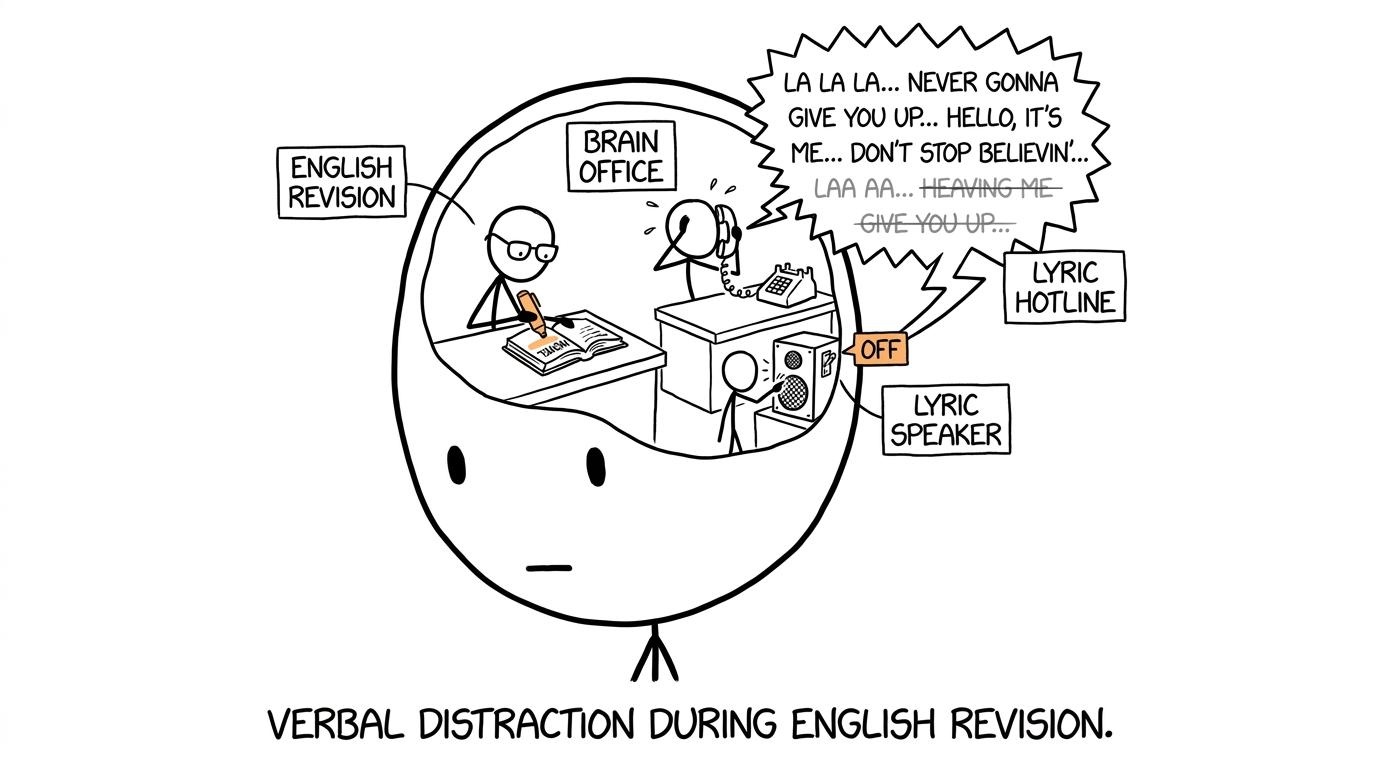 A busy brain office trying to analyse a novel while song lyrics keep calling
Why your favourite environment may not be your best one
Humans are good at judging comfort and less reliable at measuring their own learning. Music may reduce boredom, cover household sounds and create a familiar routine. Those are genuine benefits. Yet none proves that the final work is more accurate.
There is another complication: the best environment may change as your knowledge improves. Introductory reading can demand so much attention that silence is essential. Later, organising familiar material may tolerate quiet instrumental sound. Near the exam, timed recall should return to quiet conditions.
Personality, attention, hearing and sensory needs can also influence the experience. Some students find complete silence uncomfortable because every small sound becomes noticeable. Others cannot filter music at all. Students with additional needs should use the strategies and access arrangements agreed with their school rather than treating broad revision advice as a diagnosis.
If your surroundings are noisy, steady non-verbal sound may mask unpredictable distractions. A constant fan or quiet neutral noise is generally less linguistically competitive than nearby speech. Keep it unobtrusive: if you are following it, changing tracks or adjusting it repeatedly, it has become another task.
Run a fair personal revision test
You do not need to rely entirely on opinion. Test your environment using comparable pieces of work.
Choose two similar English tasks from the same component and difficulty level. Complete one in silence and one with your proposed background sound. Keep the working time, time of day and access to notes as similar as reasonably possible.
After each session, record:
- how much work you completed;
- how often you reread instructions or lost your place;
- what you could recall after a short break;
- the quality of your response against the relevant criteria;
- how difficult it was to begin and remain on task.
Do not decide solely from which session felt nicer. Look for evidence in the work. Repeat the comparison on another day because one session can be affected by tiredness, mood or familiarity with the material.
The same test works with GCSE maths past papers. Complete comparable sections under different sound conditions, mark them consistently, then compare accuracy and unfinished questions. Students building Foundation skills can select material from the Grade 1 revision topics or Grade 4 revision topics, while Higher tier students can use the Grade 6 revision topics.
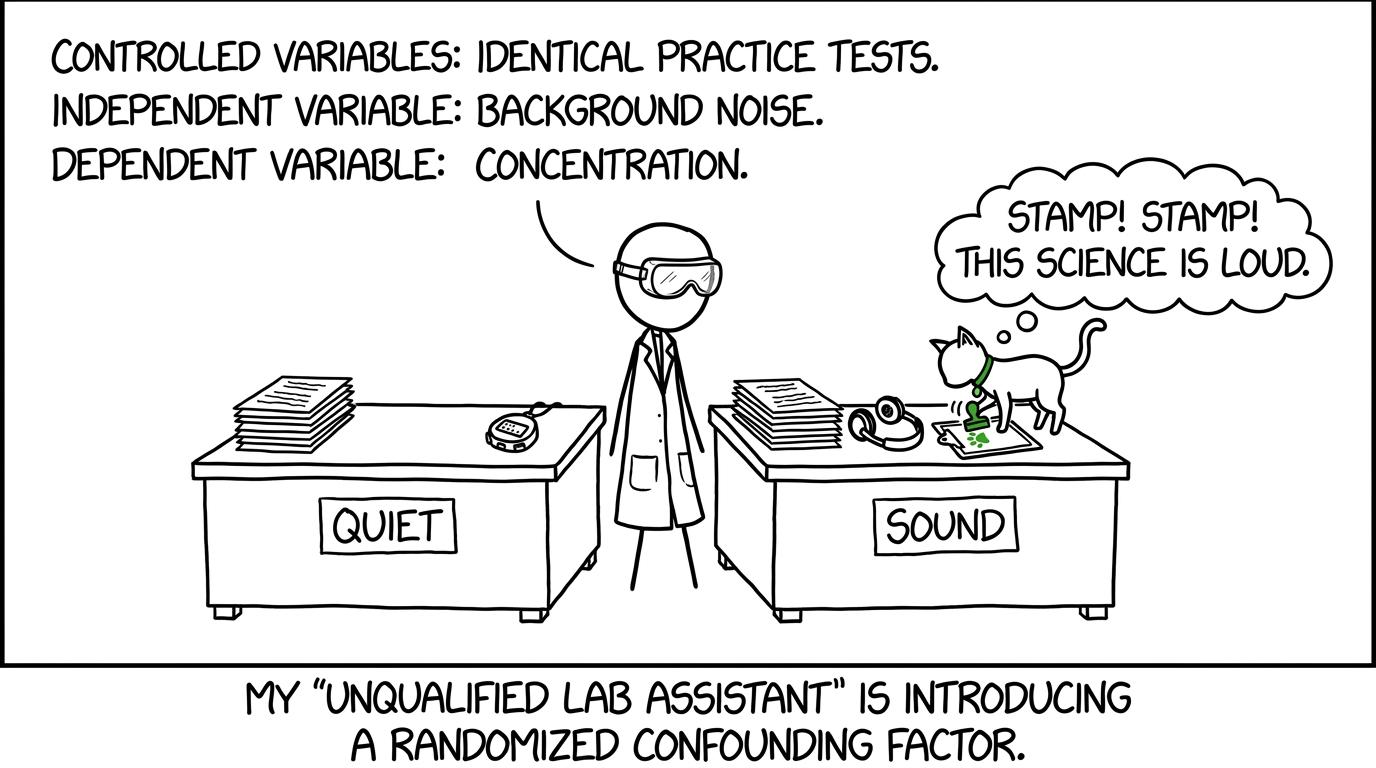 A student and an unqualified cat assistant testing quiet against background sound
Practise in the conditions that matter
GCSE examinations are completed under controlled, invigilated conditions. Although an exam hall is not perfectly silent, you cannot rely on your usual playlist. Revision should therefore include regular sessions without music.
This is not because memory works only when the learning environment exactly matches the exam room. Context can influence retrieval, but human memory is more flexible than a simple “same place, same result” rule suggests. The practical reason is clearer: silent practice shows whether you can concentrate and retrieve knowledge without an external cue.
Make some sessions deliberately exam-like. Put away your phone, use the permitted time and finish the full task before checking anything. For maths, MathsGenie predicted papers and official-style practice can help you rehearse sustained problem solving. If you later progress to sixth form, the same habit matters when using A Level maths revision resources and A Level past papers.
Common mistakes when choosing revision sound
Assuming preference proves performance
Enjoying a playlist may help motivation, but enjoyment is not a measure of recall or written quality. Compare completed work rather than trusting the session’s atmosphere.
Using lyrical music for verbal tasks
English revision already fills your attention with words. Adding another meaningful verbal stream creates unnecessary competition, even when the song is familiar.
Changing tracks throughout the session
Searching, skipping and adjusting music repeatedly fragments attention. If you use sound, prepare it beforehand and keep your phone out of reach.
Making the sound too loud
Background sound should remain in the background. High headphone volume can distract you and may risk your hearing. Lower the volume rather than using sound to overpower the room.
Never practising without headphones
A playlist can become a cue for beginning revision, but it will not enter the exam hall with you. Include quiet timed work every week as exams approach.
Treating every task identically
Low-demand organisation, close reading and timed writing do not place the same demands on attention. Change the environment when the task changes.
Choose evidence over revision folklore
For GCSE English Language and Literature, silence is the best general starting point. It removes avoidable verbal distraction and closely resembles the conditions in which you will need to read, recall, plan and write. If complete silence prevents you from settling, try quiet instrumental music or steady neutral sound, then judge it through the quality of your work.
The broader lesson applies across your revision timetable: concentration is not a feeling you wait for. It is an environment you design and a skill you practise.
Once your sound is settled, turn that attention into useful action. Visit MathsGenie for free revision lessons, video solutions, practice questions, mini tests, past papers, predicted papers and mark schemes. Choose one topic, remove the avoidable distractions and begin.










