GCSE English Literature Grade Boundaries Year to Year
GCSE English Literature grade boundaries year to year: see recent shifts, why exam boards adjust marks, and how to set safer revision targets for exams.
A past paper goes well. You total the marks, find last year’s grade boundary and feel relieved. Then a thought arrives: what if the boundary rises this year?
The short answer is reassuring. GCSE English Literature grade boundaries year to year usually move by a relatively small number of raw marks, although the movement is not identical across grades or exam boards. In the latest completed summer comparison, from 202420242024 to 202520252025, selected boundaries across AQA, Pearson Edexcel, OCR and Eduqas generally shifted by between −2-2−2 and +4+4+4 marks.
That movement exists to protect fairness. Boundaries adjust because each new paper is slightly different, while the standard of work required for a grade is intended to remain comparable.
GCSE English Literature grade boundaries checklist
Before comparing any figures, check that you have:
- the correct exam board: AQA, Pearson Edexcel, OCR or Eduqas;
- the correct specification and examination series;
- the overall qualification boundary, not a notional paper boundary;
- your total mark across all components;
- boundaries from normal, comparable summer series;
- treated historical figures as a guide rather than a prediction.
You can start with the MathsGenie GCSE grade boundaries hub, which separates boundaries by board, subject and examination series.
How much did English Literature boundaries move recently?
The table compares grades 999, 777 and 444 in the June 202420242024 and June 202520252025 series. These grades offer a useful view across the scale, but every grade has its own boundary.
| Exam board | Maximum mark | Grade 999: 202420242024 to 202520252025 | Grade 777: 202420242024 to 202520252025 | Grade 444: 202420242024 to 202520252025 |
|---|---|---|---|---|
| AQA | 160160160 | 137137137 to 136136136 | 106106106 to 108108108 | 585858 to 626262 |
| Pearson Edexcel | 160160160 | 133133133 to 135135135 | 112112112 to 115115115 | 707070 to 737373 |
| OCR | 160160160 | 133133133 to 133133133 | 103103103 to 101101101 | 484848 to 494949 |
| Eduqas | 200200200 | 148148148 to 150150150 | 124124124 to 126126126 | 828282 to 858585 |
In this one-year comparison:
- AQA’s selected boundaries moved by between −1-1−1 and +4+4+4 marks;
- Edexcel’s moved by between +2+2+2 and +3+3+3 marks;
- OCR’s moved by between −2-2−2 and +1+1+1 marks;
- Eduqas’s moved by between +2+2+2 and +3+3+3 marks.
So boundaries do change, but recent movement has generally been measured in a few marks rather than dramatic jumps. You can inspect every grade through the AQA English Literature boundary table, Edexcel English Literature boundary table and Eduqas English Literature boundary table.
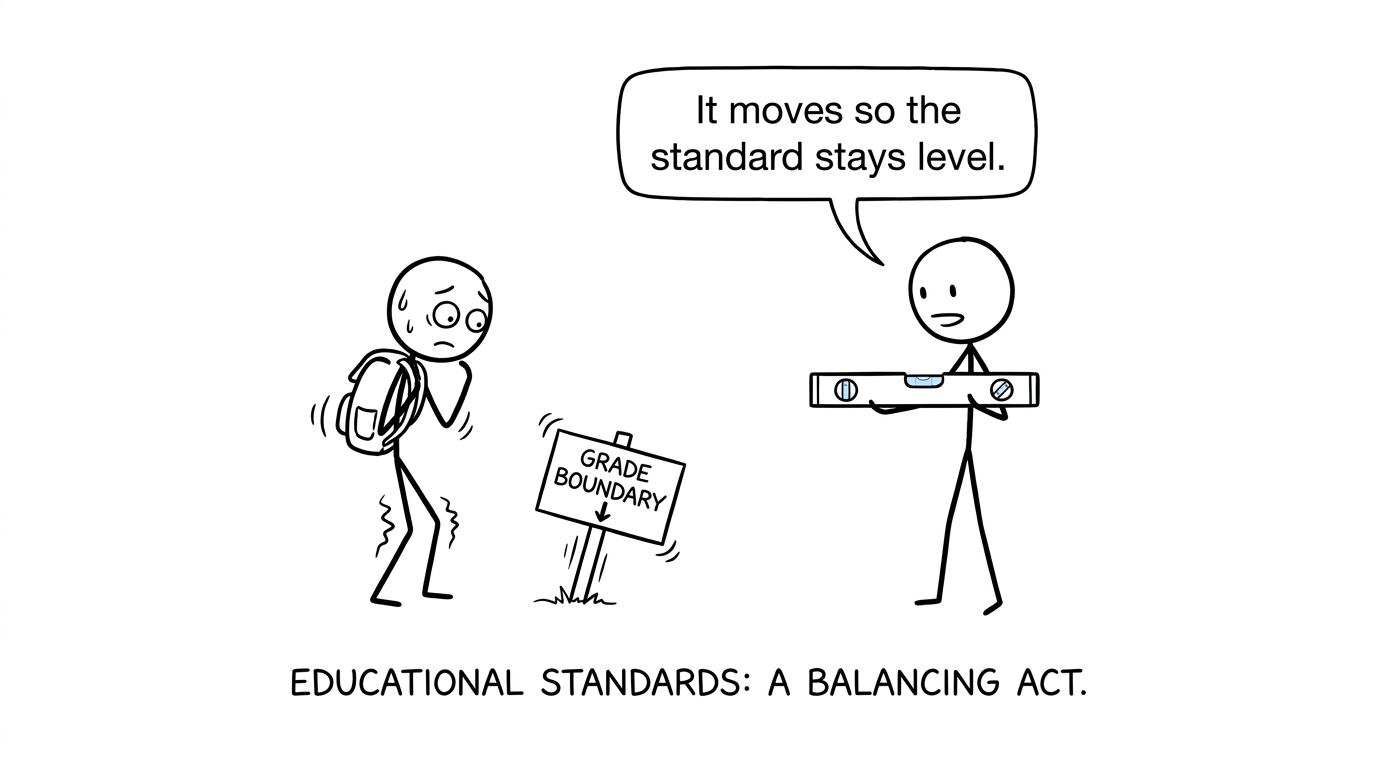 A grade boundary wobbling while an examiner keeps the standard level
Why do grade boundaries change each year?
Every examination paper is new
Exam boards aim to produce papers with consistent demand, but no two papers can be perfectly equal. A particular extract may prompt stronger responses. An unseen poem may prove more challenging than expected. A question that appeared accessible when written may require more interpretation under examination conditions.
The true difficulty becomes clearer only after students have taken the papers and marking is nearly complete. If a paper proves harder, a boundary may fall. If it proves easier, the boundary may rise.
A higher boundary therefore does not automatically mean that grading became harsher. It may mean students generally found that assessment more accessible.
Examiners consider evidence and actual student work
Awarding is not based on one national percentage rule. Exam boards use statistical evidence to identify possible boundary ranges, while senior examiners examine work around those proposed boundaries. They compare its quality with work awarded the same grade in previous years.
The aim is stability of standards, not stability of raw marks. A grade 777 should represent a comparable quality of performance even if the mark needed changes.
There is also no fixed quota stating that only a particular number of students may receive each grade. A student’s result depends on their achieved marks and the confirmed boundaries for that qualification.
For a wider explanation of the process, read how GCSE grade boundaries work.
Each board sets boundaries for its own assessment
AQA, Edexcel, OCR and Eduqas use different papers and may use different maximum marks. Eduqas English Literature was marked out of 200200200 in the 202520252025 series, while the other three boards shown above used totals of 160160160.
That makes direct raw-mark comparisons misleading. Edexcel requiring 737373 marks for grade 444 while OCR required 494949 does not show that Edexcel was harder to pass. They were separate assessments, taken by different cohorts and awarded using evidence from each specification.
The GCSE English Literature marks per grade guide brings the main boards together without implying that their raw marks are interchangeable.
Do boundaries follow predictable trends?
Not reliably. A boundary can rise for two years and then fall. One grade can move upwards while another remains unchanged. Historical data describes completed examination series; it cannot reveal how students will respond to an unseen paper.
Edexcel illustrates the danger of assuming that a trend must continue. Between 202320232023 and 202520252025, its grade 999 boundary rose from 132132132 to 135135135, grade 777 rose from 110110110 to 115115115, and grade 444 rose from 676767 to 737373. Those figures show what happened, not what must happen next.
The English Literature grade boundary history provides longer-term context. However, comparisons need care. Summer examinations were cancelled in 202020202020 and 202120212021, while some 202220222022 assessments had altered content or totals. Those years should not be treated as ordinary like-for-like forecasts.
As of 101010 August 202620262026, the official summer 202620262026 boundaries are not yet available. They will be confirmed and published around GCSE results day on 202020 August 202620262026. Any exact boundary circulating before official publication is an estimate.
How should students use past boundaries?
Past boundaries are useful for interpreting completed papers. They are less useful as targets.
If you complete a 202420242024 paper, mark it using the correct 202420242024 mark scheme and compare your total with the 202420242024 qualification boundaries. Then repeat the process with papers from several relevant years. This gives you a range rather than one flattering result.
More importantly, aim for a margin above the historical boundary. A target sitting exactly on last year’s threshold leaves no room for an unfinished paragraph, a misunderstood question or a few lost analysis marks.
The principle transfers directly to maths revision. Do not build your plan around the lowest boundary you can find. Use the GCSE Maths revision hub to improve the marks you can control through revision lessons, practice questions and board-specific papers.
 Past papers and mark schemes being pushed uphill while a predicted-boundary crystal ball rolls away
What this means for students preparing for maths exams
English Literature is not split into foundation and higher tier in the way GCSE maths is. Nevertheless, the sensible response to boundaries is the same in both subjects: revise for performance, not for a guessed threshold.
A productive revision loop is:
- complete an appropriate paper under timed conditions;
- mark it strictly using the correct mark scheme;
- identify where marks were lost;
- revisit the relevant skill or assessment objective;
- practise it again;
- retest it on a different question.
For maths, using GCSE past papers properly means moving from a total mark to an error log, then using lessons, topic questions and mini tests to repair the underlying gaps. That is much more valuable than refreshing speculative boundary discussions after every examination.
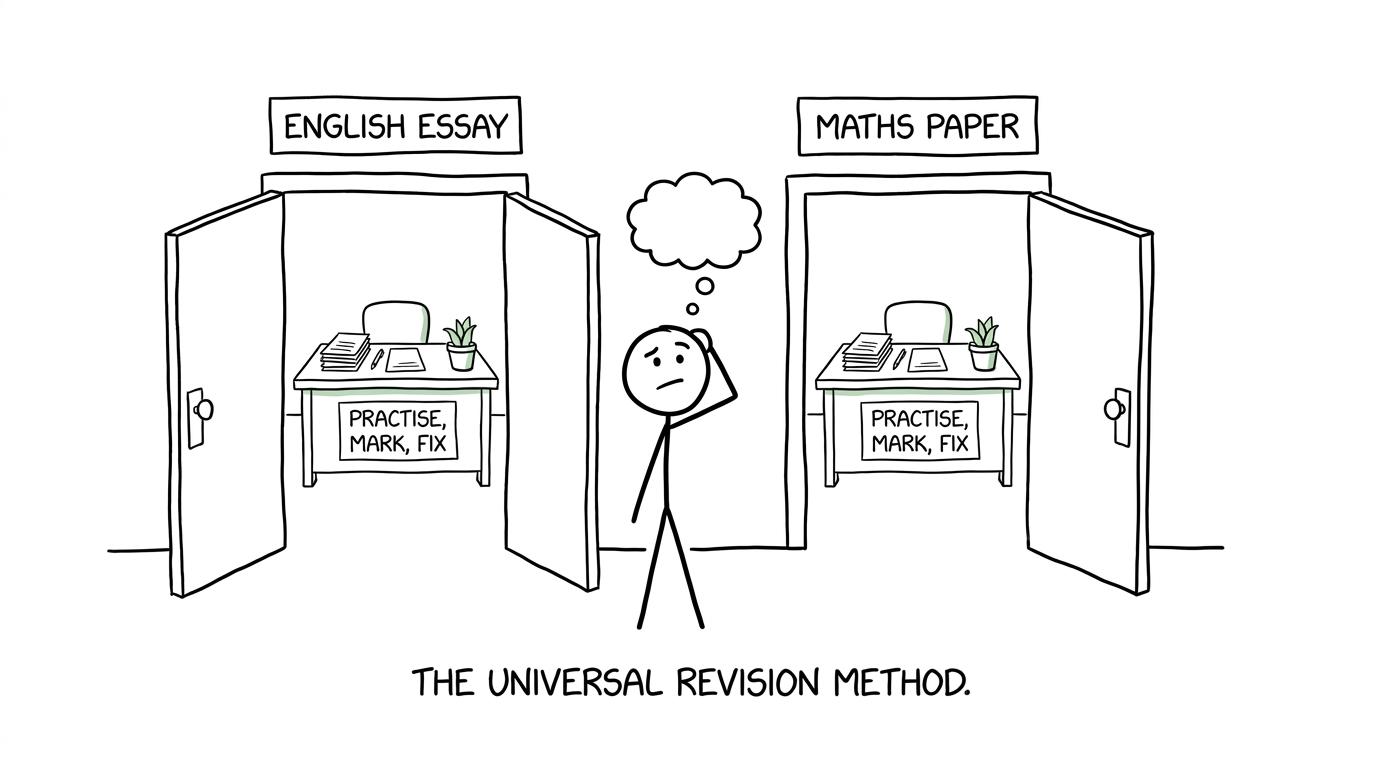 English and maths revision doors leading to the same practise, mark and fix desk
Common mistakes when reading English Literature boundaries
Using one paper’s notional boundary as a final grade
Linear GCSEs award an overall subject grade. Some boards publish notional component boundaries to help schools interpret performance, but these are not separate certificated grades. Use your combined qualification mark unless the table explicitly says otherwise.
Comparing raw marks between exam boards
A mark only makes sense alongside its maximum, specification, paper structure and awarding evidence. Do not conclude that one board is easier because its raw boundary is lower.
Treating last year’s boundary as this year’s target
The next boundary is unknown until the papers have been taken, marking is nearly complete and awarding has occurred. Build a safety margin instead of relying on an exact prediction.
Mixing unusual examination years with normal series
Cancelled summer examinations and altered assessment arrangements make some pandemic-era figures unsuitable for direct trend comparisons. Recent normal summer series provide clearer context.
Focusing on boundaries instead of available marks
Students cannot control the national awarding process. They can control whether they answer the precise question, use evidence effectively, manage time and review mistakes. In maths, they can control whether they show working, check units and practise weak topics.
A boundary can move while the standard stays still
That is the central idea. GCSE English Literature boundaries move because papers and student responses vary, not because the meaning of a grade is supposed to drift each summer. From 202420242024 to 202520252025, recent changes across the main boards were generally a few raw marks, although no future movement can be guaranteed.
Use boundaries to understand completed papers, not to bargain with the future. Then put your attention where it earns marks.
For maths preparation, begin with MathsGenie’s free revision lessons and practice questions, then test yourself using mini tests, past papers and predicted papers. Mark every attempt, use the mark schemes and video solutions, and turn each error into the next item on your revision planner. Boundaries will take care of fairness. Your task is to make your performance increasingly reliable.