GCSE English Literature Grade 9 Rate: 2025 Data
GCSE English Literature grade 9 rate explained using 2025 data, recent trends and fair comparisons with maths and other GCSE subjects in England.
There is a peculiar kind of pressure attached to a grade 999. It is only one number above an 888, yet it can feel like an entirely different destination. If you are balancing English revision with GCSE maths, you may wonder how rare that destination really is.
The latest GCSE English Literature grade 9 rate was approximately 3.6%3.6\%3.6% in England in summer 2025. In other words, roughly 111 in every 282828 English Literature results was a grade 999. That makes the grade uncommon, but not mysterious: around 21,90021{,}90021,900 of the approximately 608,110608{,}110608,110 entries recorded in the JCQ subject data achieved it.
The important word is results. These figures describe examination outcomes across a cohort. They do not set a quota for your school, predict your result or measure how intelligent you are.
The figures at a glance
Here is the short version:
- Around 3.6%3.6\%3.6% of English Literature entries in England received grade 999 in summer 2025.
- The proportion was also around 3.6%3.6\%3.6% in 2024, so the national rate was broadly stable.
- About 20.2%20.2\%20.2% achieved grade 777 or above in England in 2025.
- English Language had a lower grade 999 rate of approximately 2.3%2.3\%2.3% in 2025.
- GCSE maths had a broadly similar grade 999 rate, at around 3.3%3.3\%3.3% in England.
- Rates cannot be compared as if every subject has the same group of candidates, assessment structure or entry policy.
- Grade boundaries are set to maintain standards, not to guarantee that a fixed percentage receives each grade.
If the statistics make grade 999 look distant, remember what they cannot see: your current marks, the gaps you can repair and the weeks of useful practice still available.
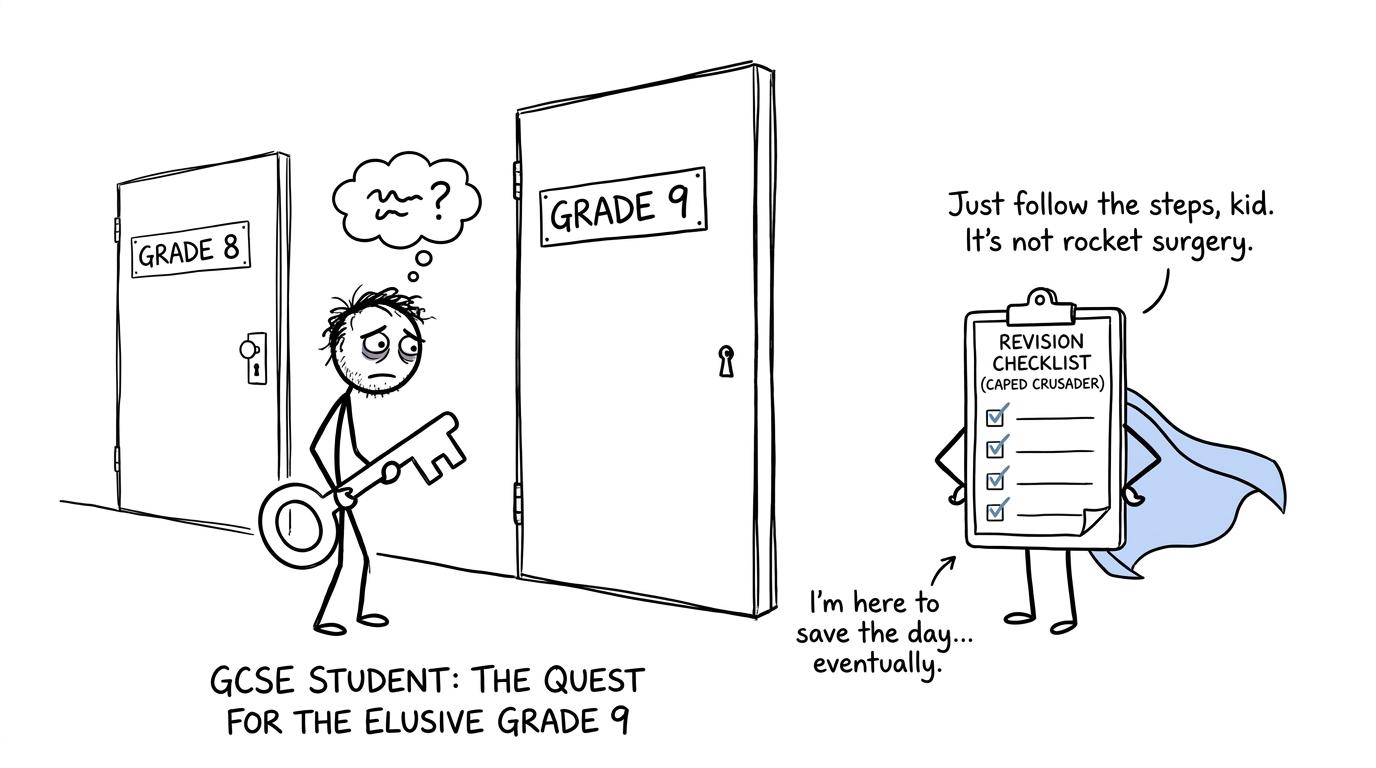 A student discovers that the grade 9 door needs a revision checklist rather than a magical key
How many students got grade 9 in English Literature in 2025?
JCQ's summer 2025 data for England recorded approximately 608,110608{,}110608,110 GCSE English Literature entries. The combined grade 999 rate was just under 3.6%3.6\%3.6%.
A percentage rate is calculated using:
grade 9 rate=number of grade 9 resultstotal entries×100\text{grade 9 rate}=\frac{\text{number of grade 9 results}}{\text{total entries}}\times 100grade 9 rate=total entriesnumber of grade 9 results×100Applying the published rate to the entry total gives an estimated figure of about 21,90021{,}90021,900 grade 999 results. It is sensible to describe that count as approximate because published datasets may be provisional, may be revised and can use slightly different inclusion rules.
The latest official figures therefore support a clear answer: a little under 4%4\%4% of English Literature entries achieved grade 999 in England in 2025.
That is different from saying only the “top 4%4\%4%” are allowed the grade. There is no predetermined national quota. If more candidates demonstrate the required standard, more can receive grade 999.
Has the GCSE English Literature grade 9 rate changed?
The recent picture is more stable than headlines about results day sometimes suggest.
| Summer series | Approximate grade 999 rate in England | What it suggests |
|---|---|---|
| 202420242024 | Around 3.6%3.6\%3.6% | Roughly 111 result in 282828 reached grade 999 |
| 202520252025 | Around 3.6%3.6\%3.6% | The top-grade share remained broadly stable |
Small year-to-year movements should not be overinterpreted. Entry patterns change, papers differ and results can be reported provisionally before later revisions. A movement of a few tenths of a percentage point may look dramatic on a chart while making little practical difference to an individual candidate.
It is also important to use the correct geographical dataset. England uses reformed GCSE grades from 999 to 111, while qualification structures and reporting in Wales and Northern Ireland differ. A UK-wide English Literature figure can therefore combine grading systems that are not directly identical. For a student taking an English GCSE in England, the England grade 999 distribution is usually the clearest comparison.
How does English Literature compare with other GCSEs?
In England's 2025 results, English Literature sat above English Language but close to mathematics at grade 999.
| GCSE subject | Approximate grade 999 rate in England, 202520252025 |
|---|---|
| English Language | 2.3%2.3\%2.3% |
| Mathematics | 3.3%3.3\%3.3% |
| English Literature | 3.6%3.6\%3.6% |
These figures tell us that a grade 999 was rare in all three large-entry subjects. They do not prove that English Literature was easier than mathematics or English Language.
Subject distributions reflect who enters the qualification as well as how candidates perform. English Language and maths are taken by extremely broad cohorts. Separate sciences and some languages can show higher proportions of top grades partly because their entry groups are more selective. Different subjects also test different forms of knowledge: an extended literary argument cannot be compared mark for mark with algebraic reasoning.
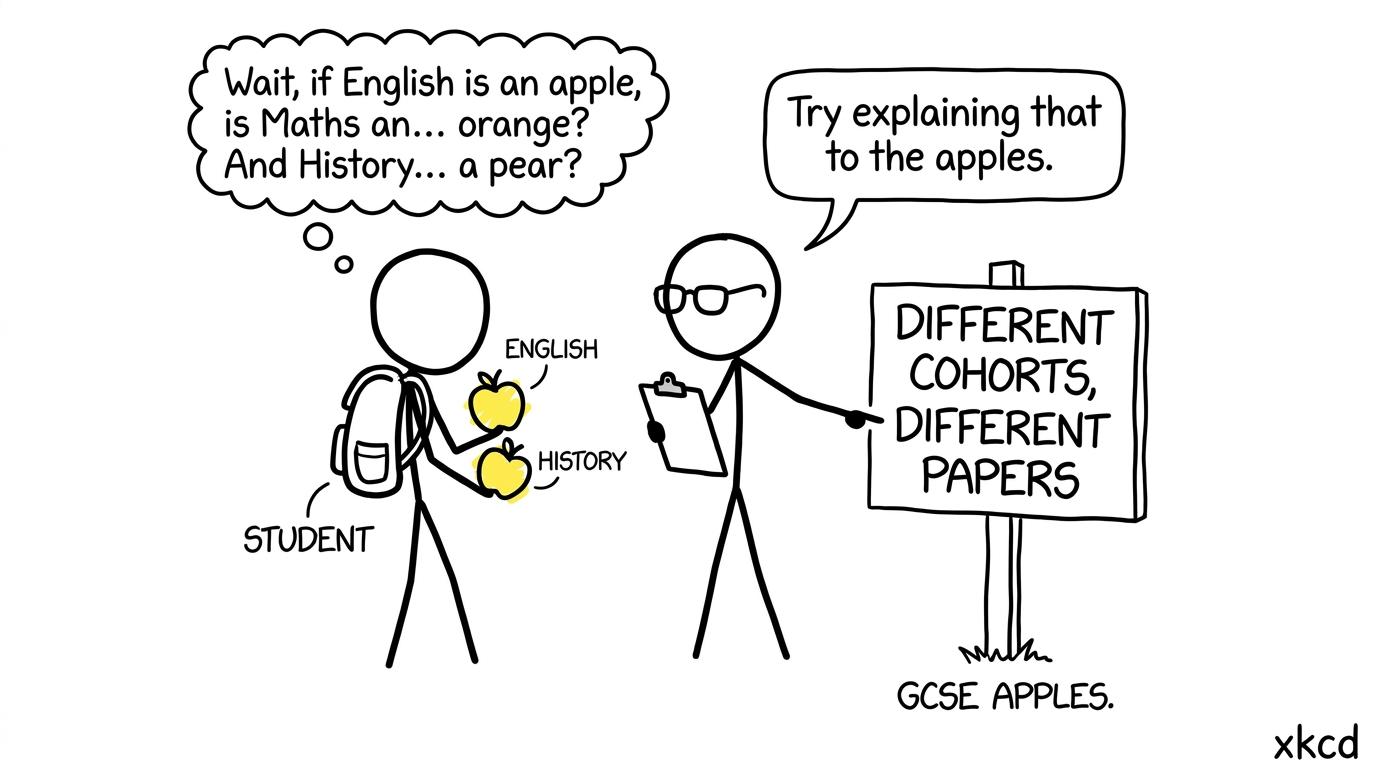 A student learns that comparing GCSE subjects is not quite as simple as comparing identical apples
Why exam-board percentages differ
The national figure also combines specifications from boards including AQA, Pearson Edexcel, OCR and Eduqas. Their 2025 published statistics showed different grade 999 proportions. For example, the rate was approximately 3.4%3.4\%3.4% for AQA English Literature, 4.5%4.5\%4.5% for Pearson Edexcel and 7.1%7.1\%7.1% for OCR.
This is not evidence that one board offers an automatic shortcut. Exam boards can have very different entry sizes and candidate profiles. OCR's English Literature cohort, for instance, was much smaller than AQA's. Boundaries and assessment decisions are intended to preserve comparable standards, but the raw percentages need context.
The same warning applies in maths. Your preparation should match your own board, specification and tier. MathsGenie's GCSE maths revision hub lets you choose the correct board and find relevant revision material rather than relying on national averages.
What the grade 9 rate means for your own target
A national rate is descriptive, not personal. It answers, “What happened across all entries?” It cannot answer, “What will happen to me?”
Your result depends on the quality of the evidence in your scripts. In English Literature, that means responding precisely to the question, selecting useful textual references, analysing methods and developing a convincing interpretation in line with your specification. In maths, it means securing marks through accurate methods, reasoning and clear working.
The disciplines overlap more than they first appear. Both reward careful reading. Both punish answering the question you expected rather than the one printed. Both improve when you practise under realistic conditions and examine why marks were lost.
For maths revision, use a repeatable loop:
- diagnose a weak topic;
- learn or refresh the method;
- complete focused practice questions;
- check the mark scheme or video solution;
- record the cause of each lost mark;
- return to the skill later without notes.
The GCSE one-month revision plan turns that loop into a manageable weekly structure. If you are deciding when to move from topic questions to complete papers, read when to start GCSE past papers.
Grade rates are not grade boundaries
These ideas are often confused.
A grade rate is the percentage of entries receiving a grade. A grade boundary is the minimum mark needed for that grade on a particular specification and examination series.
Boundaries are not fixed permanently in advance. Awarding organisations set them after examining evidence about the assessments and candidate performance, with the aim of maintaining comparable standards when paper difficulty changes.
That means last year's grade 999 boundary can help you interpret a past paper, but it cannot promise this year's boundary. MathsGenie's GCSE grade boundaries database brings together historical information for boards including AQA, Edexcel, OCR and Eduqas. The guide to how GCSE grade boundaries work explains why aiming slightly above a historical boundary is safer than treating it as a guaranteed target.
Common mistakes when interpreting grade 9 statistics
Treating the percentage as a quota
A rate of 3.6%3.6\%3.6% does not mean examiners stop awarding grade 999 after a fixed number of scripts. Grades are awarded against standards through the examination-board process.
Mixing grade 9 with grades 7 to 9
The 2025 English Literature rate for grade 777 or above was approximately 20.2%20.2\%20.2% in England. That is a cumulative figure covering grades 777, 888 and 999. It is not the grade 999 rate.
Comparing subjects without considering their cohorts
A subject with a higher top-grade proportion is not automatically easier. Entry policies, prior attainment, cohort size and optional versus compulsory status can all affect the distribution.
Assuming one exam board is easier
Board-level percentages describe different candidate groups. They should not be used as a league table of difficulty, particularly where cohort sizes differ substantially.
Letting a national statistic control a personal target
The percentage cannot see your marked essays, mock results or maths topic gaps. Use evidence from your own work instead. A carefully reviewed paper is more useful than an hour spent worrying about national rankings.
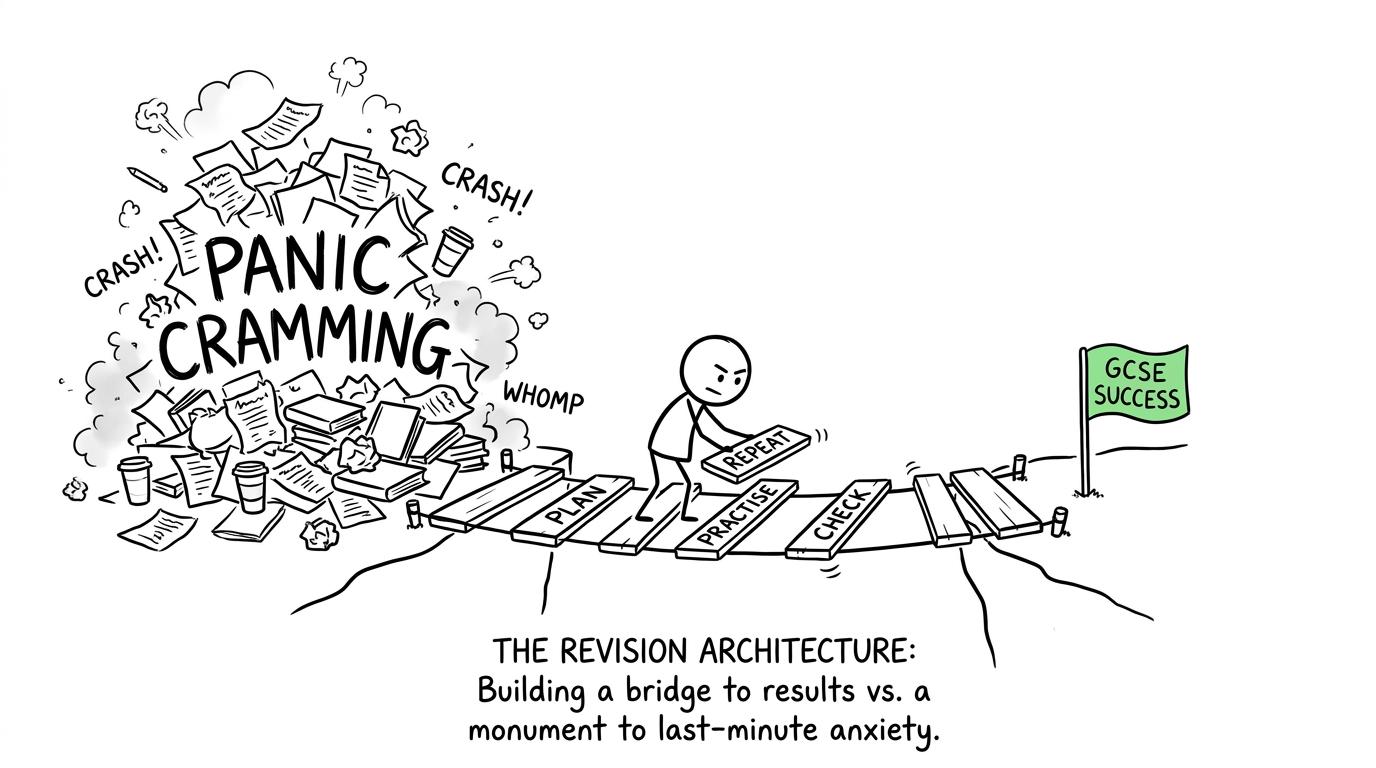 A student builds a steady revision bridge while panic cramming collapses in the background
Turn comparison into a better revision decision
Statistics are most useful when they change an action. The fact that around 111 in 282828 English Literature entries reached grade 999 tells you the standard is demanding. It does not tell you to give up, nor does it tell you to neglect maths while chasing one extra grade elsewhere.
Start by protecting time across your subjects. For maths, choose material matched to your tier and exam board through the free GCSE maths revision resources. Use shorter tests to locate weaknesses before spending hours on full papers. Then review every error properly.
If you are unsure how much complete-paper practice is useful, MathsGenie's guide to how many GCSE past papers to complete focuses on quality of review rather than an impressive paper count. Edexcel students can also follow the structured advice on revising GCSE maths efficiently.
The number is small, but your next step is not
The GCSE English Literature grade 999 rate was approximately 3.6%3.6\%3.6% in England in 2025, around 21,90021{,}90021,900 results from roughly 608,110608{,}110608,110 entries. It was broadly stable compared with 2024, higher than the English Language rate and close to the rate for GCSE maths.
That answers the statistical question. The more useful question is what you do next.
Open MathsGenie, select your exam board and turn your latest mistakes into a revision list. Use the free revision lessons to understand difficult methods, practice questions and mini tests to build accuracy, then past papers and predicted papers to develop timing. Mark schemes and video solutions complete the loop.
A grade distribution describes the crowd. Good revision concentrates on the script you can still change: your own.