GCSE English Literature Flashcards: Best Quizlet Sets
GCSE English Literature flashcards Quizlet guide: find reliable decks, check quotes and analysis, build cards quickly, and revise with active recall.
There is a particular kind of revision panic that begins when you search Quizlet for a set text and find dozens of decks. One contains hundreds of quotations. Another promises everything you need for a grade 999. A third looks useful until you notice that it covers the wrong poetry anthology.
The best GCSE English Literature flashcards Quizlet sets are not necessarily the longest or most popular. They match your exam board and exact set text, contain accurate short quotations, connect evidence to themes and methods, and force you to retrieve information rather than simply reread it.
If no existing deck passes those tests, build your own. A focused set can be created surprisingly quickly, and the act of choosing what deserves a card is valuable revision in itself.
The quick checklist
Before using any English Literature deck, check that it:
- names your exam board: AQA, Edexcel, OCR or Eduqas
- covers the exact text, character or poetry cluster you study
- uses accurate quotations checked against the original text
- includes prompts on themes, characters, methods and context
- separates questions from answers clearly
- keeps each answer short enough to retrieve
- supports essay practice rather than replacing it
- has been checked by you or your teacher
Community-made Quizlet sets can be edited, incomplete or based on a different specification. Treat every public deck as a useful draft, not an unofficial mark scheme.
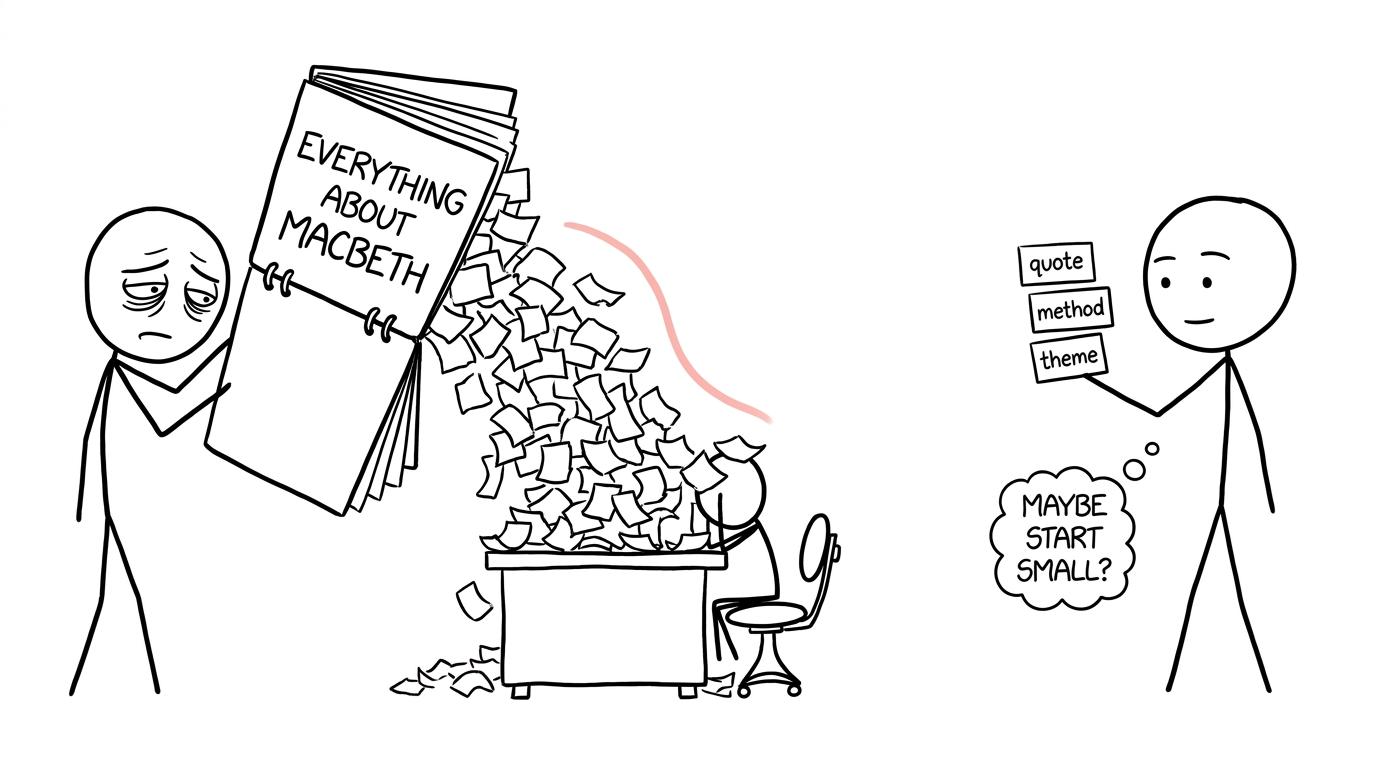 A student discovers that one enormous flashcard is less useful than three focused cards
Which GCSE English Literature Quizlet decks are worth using?
There is no single best deck for every student because schools study different texts and poetry collections. The strongest choice is usually a small group of specialised decks rather than one enormous collection labelled “complete GCSE English Literature”.
Teacher-created, text-specific sets
Start with decks whose creator clearly identifies themselves as a teacher or school department. Current Quizlet search results include sets such as Macbeth Act 1 Key Quotes & Analysis, created under a teacher-labelled account, alongside broader collections such as AQA GCSE: Macbeth.
These can be worthwhile starting points, but a teacher-style username is not proof of accuracy. Check several cards against your own copy of the play and your class notes before committing time to the whole set.
A strong text-specific deck should cover:
- a concise bank of versatile quotations
- major characters and how they change
- central themes
- language, form and structural choices
- relevant contextual ideas
- links between different moments in the text
Avoid decks that give a long quotation followed by a paragraph copied from revision notes. That format tests neither precise recall nor independent interpretation.
Character and theme decks
Focused sets are often more useful than whole-text decks when you have identified a specific weakness. Current search results for An Inspector Calls, for example, include focused collections such as Mrs Birling Quotes & Knowledge and Older vs Younger Generation in An Inspector Calls.
That narrower structure is useful because an examination question asks you to build an argument about a character or idea. A card prompting you to connect a character with responsibility, class or generational change is closer to that task than a card asking only what happens in Act One.
Use plot-summary decks only if your knowledge of the story is genuinely insecure. Once you can explain the sequence of events, move towards interpretation and writer’s methods.
Poetry comparison decks
For anthology poetry, look for a deck naming both the exam board and the exact cluster. “GCSE poetry” is too vague. AQA students, for example, need the appropriate current cluster taught by their school; an Eduqas or OCR anthology deck will not be interchangeable.
The best poetry cards ask about:
- the poem’s central argument or perspective
- a small number of adaptable quotations
- form and structural choices
- significant language methods
- useful comparison partners
- similarities and differences in ideas and methods
A deck that reduces each poem to a single theme can become a trap. Poems are flexible texts, and strong responses adapt evidence to the question rather than reproducing a memorised label.
Assessment-objective decks
Across GCSE English Literature specifications, the core assessment objectives reward an informed response supported by textual references, analysis of language, form and structure, understanding of context, and accurate writing where assessed.
Flashcards should therefore do more than test quotation recall. Keep a small separate deck for prompts such as:
- What makes an interpretation convincing?
- How can form affect meaning?
- When is context relevant rather than bolted on?
- What should a comparison explain?
Always compare these prompts with your board’s current specification and your teacher’s guidance. Paper structures and the places where particular objectives are assessed vary between boards.
A reliable way to judge a public deck
Audit the first 101010 cards before learning the remaining 100100100. This small check protects hours of revision.
| Check | What you want to see |
|---|---|
| Specification | Your board, text and current anthology are named |
| Accuracy | Quotations match the original text |
| Scope | Characters, themes, methods and context are balanced |
| Card size | One clear retrieval task appears on each card |
| Analysis | Interpretations explain effects rather than list techniques |
| Flexibility | Evidence can support more than one possible question |
| Language | Definitions and explanations are precise and readable |
Be cautious if the deck promises a particular grade. A flashcard collection cannot guarantee a grade because Literature rewards the quality of the argument produced in response to the question. Memorised material is raw material, not the finished essay.
How to build your own flashcards quickly
Creating cards becomes slow when you try to preserve every page of your notes. The goal is selection.
Begin with an exam map
Write down the texts and components you will actually sit. Under each text, list its main characters, themes and likely areas of analysis. Confirm this map with your school’s specification and teaching plan.
Then gather only three sources:
- the original text or anthology
- your strongest class notes
- the official assessment objectives or mark scheme language provided by your board
Too many sources create contradictions and encourage copying. Your deck should reflect what you understand and can defend.
Use four card types
A compact deck can be built from four repeatable formats:
- Quotation card: a cue on the front; an accurate short quotation and location on the back
- Analysis card: a quotation or moment on the front; method, effect and interpretation on the back
- Connection card: a theme or character on the front; linked moments from across the text on the back
- Context card: a precise contextual idea on the front; its relevant connection to the writer’s purpose on the back
Do not place an entire essay paragraph on one card. If an answer contains several independent ideas, split it. Retrieval should feel clear and effortful, not like opening a hidden page of notes.
Build a minimum viable deck
Start with approximately 101010 to 151515 versatile quotations for each major text, then add cards only when practice exposes a real gap. This is more manageable than trying to memorise every striking line.
A fast creation session might look like this:
- 101010 minutes to list characters and themes
- 151515 minutes to select quotations
- 151515 minutes to add methods and interpretations
- 101010 minutes to check wording and remove duplicates
The exact timings matter less than the limit. Revision expands to fill the space you give it.
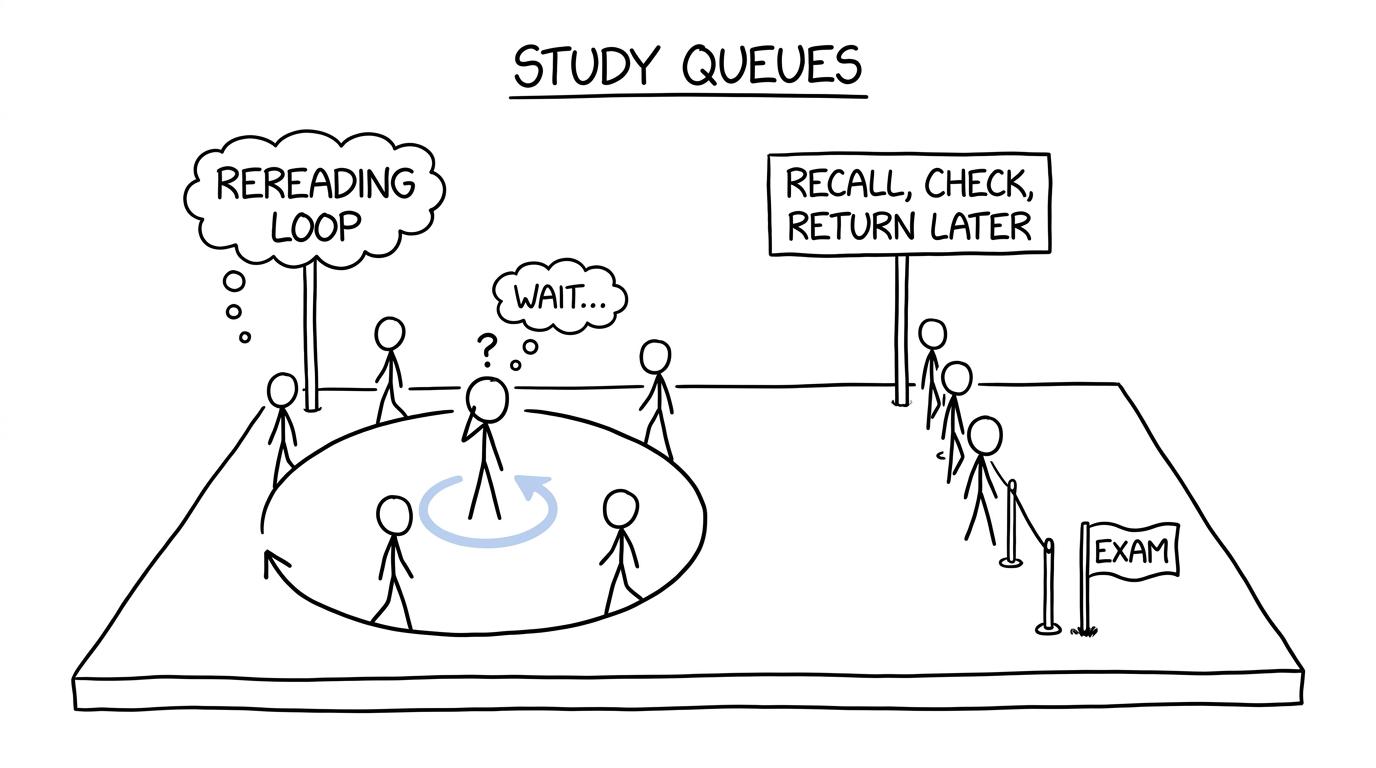 A student realises that active recall leads forward while rereading travels in circles
How to revise with flashcards effectively
Flashcards work best as retrieval practice: look at the prompt, hide the answer and make a genuine attempt to recall it. Research on learning consistently supports combining retrieval with sessions spaced across time rather than concentrating every review into one evening.
Use this simple routine:
- answer aloud or write the response before turning the card
- check immediately and correct inaccurate wording
- separate secure cards from uncertain cards
- revisit difficult material sooner
- shuffle the order so sequence does not become a clue
- return to apparently mastered cards after a longer gap
Quizlet currently offers flashcard activities alongside modes that generate different question formats. Features and access arrangements can change, so check the platform itself rather than relying on an old tutorial. Whatever mode you choose, written or spoken recall is usually more revealing than recognising the right option in a multiple-choice list.
Most importantly, transfer recalled knowledge into essay plans and timed paragraphs. Flashcards build availability; writing practice builds application.
Keeping maths revision alive during English preparation
The target audience for this guide is also preparing for maths exams. English Literature can absorb every available hour because there is always another quotation to learn. That does not mean maths should disappear for a week.
A balanced evening might contain a short English retrieval session followed by one focused maths task. Use the GCSE Maths revision hub to choose your board and topic, or complete an Edexcel GCSE Maths mini test for quick feedback.
If your schedule feels crowded, use the structure in the GCSE maths revision timetable. During an English-heavy week, the aim is maintenance: one short lesson, a handful of practice questions or part of a paper. The GCSE English Literature exam-week checklist offers a practical way to coordinate both subjects.
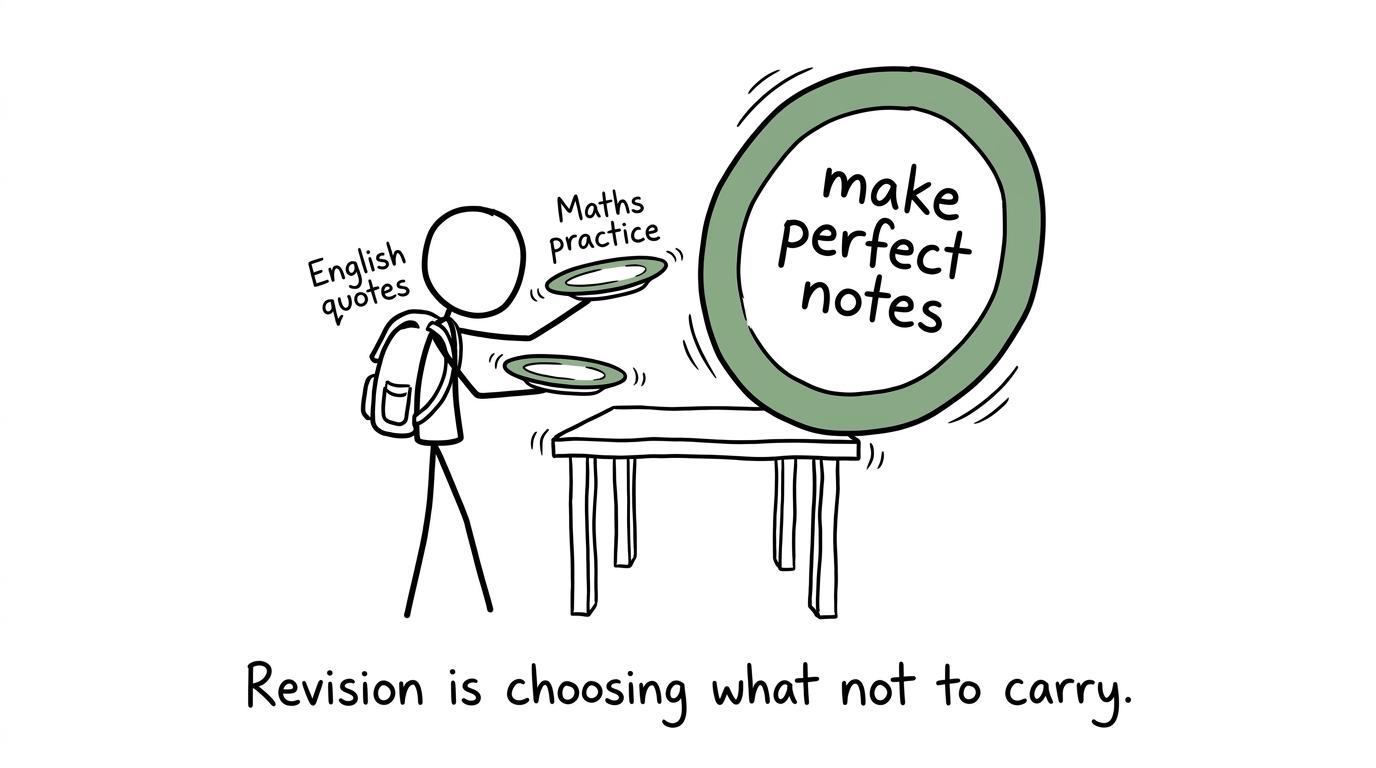 A student balances English quotation recall with maths practice while abandoning perfect notes
Common mistakes with English Literature flashcards
Choosing by popularity alone
A widely used deck may still cover the wrong board, old anthology or different interpretation. Relevance and accuracy matter more than view counts.
Memorising analysis word for word
Learn evidence and possible lines of reasoning, but preserve room for an informed personal response. A memorised paragraph can become irrelevant when the question changes.
Writing vague context cards
Large historical facts are difficult to apply. Context earns its place when it illuminates the text, writer’s purpose or reader response.
Recognising instead of recalling
Flipping a card immediately creates familiarity, which can feel like knowledge. Pause, answer fully and then check.
Never moving into exam practice
An English deck cannot test whether you can sustain an argument. Likewise, formula cards cannot replace mathematical problem-solving. For maths, follow the paper, mark, fix and retest method, then use Edexcel predicted papers or papers for your own board when appropriate.
Build a small system you can trust
The best GCSE English Literature flashcards are accurate, specific and deliberately limited. Start with a teacher-approved, board-matched Quizlet deck if one is available. Audit it. Remove weak cards, add your own interpretations and use it alongside timed writing.
Then keep your maths moving. MathsGenie gives you free revision lessons, practice questions, mini tests, past papers, predicted papers, mark schemes and video solutions in one organised place. If you are unsure where to begin, use the weak-topic diagnostic process and turn your next revision session into one clear action.
A useful revision system does not try to remember everything at once. It makes the right knowledge easier to retrieve and gives you somewhere meaningful to use it.