GCSE English Literature 20 Minute Study Routine
GCSE English Literature 20 minute study routine: build recall, quotation knowledge and essay skills daily, while protecting time for maths revision and rest.
There is a familiar problem during GCSE revision: English Literature feels too large to begin. Several texts, dozens of quotations, unfamiliar poems and essay skills compete for attention. Meanwhile, maths needs regular question practice too.
A GCSE English Literature 20 minute study routine solves the problem by making each session small and active. Spend three minutes recalling knowledge, seven minutes strengthening one text, seven minutes planning or writing, and three minutes checking your work. Stop when the timer ends. Repeated across the week, this builds knowledge without allowing English to consume the evening.
This is not a promise that twenty minutes replaces lessons, reading or occasional timed essays. It is a dependable daily minimum that fits around homework, maths revision and rest.
Your daily routine at a glance
Use the same four-part structure each day so that you spend less time deciding and more time retrieving, analysing and writing.
| Time | Activity | Purpose |
|---|---|---|
| First three minutes | Recall without notes | Strengthen memory and reveal gaps |
| Next seven minutes | Review one narrow area | Improve knowledge of a text, character, theme or poem |
| Next seven minutes | Plan or write analytically | Turn knowledge into exam-ready thinking |
| Final three minutes | Check and schedule | Correct misconceptions and choose the next task |
Before beginning, prepare one text, your class notes, a blank page and a timer. Your phone should be out of reach unless it is the timer.
If competing subjects make the week feel disorganised, place this English block beside the sessions in the MathsGenie revision planner. A routine is easier to sustain when every subject has a defined place rather than fighting for the whole evening.
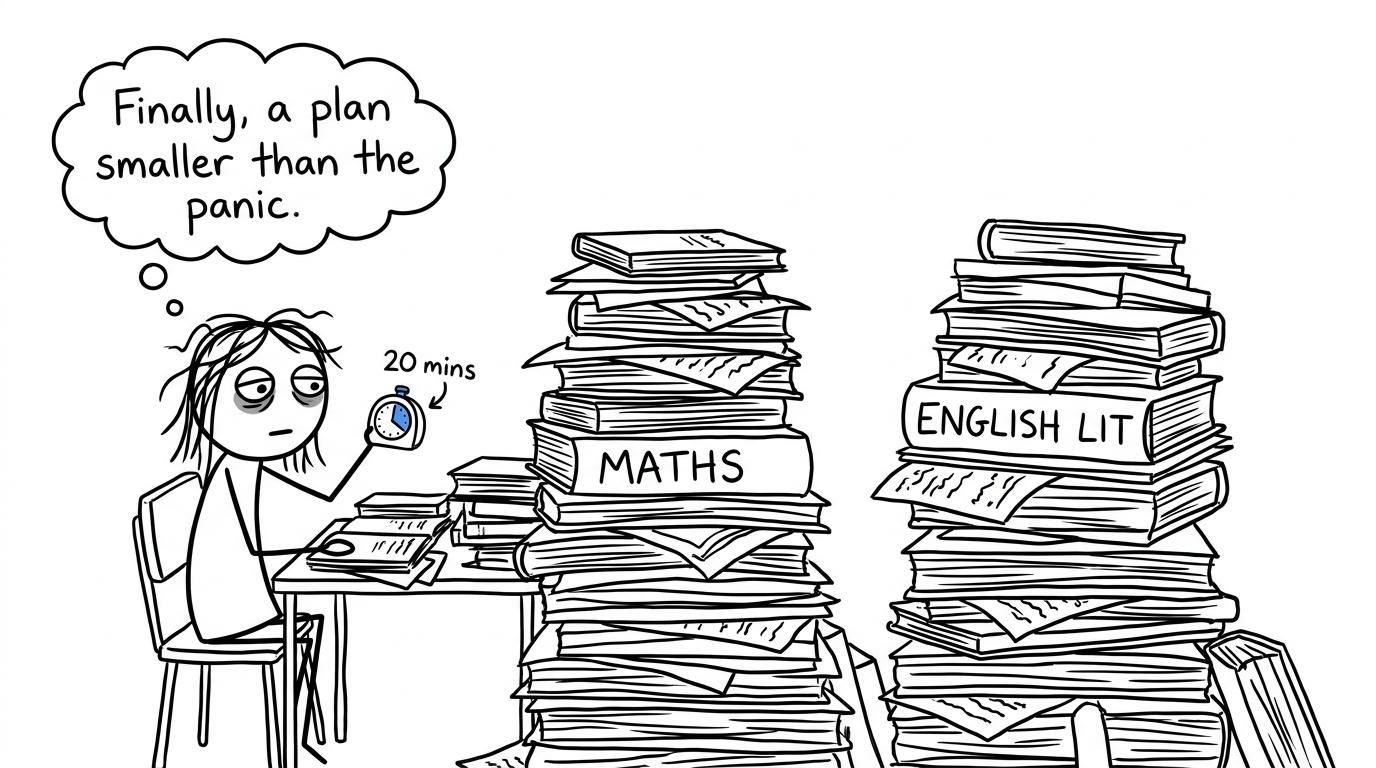 A student uses a small timer to balance English Literature and maths revision
Why short daily English Literature revision works
Government subject requirements for GCSE English Literature emphasise critical reading, textual evidence, analysis of language, form and structure, contextual understanding, comparison, and clear analytical writing. Across AQA, Edexcel, OCR and Eduqas, these ideas are represented by four assessment objectives:
- AO1: respond thoughtfully and support interpretations with textual references, including quotations;
- AO2: analyse how language, form and structure create meanings and effects;
- AO3: understand relationships between texts and their contexts;
- AO4: write accurately and effectively where it is assessed.
The precise weighting and question structure depend on your exam board, text and component, so check the current specification and guidance supplied by your school. English Literature is not divided into foundation and higher tiers, unlike GCSE maths.
The daily routine works because it alternates retrieval and application. Evidence on learning consistently supports retrieving previously learned material and revisiting it after a gap. Simply recognising a quotation while reading notes can create false confidence. Recalling it with the book closed gives you a more honest picture.
Twenty minutes also has a practical advantage: it is repeatable. The best revision plan is rarely the most ambitious plan written on Sunday evening. It is the one you can still follow on a wet Wednesday after lessons and homework.
How to use each part of the routine
Recall for three minutes
Close the book and choose one tightly defined prompt. You might retrieve:
- five events from one part of the plot;
- three quotations connected to a character;
- two contrasting interpretations of a theme;
- the speaker, tone and structural movement of a poem;
- contextual knowledge that genuinely changes your reading of the text.
Write what you remember before checking anything. If a quotation is incomplete, record the missing words afterwards. If your exam does not require extensive verbatim quotation, accurate textual references remain useful, but you should follow your teacher’s advice and your board’s current mark scheme.
Do not spend the three minutes making attractive flashcards. The valuable action is attempting to remember. Existing cards can help, provided you answer before turning them over.
Strengthen one area for seven minutes
Now open your notes and repair one gap. Keep the target narrow: Lady Macbeth’s changing use of imperatives is workable; “revise Macbeth” is not.
Look for connections rather than isolated facts. For a quotation, consider:
- who says it and at what point;
- what it suggests about character or theme;
- one important word, image or structural choice;
- how its meaning develops elsewhere in the text;
- whether context illuminates the interpretation.
Context should support analysis, not sit in a detached paragraph. Knowing a historical fact is only useful when you can explain how it shapes the text, its production or a credible interpretation.
Plan or write for seven minutes
Knowledge earns marks when it becomes a relevant argument. Use this block for one small output:
- write a thesis answering a possible question;
- plan three connected paragraph claims;
- produce one analytical paragraph;
- compare the methods or ideas in two poems;
- annotate a short unseen extract;
- improve a paragraph using teacher feedback.
Keep the question visible. Every claim should help answer it. When analysing a method, move beyond identifying a metaphor or adjective: explain the meaning created, its effect within the text and why it matters to your interpretation.
A compact paragraph can follow this logic: claim, evidence, analysis, development. It does not need to follow a rigid acronym, but it does need a clear line of reasoning.
Check and schedule for three minutes
Compare your work with class materials, teacher feedback or an official mark scheme supplied for your course. Ask:
- Did I answer the exact question?
- Is my evidence accurate and relevant?
- Did I analyse rather than retell?
- Did I connect context naturally where appropriate?
- What should I retrieve again tomorrow or later this week?
Write one correction and one next action. That final decision removes tomorrow’s starting friction.
Maths revision benefits from the same feedback habit. The GCSE 20-minute maths revision routine provides a parallel structure for busy school days: recall, practise, mark and choose the next target.
A balanced weekly English Literature rotation
The daily structure stays fixed, but the content changes. Adapt this rotation to the texts and components listed by your own board.
| Day | Main focus | Seven-minute output |
|---|---|---|
| Monday | Shakespeare | Character or theme paragraph |
| Tuesday | Nineteenth-century novel | Quotation connections and thesis |
| Wednesday | Modern prose or drama | Three-part essay plan |
| Thursday | Anthology poetry | Comparison plan |
| Friday | Unseen poetry | Annotation and central argument |
| Saturday | Mixed retrieval | Closed-book knowledge check |
| Sunday | Review or rest | Correct weak material if needed |
OCR, AQA, Edexcel and Eduqas arrange texts and questions differently. Some questions provide extracts while others demand broader whole-text knowledge. Use the rotation as a framework, then match it to your specification and school’s teaching order.
Once a week, extend one session if your timetable permits. Write a complete paragraph, comparative section or timed essay plan. Closer to the exam, occasional full responses are important because twenty-minute sessions do not develop complete-paper stamina on their own.
How to fit English around GCSE maths revision
English and maths require different forms of thinking, but both improve through regular retrieval, deliberate practice and feedback. Give each subject a minimum task rather than waiting for a large empty evening.
For example, complete the English routine after school and schedule maths later using the GCSE maths revision hub. On maths days, choose one lesson and its practice questions rather than wandering between topics.
Short English sessions can sit alongside GCSE maths mini tests and shorter practice. Longer weekend blocks are better suited to GCSE maths past-paper planning, while a brief weekday block can maintain Literature quotations and interpretations.
Near the exams, protect the balance:
- keep daily English retrieval short;
- add a timed Literature response on a suitable day;
- use maths revision lessons to repair specific gaps;
- complete maths past papers under the correct calculator conditions;
- use predicted papers as extra practice, not as a guarantee of what will appear;
- preserve sleep rather than borrowing hours from the next day.
The GCSE maths revision timetable guide can help you arrange topic sessions, timed work and review around other GCSE subjects.
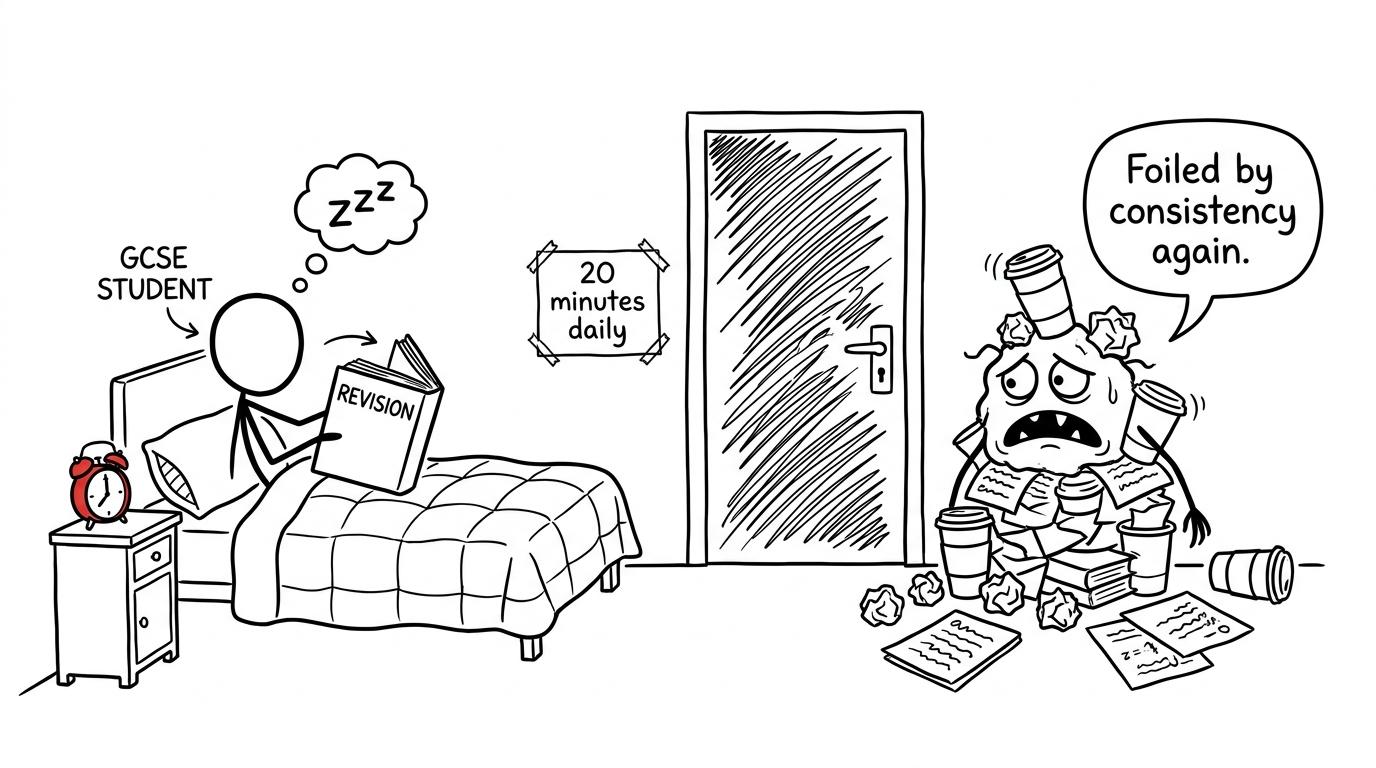 An all-nighter monster is defeated by a consistent daily revision routine
Common mistakes in a 20-minute study routine
Rereading for the entire session
Rereading feels fluent because the page supplies the information. Begin with closed-book retrieval, then use notes to correct what you could not remember.
Trying to revise a whole text
A broad goal produces shallow attention. Choose one scene, relationship, theme, poem or essay skill. Small targets accumulate.
Memorising quotations without interpretation
A quotation is evidence, not an answer. Connect it to a claim and analyse how the writer’s choices create meaning.
Forcing context into every paragraph
Detached historical facts can interrupt an argument. Include context when it genuinely clarifies a writer’s choice, a contemporary attitude or a plausible interpretation.
Avoiding writing until knowledge feels complete
You will never feel as though every quotation is secure. Planning and writing expose the gaps that revision needs to address.
Allowing twenty minutes to become two hours
The boundary is part of the method. Finish the planned task, record the next step and stop. If you repeatedly extend the session, the routine will become harder to start.
Treating predicted content as certain
Do not revise only a rumoured character, theme or poem. Cover the full requirements of your specification. This principle matters in maths too: GCSE predicted topics should guide practice without replacing broad revision.
Build a routine that survives busy weeks
A calm revision plan does not remove hard work. It gives hard work a shape. Set the timer, retrieve from memory, repair one gap, produce a small piece of analysis and leave a clear instruction for tomorrow.
Then give maths the same clarity. Use MathsGenie’s free revision lessons and practice questions for focused topic work, mini tests for quick checks, and past papers with mark schemes and video solutions for exam preparation. As the examination period approaches, add Edexcel GCSE maths predicted papers, where relevant to your entry, without neglecting the wider specification.
Start with twenty minutes today. Not because twenty minutes can do everything, but because it is small enough to begin, and consistency is what prevents the final week from becoming an all-nighter.