GCSE English Language Results Day: Wrong Grade?
GCSE English Language results day wrong grade? Learn what to check in the first hour, how marking reviews work and what to ask your exams officer.
Results day can turn confidence into doubt in a few seconds. Your GCSE English Language grade appears lower than your mock or predicted grade, and the immediate thought is simple: something must be wrong.
If you are searching for GCSE English Language results day wrong grade advice, the short answer is this: do not panic, but do act promptly. Check that the result belongs to the correct qualification, ask for your component marks and grade boundaries, and speak to your school's exams officer before requesting any post-results service. A predicted grade is not proof of an error, but an unexpected result deserves a calm, informed check.
This matters beyond English. If you are also waiting for GCSE Maths, the same habit applies: separate the disappointment from the evidence, then take the next sensible step.
Your first-hour checklist
In the first hour after receiving an unexpected English Language result:
- Check that you are looking at GCSE English Language, not English Literature.
- Confirm the exam board and qualification details.
- Ask for your total mark and, if available, the marks for each paper or component.
- Find out how far your mark is from the relevant grade boundary.
- Tell a teacher or the exams officer that the result is unexpected.
- Ask about access to your exam scripts and reviews of marking.
- Explain immediately if a sixth form, college course or apprenticeship place depends on the grade.
- Record the school's internal deadlines, which may be earlier than the exam board's deadline.
- Avoid posting your candidate details or results documents publicly.
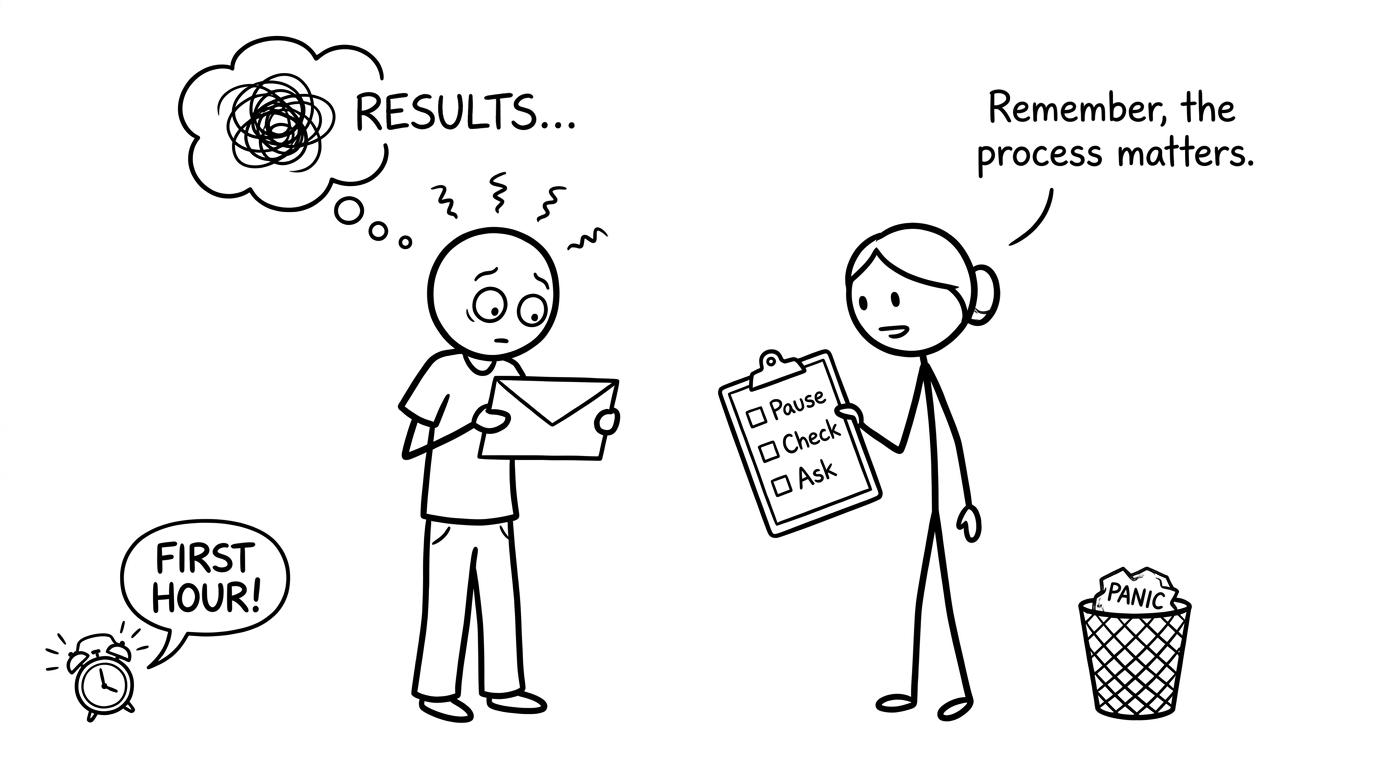 A student replaces results-day panic with a calm checklist
What to do in the first hour
Pause before deciding that the grade is wrong
Predicted and mock grades are estimates. Schools may use different papers, grade boundaries and assessment conditions, while the final GCSE is marked against the requirements of the live examination. A lower grade can therefore be disappointing without being administratively or academically incorrect.
Equally, mistakes can happen. A page could require checking, marks might not have been totalled or recorded as expected, or you may have a reasonable concern about how the mark scheme was applied. The purpose of the post-results process is to investigate those possibilities using evidence.
Do not compare only the grade. Ask for the marks behind it.
Check the qualification and components
English Language and English Literature are separate GCSEs. On a crowded results sheet, it is surprisingly easy to focus on the wrong line or misunderstand an abbreviation.
Check:
- your name and candidate details;
- the qualification title;
- the awarding organisation, such as AQA, Pearson Edexcel, OCR or Eduqas;
- whether every expected component has a result; and
- whether the result is provisional or subject to any outstanding issue.
If a result is missing rather than merely lower than expected, tell the exams officer immediately. That is not something to solve by estimating your own mark.
Ask for your marks and the grade boundaries
A grade boundary is the minimum mark required for a particular grade in that examination series. Boundaries can change between series because papers are not identical in difficulty. Last year's boundary may provide context, but it cannot determine this year's grade.
Knowing the distance from the next boundary helps you discuss your options. Being close does not automatically mean a review will raise the grade, and being further away does not prove the marking is correct. It simply gives you a clearer picture of what would need to change.
Speak to the exams officer, not the internet
Your teacher can help assess whether the mark looks surprising, but the exams officer manages the formal process through your centre. Ask these questions:
- Which post-results services are available for this qualification?
- Can the school obtain a copy of the script before deciding?
- What is the school's internal deadline?
- Is there a fee, and when might it be refunded?
- Could the grade go down as well as up?
- Is a priority service available or appropriate if progression depends on the result?
Services, fees, consent requirements and deadlines can vary by exam board, qualification and centre. Your exams officer should confirm the current arrangements rather than relying on a previous year's social-media post.
Is a remark the right next step?
The familiar word is “remark”, but the formal service is usually called a review of marking. It is not normally a completely fresh marking exercise. The reviewer checks whether the mark scheme was applied correctly and whether any marking errors should be corrected.
Your mark and grade can rise, remain unchanged or fall. Because the outcome can be lower, centres normally need the candidate's consent before submitting a review. Read the consent information rather than treating the request as a risk-free second chance.
Clerical recheck
A clerical recheck looks for administrative issues, such as whether all parts were marked and whether marks were recorded and totalled correctly. It does not reconsider academic judgements in the same way as a review of marking.
This may be relevant where the concern is missing or incorrectly processed marks rather than the interpretation of an English response.
Access to scripts
A copy of the marked script can help a teacher judge whether a review is sensible. They can look for unmarked sections, unexpected mark allocations or places where the mark scheme may not appear to have been followed.
Script access is valuable because it turns “this feels wrong” into a more specific conversation. However, availability and timing differ, and waiting for a script must not cause you to miss a post-results deadline. Ask the exams officer how the services fit together.
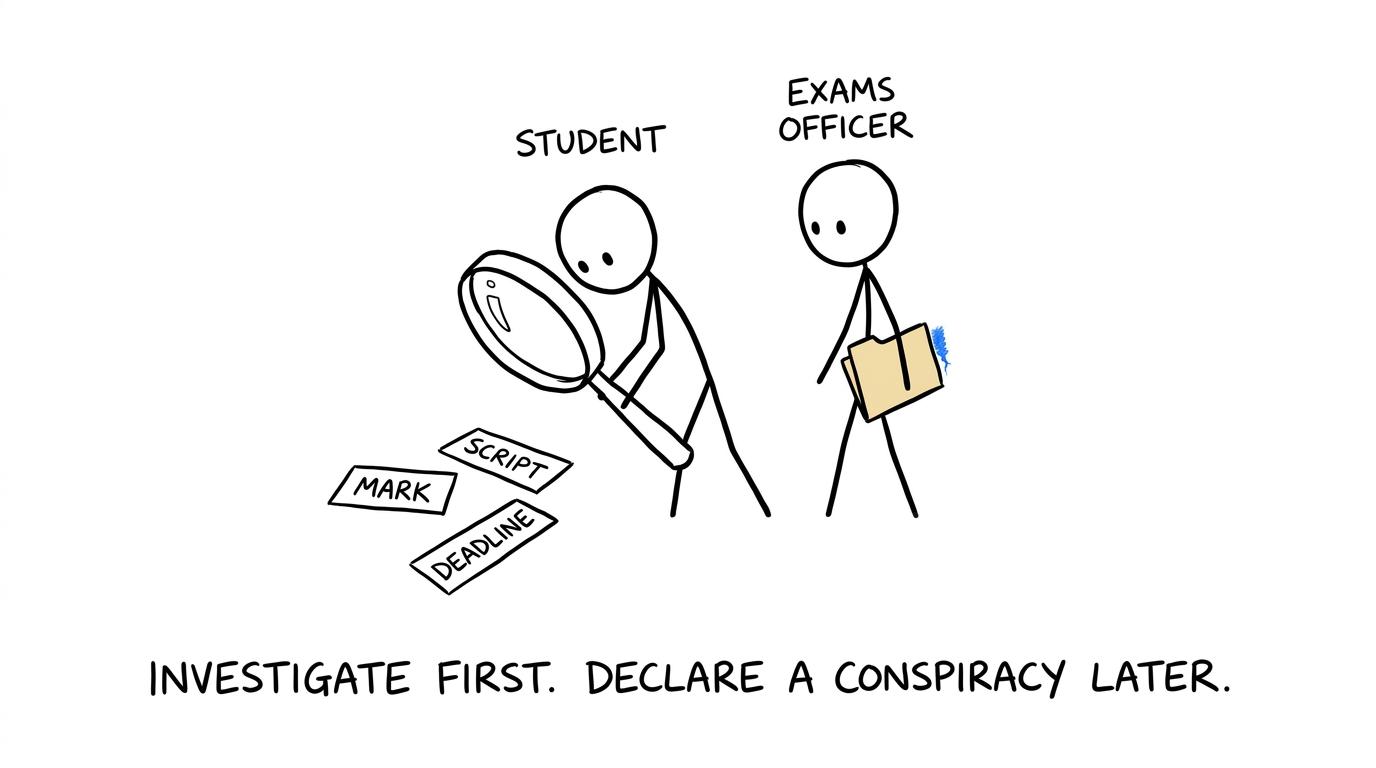 A results-day investigation using marks, scripts and deadlines
Review of marking
A review is most worth discussing when there is a credible reason to question the marking, not simply because the result is close to a boundary. Useful evidence might include a teacher's examination of the script or a component mark that is sharply out of line with your assessed work.
Closeness to a boundary affects the possible consequence of a mark change. It does not change the standard used by the reviewer.
Appeals
An appeal is not usually the immediate first step and is not simply another attempt to obtain more marks. It generally follows the relevant post-results process and concerns whether procedures were followed correctly. If that stage becomes relevant, your centre should explain the permitted grounds and submit the case through the appropriate route.
Protect your next destination while checks happen
If your place at sixth form, college or on an apprenticeship depends on English Language, contact the provider on results day. Explain that you are discussing a post-results service with your school and ask what evidence or updated result they would accept.
Do not promise that your grade will change. Give accurate information and keep copies of messages, deadlines and names of people you speak to.
If the grade remains below the entry requirement, ask about alternatives. Depending on your circumstances and where you study in the UK, these might include a resit, a different course pathway or another accepted English qualification. GCSE English Language is commonly available in a November examination series, but availability, entry arrangements and funding rules should be confirmed with your school or college.
Keep maths revision moving
One unexpected result can consume the whole day. Yet results day is also about deciding what comes next. If GCSE Maths needs another attempt, or if you are moving towards A Level Maths, a clear revision plan is more useful than repeatedly reopening the results page.
Start with the free MathsGenie GCSE revision programme, where topics are organised by grade and supported by videos and practice questions. Then use GCSE Maths past papers and mark schemes to identify whether lost marks come from knowledge, method, accuracy or exam timing.
The GCSE Maths revision planner can turn a vague intention to improve into manageable sessions. Closer to the examination, MathsGenie predicted papers provide further exam-style practice, while the MathsGenie homepage keeps the wider collection of free resources within reach.
Students progressing beyond GCSE can move into the A Level Maths revision resources and practise with A Level Maths past papers. The principle is the same in every qualification: diagnose first, practise deliberately, then check your work against the mark scheme.
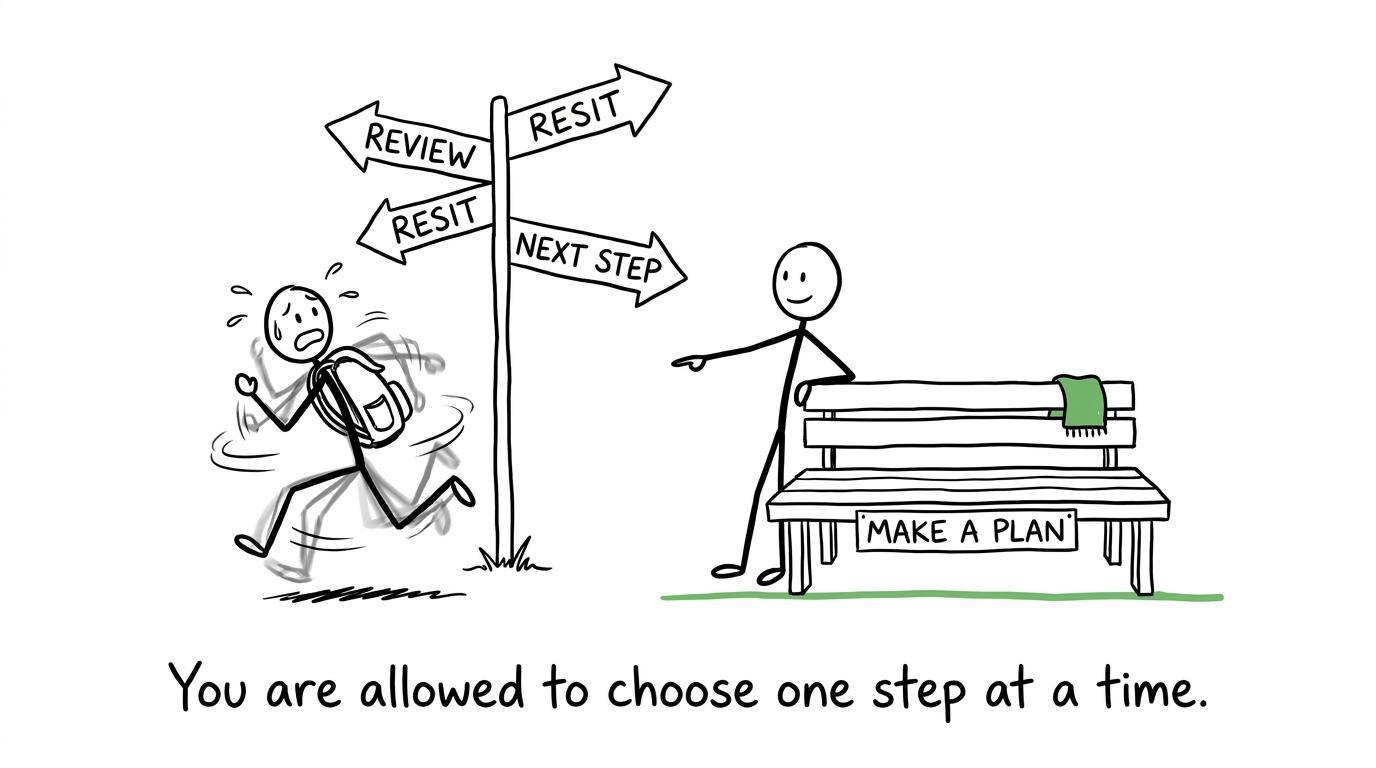 A student chooses one sensible next step instead of sprinting in every direction
Common mistakes after an unexpected grade
Assuming a predicted grade guarantees the final result
A prediction describes what a school expected, not what an awarding organisation must award. Use it as a reason to investigate, not as proof that an error occurred.
Requesting a review without understanding the risk
Marks can decrease as well as increase. Read the candidate consent information and discuss the script, boundary and progression consequences with your school.
Missing the school's deadline
The exam board publishes deadlines, but schools often set earlier internal dates so they have time to process requests. Write down the deadline during your first conversation.
Treating closeness to a boundary as evidence
Being one or two marks below a boundary can make a successful increase consequential, but it does not show that any mark was awarded incorrectly.
Waiting silently when a place depends on the grade
Tell both the exams officer and your intended provider. A priority process may be relevant in some circumstances, and the provider may have its own policy for pending reviews.
Letting one result stop every other plan
You can investigate an English Language result while also preparing for a resit, starting your next course or strengthening GCSE Maths. Parallel planning is not pessimism. It protects your options.
Make the next decision from evidence
A surprising GCSE English Language grade deserves attention, but not an instant conclusion. In the first hour, verify the qualification, obtain the marks, check the boundary, speak to your exams officer and protect any course place that depends on the outcome. Then decide whether script access, a clerical recheck or a review of marking is justified.
Whatever the decision, keep moving. MathsGenie's free revision lessons, video solutions, practice questions, mini tests, past papers, predicted papers and revision planner can help you approach your next maths exam with a clearer system than before. Results tell you where you landed. Careful action determines where you go next.