GCSE English Language Predicted Grade Process
GCSE English language predicted grade process explained: learn how teachers use mocks, classwork, assessment objectives and progress to reach a fair estimate.
A predicted grade can feel strangely official. It appears on a report, sits beside your name and may influence sixth-form or college conversations. Yet it is not awarded by an exam board, and it is not a promise about results day.
The GCSE English language predicted grade process is usually a teacher's evidence-based judgement of the grade you are likely to achieve. Teachers consider mock exams, timed assessments, classwork and your performance across the course. They normally apply their school's assessment policy and may compare judgements within the English department. There is no single national formula that every school must use.
That distinction matters. A prediction is a useful snapshot, not a locked door.
The predicted grade checklist
Most English teachers will consider some combination of:
- full mock papers completed under controlled conditions;
- timed reading and writing assessments;
- marks across different assessment objectives;
- recent classwork and independent work;
- consistency across both reading and writing;
- progress over time;
- whether the evidence covers enough of the specification;
- departmental standardisation or checking;
- the school's own rules for reporting predicted grades.
The strongest evidence usually resembles the final examination. A complete, unseen paper completed independently and under timed conditions normally says more than an essay produced over several lessons with feedback.
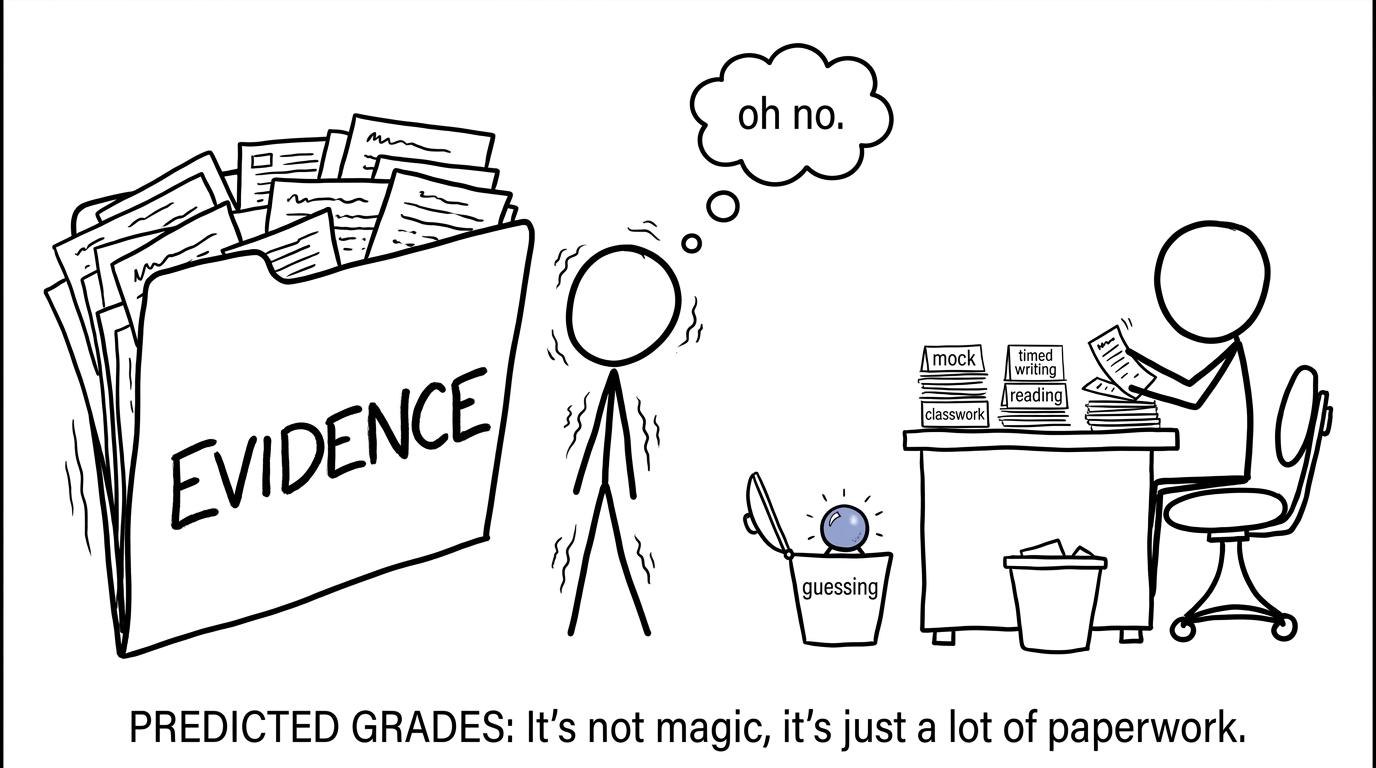 A teacher chooses evidence instead of a crystal ball when deciding a predicted grade
What does a GCSE English Language predicted grade mean?
Different schools use terms such as predicted grade, working at grade, current grade, target grade and most likely outcome. These labels are not automatically interchangeable.
A current or working grade usually describes the standard demonstrated now. A target grade may be based partly on prior attainment and is intended to provide an aim. A predicted grade is generally the teacher's judgement of the likely final outcome, based on the evidence available and the school's definition.
Ask what the label means at your school before drawing conclusions from it. Two reports could display the same grade while answering different questions.
The official GCSE grade is different again. For English Language, it is determined from your final written examinations and awarded by the exam board, such as AQA, Edexcel, OCR or Eduqas. Grade boundaries are set after students have taken the papers, so a teacher cannot know the future boundary precisely.
How teachers actually arrive at the prediction
They start with assessment evidence
Mock exams often carry substantial weight because they can reproduce important features of the real assessment: unseen texts, time pressure, independent writing and full-paper demands.
However, one mock does not necessarily decide everything. Teachers may also look at shorter assessments targeting particular reading or writing skills. This helps them see whether a result represents your usual standard or an unusually strong or difficult day.
For example, a teacher may have evidence from:
- analysis of language and structure;
- comparison or evaluation questions;
- creative, imaginative or transactional writing;
- spelling, punctuation and grammar;
- complete papers testing timing and stamina.
This breadth matters because a student can be strong in creative writing but less secure when comparing viewpoints. A reliable prediction should reflect the qualification as a whole rather than one favourite task.
They interpret marks through assessment objectives
Across GCSE English Language specifications in England, reading contributes 50%50\%50% of the qualification and writing contributes 50%50\%50%. The common assessment objectives cover identifying and interpreting information, analysing language and structure, comparing perspectives, evaluating texts, communicating effectively and writing accurately.
Technical accuracy under AO6 constitutes 20%20\%20% of the whole qualification. That means spelling, punctuation, sentence control and vocabulary are not a small extra added at the end. They form a meaningful part of the available marks.
Question structures and the distribution of individual objectives vary between AQA, Edexcel, OCR and Eduqas. Teachers therefore use material that matches the board their students are taking. They should not treat a raw mark from an unrelated paper as if every specification were identical.
They translate marks into an indicative grade
Teachers may compare mock totals with suitable historical grade boundaries or boundaries chosen by their department for that assessment. Those boundaries provide a guide, not certainty.
Live grade boundaries are not fixed before the final examinations. They can change because papers differ in difficulty and because awarding takes place after examiners have evidence of national performance. A mock result close to a boundary should therefore be treated with appropriate caution.
This is one reason predictions often involve professional judgement rather than a mechanical conversion from one mark.
They check whether the evidence is representative
A prediction becomes more dependable when several pieces of evidence tell a similar story. If your recent timed responses, mock papers and independent work all sit at a comparable standard, the teacher has a clearer basis for judgement.
Conflicting evidence requires more thought. A teacher may consider whether:
- one paper covered an unusually weak area;
- some work was completed with substantial help;
- access arrangements were used correctly;
- illness or an authorised disruption affected an assessment;
- recent improvement has been sustained;
- enough of both reading and writing has been assessed.
This does not mean teachers simply remove every disappointing result. It means they consider the conditions and quality of the evidence before deciding how much weight to give it.
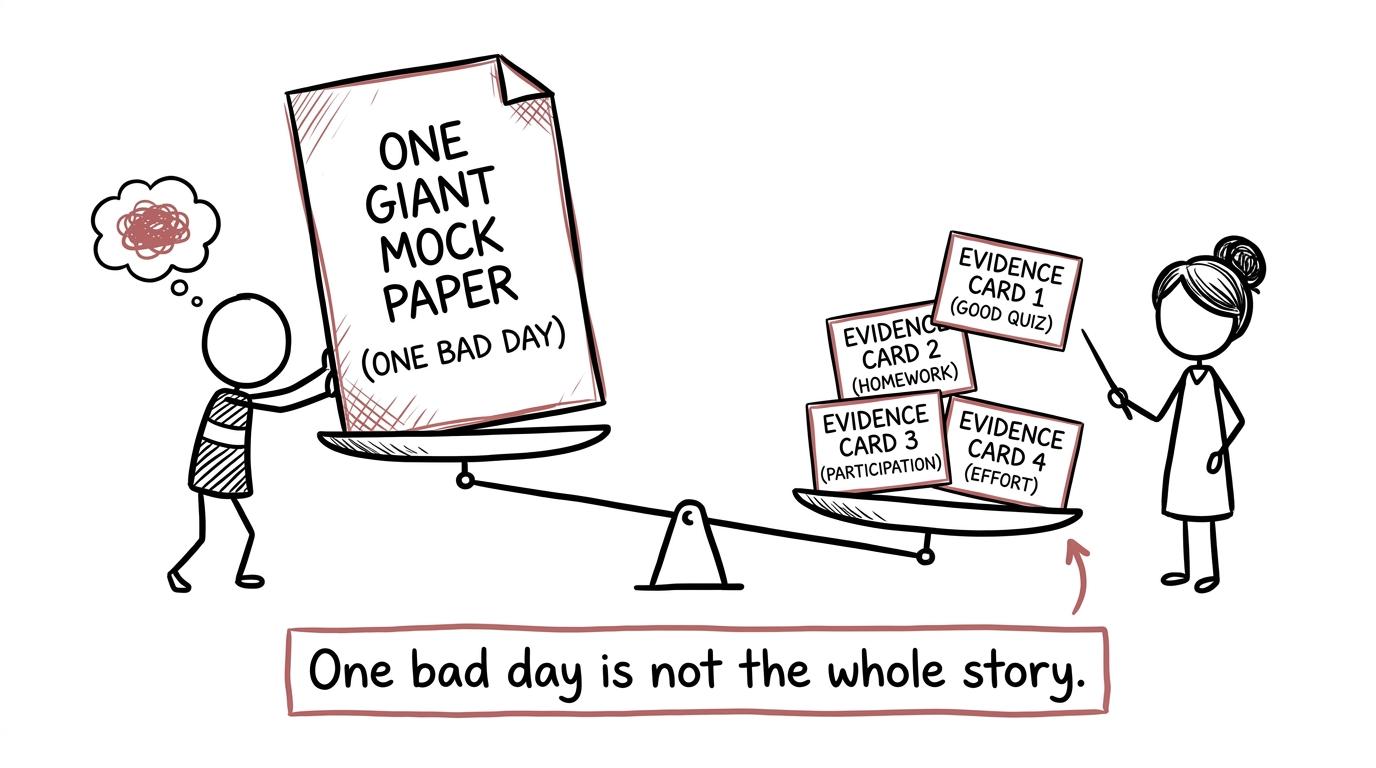 A balance scale shows why one mock should not tell the entire story
They may compare judgements across the department
English responses require examiners to apply level-based mark schemes. Schools often use standardisation activities so that teachers develop a shared understanding of the criteria. A head of department or another teacher may review scripts, discuss borderline responses or check reporting data.
The details differ by school. Internal checking can improve consistency, but it does not turn a prediction into an official exam-board result.
Which evidence normally matters most?
The exact weighting is determined locally, but evidence is often most persuasive when it is recent, independent, broad and completed under realistic conditions.
A useful hierarchy is:
- Full unseen mock papers: strong evidence of whole-paper performance, timing and stamina.
- Timed assessment sections: useful evidence about individual reading or writing objectives.
- Independent classwork: helpful for showing consistency and progress.
- Homework: relevant, but teachers may be cautious because working conditions and support are harder to confirm.
- Effort and participation: important for learning, but not direct proof of an examination grade.
Prior attainment or target data may provide context, but it should not act as a ceiling on what you can achieve. The most useful question is always: what standard does your current evidence demonstrate?
English Language is untiered
Unlike GCSE maths, GCSE English Language is not divided into foundation and higher tier. Students following the same exam-board specification sit the relevant common papers, and the available grades run from 999 to 111.
This means an English prediction is not constrained by a tier entry. In maths, tier decisions affect the range of grades available, so students should confirm their tier when choosing resources from the GCSE maths revision hub. In English Language, the emphasis is instead on demonstrating increasingly secure and sophisticated reading and writing skills on the same assessment route.
The Spoken Language endorsement is compulsory but reported separately as Pass, Merit, Distinction or Not Classified. It does not contribute to the final 999 written 111 English Language grade, so teachers should not add it to written-paper marks when estimating that grade.
What can you do if the prediction seems wrong?
Begin with curiosity rather than negotiation. Ask your teacher:
- Which pieces of evidence were used?
- Is this a current grade, target or predicted outcome?
- Which assessment objectives are holding the grade down?
- When will the prediction next be reviewed?
- What evidence would demonstrate improvement?
A request for a higher grade is less persuasive than stronger work. If analysis is the weakness, complete another independent timed response and apply the feedback. If writing accuracy is limiting AO6, practise editing deliberately. If timing damaged the mock, build towards another controlled paper rather than relying only on untimed classwork.
This is the same evidence cycle that works in maths: attempt, mark, diagnose, repair and retest. MathsGenie's guide to finding your weakest GCSE topics explains how to turn dropped marks into focused next steps.
How to improve the evidence before the next report
A predicted grade usually changes because the evidence changes. Build evidence that is difficult to dismiss:
- complete timed work without notes or outside help;
- cover both reading and writing rather than repeating one comfortable task;
- use feedback in the next response;
- check your work against the assessment objective being tested;
- keep corrected responses so progress is visible;
- practise managing a complete paper.
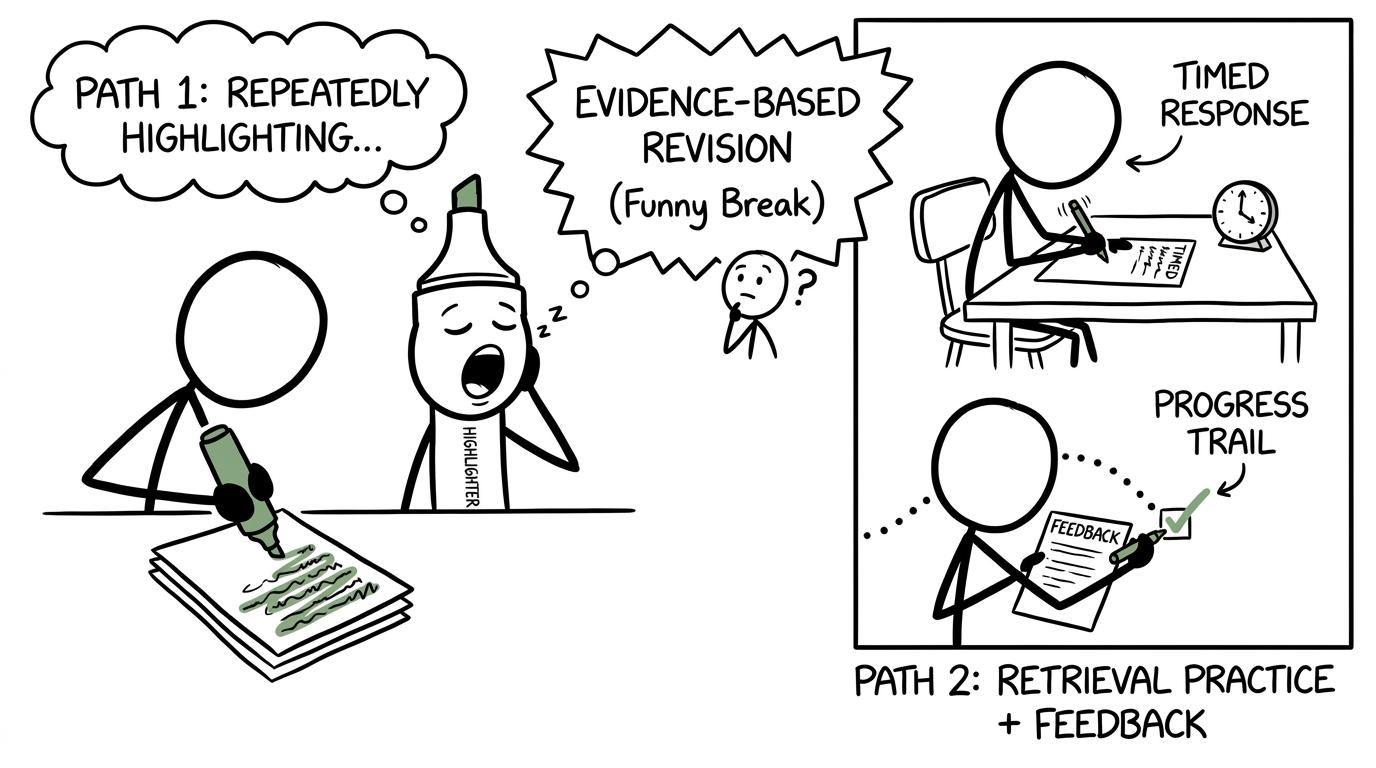 One student highlights endlessly while another creates useful assessment evidence
For students balancing English with maths exams, consistency matters more than heroic revision sessions. The GCSE maths revision timetable guide can help you protect regular maths practice while making room for English responses.
Use the same principle in both subjects: produce work, review it honestly and return to the weakest skill. MathsGenie's free revision resources include mini tests, predicted papers and shorter practice formats for keeping maths active alongside English revision.
Common mistakes when interpreting predicted grades
Treating the grade as a guarantee
A prediction is an informed judgement based on current evidence. It is not the grade an exam board has reserved for you.
Assuming one mock is always the whole calculation
A mock can be the strongest evidence available, but schools may also consider other timed assessments, classwork and progress. Ask about your school's policy rather than assuming.
Comparing raw marks from different exam boards
AQA, Edexcel, OCR and Eduqas organise questions and marks differently. Evidence should be interpreted using the correct specification and assessment structure.
Believing effort automatically earns a higher grade
Effort makes improvement more likely, but grades describe demonstrated performance. Convert effort into completed responses that meet the mark scheme.
Chasing an uncertain grade boundary
Past boundaries can guide teachers, but the final boundary for a new paper is set after the examination. Focus on improving the quality and consistency of your answers rather than trying to land on a guessed minimum mark.
Ignoring the word used on the report
A target, working grade and predicted grade may communicate different things. Clarify the definition before worrying about the number.
Turn the prediction into a plan
The GCSE English language predicted grade process is less mysterious once you see it as a collection of evidence. Teachers examine what you have produced, judge how well it represents the full specification and estimate the outcome you are likely to achieve. The precise method belongs to your school, while the final qualification grade belongs to the exam board.
Your most useful response is not to argue with the snapshot. Ask what created it, identify the weakest assessment objectives and produce better evidence before the next review.
Then keep maths moving too. Start with MathsGenie's GCSE revision resources, use past papers with mark schemes and solutions, and follow the guide on when to begin GCSE past papers. Revision lessons rebuild the method, practice questions test it, mini tests reveal gaps, and predicted papers prepare you for unfamiliar questions.
A predicted grade describes the evidence collected so far. Your next piece of work is evidence too.