

GCSE English Language: Memory vs Understanding
GCSE English Language memory vs understanding explained: learn what to memorise, what requires real comprehension, and how to revise effectively.
The night before an English Language exam, it is tempting to collect sentence starters, ambitious words and model paragraphs as if the right pile of phrases could guarantee a grade. But the GCSE English Language memory vs understanding question has a clear answer: understanding matters more, while memory supports it.
You need to remember useful terminology, writing conventions and reliable routines. Yet examiners primarily reward what you can do with an unfamiliar text or task: interpret it, analyse choices, select evidence, develop ideas and communicate for a particular audience and purpose.
That distinction matters for maths students. In both subjects, memorising a method may get you started, but understanding tells you when to use it and how to adapt when the question looks different.
The short answer: understanding leads, memory supports
GCSE English Language is not a test of how many model answers you can reproduce. Across Edexcel, AQA, OCR and Eduqas, the precise paper structure and wording differ, so you should always check your own specification. However, the broad skills are consistent.
You are expected to:
- understand explicit and implicit information;
- select relevant evidence from unseen material;
- analyse language and, where required, structure;
- compare ideas, viewpoints or methods when instructed;
- evaluate texts and support judgements;
- write clearly for a stated form, audience and purpose;
- control vocabulary, organisation, spelling, punctuation and grammar.
Most of those actions require judgement. Memory can supply tools, but it cannot decide which tool fits the passage in front of you.
A practical revision checklist
Your preparation should include all four of these elements:
- Remember: command words, core terminology and writing conventions.
- Understand: how writers create meaning and shape a reader's response.
- Apply: practise using your knowledge on unfamiliar texts and prompts.
- Review: compare your response with a mark scheme and improve it.
This is close to effective maths revision. A formula is useful, but only if you recognise the situation in which it applies. MathsGenie's GCSE maths revision resources use videos and practice questions to develop that same movement from knowledge to independent application.
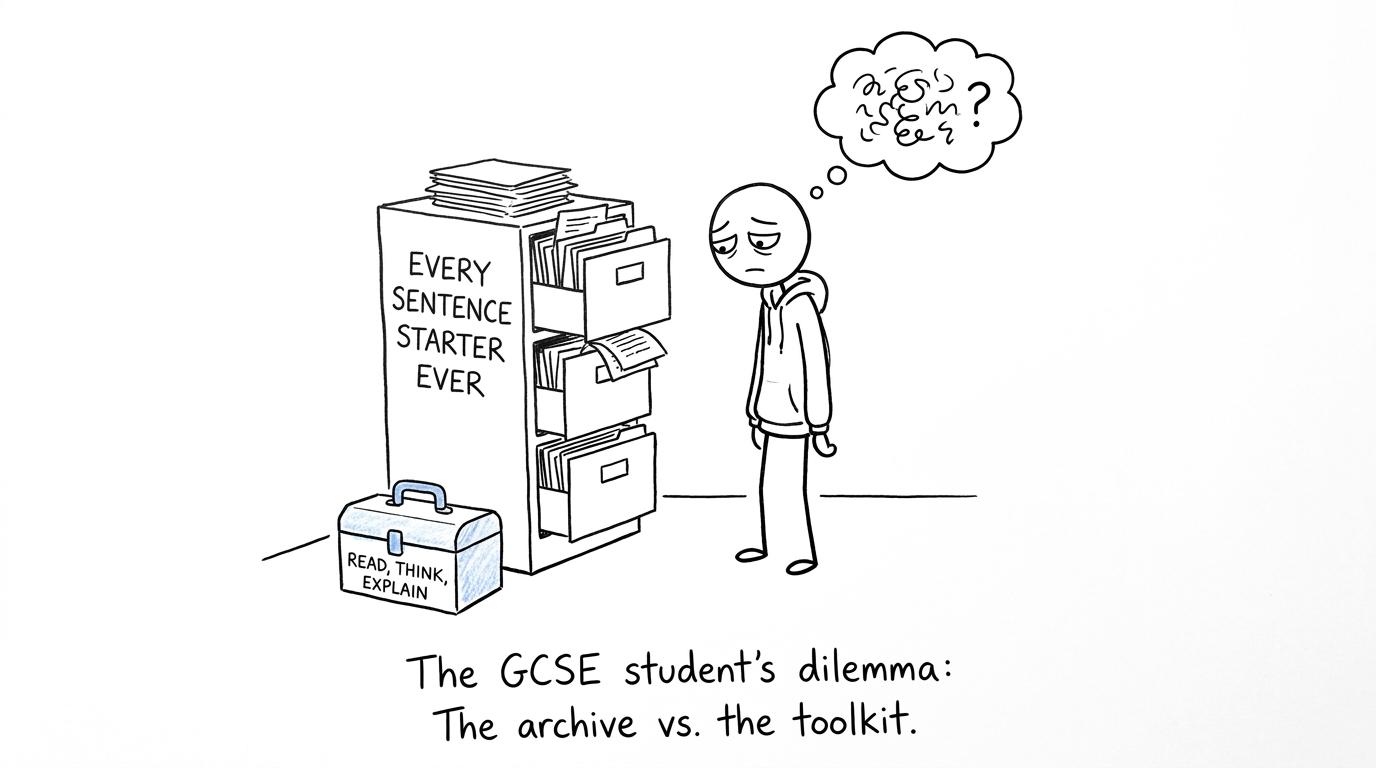 A student chooses a useful thinking toolbox instead of memorising every sentence starter
What should you memorise for GCSE English Language?
Memory still has an important role. The mistake is not memorising; it is memorising material that cannot respond to the actual question.
Your exam paper and question demands
Know the structure of your own exam board's papers. You should understand which sections assess reading and writing, what each command word asks you to do, and how much time you intend to allocate.
Do not borrow a routine from a friend taking another board without checking it. AQA, Edexcel, OCR and Eduqas do not present every question in the same way. Even familiar-looking tasks may have different mark totals or assessment emphases.
Remembering the paper structure reduces avoidable uncertainty. It means you can spend more attention on thinking rather than trying to work out what the exam looks like.
A small bank of precise terminology
Terms such as metaphor, contrast, semantic field, tone, narrative perspective and sentence structure can help you explain a writer's choices. But terminology earns its place only when it improves the analysis.
Naming a technique is not the finish line. You must connect the choice to meaning, context within the passage and its possible effect. A precise explanation without an elaborate label is usually more valuable than a sophisticated label followed by a vague comment.
Flexible analytical and writing routines
It is sensible to remember a sequence for organising your thoughts. For reading, that might involve making a clear inference, selecting evidence and exploring how the evidence supports your interpretation. For writing, it could mean checking audience, purpose, form, paragraph movement and technical accuracy.
Treat these as routines rather than scripts. A routine guides attention; a script attempts to replace thought.
Technical writing knowledge
Spelling, punctuation, grammar, paragraphing and sentence control all benefit from deliberate practice and recall. You should also know the conventions of forms that may appear in your specification, such as articles, speeches, letters or imaginative writing.
This is procedural memory: knowledge strengthened by repeated use. It develops through writing, checking and correcting, not simply reading lists of rules.
What must be understood rather than memorised?
The central challenge of English Language is transfer. You prepare in advance, but you must use your preparation on material you have not seen before.
How meaning is created
You need to understand that language choices work together. A single word may contribute to a pattern of imagery, reinforce a viewpoint or change the tone. Structure can control what is revealed, shift attention or create a contrast between parts of a text.
This is why a memorised statement such as “the short sentence creates tension” is unreliable. A short sentence could instead suggest certainty, shock, humour, interruption or emotional restraint. Its effect depends on its wording and position.
How to select evidence
Finding a quotation is not merely a retrieval exercise. Good selection requires you to decide which detail best supports the argument you are making.
In GCSE English Language, the source material is supplied in the examination. Unlike GCSE English Literature, you generally do not need to memorise quotations from set literary texts. Your challenge is to read the provided material carefully and choose evidence with purpose.
How to build an interpretation
Strong reading responses do more than decode a sentence. They make a defensible interpretation and explain the evidence behind it. There may be more than one reasonable reading, provided your explanation remains rooted in the text.
That is understanding in action: not guessing what an examiner secretly wants, but constructing a thoughtful answer that can be supported.
How to adapt writing
A remembered opening may suit one task and feel completely misplaced in another. Effective writing depends on decisions about voice, detail, organisation and register.
If the audience changes, your choices may need to change. If the purpose moves from describing to persuading, the whole shape of the response may change. The ability to adapt is more important than the ability to reproduce a polished paragraph from memory.
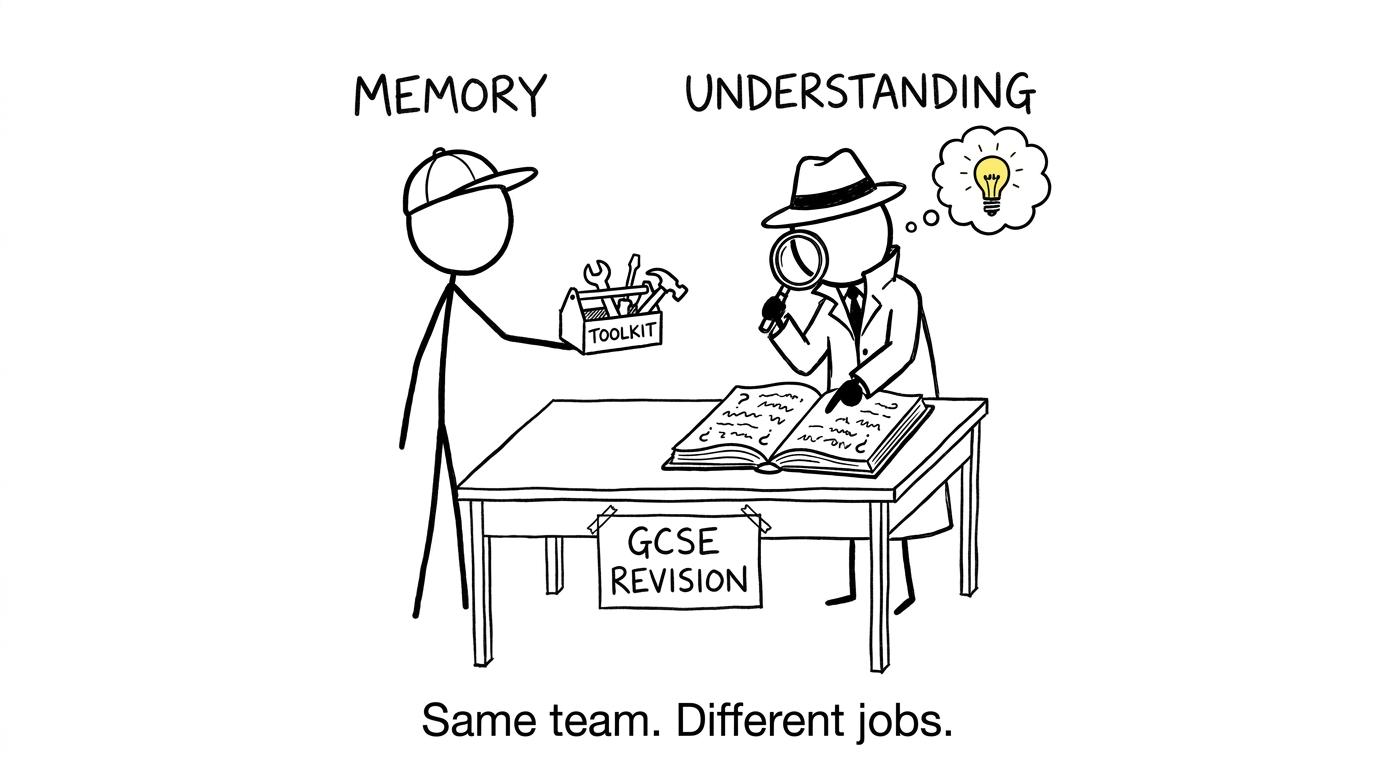 Memory and understanding work as a team but have different jobs
Why memorised answers often underperform
A model answer can look reassuring because it is complete. Your exam question will not be identical, however, so reproducing it can lead to irrelevant analysis, forced terminology or writing that ignores the stated audience.
There is also an illusion hidden inside rereading. Familiarity can feel like mastery. Recognising somebody else's explanation is easier than producing your own under timed conditions.
Maths students meet the same trap when they watch a solution and think, “I could do that.” The useful test comes later: can you solve a fresh question without the solution beside you? MathsGenie's GCSE maths past papers provide that independent test, while predicted GCSE maths papers offer further exam-style practice.
The English equivalent is simple: close the notes, open an unfamiliar source and decide what matters for yourself.
How to revise memory and understanding together
The best revision does not choose between memory and comprehension. It gives each one the right job.
Learn less, but retrieve it more often
Build a short list of genuinely useful knowledge: assessment language, core techniques, form conventions and personal accuracy targets. Then retrieve it from memory rather than repeatedly copying it.
Brief, regular recall is more revealing than passive rereading. If you cannot explain a term without seeing your notes, it is not yet secure.
Practise with unfamiliar material
Use a range of fiction and non-fiction extracts appropriate to your board. Before writing, identify the exact focus of the question. Afterwards, ask whether every paragraph answers that focus.
This prevents technique spotting. You are training yourself to notice relationships between choices, ideas and effects rather than hunting for a preselected list of devices.
Use mark schemes carefully
A mark scheme should help you identify the qualities of a response, not supply a paragraph to memorise. Look for distinctions such as clear versus perceptive analysis, relevant versus judicious evidence, or inconsistent versus controlled writing.
Translate that feedback into one concrete action for the next response. “Analyse more” is too broad. “Explain why this word changes the tone at this moment” is usable.
Interleave English with maths revision
Students preparing for maths exams often have several subjects competing for attention. A revision planner should therefore alternate focused tasks rather than leaving English as one large, vague block.
For example, one session might combine a short English retrieval task with a set of maths questions. Another might pair timed English planning with corrections from a maths paper. MathsGenie's free maths revision homepage makes it easy to move between targeted topic practice and full papers, while the A Level maths revision section supports students continuing beyond GCSE.
The principle is the same in both subjects: retrieve, apply, check, correct and return later.
Common mistakes in English Language revision
Memorising entire paragraphs
A paragraph written for one source is unlikely to answer another question precisely. Memorise a thinking process, not a finished response.
Collecting impressive vocabulary without context
An unusual word is not automatically an effective word. Accuracy, tone and clarity matter more than decoration. Learn vocabulary through reading and use it only when it expresses your meaning precisely.
Naming techniques without explaining them
Feature spotting produces shallow analysis. Explain what the choice suggests, how it fits the passage and why it matters.
Ignoring your own exam board
Generic advice can be helpful, but timings, question sequences and task formats must be checked against the current materials for your board and specification.
Revising by watching rather than doing
Videos and model responses can teach a method, but improvement requires independent practice. The same is true when using MathsGenie's grade-focused GCSE revision lessons: watch for understanding, then answer the practice questions without support.
Treating memory and understanding as opponents
Memory gives you quicker access to useful knowledge. Understanding helps you choose, adapt and explain. You need both, but they are not equally responsible for success.
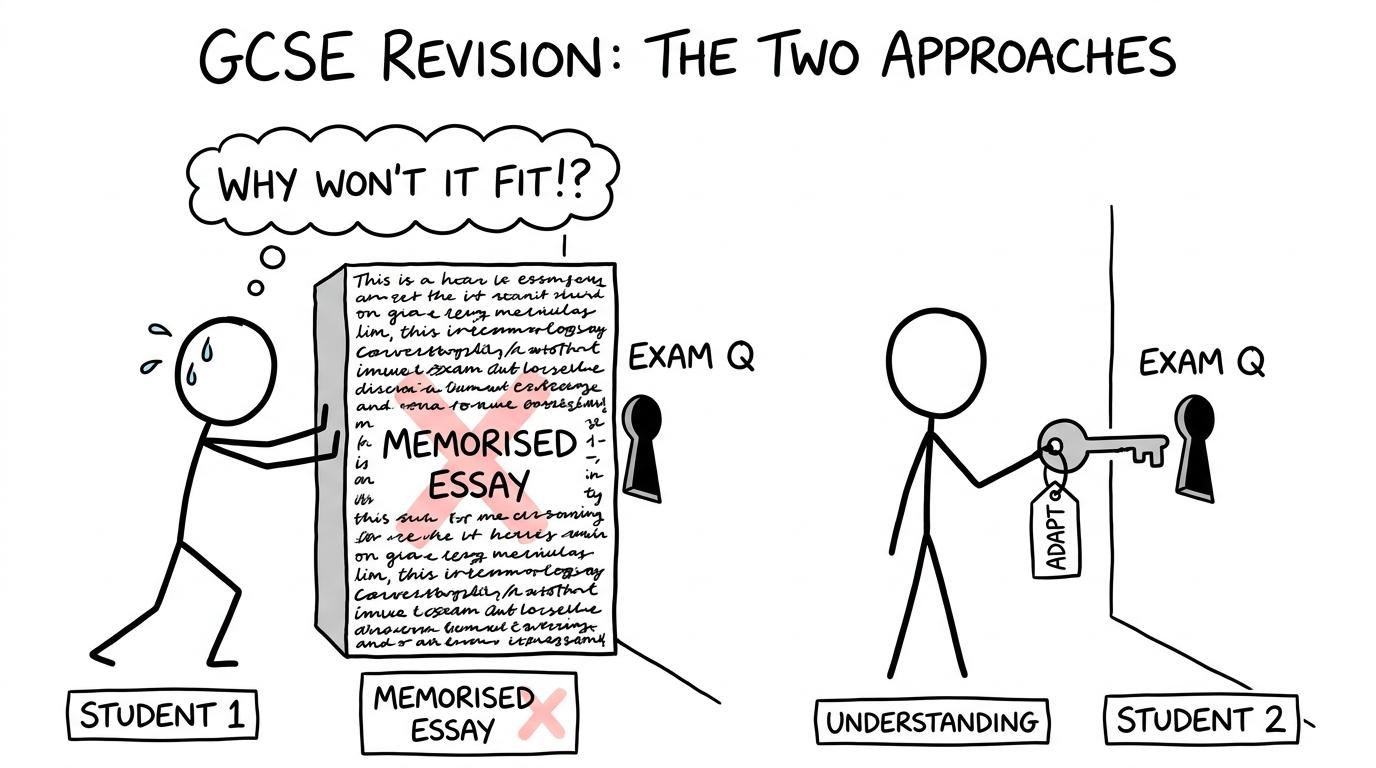 A memorised paragraph refuses to fit an unfamiliar exam question
The better question to ask
Instead of asking, “How much can I memorise?”, ask, “What must become automatic so that I have more attention available for thinking?”
Command words, punctuation rules and a dependable checking routine can become automatic. Your interpretation of an unseen passage cannot. Nor can the exact content of a writing response. Those decisions must be made in the examination.
This creates a useful balance. Memory should make you calmer and more efficient; it should not make your answer rigid.
Build revision around transfer, not repetition
GCSE English Language rewards understanding most because its central tasks involve unfamiliar texts, fresh prompts and purposeful communication. Memory remains valuable when it supports those tasks through secure terminology, conventions and routines.
Revise English as you would revise maths well: learn essential knowledge, apply it without prompts, check the result and revisit weak areas. For your maths preparation, begin with MathsGenie's GCSE revision lessons and practice questions, then test your understanding with past papers and mark schemes and predicted papers.
The goal in either subject is not to remember what somebody else did. It is to understand enough to decide what you should do next.










