GCSE English Language & Literature: No Background?
GCSE English Language and Literature with no background knowledge is possible. Learn what each course requires and how to build an effective catch-up plan.
There is a particular kind of worry that appears when everyone else seems to know the rules already. Classmates mention quotations, language techniques and exam questions as if they have been collecting them for years. You may feel that you have arrived halfway through a film.
The short answer is reassuring: taking GCSE English Language and Literature with no background knowledge can be realistic if your school or exam centre permits the entry and you have enough time for structured preparation. Neither subject depends on secret knowledge. However, English Literature requires substantial knowledge of set texts, while English Language rewards reading, analysis and writing skills developed through repeated practice.
The gap can be closed. But it needs a plan rather than vague promises to “do more English”.
What to check before you begin
Before opening a novel or downloading a paper, establish exactly what you are preparing for:
- Ask whether your school will allow you to join or enter the qualifications.
- Confirm your exam board: Edexcel, AQA, OCR or Eduqas.
- Download the current specifications from the exam board.
- Identify every Literature text and poetry collection your centre teaches.
- Check which Language papers, writing tasks and reading questions you will face.
- Ask how the spoken language assessment will be arranged.
- Find out when your school sets internal entry deadlines and mock exams.
- Build a timetable that protects your GCSE maths revision as well as English.
A school may decide that a late entry is impractical because of teaching time, staffing, exam administration or the amount of material remaining. That is a local decision, not proof that the subjects themselves are inaccessible.
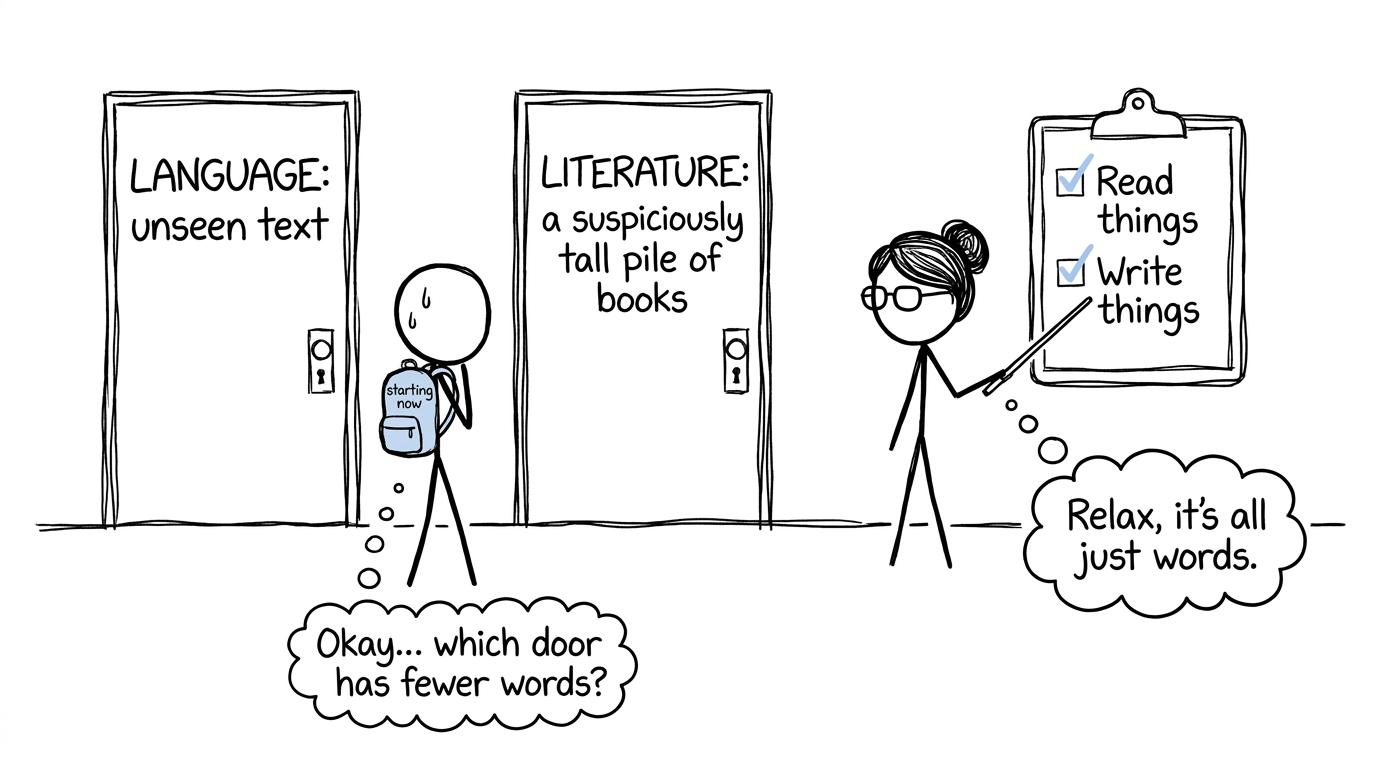 A student choosing between English Language and Literature while carrying a small starting-now backpack
Is GCSE English possible without the usual background?
English Language is a skills-based qualification
GCSE English Language does not normally require you to remember a collection of set novels. Its assessment is built around reading and responding to unseen material, then producing your own writing for a stated purpose or audience.
Depending on the board, you may analyse fiction, literary non-fiction and other non-fiction from different periods. You may also be asked to compare texts, evaluate a writer's methods, write creatively or present a viewpoint. The precise question structure and mark allocation vary, so use your board's current specification and official papers rather than assuming that advice for one board applies to another.
This makes a late start possible, but not effortless. You need to learn how to:
- retrieve relevant information from a text;
- explain how language and structure create effects;
- support interpretations with concise evidence;
- evaluate ideas without simply repeating the passage;
- organise imaginative and transactional writing;
- control spelling, punctuation, grammar and vocabulary;
- allocate time according to the available marks.
These are trainable skills. Reading a list of techniques is not enough because recognition and explanation must become reliable under timed conditions.
GCSE English Language is untiered, meaning there is no separate foundation or higher paper. The spoken language component is reported separately from the numerical GCSE grade, although your centre must still make the appropriate assessment arrangements.
English Literature has a larger knowledge burden
English Literature is also untiered, but it presents a different catch-up problem. You must know the texts selected for your exam board and centre. These may include a Shakespeare play, a nineteenth-century novel, modern prose or drama, and poetry. The permitted choices and assessment arrangements differ between specifications.
You do not need years of cultural knowledge before starting. You do need enough familiarity with each text to discuss characters, themes, relationships, settings, structure and the writer's choices. Relevant context should illuminate the text rather than become a memorised history essay.
For many papers, you cannot rely on having the complete text beside you in the examination. Some questions provide an extract or a named poem, but this does not remove the need to understand the wider work. Check the current rules for your board instead of relying on an older revision guide or another student's recollection.
The realistic conclusion is simple: Language can often be developed through focused skills practice, while Literature requires both knowledge acquisition and essay practice. Starting both late is possible, but Literature usually determines how demanding the catch-up will be.
How to catch up quickly without learning badly
Begin with the specification, not random notes
A specification turns a frighteningly broad subject into a finite one. Record the papers you will sit, their duration, the assessed skills and the Literature texts you need. Then compare that list with what you can already do.
Label each area:
- Secure: you can complete it under timed conditions.
- Developing: you understand it but cannot yet produce a strong answer reliably.
- Missing: you have not learnt the content or question method.
This is similar to organising GCSE maths topics by grade and confidence. The MathsGenie GCSE revision resources make that process visible for maths; your English plan should be equally specific.
Build Literature knowledge in layers
Do not begin by attempting to memorise dozens of isolated quotations. First understand the shape of each work:
- the main sequence of events;
- the central characters and relationships;
- the development of major themes;
- important turning points;
- recurring images or contrasts;
- a small bank of flexible textual references.
Read the complete set texts wherever possible. Summaries are useful for orientation and recall, but they cannot reproduce a writer's language, structure or pattern of ideas. After each act, chapter or group of poems, close your materials and write what you remember. Retrieval exposes gaps that rereading can hide.
A compact theme-and-character grid is more useful than an enormous folder you never revisit. Add only material that helps you answer an exam question.
Practise English Language through short cycles
Language improves when reading, planning, writing and checking happen repeatedly. A productive session might focus on one question type rather than an entire paper. Read the question carefully, complete it within a realistic time, compare your response with the mark scheme and improve one weakness.
Mark schemes describe what assessment objectives reward, but they are not scripts to copy. Use them to understand the difference between identifying a technique, explaining its effect and developing a supported interpretation.
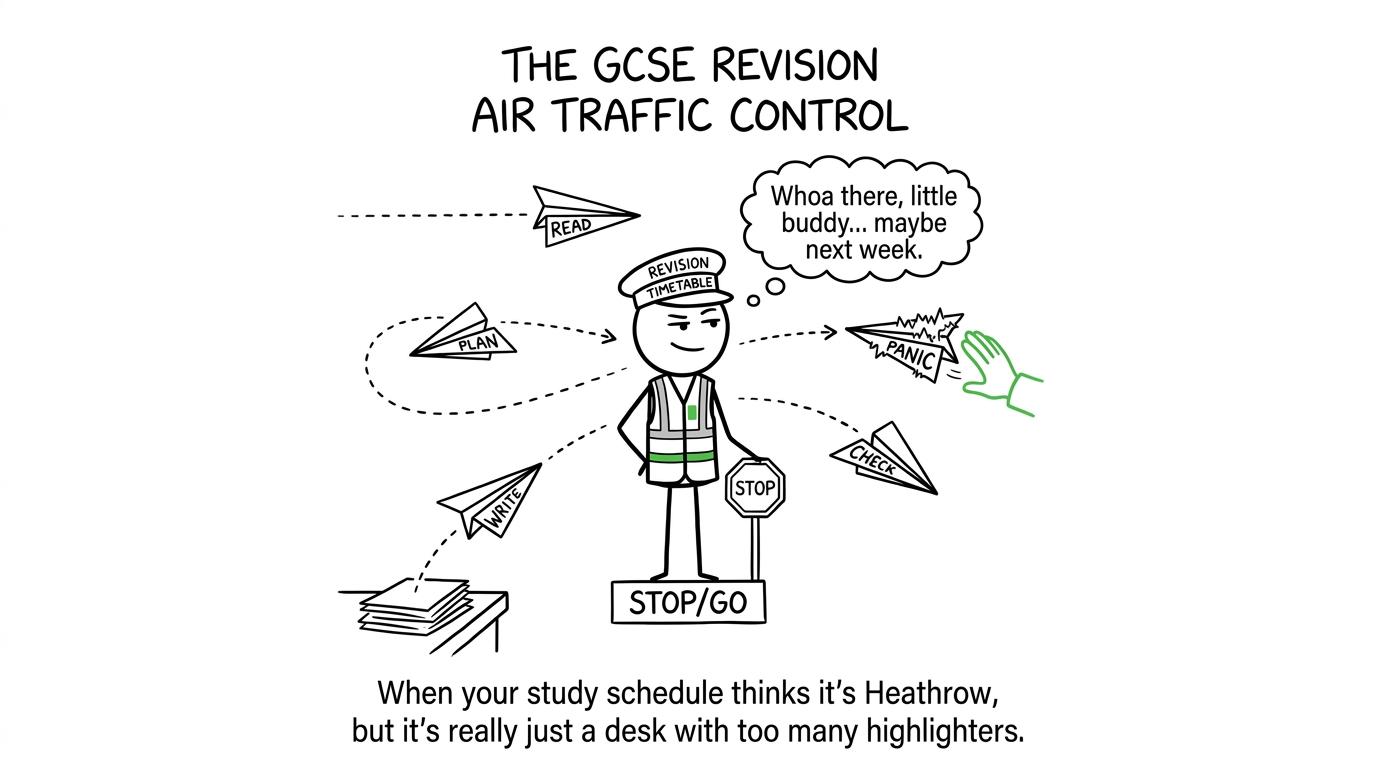 Paper planes labelled with revision actions being directed away from panic
Move from knowledge to timed papers
Full papers matter because individual questions do not teach stamina or time allocation. The progression should be:
- learn the content or question method;
- complete short practice without strict timing;
- repeat the task with a time limit;
- attempt a full paper;
- review errors and revisit the weakest area.
MathsGenie's GCSE maths past papers can be used in the same weekly paper cycle. Students taking Edexcel can organise practice through the Edexcel maths paper collection, while separate resources are available for AQA GCSE maths and OCR GCSE maths.
Keep English and maths paper practice on different days when possible. Completing two demanding papers back-to-back often produces tired work rather than useful evidence.
A realistic catch-up timetable
Your timetable should be built around remaining weeks, not an imaginary perfect routine. Count the teaching weeks available, remove mock periods and major commitments, then distribute the work.
If you have several months
Spend the early phase reading Literature texts and learning the Language question formats. In the middle phase, combine retrieval with paragraph and essay practice. Use the final phase for timed sections, complete papers and targeted corrections.
If you have only a few weeks
Prioritise ruthlessly. Confirm the exact texts and papers, learn the central narrative and themes, develop a small flexible bank of references, and practise the highest-demand question types. Ask a teacher to identify which weaknesses are losing the most marks.
Do not abandon maths because English feels urgent. A simple weekly structure could include short English retrieval sessions, longer writing sessions and protected maths blocks. Use MathsGenie predicted papers alongside past papers when they are available for the relevant examination series. Predicted papers are practice resources, not forecasts of exact exam questions.
The principle is to reduce decision-making. Decide in advance what resource, paper or text you will use. Revision time should be spent working, not searching.
Maths habits that transfer well to English
Maths and English feel different, but effective preparation has the same architecture.
In maths, you learn a method, answer questions, check the solution and record the error. In English, you learn what a question assesses, write a response, compare it with the criteria and improve the weakest feature.
Useful transferable habits include:
- reading command words carefully;
- showing evidence for a conclusion;
- distinguishing knowledge gaps from avoidable mistakes;
- practising under timed conditions;
- keeping an error log;
- returning to weak areas after a delay;
- using marks and assessment objectives to guide time.
The transferable skill is not being “naturally academic”. It is accepting that performance improves through a loop of attempt, feedback and correction.
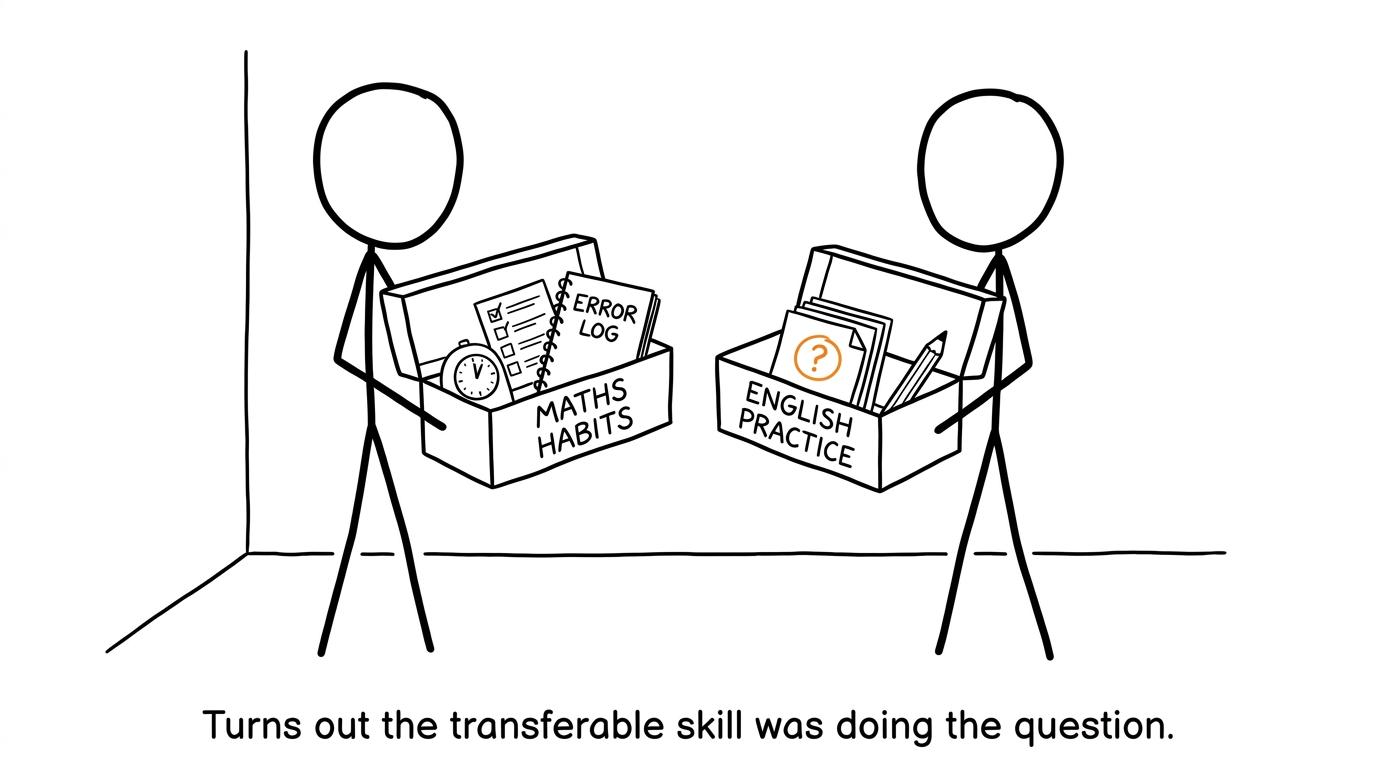 Students exchanging maths habits and English practice toolboxes
If you continue to A Level maths, the same disciplined habits remain valuable. MathsGenie also provides A Level maths revision lessons and A Level past papers, so the routine you build now can survive beyond GCSE.
Common mistakes when starting GCSE English late
Revising the wrong specification
A strong answer to the wrong paper is still preparation for the wrong paper. Confirm the exam board, specification and set texts with your centre before buying resources or making notes.
Treating Language as a knowledge quiz
Memorising terminology does not automatically produce analysis. A technique matters because of what it helps the writer communicate and how it shapes the reader's response.
Replacing Literature texts with summaries
Summaries tell you what happens. Examinations ask you to explore how writers construct characters, themes and ideas. Use summaries to support complete reading, not replace it.
Memorising essays
A prepared essay may not fit the question asked. Learn adaptable knowledge and practise selecting relevant material. Examiners reward a response to the actual task.
Collecting resources instead of answering questions
A large folder can create the feeling of progress without producing it. Keep resources limited and increase the proportion of time spent retrieving, planning and writing.
Ignoring teacher feedback
General advice such as “add more detail” is hard to act upon. Ask which specific feature needs improvement: evidence selection, explanation, structure, accuracy, comparison or timing.
Sacrificing every other subject
A late English start should not erase maths revision. Protect regular topic practice and paper sessions using MathsGenie's free revision lessons, video solutions, practice questions and mark schemes.
Your next move
Starting GCSE English Language and Literature without the usual background is a serious project, not an impossible one. The decisive questions are whether your centre allows the entry, whether you know the exact specification, and whether you can sustain focused practice across the time available.
Begin by speaking to your school or exam centre. Then map the papers, texts and assessment requirements. Read Literature in layers, practise Language in short cycles, and move steadily towards timed papers.
Meanwhile, keep your maths preparation calm and visible. Start with MathsGenie's GCSE revision hub, use topic lessons and practice questions to close gaps, and test your progress with past papers, predicted papers, mark schemes and video solutions. Background knowledge helps, but a clear plan tells you what to do next.