GCSE English Language Grade: Sixth Form Entry
GCSE English Language grade sixth form entry rules vary. Learn how much your grade matters, when resits apply and what maths applicants should check.
A sixth form application can make one grade feel as if it controls everything. For GCSE English Language grade: sixth form entry decisions, the short answer is that your result matters, but its weight depends on the provider and course. It is often a baseline entry requirement rather than the main grade used to judge whether you are ready for A Level Maths.
Many sixth forms and colleges ask for at least a grade 444 in GCSE English Language. Some set a grade 555, while others may admit you with a lower grade and require you to continue English alongside your chosen programme. Your overall GCSE profile and subject-specific grades can carry equal or greater weight.
The important lesson is simple: do not guess. Read the published admissions policy for every place you are considering.
The quick answer
When assessing an application, a sixth form or college may consider:
- whether you meet its general GCSE entry requirements;
- your GCSE English Language and Maths grades;
- the grades required for each A Level or vocational course;
- your overall GCSE profile;
- predicted grades when making a conditional offer;
- your achieved grades when confirming enrolment;
- available places and any published oversubscription rules.
For a student applying for A Level Maths, the GCSE Maths requirement will normally be especially important. However, a strong Maths result does not automatically cancel a missed English Language requirement.
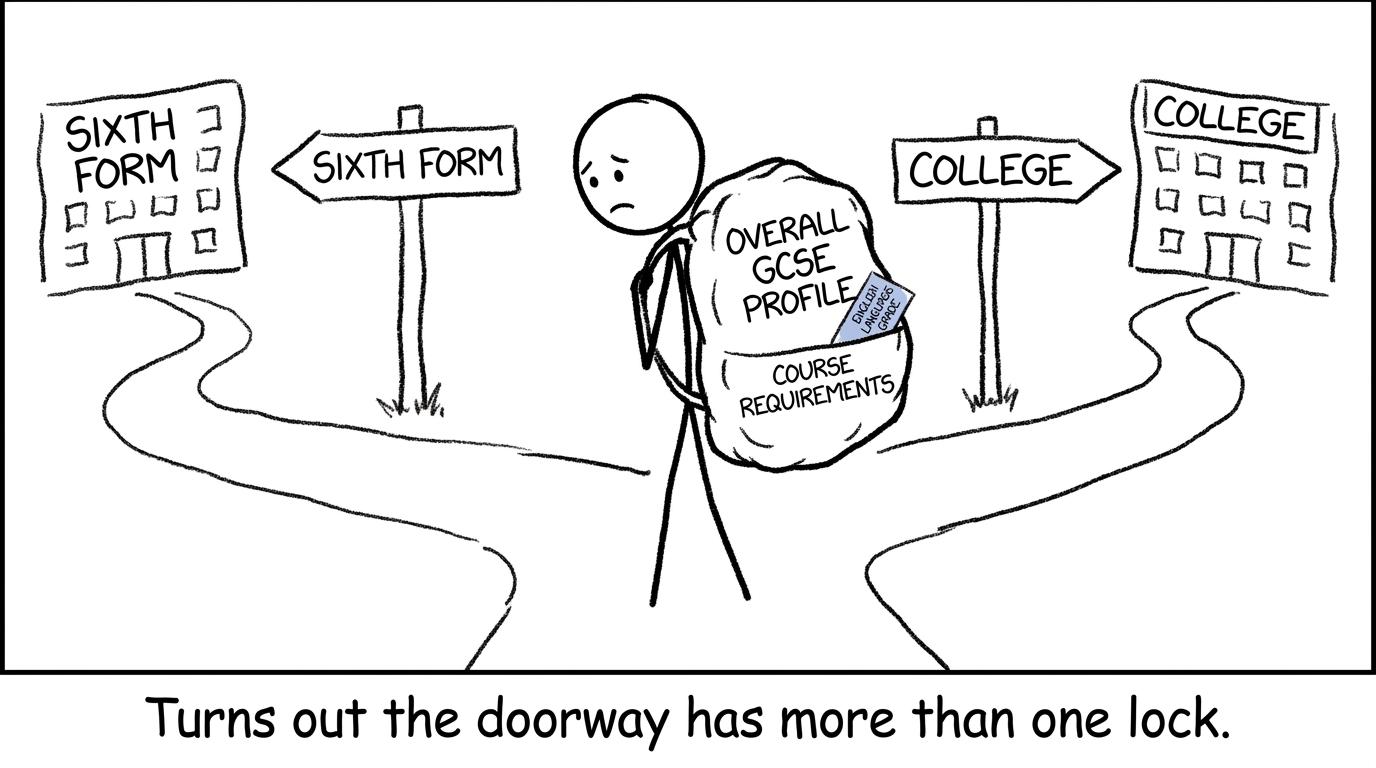 A student discovers that the sixth-form doorway has more than one lock
How much weight does English Language actually carry?
There is no single national admissions rule used by every sixth form and college. Each provider publishes its own entry criteria, so the same grade may be treated differently in different places.
The weight placed on English Language usually falls into one of three categories.
It can be a basic eligibility threshold
A provider might require a minimum grade in both GCSE English Language and GCSE Maths before a student can join a particular programme. In this situation, English acts like a gate: once you meet the threshold, higher English grades may add relatively little to an application for A Level Maths.
If you miss the threshold, however, the grade can suddenly become very important. Admissions teams must apply their published criteria consistently, particularly where courses are full.
It can form part of your overall GCSE profile
Some sixth forms ask applicants to achieve a specified number of GCSEs within a particular grade range. English Language may count as one of those qualifications as well as having its own minimum requirement.
This means a grade should not be viewed in isolation. An admissions team may be looking at the pattern created by all your results: whether you have the foundation needed for an academic programme, whether you meet individual subject conditions, and whether your achieved grades match the terms of your offer.
It can affect what you must study after GCSEs
In England, the current funding framework generally requires students aged 161616 to 191919 who have not achieved a grade 444 in GCSE English and/or Maths to continue studying the relevant subject. The precise qualification and programme offered can depend on the grade already achieved, the provider and the applicable funding rules.
That does not necessarily mean you will be rejected. A college may offer your chosen course alongside English lessons or a resit programme. Equally, a selective sixth form may require grade 444 or 555 before admission. These are separate decisions, which is why the provider's own policy matters.
The continuation requirement described above applies in England. Education and funding arrangements differ across the UK, so students elsewhere should check the rules that apply locally.
What matters when applying for A Level Maths?
For A Level Maths, your GCSE Maths grade is normally the clearest evidence of subject readiness. Many providers set a course-specific requirement above their general entry threshold because A Level work becomes algebraically demanding quite quickly. Further Maths may have a still higher requirement.
There is no universal grade for entry. One sixth form might ask for a grade 666 in GCSE Maths, while another might set a different condition. Always check rather than treating these figures as national rules.
English Language still matters because it may be part of the general offer. It also supports skills used throughout post-161616 education: interpreting instructions, explaining reasoning and communicating conclusions clearly. Yet an English grade is not usually treated as a substitute for the required Maths grade.
If your main concern is reaching your Maths condition, begin with the MathsGenie GCSE revision programme. It organises topics by grade so you can identify what you know and where the gaps remain. Students working towards a secure pass can focus on the grade 444 revision topics, while those targeting more demanding A Level entry conditions can progress through the grade 555 topics and grade 666 revision resources.
What happens if you achieve below grade 444?
A result below grade 444 does not end your post-161616 options. It does mean that you need to speak to the sixth form or college promptly and understand both its admissions decision and its English programme.
Possible outcomes include:
- admission to your intended programme with compulsory English study;
- admission to a different course or programme level;
- a discussion about whether another combination of subjects is suitable;
- referral to a different provider whose entry criteria you meet;
- refusal where the published minimum requirement has not been achieved.
None of these outcomes is automatic. Colleges often provide routes for students who need to continue English or Maths, whereas some school sixth forms have narrower entry criteria. A conditional offer is not a guarantee that missed grades will be overlooked.
GCSE English Literature is also not automatically interchangeable with English Language. If an admissions page specifically asks for English Language, confirm whether it accepts any alternative qualification before relying on one.
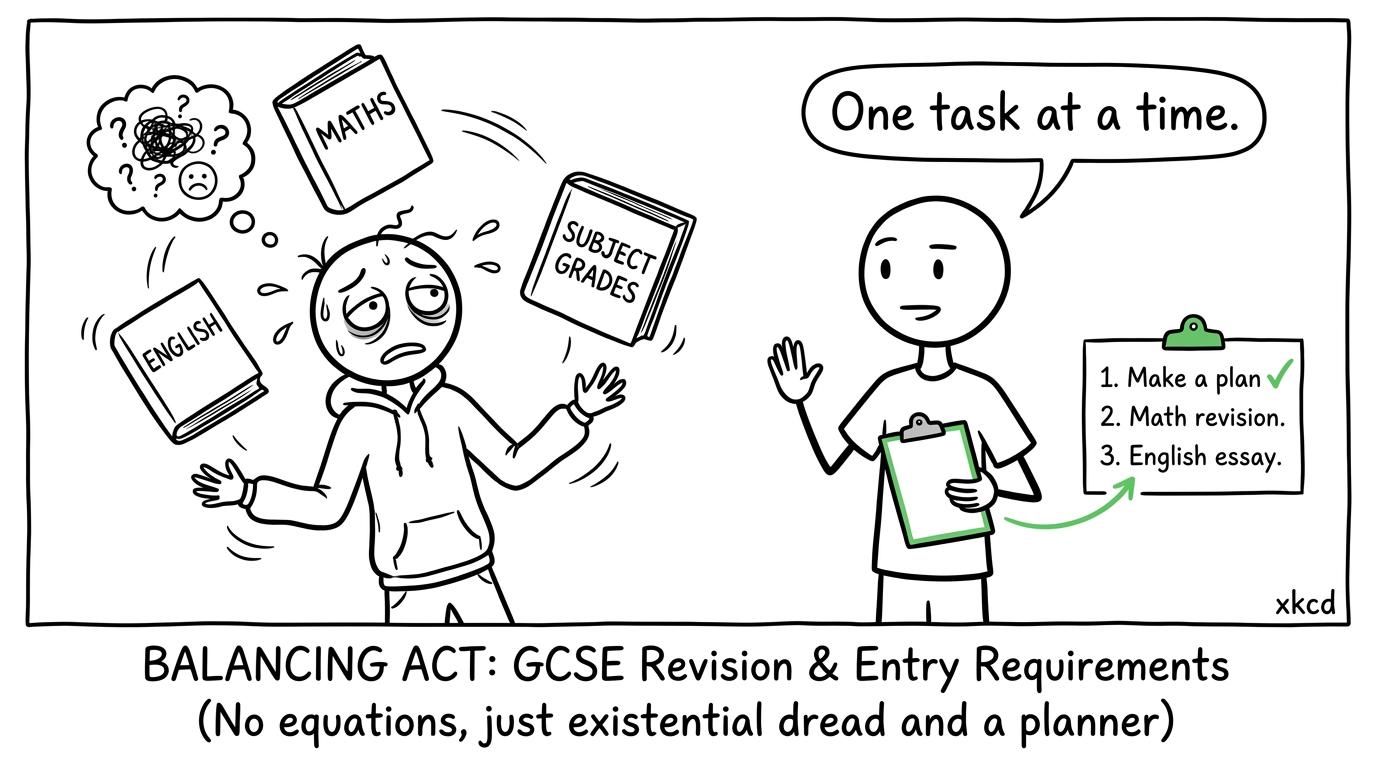 A revision planner helps a student juggle English, Maths and subject grades
How to check your own sixth form entry position
Admissions language often looks more complicated than it is. Break each policy into separate questions.
Find the general entry requirement
Look for the minimum number and range of GCSE grades required for the overall programme. Check whether English Language and Maths must be included.
Find the subject-specific requirement
Next, open the course information for A Level Maths, Further Maths or any other subject you want to take. A student can meet the general sixth form requirement but still miss the condition for a particular A Level.
Check the exact English qualification named
Note whether the policy says GCSE English Language, English Language or Literature, or an approved equivalent. Do not assume these phrases mean the same thing.
Separate predicted grades from final grades
Applications are often made before final GCSE results are known, so providers may use predicted grades when considering an application or issuing a conditional offer. Enrolment decisions can then depend on achieved results. Read the offer carefully to see which grades must be confirmed on results day.
Ask what happens if you narrowly miss
Contact admissions before results day if the policy is unclear. Useful questions include whether English can be retaken alongside your programme, whether course changes are possible, and when final decisions are made. Ask for the answer in writing where possible.
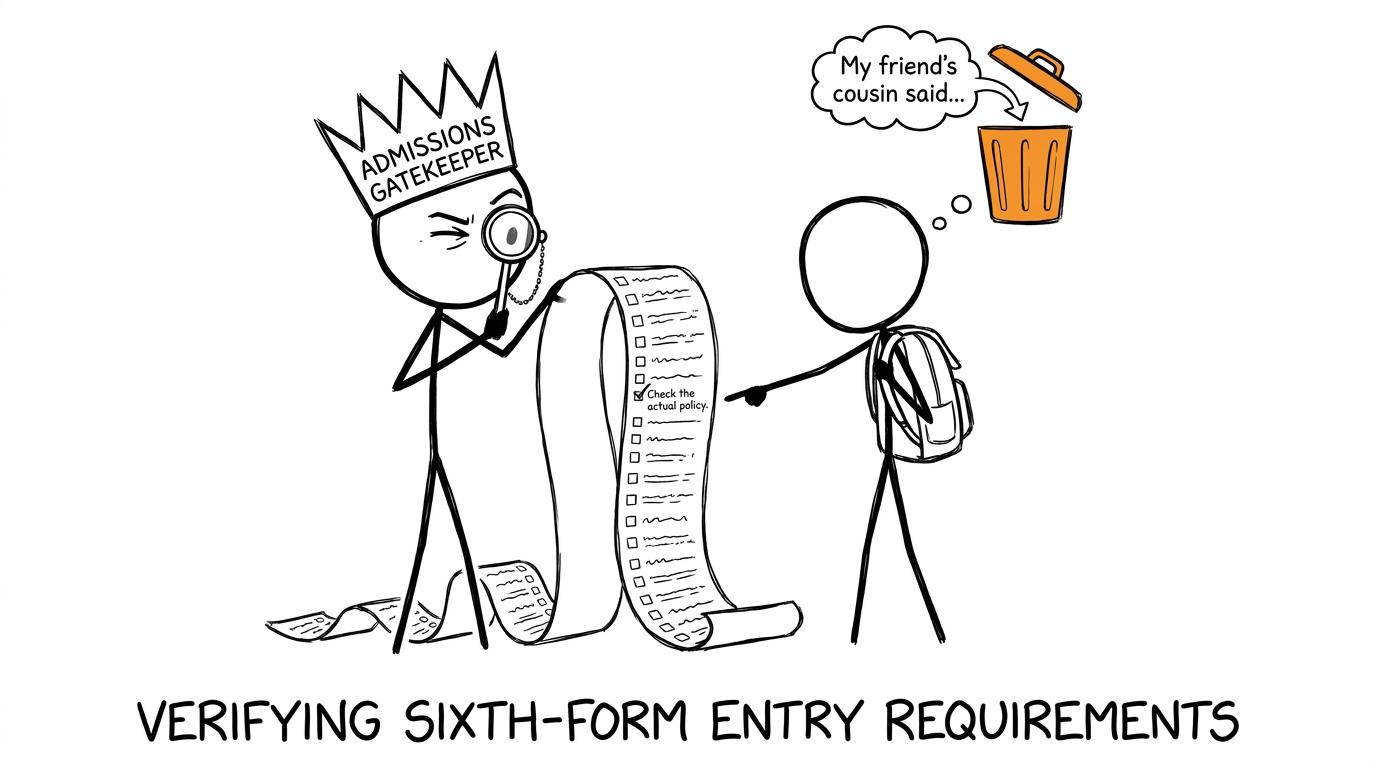 A student replaces admissions rumours with the actual published policy
Plan for English without neglecting GCSE Maths
Entry requirements create a difficult revision problem: several grades can matter at once, but your available time is limited. The answer is not to panic about every subject equally. It is to identify the grades that act as gates for your intended route.
Write down the general English and Maths requirements for each provider, followed by the course-specific Maths condition. This gives you a practical set of targets rather than a vague fear about results day.
For Maths, use topic practice to repair specific weaknesses, then use full papers to develop timing and decision-making. MathsGenie's GCSE past papers and mark schemes let you compare your work with the expected methods. The GCSE predicted papers provide further exam-style practice, but they should complement broad revision rather than encourage predictions about the exact questions that will appear.
If A Level Maths is your goal, you can also explore the A Level Maths revision resources. This is useful for understanding where GCSE algebra, graphs and trigonometry lead, although securing your current GCSE knowledge should remain the priority.
Common mistakes when judging entry requirements
Assuming grade 444 is accepted everywhere
Grade 444 is an important benchmark, but individual sixth forms can set a higher admissions threshold. Check every provider separately.
Looking only at the A Level Maths requirement
You may satisfy the subject condition but miss the sixth form's general requirement for English Language, Maths or your wider GCSE profile. Both layers matter.
Believing a high Maths grade always compensates for English
Admissions teams may have discretion in some circumstances, but you should never plan around an exception. A published English minimum can still apply to an excellent Maths applicant.
Confusing English Language with English Literature
A strong Literature grade may not satisfy a requirement explicitly written for English Language. Ask the provider if its wording is unclear.
Relying on another student's experience
A decision made in a previous year may have involved different entry criteria, course capacity or personal circumstances. Use the current policy and your own written offer.
Waiting until results day to investigate alternatives
Researching backup courses and providers is not pessimistic. It is sensible planning. Knowing whom to contact makes it easier to act calmly if one result is below your offer.
Make each requirement manageable
Your GCSE English Language grade can carry real weight in sixth form entry, particularly when it is a minimum condition. But it is rarely the only fact being considered. General entry criteria, your overall GCSE profile and the subject-specific Maths grade all contribute to the decision.
Start by checking the exact policies of your preferred providers. Then turn the Maths requirement into a revision plan you can control. Use MathsGenie's free revision lessons and practice questions to strengthen individual topics, complete GCSE past papers under timed conditions, and learn from the accompanying mark schemes and video solutions. When your core knowledge is secure, predicted papers can add another layer of realistic practice.
Entry requirements describe the doorway. Consistent revision is what helps you reach it.