GCSE English Language 6 to 8: How to Improve
GCSE English Language 6 to 8: discover the reading, writing and exam-practice changes that can make responses more perceptive, precise and controlled.
A grade 6 answer is often good. That is what makes improvement frustrating. You may understand the text, select relevant quotations and write accurately, yet still find that your marks have stopped moving.
The route from GCSE English Language 6 to 8 is not about adding longer words or identifying twice as many techniques. It is about becoming more selective, more precise and more independent. Grade 8 responses tend to explain not only what a writer does, but how the details work together and why they shape the reader's interpretation.
The same principle applies to creative and persuasive writing: control matters more than decoration. You need deliberate structure, convincing ideas and accurate expression under timed conditions.
The grade 6 to grade 8 checklist
Focus your revision on these changes:
- move from clear explanations to perceptive interpretations;
- choose short, revealing evidence rather than collecting quotations;
- analyse the effects of precise words, images and structural decisions;
- compare writers' viewpoints, methods and purposes rather than topics alone;
- plan writing around an intentional journey or argument;
- vary sentences and vocabulary for a reason, not merely for variety;
- edit recurring technical errors systematically;
- practise complete questions under the timing of your own exam board.
There is no universal number of marks that always equals grade 8. Grade boundaries vary by exam series and exam board, and your final grade reflects performance across the qualification. Treat grade descriptors and previous boundaries as guidance, not guarantees.
What separates a grade 6 from a grade 8?
Across Edexcel, AQA, OCR and Eduqas, GCSE English Language assesses reading and writing, although paper structures, question wording and assessment-objective weightings differ. Always use the specification and mark schemes for your board.
Broadly, the difference is the quality of the decisions made on the page.
| A secure grade 6 response often | A grade 8 response tends to |
|---|---|
| explain a relevant meaning clearly | explore a more perceptive interpretation |
| identify a suitable method | analyse how specific choices create meaning |
| use several relevant quotations | select concise, especially revealing evidence |
| comment on a general reader effect | explain a precise effect within its context |
| compare obvious similarities or differences | connect viewpoint, purpose, tone and method |
| organise writing logically | shape the whole response deliberately |
| use varied vocabulary and punctuation | control language and punctuation for effect |
These are tendencies, not mechanical grade rules. Examiners mark against question-specific criteria, and one sophisticated paragraph cannot assign a grade to an entire paper.
The key shift is from showing that you noticed something to showing that you understand its significance.
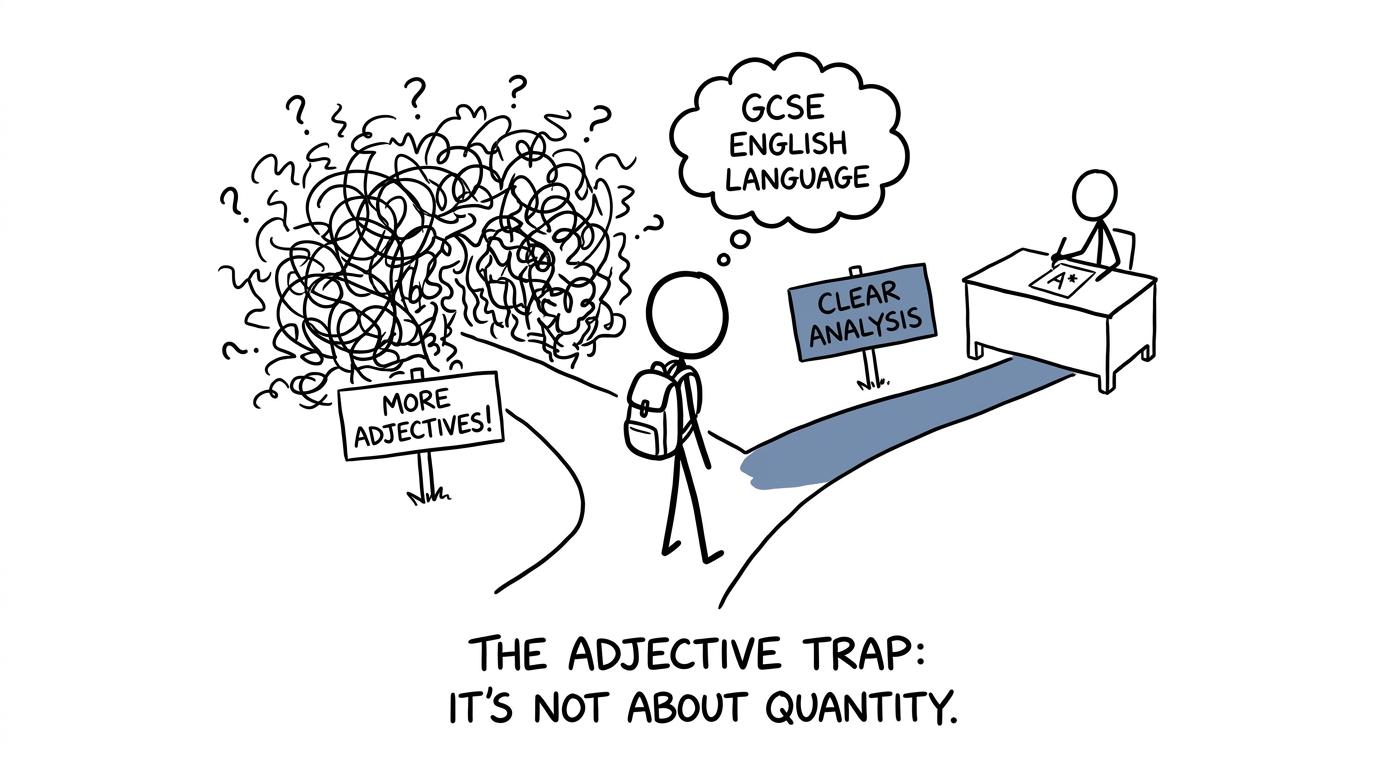 A student chooses between more adjectives and clear analysis
Make reading analysis more precise
Many grade 6 responses use a familiar pattern: quotation, technique and effect. That structure can keep an answer relevant, but it may also become predictable. A label such as “metaphor” does not earn high-level credit by itself. The explanation that follows matters.
Start with an interpretation
Before searching for techniques, decide what the writer is communicating. Ask:
- What attitude or feeling is being created?
- Does that attitude change?
- Is there tension between what is said and what is implied?
- What does the reader gradually realise?
Your paragraph should be driven by an interpretation, with the evidence and method used to prove it. This prevents technique spotting from replacing analysis.
Analyse the smallest useful detail
Choose a brief quotation containing language you can examine closely. Consider a verb's force, the associations of a noun, the implications of an image or a shift in pronoun. Then connect that detail to the wider situation.
A useful internal sequence is:
- make a specific interpretation;
- introduce concise evidence;
- examine the most important detail;
- explain how it shapes tone, character, setting or viewpoint;
- consider a credible alternative interpretation where it adds value.
Alternative interpretations should deepen the answer. Adding “this could also mean” to every paragraph does not automatically make analysis perceptive.
Avoid vague effects
Claims such as “this makes the reader want to read on” are usually too broad. Name the response more precisely. Is the reader made suspicious, uncomfortable, sympathetic or uncertain? What in the evidence creates that response, and why is it important at this moment in the text?
Treat structure as a sequence of choices
Structural analysis is not a list of where the beginning, middle and end occur. It asks how information, focus, pace and perspective are arranged.
Track movement through the extract:
- a shift from a broad setting to one detail;
- a change in narrative perspective or focus;
- information being withheld and later disclosed;
- a contrast between calm and danger;
- a repeated image gaining a different meaning;
- a change in pace, time or paragraph length.
Use references from different points in the text, then explain the relationship between them. The strongest responses show how the reader's understanding changes as the text develops.
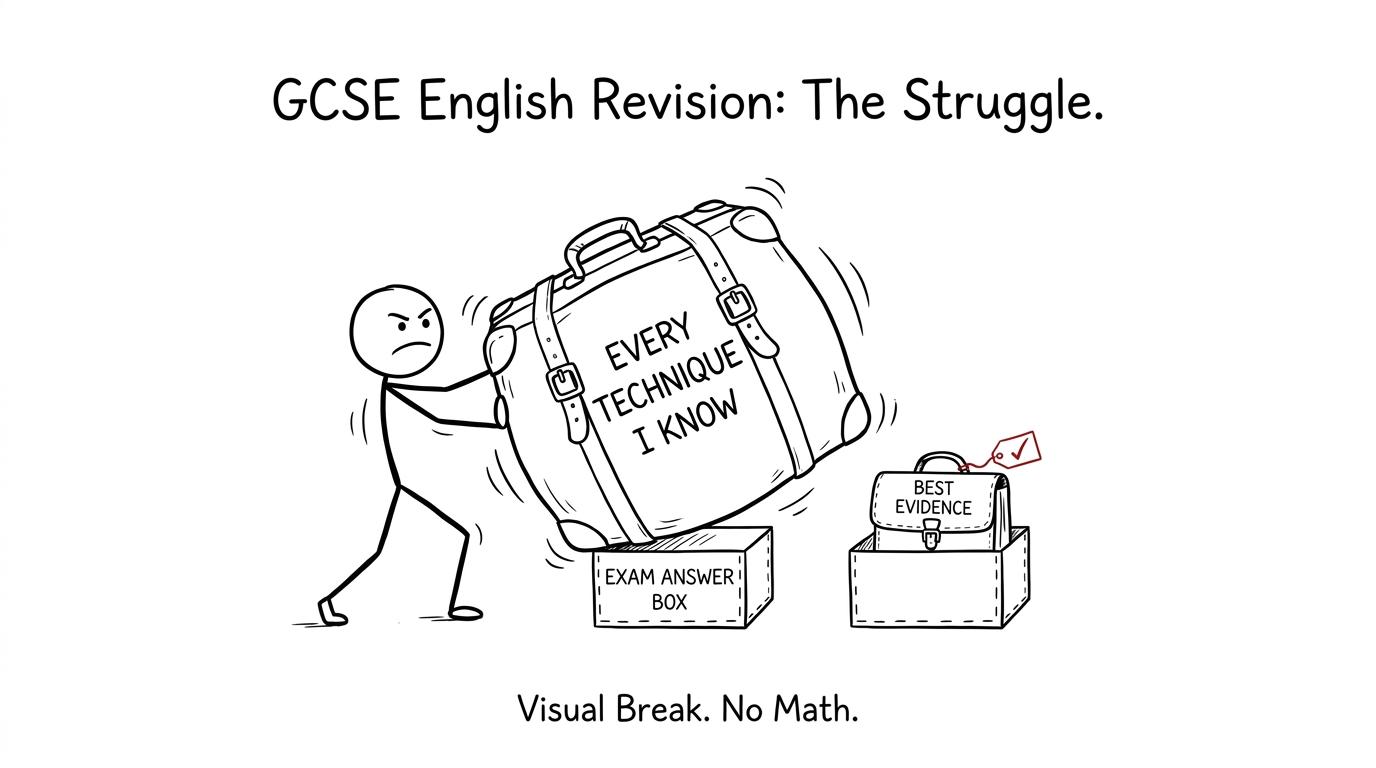 A huge suitcase of techniques fails to fit into an exam answer
Improve evaluation and comparison
Evaluation questions require judgement. Do not simply agree with the statement in the question and then write ordinary language analysis. Decide how far the statement is convincing and build a case using well-selected evidence.
A strong evaluative response usually does three things:
- gives a clear judgement;
- analyses methods and evidence supporting that judgement;
- recognises complexity, development or qualification in the text.
For comparison, move beyond matching topics. Two writers may both discuss travel, education or difficulty, but the higher-level comparison concerns their attitudes and the ways those attitudes are constructed.
Compare as you go rather than writing two isolated mini-essays. Connect viewpoint to method: tone, imagery, emphasis, anecdote, direct address, contrast or structural progression. Check your board's wording carefully because some questions prioritise perspectives while others explicitly require methods as well.
Make writing controlled rather than crowded
A common attempt to reach grade 8 is to add ambitious vocabulary, punctuation and figurative language everywhere. The result can sound forced. Sophisticated writing is not writing with the most decoration. It is writing in which each choice has a purpose.
Plan the whole journey
For creative writing, decide what changes between the opening and ending. You might shift focus, reveal information, alter the atmosphere or return to an earlier image with a new implication. A manageable idea developed with control is usually more effective than an elaborate plot rushed in the final minutes.
For transactional or persuasive writing, identify:
- audience;
- purpose;
- form;
- central viewpoint;
- sequence of arguments;
- tone and how it may change.
Organise ideas so that one develops from another. Paragraphing should create progression, not merely separate chunks of text.
Use variety deliberately
Sentence variety is valuable when it controls pace and emphasis. Punctuation should clarify meaning or shape the reader's experience. Vocabulary should be precise and natural within the chosen voice.
Leave time to check:
- sentence boundaries;
- agreement and tense;
- spelling of common and ambitious words;
- paragraphing;
- missing words;
- punctuation that obscures meaning.
Accuracy remains important at the top end. Ambition helps only when it is controlled.
Practise like a grade 8 candidate
Reading more notes can feel productive because it is comfortable. Improvement usually comes from producing an answer, checking it and changing one specific habit.
Use this revision cycle:
- complete one question under realistic timing;
- mark it using the correct board's mark scheme;
- identify the most important limitation;
- rewrite one paragraph or section;
- practise the same skill with a fresh source;
- attempt a full paper regularly to test timing and stamina.
Keep an error log with narrow targets such as “analyse individual words”, “compare methods directly” or “reserve time to proofread”. “Improve analysis” is too broad to guide your next session.
Because many students are balancing English with maths, plan both rather than letting the nearest mock decide everything. MathsGenie's GCSE maths revision resources organise topics by grade, while the grade 6 maths resources and grade 8 maths resources help you target the right level efficiently.
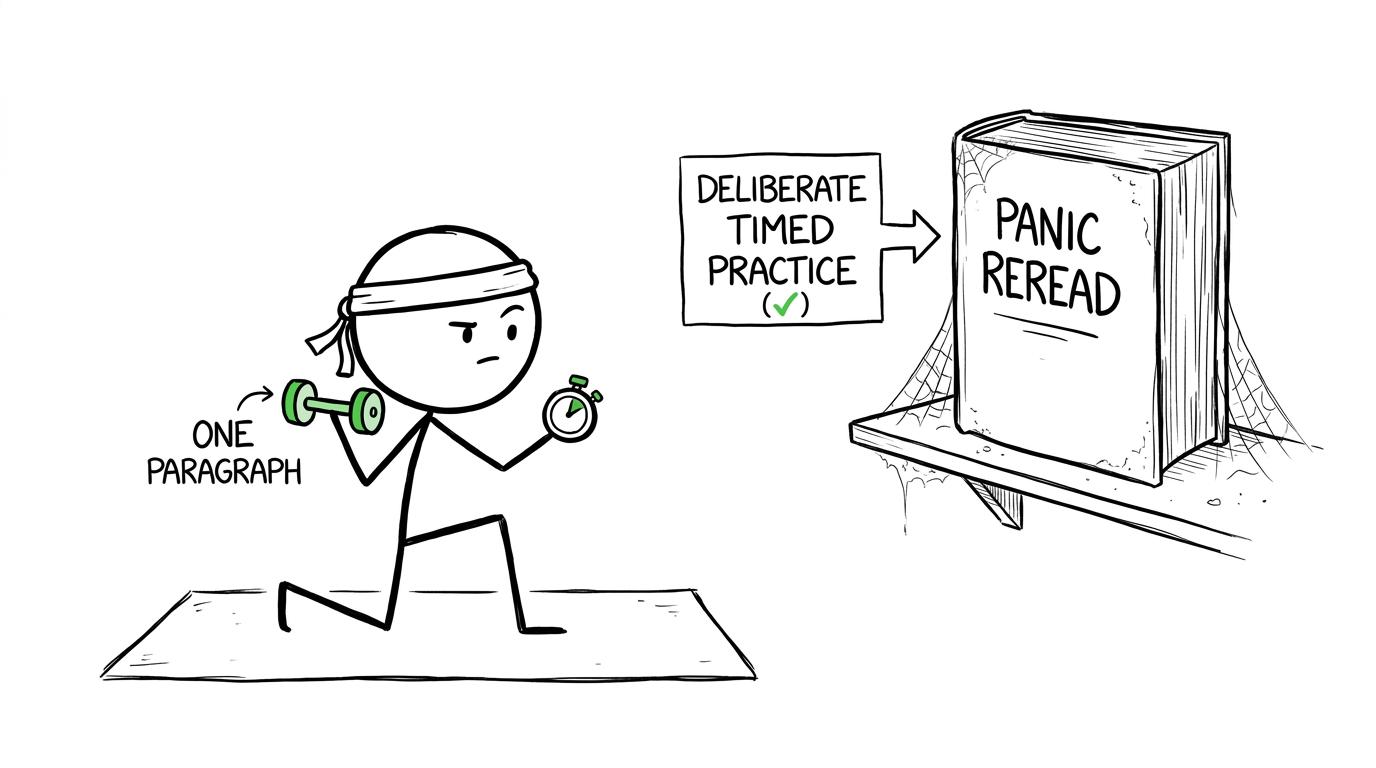 A student trains one paragraph at a time in a revision gym
Common mistakes that hold students at grade 6
Writing more instead of thinking more
Length does not compensate for repetition. Make fewer points if that gives you time to explain them precisely and connect them to the whole text.
Naming techniques without analysing them
A method is evidence for an interpretation, not the destination. Explain why that particular choice matters.
Using memorised reader effects
“The reader is intrigued” is not automatically wrong, but it needs textual proof and a precise explanation. Avoid effects that could be attached to almost any quotation.
Forcing alternative interpretations
A second interpretation should arise naturally from ambiguity, context or language. An implausible alternative can weaken an otherwise convincing paragraph.
Overloading creative writing
Too many characters, events, adjectives or punctuation marks make control harder. Select details carefully and build a coherent atmosphere or voice.
Ignoring board-specific requirements
Do not rely on generic online advice alone. Question types and timings differ across AQA, Edexcel, OCR and Eduqas. Practise using papers, mark schemes and guidance for the qualification you are actually taking.
Revising without feedback
Repeatedly completing papers in the same way can rehearse the same weakness. Use teacher feedback, mark schemes and rewritten paragraphs to close the gap.
Build a revision system that works across subjects
Moving up a grade band rarely comes from one heroic weekend. It comes from short feedback loops repeated consistently. Decide what you will practise before each session and what evidence will show improvement afterwards.
For maths revision, MathsGenie gives you a similarly structured route. Use GCSE maths past papers to rehearse full exams, explore predicted papers for additional exam-style practice, and return to the MathsGenie homepage for free revision lessons, practice questions, mini tests, mark schemes and video solutions.
For English Language, apply the same disciplined process with your board's official materials: attempt, mark, diagnose and rewrite. The jump from grade 6 to grade 8 is not a demand to become a different writer overnight. It is a series of better decisions: sharper evidence, deeper explanation, deliberate structure and calmer control.
Start with one timed question. Find the sentence where your reasoning becomes vague. Rewrite it precisely. Then repeat the process. That is how a grade boundary stops looking like a wall and starts becoming a route.