GCSE Engineering Study Group: Make It Actually Work
GCSE engineering study group advice for building a focused team with clear roles, maths practice, marking routines and accountable follow-up.
A revision group usually fails quietly. Someone creates a chat, everyone agrees to meet, and then the messages drift towards memes, timetable complaints and increasingly optimistic promises about next week.
A GCSE engineering study group works differently. It has a fixed meeting time, a short agenda and a clear output: attempt questions, mark them honestly and decide what to practise next. For students preparing for GCSE maths, the group should focus particularly on the mathematical skills that support engineering thinking: units, ratio, scale, graphs, geometry, trigonometry and interpreting data.
The goal is not to make revision more social. It is to make useful revision harder to avoid.
The study group checklist
Before inviting half your class, agree on the essentials:
- Keep the group to roughly three to five committed students.
- Meet at the same time and place each week.
- Choose one mathematical topic before each meeting.
- Bring questions rather than relying on discussion alone.
- Attempt work independently before comparing methods.
- Mark answers using an appropriate mark scheme.
- Record mistakes and assign follow-up practice.
- End on time with the next meeting already arranged.
This structure may feel formal. That is precisely why it works. Motivation changes from day to day; a dependable routine does not need to.
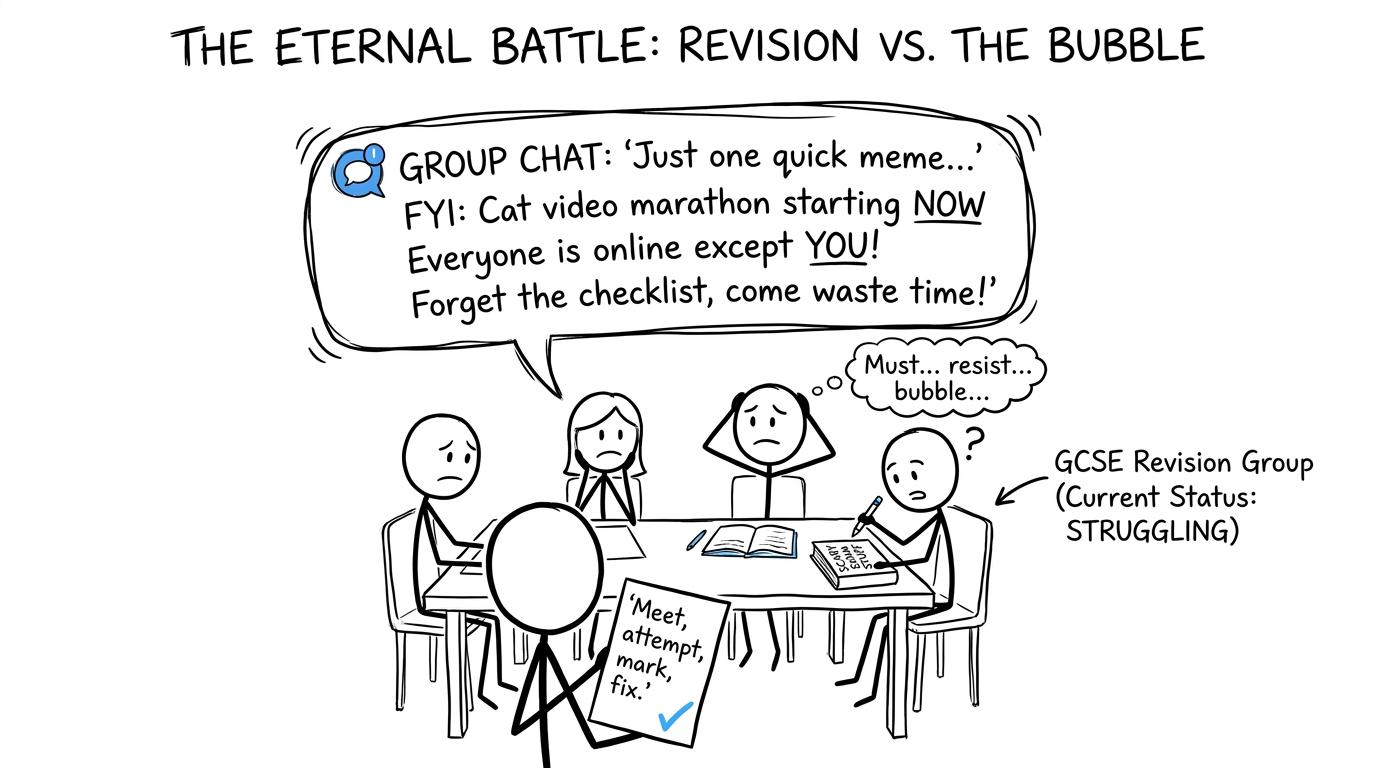 A revision group resisting a distracting group chat
Decide what the group is actually for
“Engineering revision” is too broad to guide a useful hour. Even “maths revision” leaves too much room for choosing easy tasks and avoiding difficult ones.
Start by checking the specification and guidance for your own qualification. Engineering, design and technology courses are not identical, and GCSE maths papers also vary between Edexcel, AQA, OCR and Eduqas. Foundation and higher tier students may share many core skills, but the depth and style of questions can differ.
Turn the broad aim into specific priorities such as:
- converting and checking units;
- using ratio, proportion and scale;
- calculating area, surface area and volume;
- reading linear and non-linear graphs;
- rearranging formulae;
- applying Pythagoras and trigonometry;
- interpreting tables, charts and averages;
- estimating and checking whether an answer is reasonable.
MathsGenie's GCSE maths revision lessons provide videos, questions and answers arranged by topic and grade. Use the page as a shared map: highlight what everyone needs, then identify individual gaps.
Separate shared topics from personal weaknesses
Not every member should spend the entire meeting doing identical work. A sensible plan has two layers.
The shared layer covers a topic relevant to everyone, perhaps scale drawings or compound measures. The individual layer gives each student time to tackle a known weakness. One person may need algebraic rearrangement while another needs accuracy with bearings.
This prevents the strongest voice in the room from deciding the whole agenda. It also makes mixed foundation and higher tier groups more practical: students can collaborate on common knowledge, then move to tier-appropriate questions.
Build a meeting that produces visible work
A reliable session can fit into about an hour. The precise timing matters less than the sequence.
Begin with retrieval, not a conversation
For the opening few minutes, everyone answers a small set of questions from previous topics without notes. This quickly reveals what has been retained and stops the session beginning with twenty minutes of vague discussion.
MathsGenie's GCSE mini tests can provide a compact starting point. Alternatively, select a few questions from an earlier lesson. The key is to retrieve the method before looking at an explanation.
Learn only what you need
If the group discovers a genuine knowledge gap, pause for a concise explanation or video solution. Avoid turning the meeting into a lecture led by whichever student sounds most confident.
For an engineering-focused session, relevant MathsGenie resources might include ratio revision, area revision, volume revision or trigonometry revision. Choose one main area rather than opening several lessons and finishing none.
After an explanation, close the notes. Each member should then attempt questions independently. Watching somebody else solve a problem can create familiarity, but the exam requires you to choose and carry out the method yourself.
Mark, diagnose and repair
Marking is not the administrative part at the end. It is where much of the learning happens.
When an answer is wrong, label the reason:
- knowledge gap;
- incorrect method;
- arithmetic error;
- unit error;
- rounding or accuracy error;
- misread question;
- incomplete working;
- calculator entry mistake.
The label determines the response. A missing formula needs relearning. A repeated unit mistake needs a checking routine. A misread command word needs slower annotation. Merely copying the correct answer repairs none of these.
Keep a shared list of recurring group weaknesses, but let each student maintain a personal error log. That log becomes the starting point for independent revision between meetings.
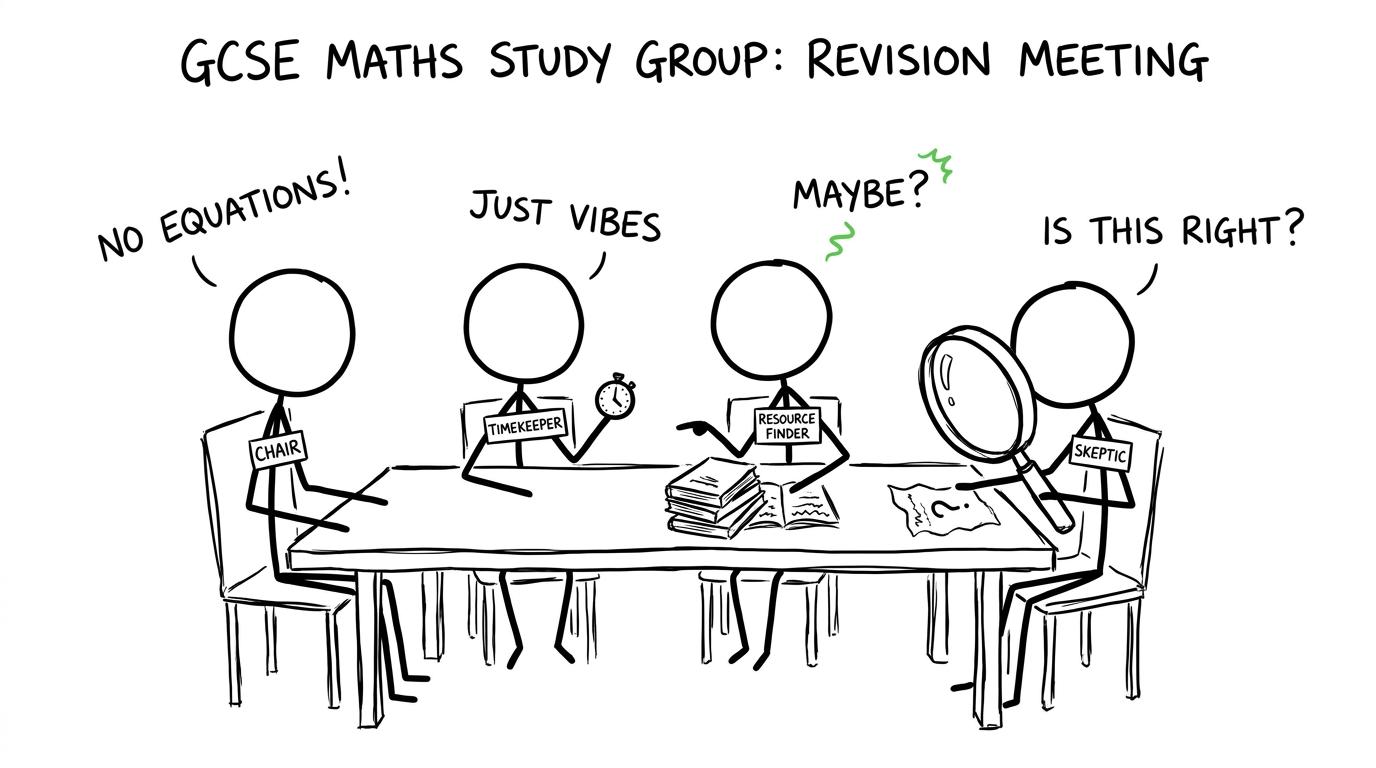 Study group members taking useful revision roles
Give everyone a role
Study groups become passive when responsibility is vague. Assign simple roles and rotate them each meeting.
The chair keeps the session on the agreed topic and moves the group through the agenda.
The timekeeper protects independent question time and prevents one disagreement consuming the meeting.
The resource finder selects the lesson, practice questions and mark scheme in advance.
The checker asks whether units, accuracy and working are complete. This person does not simply announce the answer.
The recorder notes unresolved questions and the agreed actions for next time.
A group of three can combine roles. What matters is that one student is not expected to organise everything every week. Shared responsibility makes the group more durable and gives every member a reason to prepare.
Use engineering thinking to improve maths revision
Engineering problems reward more than memorised procedures. They require attention to constraints, measurements, representations and whether a result makes sense. Your group can adopt the same habits for GCSE maths.
Treat units as part of the answer
A numerical value without the correct unit may be incomplete or meaningless. Before calculating with lengths, areas, volumes, speeds or densities, identify the units and convert where necessary.
Remember that changing a length scale affects area and volume differently. If every length is multiplied by a scale factor kkk, the area scale factor is k2k^2k2 and the volume scale factor is k3k^3k3. The group should ask explicitly: “Are these compatible units?” and “What kind of quantity should the answer represent?”
Read graphs as relationships
Graphs are not just pictures of data. The gradient, intercept, shape and scale communicate how quantities are related. Ask each member to describe a graph in words before reaching for a calculation.
The MathsGenie graphs resources can help the group practise plotting, interpreting and using different graph types. When marking, check whether errors came from the mathematics or from reading the axes inaccurately.
Make checking a standard process
Before accepting an answer, ask:
- Does its size seem plausible?
- Is the sign sensible?
- Are the units correct?
- Has the requested degree of accuracy been used?
- Does substitution confirm an algebraic result?
- Has every part of the question been answered?
Estimation is especially valuable. It may not prove an answer is correct, but it can expose an impossible calculator result before marks are lost.
Keep the group chat deliberately boring
A productive group chat is a noticeboard, not the study group itself. Restrict it to four purposes:
- confirming the next meeting;
- sharing the chosen resources;
- posting one specific question;
- recording agreed actions.
Use a fixed message format: topic, resource, deadline and meeting details. If a discussion becomes long, save it for the session or ask a teacher. Endless messages can feel like revision while producing no attempted mathematics.
Set boundaries too. Members should not post complete homework answers for others to copy. Explain a decision, suggest a relevant lesson or ask a guiding question instead. The purpose is to develop independent exam performance, not group dependence.
Connect meetings to exam practice
Topic practice builds methods; exam papers test whether students can recognise those methods under pressure. A strong GCSE engineering study group should gradually shift from isolated skills towards mixed questions.
Use MathsGenie GCSE past papers to practise authentic exam-style work with mark schemes and video solutions. Select papers for the correct exam board and tier, and check the current specification information provided by your school or exam board before treating any resource as an exact match.
Closer to the exams, MathsGenie predicted papers can offer additional practice. They are revision resources, not promises about the questions that will appear. Mark them carefully and use the results to choose the next topic rather than trying to guess the paper.
A simple progress measure is the proportion of available marks gained:
Score percentage=marks gainedmarks available×100\text{Score percentage}=\frac{\text{marks gained}}{\text{marks available}}\times 100Score percentage=marks availablemarks gained×100The percentage is useful, but the error pattern matters more. Two students with the same score may need entirely different next steps.
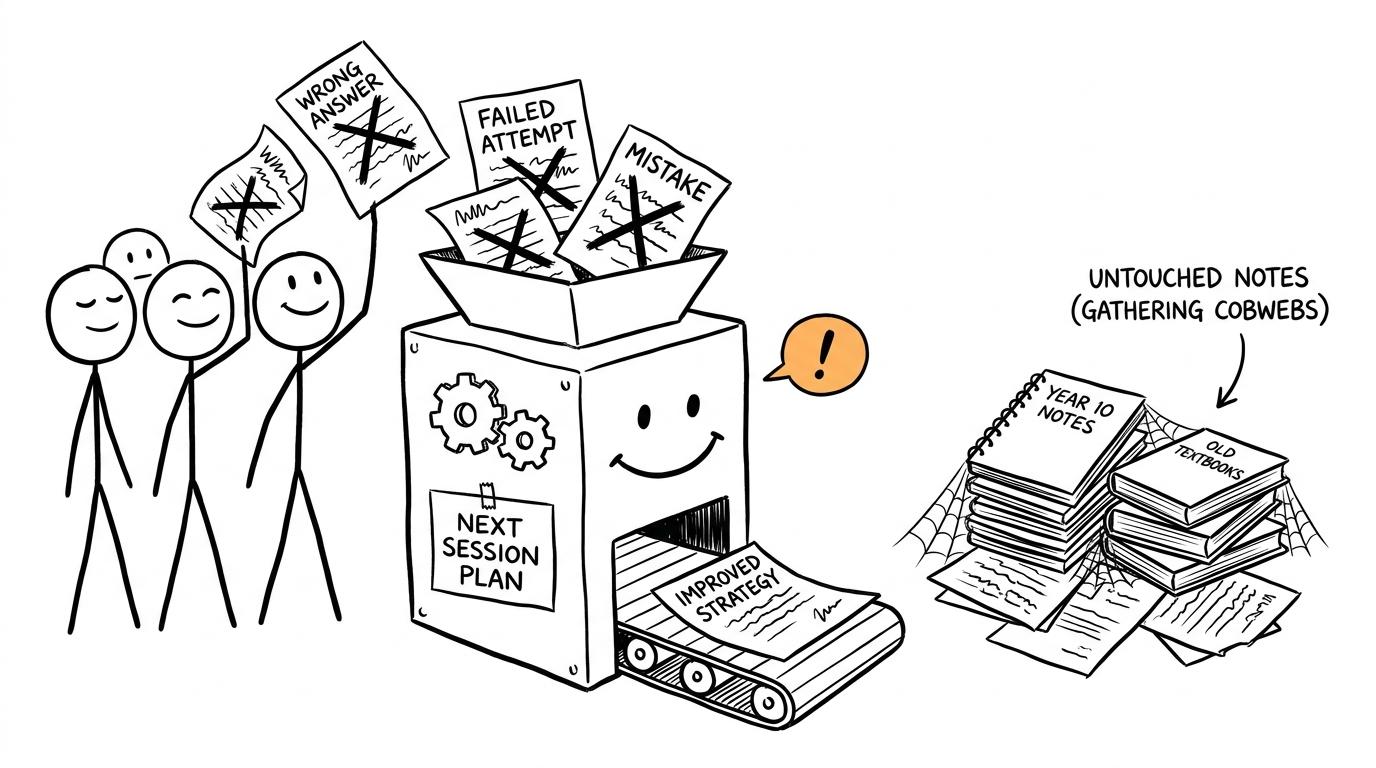 A machine turning mistakes into the next revision plan
Common mistakes that make study groups fail
Inviting too many people
Large groups make scheduling difficult and allow quiet members to disappear. Start small. Extra students can join later if they accept the routine.
Meeting without prepared questions
Good intentions are not an agenda. The resource finder should send the exact lesson, question set or paper before the meeting.
Letting one confident student teach everything
Confidence and accuracy are not the same. Explanations should be checked against solutions or mark schemes, and everyone must still attempt questions independently.
Choosing only comfortable topics
A pleasant session is not necessarily a valuable one. Use mini-test results, marked papers and error logs to decide priorities.
Comparing marks instead of methods
Competition can distract from diagnosis. Discuss where a method went wrong, what the mark scheme required and what action will prevent the same error.
Finishing without follow-up
Every meeting should end with a written commitment: what each person will practise, which resource they will use and when it will be checked. Otherwise, the same weaknesses simply return next week.
Turn the next meeting into a real one
Do not begin by designing the perfect revision system. Choose three to five students, book one hour and select one topic. Bring questions. Work alone before discussing. Mark honestly. Leave with a small, specific task.
That is how a GCSE engineering study group becomes more than a chat: it turns good intentions into repeated evidence of learning.
Start with MathsGenie's free GCSE revision lessons, then combine practice questions and video solutions with mini tests, past papers, predicted papers and mark schemes. Use each result to plan the next session. Revision becomes less mysterious when every mistake tells the group what to do next.