

GCSE Engineering Paper 1: What to Actually Expect
GCSE Engineering Paper 1 explained: understand the timing, question styles, maths skills and revision priorities so you can prepare with confidence.
The unsettling thing about an engineering exam is not usually the machinery. It is the uncertainty. Will you need to calculate, sketch, explain, evaluate, or somehow do all four at once?
Here is the short answer: GCSE Engineering Paper 1 is a timed written assessment that tests whether you can apply engineering knowledge to unfamiliar products, processes and design situations. Expect a mixture of selected-response, short-answer, calculation and extended-response questions rather than simple recall from start to finish.
There is an important naming point. Under the current AQA GCSE Engineering specification, the qualification has one written examination, worth 60%60\%60% of the GCSE, alongside non-exam assessment worth 40%40\%40%. Students and teachers may informally call the written component “Paper 1” or “Unit 1”. Always confirm the exam board and component code on your timetable because similarly named design and engineering qualifications can have different arrangements.
GCSE Engineering Paper 1 at a glance
For the current AQA GCSE Engineering qualification, the written examination has these headline features:
| Feature | What to expect |
|---|---|
| Duration | 222 hours |
| Marks | 120120120 marks |
| Qualification weighting | 60%60\%60% |
| Tier | No separate foundation or higher tier |
| Question styles | Selected response, short answers and extended responses |
| Main focus | Applying engineering knowledge, not merely recalling definitions |
| Other assessment | Non-exam assessment worth 40%40\%40% |
Your school should confirm the final arrangements for your examination series. Read the front of the live paper carefully, including the instructions about equipment and calculator use.
A useful preparation checklist is:
- know the required engineering materials and their properties;
- connect manufacturing processes to suitable materials and production scales;
- revise systems, testing, modern technologies and environmental considerations;
- practise calculations with units and sensible rounding;
- learn how to justify a choice using evidence from the context;
- complete timed questions and check answers against mark schemes.
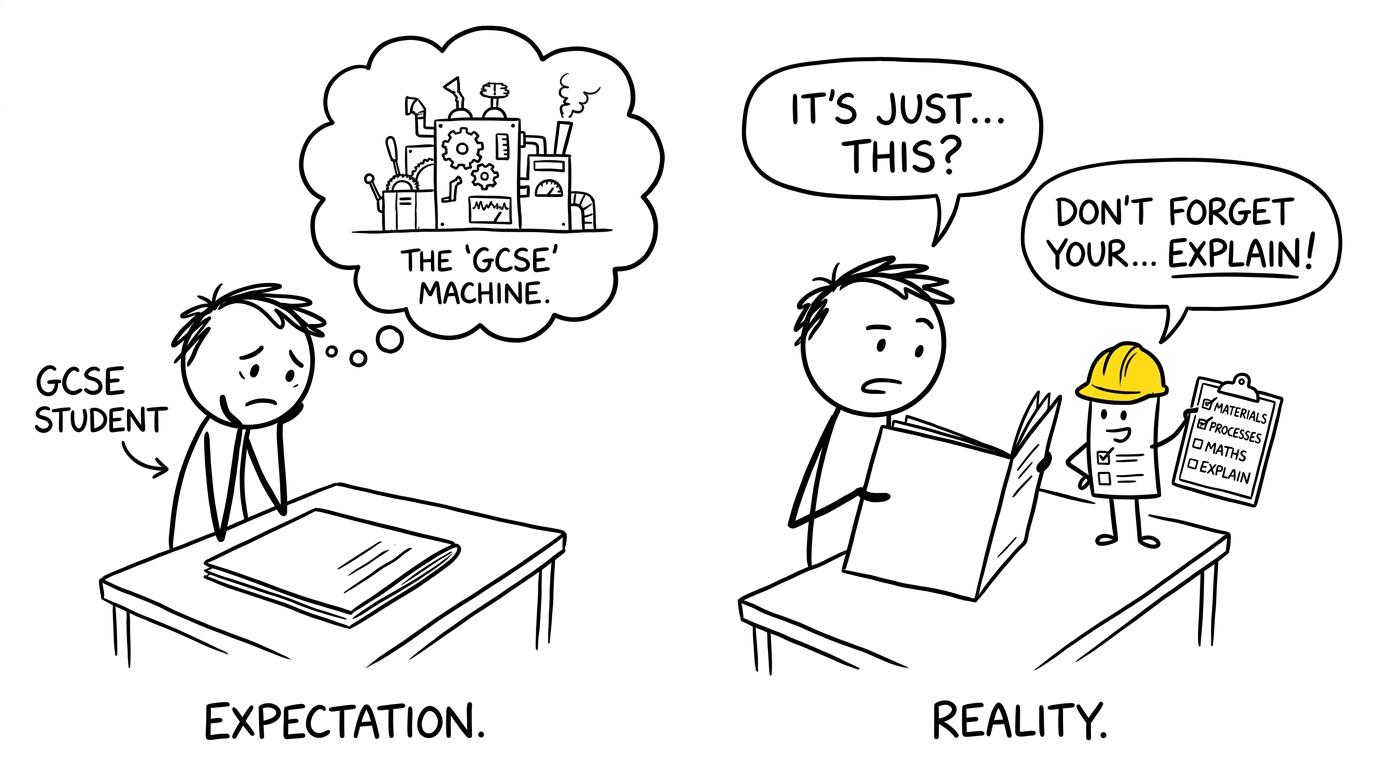 A student discovers that the engineering exam is a manageable checklist rather than a giant machine
What is actually different about the written paper?
The written examination is different from the non-exam assessment because you cannot develop one project gradually, test it repeatedly or improve it over several lessons. You must interpret the information provided and make defensible decisions within 222 hours.
That changes the kind of preparation that works.
For non-exam assessment, careful documentation and an extended design-and-make process matter. In the written paper, speed of recognition matters more. You may need to identify a material, select a process, use technical data and explain why that combination suits the stated product.
It is also not organised like GCSE Maths Paper 111. The label does not automatically mean “non-calculator”, and there is no foundation or higher version of AQA GCSE Engineering. Do not transfer assumptions from your maths timetable. Follow the instructions printed on the engineering paper itself.
The question types Paper 1 tends to favour
Selected-response and short recall questions
Some questions reward accurate knowledge: the property of a material, the purpose of a component, a safety consideration or the meaning of an engineering term. These can look straightforward, but similar technical words are not interchangeable.
For instance, strength, hardness, toughness, stiffness and durability describe different ideas. Revision should therefore focus on meaning and appropriate use, not isolated lists of impressive-sounding words.
Questions built around an unfamiliar context
A product diagram, manufacturing situation, data table or engineering problem can act as the starting point. The product itself may be unfamiliar, but the principle being tested should come from the specification.
Read the context before reaching for a memorised answer. A material that is suitable in one situation may be unsuitable when cost, mass, corrosion, production quantity or environmental impact changes.
Calculation questions
Engineering calculations often reward a disciplined process:
- identify the required quantity;
- select the correct relationship;
- substitute values consistently;
- calculate accurately;
- include the correct unit;
- check whether the result is realistic.
Relevant mathematical skills can include percentages, ratio, scale, area, volume, rearranging formulae, interpreting graphs and working with standard form. The exact demand depends on the specification and the question context.
You can rebuild these foundations through the free GCSE Maths revision lessons. Pay particular attention to proportional reasoning and measures because engineering questions often combine mathematical technique with practical judgement.
Useful relationships may include density,
ρ=mV,\rho = \frac{m}{V},ρ=Vm,and efficiency,
efficiency=useful outputtotal input×100%.\text{efficiency} = \frac{\text{useful output}}{\text{total input}} \times 100\%.efficiency=total inputuseful output×100%.Knowing a relationship is only the beginning. Marks can also depend on unit conversion, substitution, working and interpretation. Use MathsGenie practice questions to make these steps automatic before adding the engineering context.
Explain, justify and evaluate questions
Longer responses favour connected reasoning. “Name” asks for identification. “Explain” needs a reason or consequence. “Justify” asks you to defend a choice against the requirements. “Evaluate” usually requires a balanced judgement supported by relevant evidence.
A strong engineering explanation often follows this chain:
choice or feature →\rightarrow→ relevant property →\rightarrow→ effect in the stated situation.
Generic praise such as “it is strong and cheap” is rarely persuasive without context. Strong enough for what? Cheap compared with which realistic alternative? Why does either feature matter to the user, manufacturer or environment?
The knowledge areas you should prioritise
Materials and properties
Revise the major categories of engineering materials specified by your exam board, together with characteristic properties, applications and limitations. The aim is not to memorise one permanent use for each material. It is to choose rationally when several requirements compete.
Be ready to distinguish physical and mechanical properties, and to consider how material choice affects manufacture, performance, maintenance and end-of-life decisions.
Manufacturing processes
Learn what each required process does, which materials it suits, its characteristic stages and when it becomes economical. Production quantity matters: a process suitable for a one-off prototype may not be sensible for mass production.
Quality control, tolerances, safety and waste can turn a basic process question into an applied one. This is why revision based only on definitions often feels comfortable but performs poorly under exam conditions.
Systems, testing and modern technology
Engineering is rarely a collection of isolated components. Revise how inputs, processes and outputs interact, how systems can be controlled, and how testing provides evidence about performance.
You should also understand the implications of modern technologies and engineering decisions. Environmental impact is broader than whether a material can be recycled. Raw material extraction, energy use, manufacture, transport, repair, service life and disposal may all matter.
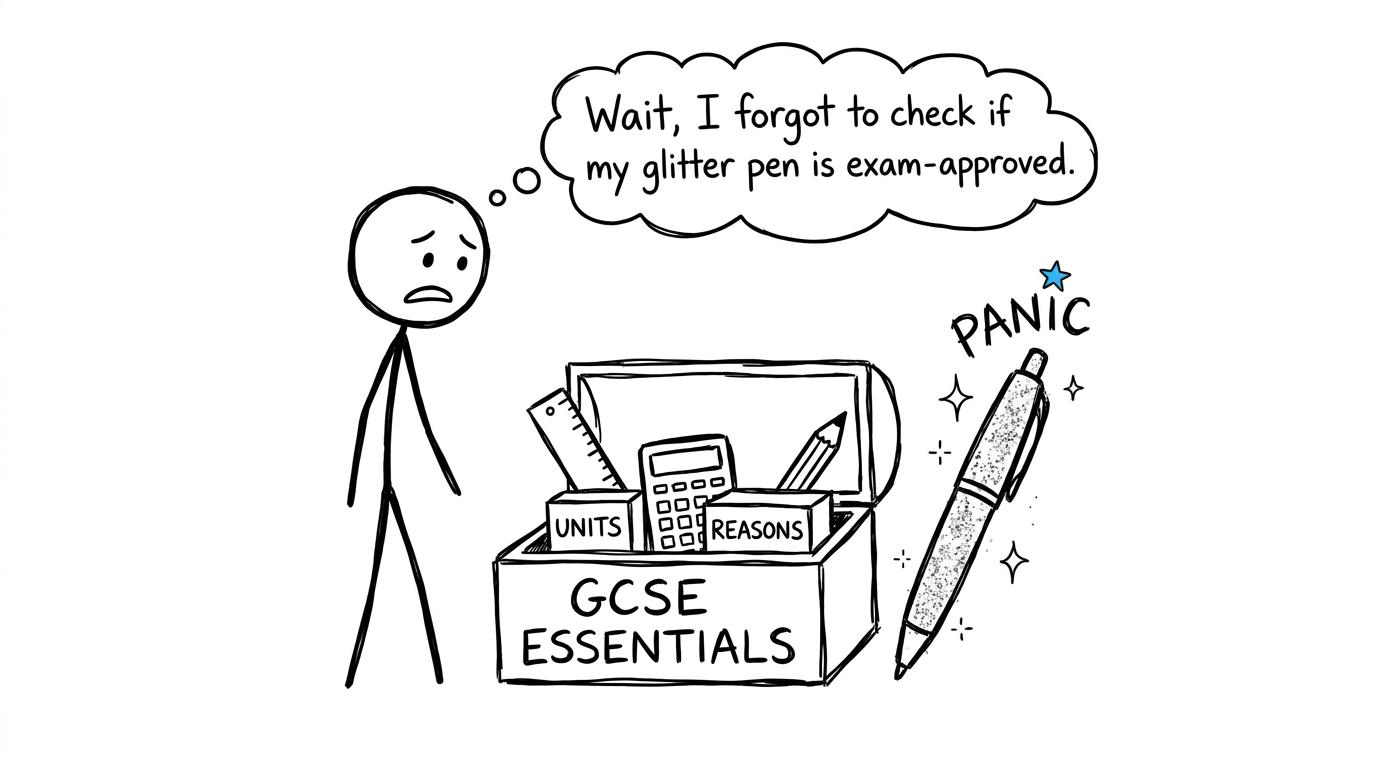 A revision toolbox contains useful exam habits while panic sits unused
How to manage the two hours
A sensible starting benchmark is to compare the available minutes with the marks:
120 minutes120 marks=1 minute per mark.\frac{120\text{ minutes}}{120\text{ marks}} = 1\text{ minute per mark}.120 marks120 minutes=1 minute per mark.This is a planning guide, not a rigid law. Reading a detailed context may take longer, while some short questions should take less. Reserve time at the end to check calculations, units, omitted questions and extended responses.
If a question is consuming far more time than its marks justify, record any useful working and move on. A blank answer cannot earn a method mark. A partly completed calculation or relevant engineering point may do so, depending on the mark scheme.
For longer questions, pause briefly before writing. Identify the command word, product requirements and evidence you will use. Planning for half a minute can prevent several minutes of unfocused writing.
A revision method that matches the assessment
Begin with the specification or your teacher's checklist. Sort each area into three categories: secure, partly secure and weak. That gives you a better plan than repeatedly revising favourite topics.
Then use a short cycle:
- recall the principle without notes;
- answer a question that places it in context;
- mark it carefully;
- record the exact reason for any lost marks;
- revisit the same weakness later.
For the mathematical parts, choose topics from the MathsGenie GCSE revision programme, then attempt mixed questions rather than watching solutions passively. Video solutions are most useful after a genuine attempt because the gap between your method and the correct one becomes visible.
Use GCSE Maths past papers selectively to strengthen calculation fluency, graph interpretation and formula work. They do not replace official engineering papers, but they can remove the avoidable maths errors that cost engineering marks.
Closer to the exam, MathsGenie predicted papers can support broader maths practice. Predicted papers are preparation tools, not claims about the exact questions that will appear. Your engineering revision should still be led by the current specification and official assessment materials supplied by your exam board or school.
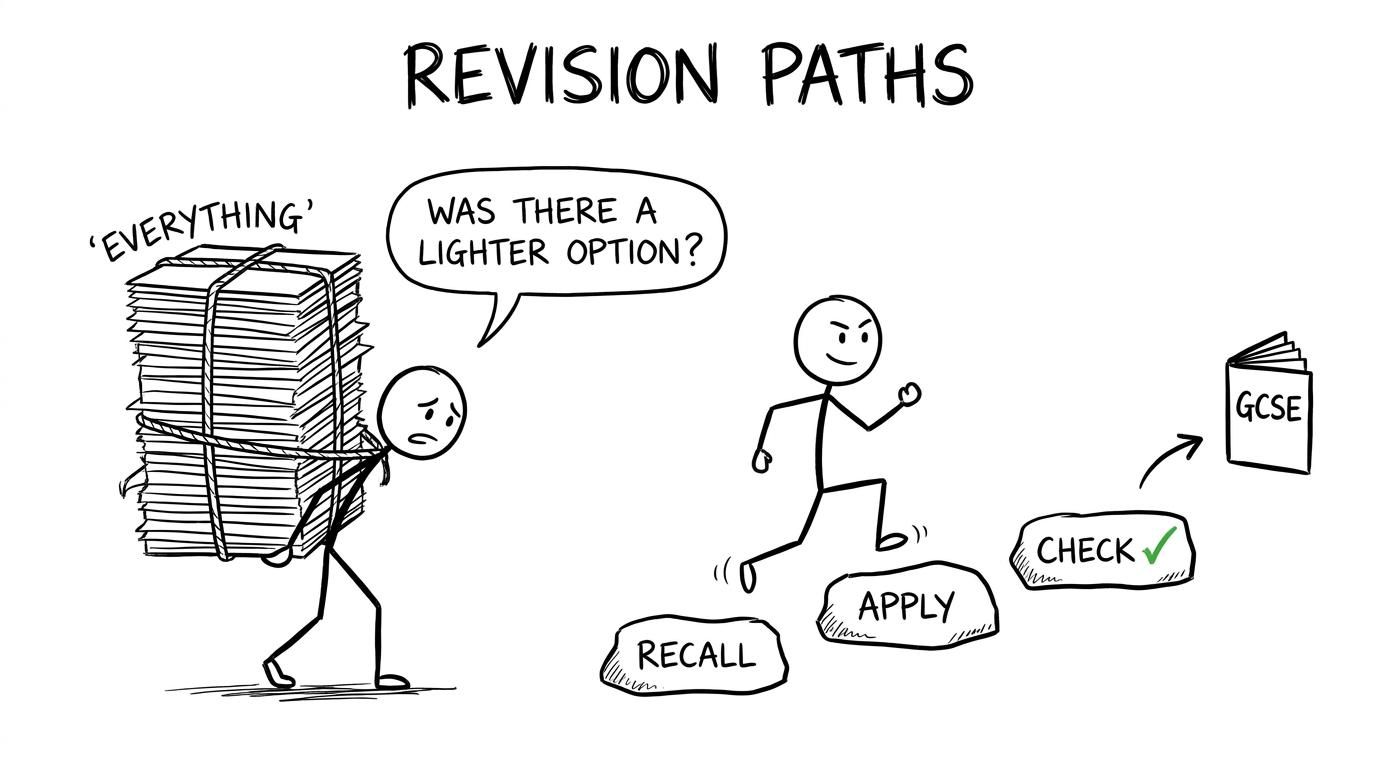 One student carries every flashcard while another follows a focused recall, apply and check route
Common mistakes in GCSE Engineering Paper 1
Answering the topic rather than the question
A student may know a great deal about polymers but earn little if the question asks specifically about production quantity or environmental impact. Underline the command word and the product requirement before answering.
Naming a property without connecting it to use
A property becomes evidence only when its relevance is explained. Link the material or process to performance in the stated context.
Ignoring units
A correct numerical value with a missing or incorrect unit can lose marks. Check conversions before calculating, especially where lengths, areas or volumes use different metric units.
Giving several vague reasons
One precise, developed reason is often more valuable than a list of unsupported claims. Use technical vocabulary accurately and build a clear chain of reasoning.
Spending too long on low-mark questions
The paper contains 120120120 marks. Protect your opportunity to reach all of them. If you are stuck, leave space, continue and return later.
Revising engineering while neglecting the maths
Understanding the design situation does not compensate for an incorrect percentage, scale conversion or rearrangement. Use MathsGenie's free revision resources to target the exact mathematical weakness rather than restarting the whole GCSE course.
Prepare for decisions, not surprises
The written engineering paper becomes less mysterious when you see what it is really measuring. It asks whether you can recall sound engineering knowledge, apply it to a context, handle relevant calculations and defend a practical decision.
Start with your exam board's current specification and confirm the component named on your timetable. Then practise little and often: technical recall, contextual questions, accurate calculations and timed extended responses.
MathsGenie can support the mathematical side of that plan with free revision lessons and video solutions, past papers and mark schemes, predicted papers and practice questions. Choose one weakness today, practise it without notes, mark it honestly and decide what comes next. Calm preparation is rarely dramatic. That is precisely why it works.











