GCSE Engineering Grade 6 Meaning: A Clear Guide
GCSE engineering grade 6 meaning explained: discover the ability it represents, its old-grade comparison and how stronger maths revision can help.
A results sheet can compress two years of decisions, calculations and practical work into one small number. That is why students searching for the GCSE engineering grade 6 meaning often want more than a grading chart. They want to know what the result says about their ability.
In short, a grade 6 is a good GCSE result. It sits above grades 4 and 5, which are associated with the standard and strong pass benchmarks used in school performance measures. In GCSE Engineering, it suggests that you have demonstrated secure knowledge, applied engineering ideas effectively and performed consistently across the assessed components. It is not, however, an exact measurement of every engineering skill you possess.
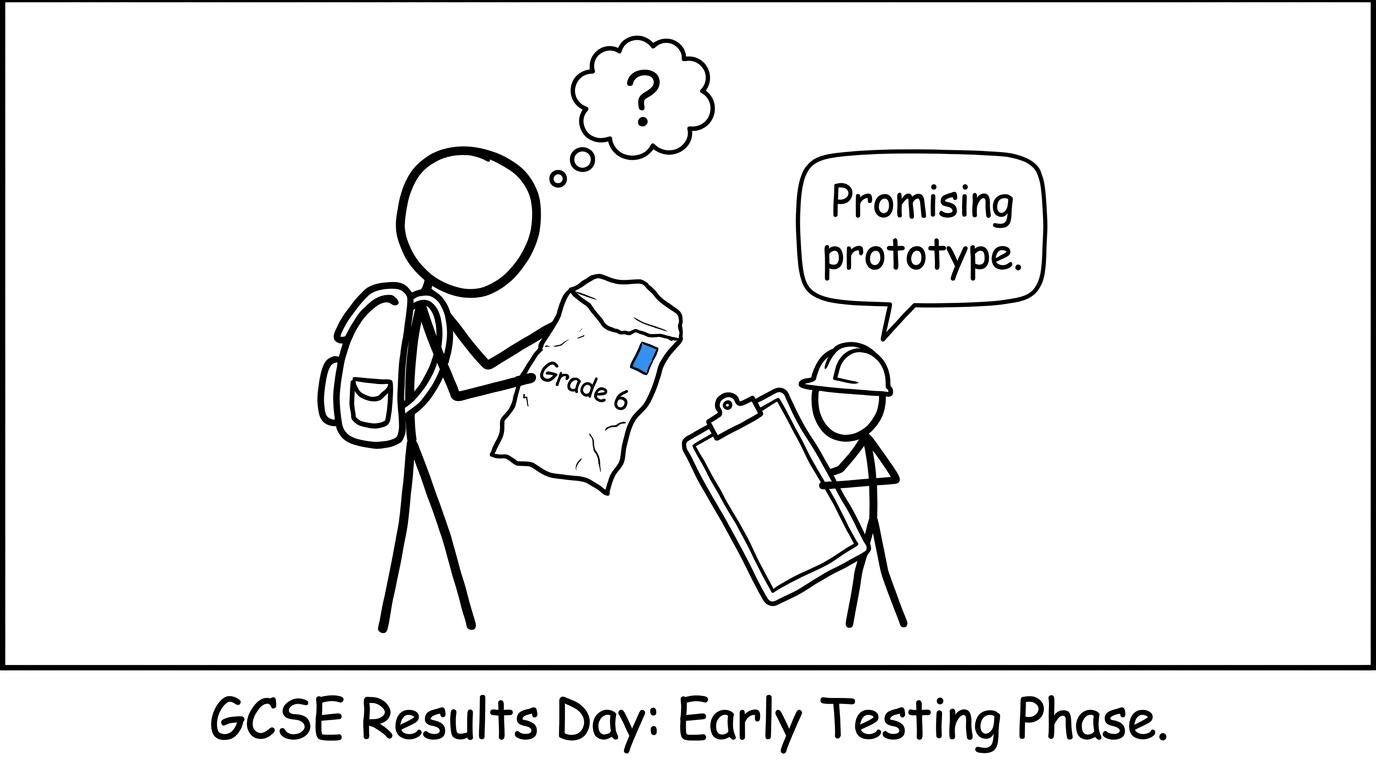 A student receives a grade 6 inspected by a tiny engineer
The quick meaning of a grade 6 in GCSE Engineering
Here is the useful summary:
- Grade 6 is the fourth-highest grade on the GCSE scale of 9 to 1.
- It is above both grade 4 and grade 5.
- It broadly occupies the upper part of the old grade B and C range, but there is no exact letter-grade conversion.
- It reflects your overall assessed performance, rather than guaranteeing mastery of every topic.
- For AQA GCSE Engineering, the final result combines a written examination and non-exam assessment.
- It is a solid foundation for further technical revision, although individual colleges and courses set their own entry requirements.
One important distinction is easily missed: a grade 6 in Engineering is not automatically evidence of grade 6 performance in GCSE Maths. The subjects overlap, but they assess different knowledge and skills.
How GCSE Engineering is assessed
The qualification title matters. Some schools offer AQA GCSE Engineering, while others offer vocational engineering qualifications from organisations such as OCR, Pearson or NCFE. These may use different assessment structures and grading systems. Check the exact title and specification shown by your school before comparing results.
Under the current AQA GCSE Engineering specification, the qualification is linear. Students complete the assessment at the end of the course, with the final grade based on two components:
| Component | Raw marks | Qualification weighting |
|---|---|---|
| Written examination | 120120120 | 60%60\%60% |
| Non-exam assessment | 808080 | 40%40\%40% |
| Total | 200200200 | 100%100\%100% |
The non-exam assessment, usually called the NEA, involves responding to an engineering brief by producing a working prototype and a concise portfolio. It assesses areas such as analysing the problem, developing a solution, communicating technical information, manufacturing accurately, testing and evaluating.
The written paper examines engineering knowledge and its application in practical contexts. Consequently, two students with the same final grade could have different profiles. One might be particularly strong in the examination, while another might produce more convincing practical and design work.
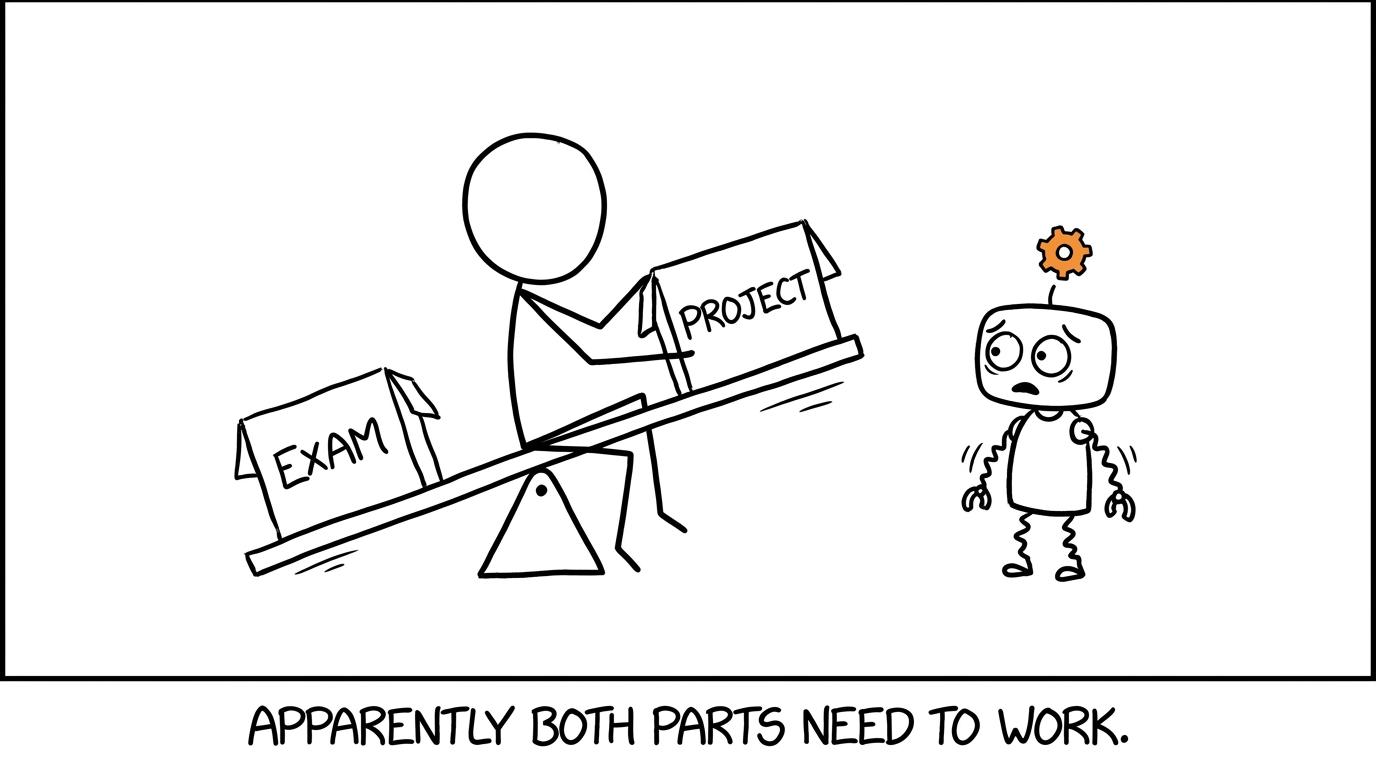 A student balances the exam and project components
What ability does a grade 6 actually represent?
There is no official statement saying that every grade 6 student can complete one fixed list of tasks. Grade descriptors indicate broad standards, while grade boundaries are set for a particular examination series. A grade is therefore best read as evidence of overall performance.
A student working around grade 6 is likely to show several of the following qualities with reasonable consistency:
- sound understanding of engineering materials, processes and systems covered by the specification;
- an ability to apply knowledge to familiar and less familiar contexts;
- competent interpretation of technical information, diagrams and data;
- sensible selection of methods when developing or manufacturing a product;
- reasonably clear justification of decisions;
- practical work completed with attention to accuracy, safety and quality control;
- evaluation based on testing and evidence rather than unsupported opinion;
- sufficiently secure numerical skills to handle the calculations required by the course.
The phrase that matters is reasonable consistency. GCSE grades reward performance across a body of work. A student does not need a flawless portfolio or a perfect examination to earn grade 6, but isolated moments of strong work are unlikely to compensate for substantial gaps everywhere else.
Grade 6 also leaves room for development. Explanations may not always be detailed enough for the highest mark bands. Calculations may be broadly accurate but occasionally lose marks through rounding, units or transcription. An evaluation may identify useful improvements without exploring them as thoroughly as a grade 8 or 9 response.
That is not a criticism. It is what grades are designed to do: show where current performance sits on a scale, not declare that learning is finished.
Is a grade 6 equivalent to an old B?
The careful answer is broadly, but not exactly.
England's current GCSE scale runs from grade 9, the highest result, to grade 1. A result of U is ungraded. Government guidance identifies firm comparison points between the old and current systems:
- the bottom of grade 7 aligns with the bottom of the old grade A;
- the bottom of grade 4 aligns with the bottom of the old grade C;
- the bottom of grade 1 aligns with the bottom of the old grade G.
Grades 4, 5 and 6 together provide more differentiation across the region previously occupied by grades C and B. This means grade 6 is commonly described as being broadly comparable with an old B, but saying that grade 6 equals B is too precise.
| Current grade region | Broad old-scale comparison |
|---|---|
| Grades 9, 8 and 7 | Old A* and A region |
| Grades 6, 5 and 4 | Old B and C region |
| Grades 3, 2 and 1 | Old D to G region |
A grade 6 is therefore clearly above the old C comparison point at grade 4, but below the old A comparison point at grade 7. That is the most accurate way to interpret it.
Why a grade is not a fixed percentage
It is tempting to assume that grade 6 always requires the same percentage. It does not.
Exam boards publish grade boundaries after marking has taken place. Boundaries can change between examination series because papers differ slightly in difficulty. Your final grade is determined by the relevant boundary for the year in which you take the qualification, based on the combined assessed mark.
This is why a mark from one year's paper should not be converted using another year's boundaries as though the result were guaranteed. When completing practice papers, use the boundary from that paper's examination series as an indication, then concentrate on the marks and topics you lost.
The same principle improves maths revision. MathsGenie's guide to using GCSE mark schemes explains how to classify lost marks instead of treating the final score as the whole story.
What grade 6 says about your mathematical skills
Engineering repeatedly turns mathematical ideas into practical decisions. Measurements, scales, ratios, percentages, graphs, areas, volumes and tolerances can all matter when analysing or communicating a solution.
A grade 6 suggests that your mathematical application was good enough to support a solid overall engineering performance. It does not necessarily mean every calculation was correct, and it cannot be treated as a substitute for your GCSE Maths result.
The distinction is important. GCSE Maths assesses a much broader body of mathematical content. Engineering usually places selected calculations inside technical contexts. A student may understand why a measurement matters but still make an arithmetic error. Another may calculate accurately yet struggle to justify whether the result is suitable for the design.
If calculations are restricting your engineering marks, begin with the GCSE Maths revision hub. MathsGenie organises free revision lessons, practice questions and solutions by topic and grade, making it easier to repair a precise weakness rather than revising everything at once.
Useful priorities include:
- fractions, decimals and percentages;
- ratio and proportion;
- rearranging and substituting into formulae;
- interpreting tables and graphs;
- perimeter, area, surface area and volume;
- units, conversions, bounds and accuracy;
- calculator use and sensible rounding.
If you are unsure where these skills fit, follow the best order for learning GCSE Maths topics. It builds from number fluency towards algebra, graphs, geometry and exam technique.
How to move from grade 6 towards grades 7 to 9
Moving beyond grade 6 is rarely about adding more hours without direction. It is usually about making your existing work more exact.
Diagnose the marks you are losing
Separate errors into categories: missing knowledge, weak application, calculation mistakes, incomplete explanations and poor time management. Each category needs a different response.
A forgotten fact needs retrieval practice. A repeated calculation error needs targeted questions. A weak evaluation needs better use of test evidence. Simply rereading notes treats all three problems as though they were identical.
Improve mathematical reliability
In technical questions, write down the formula, substitute carefully, retain sufficient accuracy and include units. Then ask whether the answer is realistic in context. These small habits protect marks across engineering and maths.
MathsGenie's GCSE Maths revision timetable guide can help you combine topic practice with timed assessment. The revision planner is particularly useful when several small weaknesses need attention without allowing one topic to consume the whole week.
Practise under pressure
Topic questions build methods; timed papers test whether those methods survive pressure. Start paper practice while there is still time to respond to what it reveals. The guide to when to start GCSE past papers sets out a sensible progression from short sections to complete timed papers.
For maths, Edexcel predicted papers can provide additional exam-style practice if that is your board. Predicted papers should complement specification coverage and official past papers, not replace them.
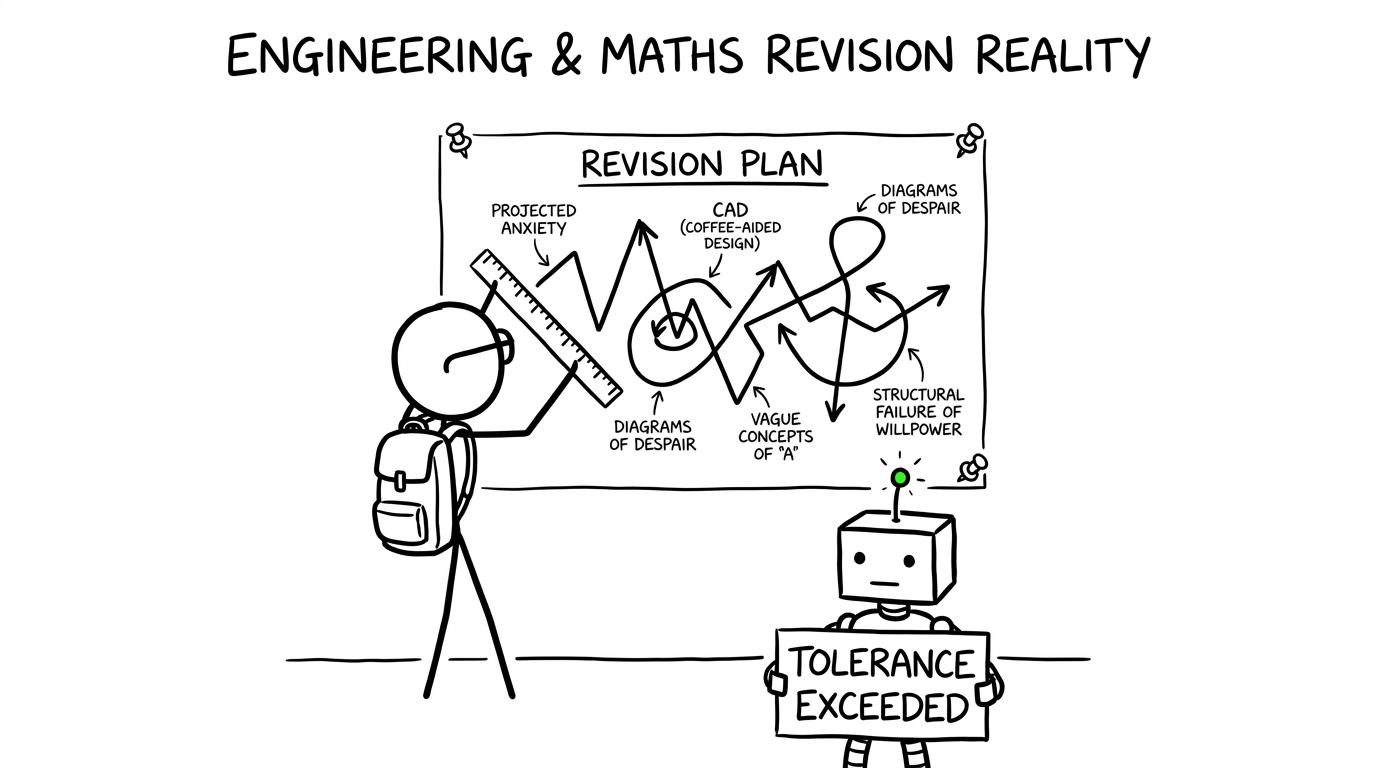 A robot reports that a revision plan has exceeded tolerance
Common mistakes when interpreting a grade 6
Treating grade 6 as an exact old B
It is a useful broad comparison, not a direct conversion. The official alignment points are grades 7, 4 and 1.
Assuming every grade 6 student has the same strengths
The result combines different assessments. Similar totals can conceal different examination, practical and communication profiles.
Believing a previous grade boundary is permanent
Boundaries vary by examination series. Use historical boundaries to review practice, not to predict a guaranteed result.
Confusing GCSE Engineering with every engineering qualification
A vocational Level 1/Level 2 engineering course may use different grades and assessment rules. Always check the qualification title, awarding organisation and specification.
Assuming engineering grade 6 guarantees maths grade 6
The subjects support one another, but they are assessed separately. Use MathsGenie's free GCSE Maths resources to test your mathematical skills directly.
A grade is a reading, not a ceiling
The clearest GCSE engineering grade 6 meaning is this: you achieved a good overall standard and demonstrated secure engineering understanding across the qualification. The result sits broadly around the old B region, although no exact conversion exists. It also shows that you are closer to the grade 7 benchmark than to the standard pass point at grade 4.
What it cannot tell you is where your next mark will come from. For that, you need your component feedback, marked work and recurring errors.
Use MathsGenie to make the mathematical part of that improvement concrete. Begin with a revision lesson, complete the practice questions, check the mark scheme and watch the video solution where needed. Then test the skill through mini tests, past papers and predicted papers. A grade records one performance. Good revision builds the next one.