GCSE Engineering Grade 5 Meaning: A Clear Guide
GCSE engineering grade 5 meaning explained clearly: ability, old letter-grade comparison, assessment, boundaries and practical ways to improve your result.

A result can look precise while still leaving you with questions. You open the envelope, see a grade 5 beside GCSE Engineering and wonder what it says about what you can actually do.
The GCSE engineering grade 5 meaning is straightforward at its core: it is a strong pass on England's 9-to-1 grading scale. It indicates achievement above the grade 4 standard-pass threshold and sits broadly around a high C to low B under the former letter-grade system. However, that comparison is approximate rather than an exact conversion.
More importantly, a grade 5 suggests that you have demonstrated a sound grasp of engineering principles and can apply knowledge, practical skills and mathematical methods in relevant contexts. It does not mean that every part of your performance was at exactly the same level.
Grade 5 at a glance
Here is the short version:
- Grade 5 is one grade above the grade 4 standard-pass threshold.
- It is commonly described by the government as a strong pass.
- It broadly overlaps with the upper part of the old grade C and the lower part of grade B.
- It reflects your combined performance across the qualification, not a fixed list of skills you completed perfectly.
- For AQA GCSE Engineering, the final result combines a written examination and non-exam assessment, or NEA.
- A grade 5 boundary is not a permanent percentage. Grade boundaries are set for each examination series.
- Engineering uses substantial mathematical content, so stronger GCSE maths skills can support a stronger engineering result.
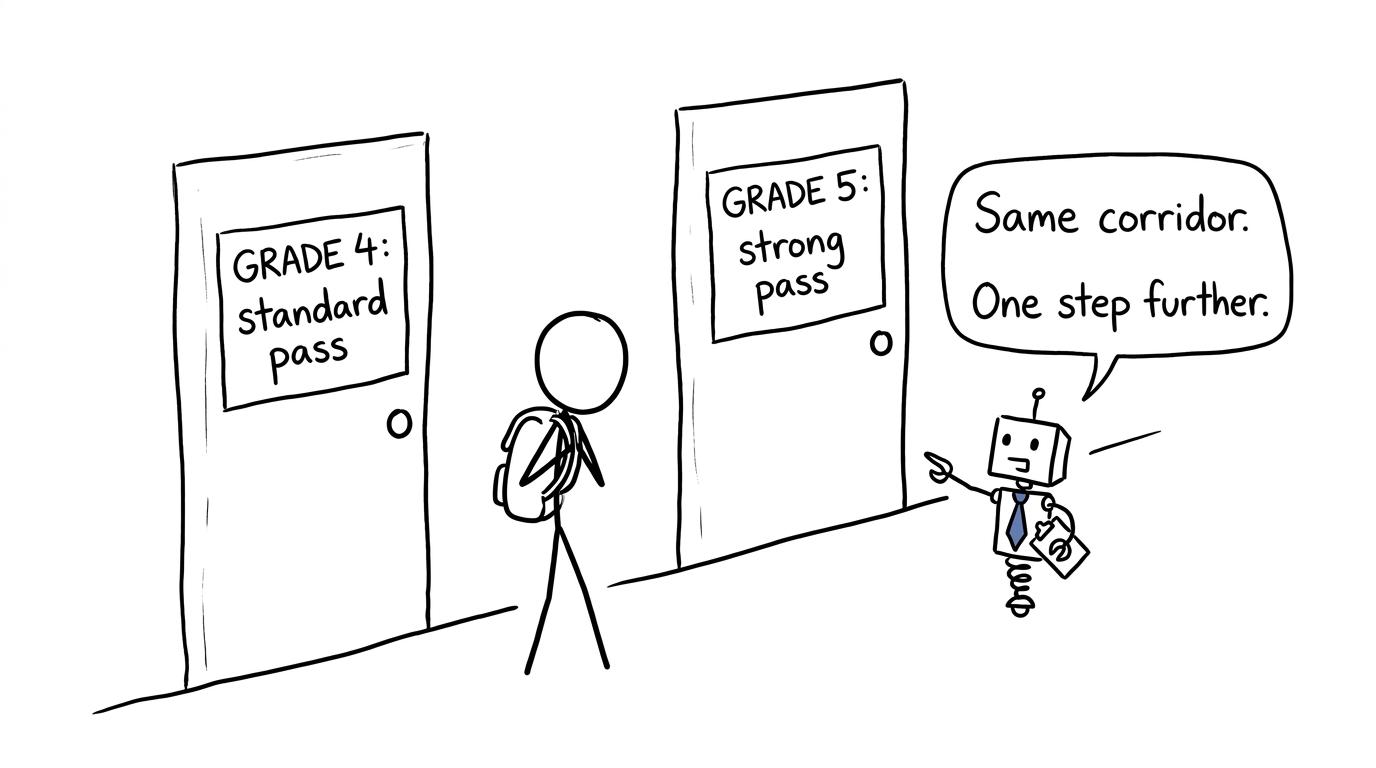 A student considering the difference between a standard pass and a strong pass
What does a grade 5 in GCSE Engineering represent?
A grade is a summary. It compresses months of design decisions, calculations, material knowledge, manufacturing work and examination answers into one number. That number is useful, but it cannot describe every strength and weakness behind it.
For the current AQA GCSE Engineering specification, students are assessed across three broad objectives:
- AO1: knowledge and understanding of engineering principles and processes
- AO2: applying knowledge, understanding and skills in different contexts
- AO3: analysing and evaluating evidence in engineering contexts
The published overall weightings are approximately 25%25\%25% for AO1, 50%50\%50% for AO2 and 25%25\%25% for AO3. Application therefore has a particularly important role.
In practical terms, a student achieving grade 5 has normally shown a credible ability to:
- recall relevant engineering knowledge;
- select and apply methods in familiar and some less familiar situations;
- use tools, materials, components and processes with reasonable competence;
- interpret technical information and data;
- perform engineering calculations with some accuracy;
- explain choices and reach supported conclusions;
- produce assessed work that, together with the examination, reaches the grade 5 boundary.
This does not mean that every one of those skills was consistently secure. A strong NEA may compensate for a less secure written paper, or the reverse. The grade belongs to the combined mark profile.
How GCSE Engineering is assessed
Under AQA's current specification, the written paper contributes 60%60\%60% of the qualification and the NEA contributes 40%40\%40%. The published scaled marks are 120120120 for the written paper and 808080 for the NEA, producing a total of 200200200 available scaled marks.
The weighting can be represented as:
120200=0.6=60%\frac{120}{200}=0.6=60\%200120=0.6=60%and
80200=0.4=40%.\frac{80}{200}=0.4=40\%.20080=0.4=40%.These expressions describe the assessment structure, not the grade 5 boundary. You should not assume that earning 50%50\%50% of the marks automatically produces grade 5. Awarding bodies set grade boundaries after reviewing the demand of the assessments and the evidence from that examination series.
Unlike GCSE Maths, where students may sit foundation or higher tier, AQA GCSE Engineering is not presented as a tiered qualification. Do not transfer assumptions about the maximum grade on a foundation maths paper to Engineering.
Your school should confirm the awarding organisation and specification you are following. Qualification titles can sound similar, particularly when GCSE Engineering is discussed alongside vocational engineering or design and technology courses.
How does grade 5 compare with the old letter grades?
The old A* to G and current 9-to-1 scales do not have a complete one-to-one conversion. Ofqual identifies three formal comparison points: the bottom of grade 7 with the bottom of the former grade A, the bottom of grade 4 with the bottom of the former grade C, and the bottom of grade 1 with the bottom of the former grade G.
That gives the following careful comparison:
| Current grade | Former scale comparison | Interpretation |
|---|---|---|
| Grade 7 | Bottom aligned with the bottom of grade A | An official comparison point |
| Grade 5 | Broadly high C to low B | A useful approximation, not an exact conversion |
| Grade 4 | Bottom aligned with the bottom of grade C | Standard-pass comparison point |
| Grade 1 | Bottom aligned with the bottom of grade G | An official comparison point |
So it is reasonable to describe grade 5 as roughly a high C or low B. It is not accurate to declare that grade 5 is always identical to one particular old letter grade.
The distinction matters because the numbered scale provides more differentiation. Grades 4, 5 and 6 collectively occupy the broad territory previously covered by grades B and C.
Is grade 5 a good result?
Yes. Grade 5 is a respectable GCSE Engineering result and is above the standard-pass threshold.
But the word “good” depends partly on your next step. A grade 5 may meet the requirement for one college course or apprenticeship but not another. Entry requirements are set by individual providers, and engineering pathways may also specify grades in GCSE Maths, English Language or science.
A grade 5 in Engineering does not replace a required grade in Maths. Equally, the post-16 rule requiring some students to continue studying English and maths concerns their results in those subjects, not their GCSE Engineering grade.
Check the published entry requirements for every course you are considering. If the wording is unclear, ask the provider directly rather than relying on a general grade-conversion chart.
Why maths matters for a grade 5 in Engineering
Engineering turns mathematical ideas into decisions. Units determine whether a component fits. Ratio describes gearing. Graphs reveal patterns in test data. Formulae connect forces, dimensions and material behaviour.
Ofqual requires at least 20%20\%20% of the marks in the examined assessment of GCSE Engineering to reward mathematical skills at an appropriate level. AQA's mathematical content includes arithmetic, standard form, ratio, percentages, significant figures, algebra, graphs, Pythagoras' theorem and trigonometry.
It also includes engineering relationships such as pressure:
P=FA,P=\frac{F}{A},P=AF,and mechanical advantage:
MA=loadeffort.MA=\frac{\text{load}}{\text{effort}}.MA=effortload.Knowing a formula is only the beginning. You must identify suitable values, keep the units consistent, substitute accurately and communicate the result clearly.
MathsGenie's free GCSE Maths revision hub lets you revisit these supporting skills through revision lessons, exam questions and solutions. If several topics feel insecure, the best order for learning GCSE Maths topics gives you a sensible route through number, algebra, graphs and geometry.
For dimensions and modelling, the similar shapes, area and volume revision guide is particularly useful when you need to understand how changes in length affect surface area and volume.
 An engineer asking a cardboard bridge to be less approximate
How to move from grade 5 towards grade 6 or higher
The jump is rarely about learning everything again. More often, it comes from making existing knowledge more dependable.
Separate knowledge gaps from application gaps
After each assessment, classify lost marks:
- Did you not know the engineering principle?
- Did you know it but apply it to the wrong context?
- Was the calculation method incorrect?
- Did inconsistent units damage an otherwise correct method?
- Was your evaluation unsupported or too general?
This distinction matters. Re-reading notes will not fix a unit-conversion habit, and more calculations will not repair missing knowledge about materials or manufacturing processes.
Practise the maths that Engineering actually uses
Focus on ratio, percentages, rearranging formulae, standard form, area, volume, graphs, gradient, Pythagoras and trigonometry. Use the GCSE Maths topics that commonly appear as a broad checklist, then prioritise the topics that appear in your Engineering specification and your own marked work.
Turn feedback into a repeatable revision cycle
Use a short loop:
- identify one weak skill;
- review the method;
- answer practice questions without notes;
- mark them carefully;
- record the exact reason for each lost mark;
- return to the skill after a short gap.
A realistic GCSE maths revision timetable can help you fit this around Engineering theory and NEA commitments. If examinations are close, the one-month GCSE maths revision plan offers a more concentrated structure.
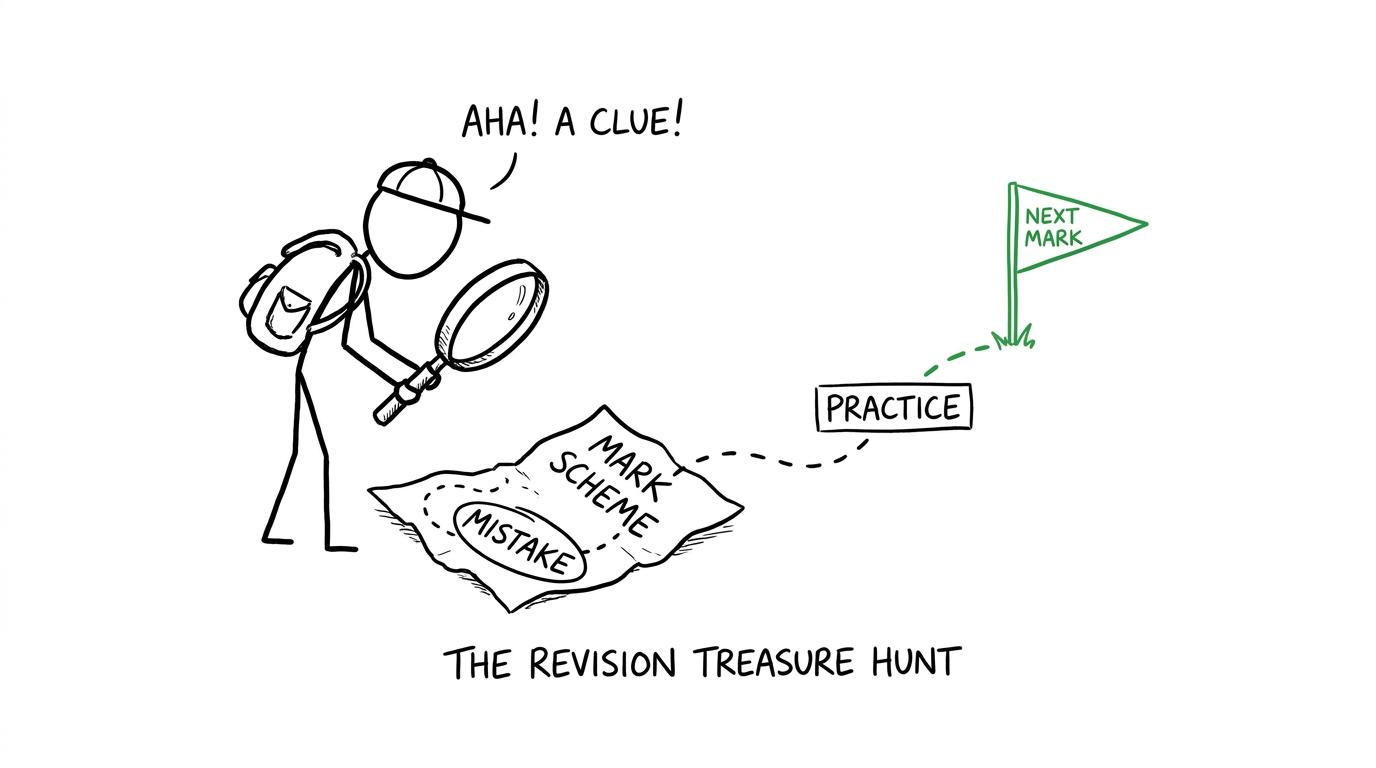 A student treating a mark scheme like a treasure map
Common mistakes when interpreting or improving a grade 5
Treating grade 5 as an exact old grade B
It is better described as broadly spanning high C to low B territory. Only certain points on the old and new scales are formally aligned.
Assuming there is a fixed percentage for grade 5
Grade boundaries can change between examination series. Raw marks should be interpreted using the correct awarding organisation, qualification code and series.
Thinking the grade measures only the written paper
For AQA GCSE Engineering, the NEA contributes 40%40\%40%. Your final grade reflects both assessment components.
Revising maths without engineering context
Engineering questions require you to decide what the numbers mean. Practise recognising units, selecting formulae and interpreting whether an answer is realistic.
Reading mark schemes without attempting questions
A solution can feel obvious once it is visible. That feeling is not the same as being able to produce the method independently. The advice in how to use GCSE Maths past papers properly applies here too: attempt, mark, diagnose and then reattempt.
Make grade 5 a starting point, not a label
A grade 5 in GCSE Engineering means you have earned a strong pass and demonstrated meaningful knowledge, application and evaluation across the assessed qualification. It is broadly comparable with a high C to low B under the old system, but no single letter captures it exactly.
If you already have grade 5, the next step is to identify where marks are leaking. If you are aiming for grade 5, build reliable foundations rather than searching for a magical boundary percentage.
Use MathsGenie's free revision lessons and practice questions to strengthen the mathematics behind Engineering. Then test your progress with GCSE predicted papers, mini tests, past papers, mark schemes and video solutions. A grade is the final summary. Improvement happens earlier, in the quiet cycle of attempting, checking and fixing one weakness at a time.