

GCSE Engineering Easter Holiday Revision: A Plan
GCSE engineering Easter holiday revision made manageable: build a balanced plan for technical topics, maths practice, past papers, feedback and rest.
The Easter holiday can create a strange kind of pressure. There is enough time to make real progress, but also enough time to feel that every hour should be productive. That is rarely a useful way to think.
Effective GCSE engineering Easter holiday revision should strengthen your technical knowledge, improve the maths that supports it and reveal what still needs attention, without consuming the entire break. The simplest approach is to plan a small number of focused sessions, protect time for rest and use questions to decide what to revise next.
You are not trying to complete revision at Easter. You are building a reliable bridge between classroom learning and the final exam period.
Your Easter revision checklist
A balanced plan should include:
- your current GCSE Engineering specification and school guidance
- a short audit of strong and weak topics
- focused technical revision
- regular GCSE maths practice
- timed questions or sections from past papers
- mark-scheme feedback and correction
- protected rest days and flexible catch-up time
Course titles, content and assessment arrangements can differ between exam boards and centres. Before planning, check the current specification used by your school and confirm which examined or non-examined components remain relevant. Then use the MathsGenie GCSE revision resources to support the mathematical skills that appear in engineering contexts.
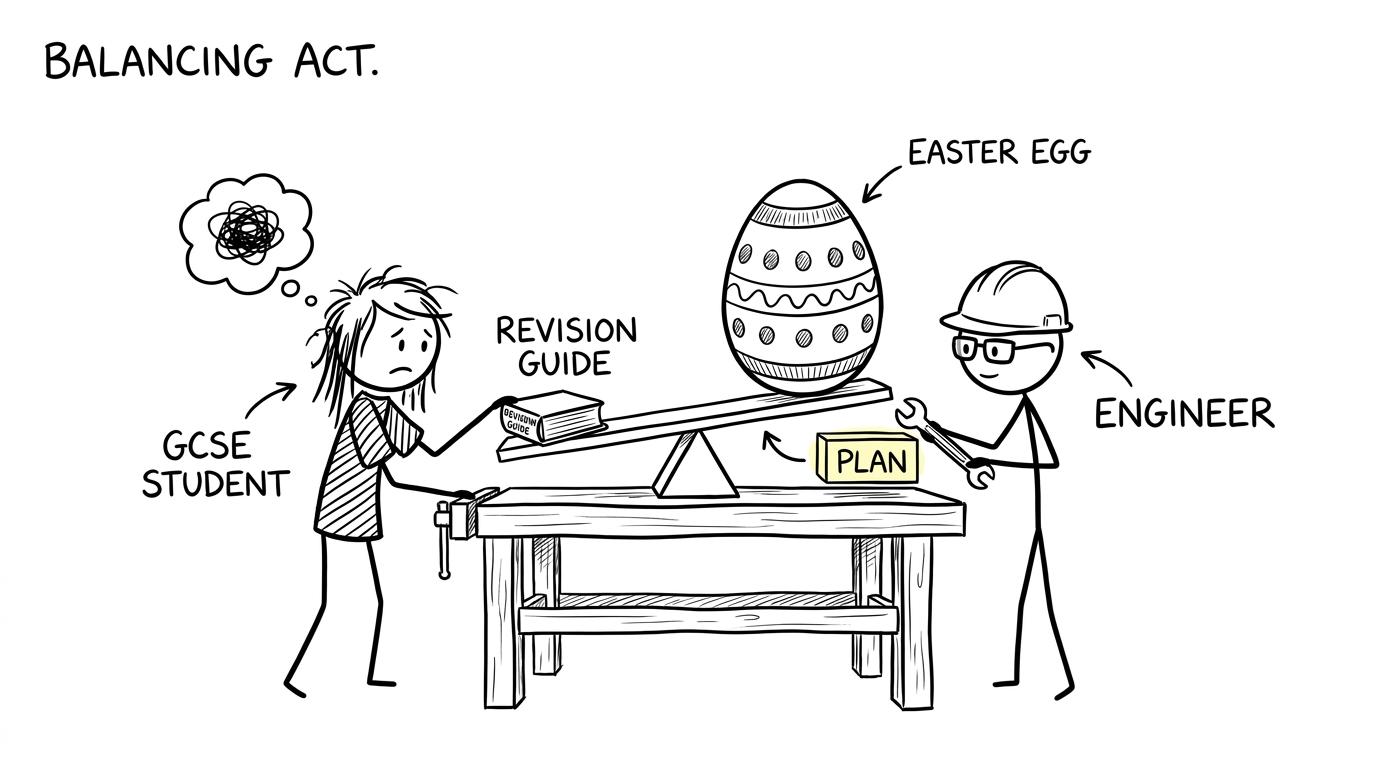 A student balancing an Easter egg and revision book on a seesaw
Start with the exam, not the timetable
Students often begin by drawing an impressive revision timetable. The colours are tidy; the assumptions underneath it are not.
A timetable only helps once you know what needs improving. Begin with your specification, class assessments, teacher feedback and any completed exam questions. Divide topics into three groups:
- Secure: you can answer questions without prompts.
- Developing: you understand the idea but lose accuracy or marks.
- Priority: you avoid the topic, rely heavily on notes or cannot begin independently.
This audit should take one short session. It is not an excuse to spend an afternoon designing a spreadsheet. Its purpose is to direct your limited revision time towards the topics with the greatest potential return.
Give priority topics more attention, but keep secure material active. A sensible allocation might be:
60% priority+30% developing+10% secure.60\% \text{ priority} + 30\% \text{ developing} + 10\% \text{ secure}.60% priority+30% developing+10% secure.This is a planning guide rather than a fixed rule. If your teacher has identified particular weaknesses or unfinished work, follow that evidence.
Build a plan that leaves room for a holiday
The best Easter plan is not the fullest one. It is the one you are likely to follow.
Plan sessions before planning days. For many students, a focused block of roughly 353535 to 505050 minutes is more manageable than an undefined instruction to “revise engineering”. After each block, step away briefly before beginning another subject.
A productive day might contain two or three focused sessions, but it does not need to. Family plans, travel, religious observance, work and rest all matter. Place these commitments into the calendar first. Revision should fit around real life rather than pretending real life will disappear.
Use three kinds of session
Give every session a clear job:
- Learn: review a technical idea using notes, a specification checklist or a revision lesson.
- Apply: answer questions without copying a method.
- Check: mark the work, identify errors and decide what to revisit.
Watching a video can explain an idea, but explanation alone does not prove that you can use it. Follow learning with independent practice as soon as possible.
The MathsGenie GCSE revision planner can help turn a broad intention into specific tasks. Write “complete ratio questions and correct errors”, for example, rather than “do maths”.
Include buffer time
Leave at least one session unassigned during each substantial block of revision days. This becomes catch-up time if a topic takes longer than expected. If everything goes to plan, it becomes free time.
That small gap matters. Engineering designs need tolerances because reality is rarely exact. Revision plans benefit from the same principle.
Connect engineering revision to GCSE maths
Engineering questions often depend on mathematical habits: interpreting information, choosing units, rearranging relationships, estimating whether an answer is realistic and communicating a method clearly. These skills are also valuable in foundation and higher tier GCSE Maths examinations.
Your exact course specification should determine what you revise, but commonly useful areas include:
- ratio and proportion
- percentages and tolerances
- unit conversions
- scale drawings
- area, surface area and volume
- reading tables, charts and graphs
- substitution into formulae
- rearranging simple formulae
- accuracy, bounds and sensible rounding
Use the MathsGenie ratio revision lesson when scale, mixtures or proportional relationships feel uncertain. For measurements and material quantities, revisit area revision and practice. The aim is not to collect pages of notes. It is to recognise which mathematical tool a technical question requires.
Keep a units routine
Units are easy to overlook because they appear small on the page. Their effect is not small.
Whenever you complete a calculation, ask:
- What quantity am I finding?
- Are the given measurements in compatible units?
- Does the required answer involve length, area or volume?
- Is the degree of accuracy appropriate?
- Is the result realistic in the engineering context?
For example, a conversion between millimetres and metres uses:
1 m=1000 mm.1\text{ m} = 1000\text{ mm}.1 m=1000 mm.But area and volume conversion factors must also be squared or cubed:
1 m2=1,000,000 mm2,1\text{ m}^2 = 1{,}000{,}000\text{ mm}^2,1 m2=1,000,000 mm2, 1 m3=1,000,000,000 mm3.1\text{ m}^3 = 1{,}000{,}000{,}000\text{ mm}^3.1 m3=1,000,000,000 mm3.These are reminders, not substitutes for checking the units in each question.
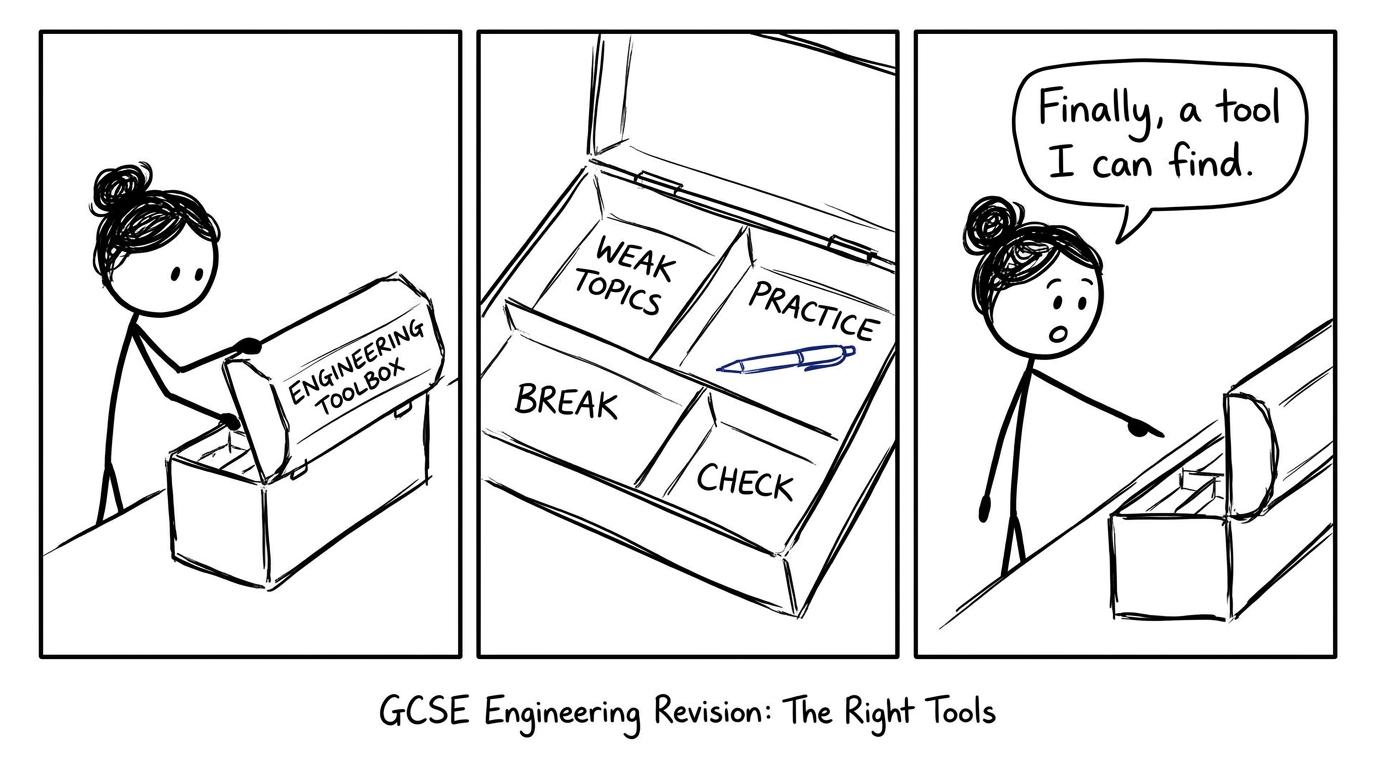 A revision toolbox with compartments for practice and breaks
Make every practice question produce feedback
A completed question is useful. A corrected question is much more useful.
After a practice session, mark your answers carefully. Use a different colour to record corrections, then label the cause of each lost mark. Useful categories include:
- knowledge gap
- wrong method
- unit error
- calculator or arithmetic error
- misread instruction
- incomplete explanation
- rounding too early
This turns mistakes into information. A page covered in corrections may feel less satisfying than a perfect page, but it gives you a far clearer next step.
Use GCSE maths past papers to experience mixed questions rather than revising every skill in isolation. Start with selected questions or a paper section if a full paper would overwhelm your schedule. Closer to the exams, complete full papers under conditions that match your exam board and tier.
MathsGenie's GCSE predicted papers can provide additional practice once you have used topic questions and available past papers. Predicted papers are practice resources, not forecasts of the exact questions that will appear, so they should complement broad revision rather than replace it.
Revisit errors after a delay
Correction can create an illusion: the method looks obvious while the mark scheme is open. Test whether the learning has lasted by returning to the question, or a similar one, several days later without notes.
A simple feedback cycle is:
attempt→mark→correct→retest.\text{attempt} \rightarrow \text{mark} \rightarrow \text{correct} \rightarrow \text{retest}.attempt→mark→correct→retest.Short MathsGenie mini tests are useful here because they make retrieval practice easier to fit around technical revision and rest days.
Protect rest without losing momentum
Rest is not a reward for finishing everything. Since revision is never completely finished, that rule would quietly remove the holiday.
Choose full days or substantial parts of days when you will not revise. Keep sleep and movement in the plan, and stop sessions at their planned finishing time. A shorter session completed with attention is more valuable than a long session spent switching between a question and a phone.
On busy days, use a minimum useful task: perhaps marking yesterday's questions, reviewing an error log or completing a short retrieval test. This preserves continuity without turning every day into an intensive revision day.
If you miss a session, do not move the entire timetable forwards. Use the buffer session, reduce a lower-priority task or simply continue with the next important item. A resilient plan bends. A perfect-looking plan often breaks.
Common Easter revision mistakes
Revising only the topics you enjoy
Familiar work feels fluent, which can be mistaken for progress. Keep some secure topics active, but direct most effort towards specific weaknesses shown by assessments and practice.
Making notes without testing recall
Notes can organise information, but they do not show whether you can select and apply knowledge independently. Close the notes and answer questions.
Completing papers without reviewing them
A mark by itself says little. Analyse why marks were lost, correct the work and schedule a retest.
Ignoring calculator fluency
Practise entering brackets, powers and fractions accurately on the calculator permitted for your course. Keep enough working visible to check your reasoning and support method marks where the mark scheme allows them.
Treating all exam boards as interchangeable
Edexcel, AQA, OCR and Eduqas materials are not automatically identical. Use resources that match your current GCSE Maths board, specification and tier, and follow your school's guidance for Engineering.
Filling every day
An overpacked timetable creates guilt whenever life changes. Rest and buffer time should be designed into the plan from the beginning.
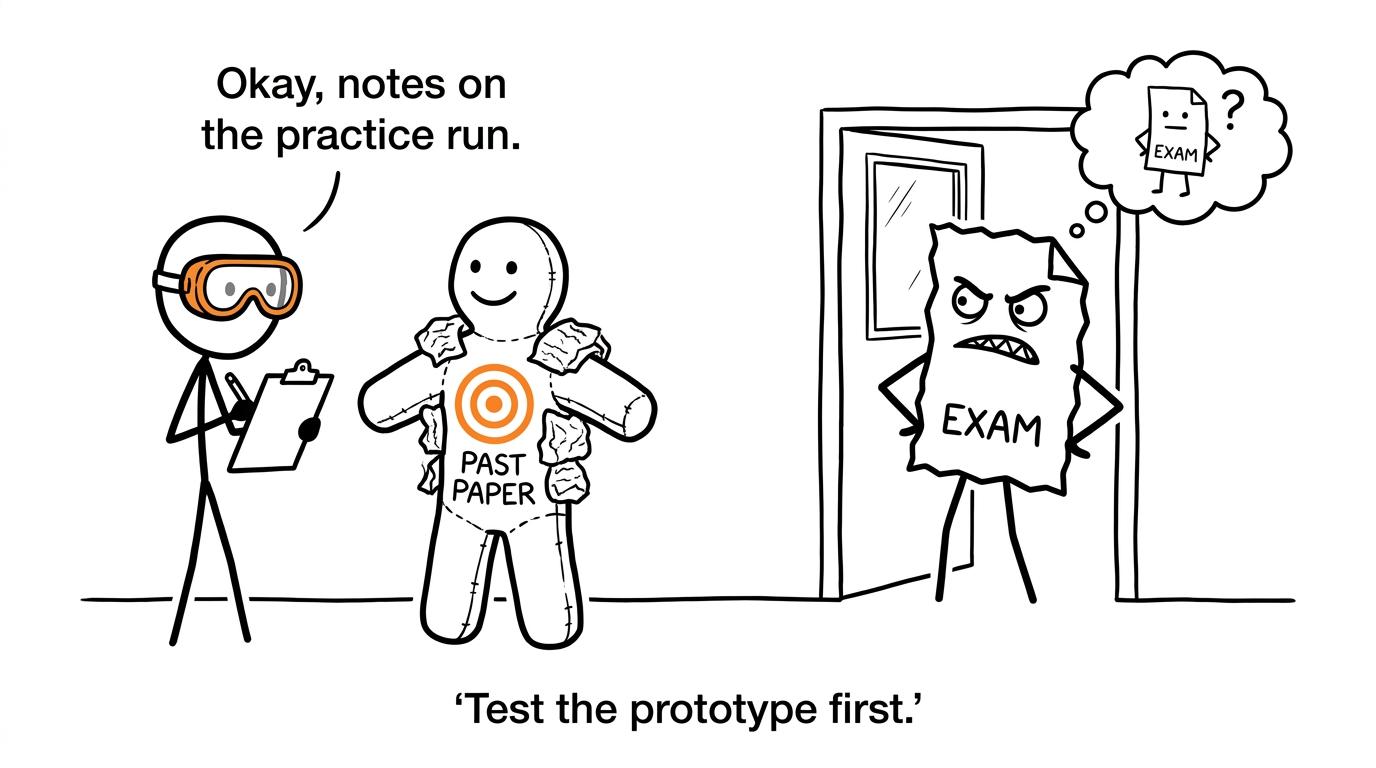 A past paper acting as a friendly engineering prototype
Finish Easter with evidence, not exhaustion
At the end of the holiday, review what changed. You should be able to identify stronger topics, recurring mistakes and the next few actions required. Keep the list short enough to use when school resumes.
Good GCSE engineering Easter holiday revision is measured less by hours than by evidence: questions attempted, errors understood, methods remembered and units checked. The holiday should leave you better prepared, not simply more tired.
Start with the free MathsGenie GCSE revision lessons, practise the maths that supports your engineering work, and then test it through practice questions, mini tests, past papers and predicted papers. Use the video solutions and mark schemes to understand errors rather than hide them. One focused session is enough to begin, and a balanced plan gives you the best chance of continuing.










