Is a GCSE Economics Revision Bootcamp Worth It?
GCSE economics revision bootcamp costs vary widely. Learn what courses offer, when paying makes sense, and how to choose effective exam support.
The price is easy to see. The value is harder to measure.
A GCSE economics revision bootcamp may promise expert teaching, complete specification coverage and renewed confidence in a few intensive days. For some students, that structure is genuinely useful. For others, it is an expensive way to receive more notes, especially when the real problem is inconsistent practice or weak exam technique.
The short answer is this: a bootcamp can be worth paying for when it provides small-group, exam-board-specific teaching targeted at weaknesses already identified through assessment. It is rarely worth the cost when it relies on large lectures, vague promises or passive content review.
That distinction matters even more if you are preparing for GCSE maths at the same time. Holiday hours are limited. Spending them on one subject has an opportunity cost in another.
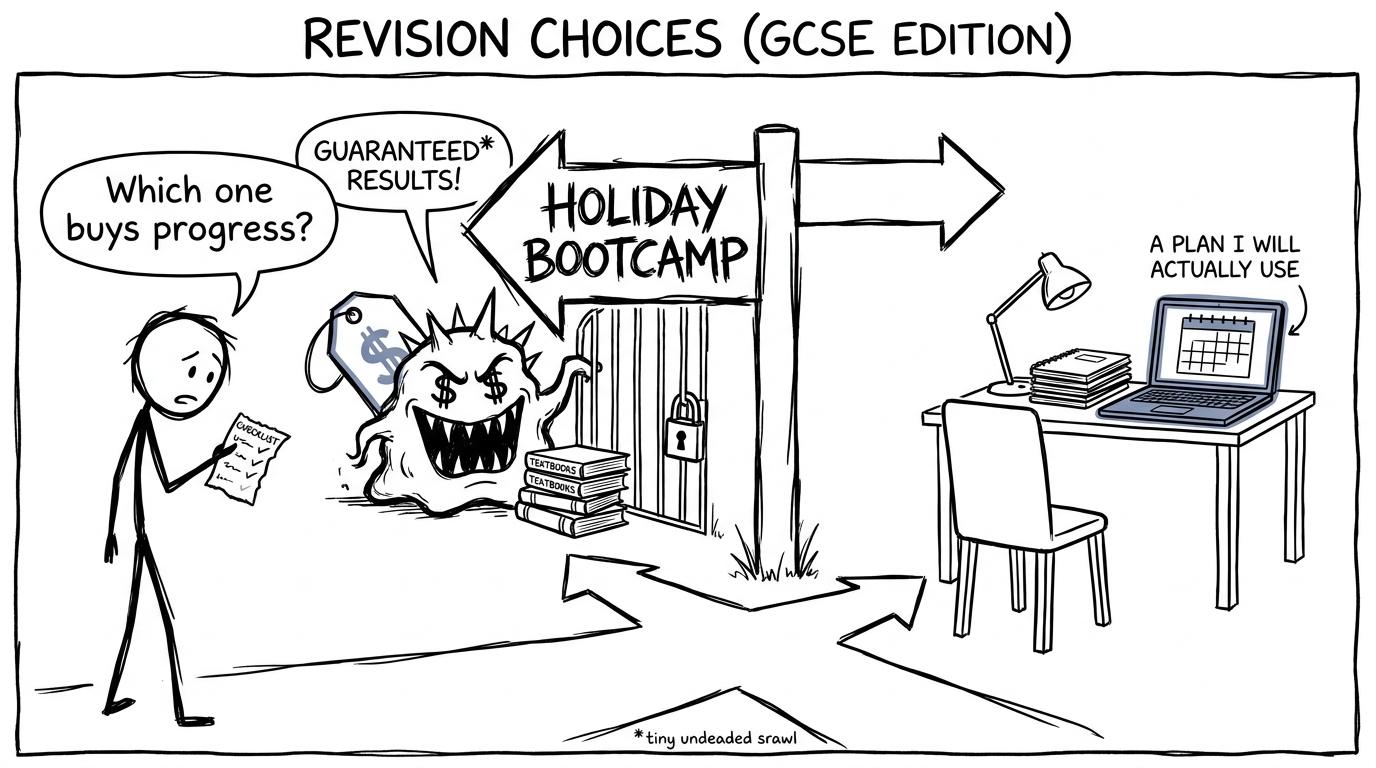 A student choosing between a costly bootcamp and a practical revision plan
The quick bootcamp value checklist
Before paying, check whether the course offers:
- teaching for your exact qualification and exam board
- a diagnostic assessment before teaching begins
- a genuinely small group with opportunities to ask questions
- practice covering knowledge, application, analysis and evaluation
- economics calculations, graphs and data interpretation
- timed exam questions followed by specific feedback
- an experienced economics teacher or examiner
- materials and support you can continue using afterwards
- a timetable that leaves space for maths and your other GCSE subjects
- clear cancellation, safeguarding and online-access arrangements
If several of these details are missing, the course may be selling intensity rather than improvement.
What a GCSE economics revision bootcamp actually offers
There is no standard definition of a revision bootcamp. One provider may offer a live online weekend; another may run five days of classroom tuition during Easter. Some programmes teach one subject intensively, while others sell access to several subjects.
Across the wider 2026 GCSE holiday-course market, advertised prices range from relatively inexpensive online packages to several hundred pounds for approximately 151515 hours of classroom teaching. Some London courses advertise prices of around £635 to £750 for a half-day week, while full-day and residential programmes can cost well over £1,000. Availability, subjects and inclusions vary, so current details must be checked directly before booking.
A useful course normally combines four elements.
Specification coverage
The tutor should organise teaching around the correct specification rather than around a generic collection of economics topics.
AQA GCSE Economics consists of two papers covering how markets work and how the economy works. OCR GCSE Economics also uses two externally assessed papers, but its structure and question styles differ. Pearson Edexcel offers International GCSE Economics, which is a different qualification again. Students should not assume that a course labelled “GCSE Economics” automatically matches their paper.
Ask for the specification code. For example, AQA GCSE Economics is 813681368136, while OCR GCSE Economics is J205J205J205.
Exam technique
Economics is not secured by memorising definitions alone. Across regulated GCSE Economics specifications, the assessment objectives place approximately 35%35\%35% on knowledge and understanding, 35%35\%35% on application and 30%30\%30% on analysis and evaluation.
A worthwhile bootcamp therefore teaches students how to:
- use a case study rather than writing a generic answer
- build a logical chain of economic reasoning
- interpret evidence and identify limitations
- compare effects on different economic groups
- reach a supported judgement in extended responses
If most of the day consists of copying slides, the course is neglecting much of what the examination rewards.
Quantitative economics
At least 10%10\%10% of the marks in GCSE Economics must reward quantitative skills at Key Stage 3 level or above. These include percentages, percentage change, averages, revenue, costs, profit, pay, graphs and economic data.
Students can strengthen this area using MathsGenie’s free quantitative skills in economics revision guide. If percentage comparisons are causing lost marks in both subjects, the percentage change revision guide provides focused support.
The essential relationships include:
Percentage change=new value−original valueoriginal value×100%\text{Percentage change}=\frac{\text{new value}-\text{original value}}{\text{original value}}\times 100\%Percentage change=original valuenew value−original value×100% Total revenue=price×quantity sold\text{Total revenue}=\text{price}\times\text{quantity sold}Total revenue=price×quantity sold Profit=total revenue−total cost\text{Profit}=\text{total revenue}-\text{total cost}Profit=total revenue−total costA good course does not merely revisit these relationships. It asks students to use the results as evidence in an economic argument.
Feedback and follow-up
Feedback is where a course becomes personal. A tutor should identify whether a response lacked knowledge, context, analysis, evaluation or accurate calculation.
The best question to ask a provider is not, “How much content will you cover?” It is, “How will the tutor diagnose and respond to my mistakes?”
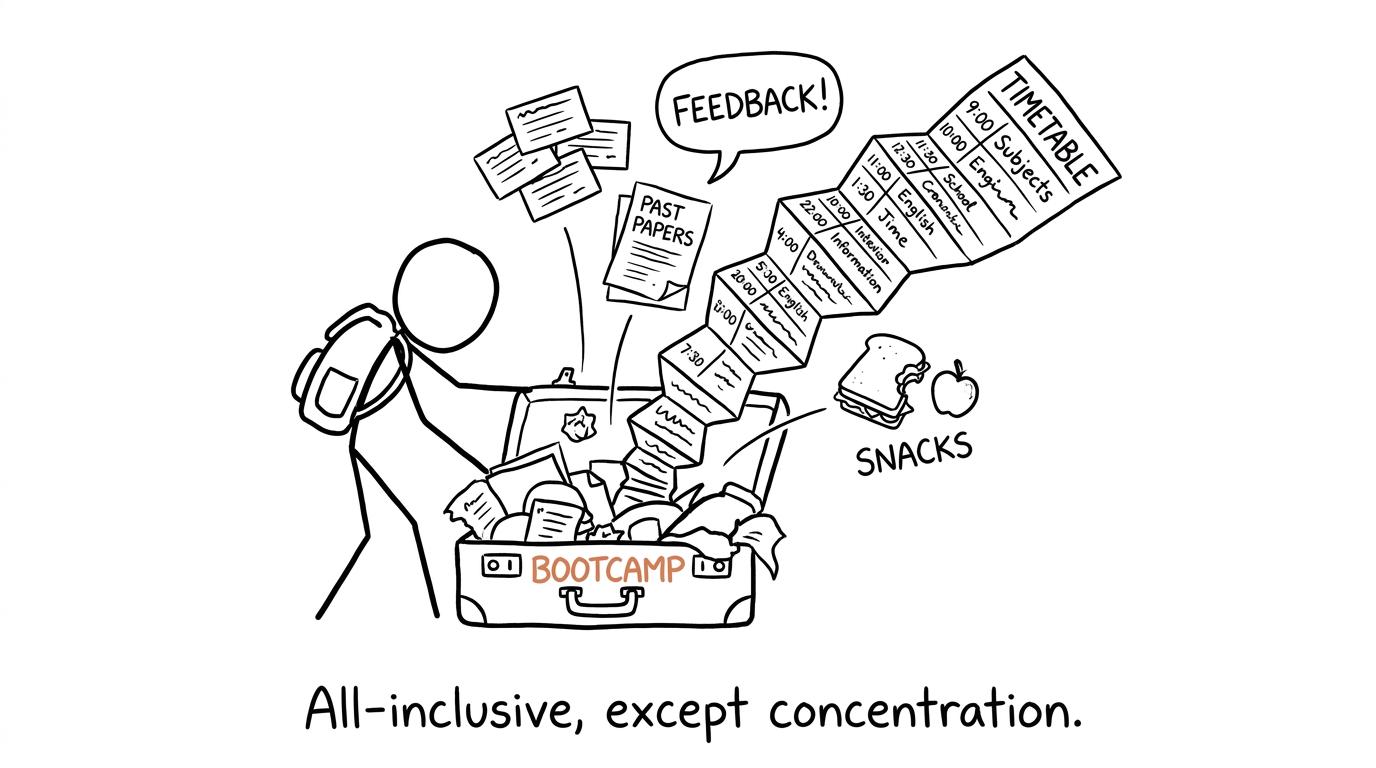 An overstuffed bootcamp suitcase containing every possible revision resource
When paying for a bootcamp is genuinely worthwhile
Research into tuition does not prove that every holiday course works. It does, however, offer a useful principle. The Education Endowment Foundation reports that small-group tuition is most likely to be effective when it targets specific needs identified through diagnostic assessment. Smaller groups, trained staff and close links to classroom learning also matter.
A bootcamp is most likely to justify its cost in the following situations.
You have identifiable gaps
Perhaps a marked paper shows that your definitions are secure but extended responses are too descriptive. Or perhaps calculations and graph interpretation repeatedly cost marks. A focused course can help when the problem is specific enough to teach.
“Improve at Economics” is not a useful target. “Use case-study evidence in extended answers” is.
You need live feedback
Independent revision is excellent for learning content and completing questions. It is harder to judge the quality of a long analytical response without teacher feedback. A strong course can shorten that feedback loop.
You struggle to create structure independently
Some students have good resources but do not use them consistently. A fixed timetable, teacher presence and small group can create accountability. In this case, part of the fee pays for an environment in which the work actually happens.
The tutor understands your paper
A teacher familiar with the exact AQA, OCR or International GCSE specification can focus on its command words, paper structure and mark scheme. That precision is more valuable than a famous venue or an enormous workbook.
When a holiday course is probably not worth it
A bootcamp is unlikely to offer good value if you already understand the content and mainly need more timed practice. The same applies if the group is so large that your work will not receive individual feedback.
Be cautious when:
- the provider will not confirm group size
- the course mixes specifications without explaining the differences
- “complete mastery” is promised in a weekend
- testimonials replace a clear teaching plan
- there is no diagnostic test or marked written work
- the schedule is mostly lectures
- travelling will consume additional time and money
- the fee would place uncomfortable pressure on your family
No revision course can guarantee a grade. Exam performance depends on prior knowledge, practice, attendance, wellbeing and what happens after the course.
How to judge the cost properly
The headline fee is only one part of the decision. Include travel, accommodation, meals, materials and the revision time displaced from maths or other subjects.
One simple comparison is:
Cost per taught hour=total course costlive teaching hours\text{Cost per taught hour}=\frac{\text{total course cost}}{\text{live teaching hours}}Cost per taught hour=live teaching hourstotal course costBut taught hours are not automatically useful hours. A better personal measure is:
Effective cost=total costhours of targeted teaching and feedback\text{Effective cost}=\frac{\text{total cost}}{\text{hours of targeted teaching and feedback}}Effective cost=hours of targeted teaching and feedbacktotal costCompare that figure with alternatives such as school revision sessions, a few individual tutoring lessons or a planned week of independent revision.
This is economics in practice: the relevant cost includes the next-best use of your money and time.
Protecting your GCSE maths revision
Economics includes quantitative skills, but an economics bootcamp is not a replacement for GCSE maths preparation. If your maths examination is the greater risk, reserve time for board- and tier-specific practice.
Start with the GCSE Maths revision hub, where resources are organised for Edexcel, AQA, OCR, Eduqas and other boards. Short GCSE mini tests can diagnose weak topics without taking over an entire evening.
A balanced holiday could include:
- economics teaching during the course hours
- a short daily maths retrieval session
- one timed maths section during the week
- immediate marking and correction
- a rest period that is genuinely protected
The GCSE maths revision timetable guide can help turn those intentions into a realistic schedule. If full papers are appropriate, follow the MathsGenie past-paper revision process: attempt, mark, diagnose, fix and retest.
Questions to ask before booking
Send the provider a short list of direct questions:
- Which specification code will be taught?
- What is the maximum group size?
- Who teaches the course, and what economics experience do they have?
- Is work marked individually?
- How much time is spent answering exam questions?
- Will students complete an assessment before the course?
- Are sessions live, recorded or both?
- What materials are included in the fee?
- What happens if too few students book?
- Is there support after the final session?
Specific answers indicate a considered programme. Evasive answers are information too.
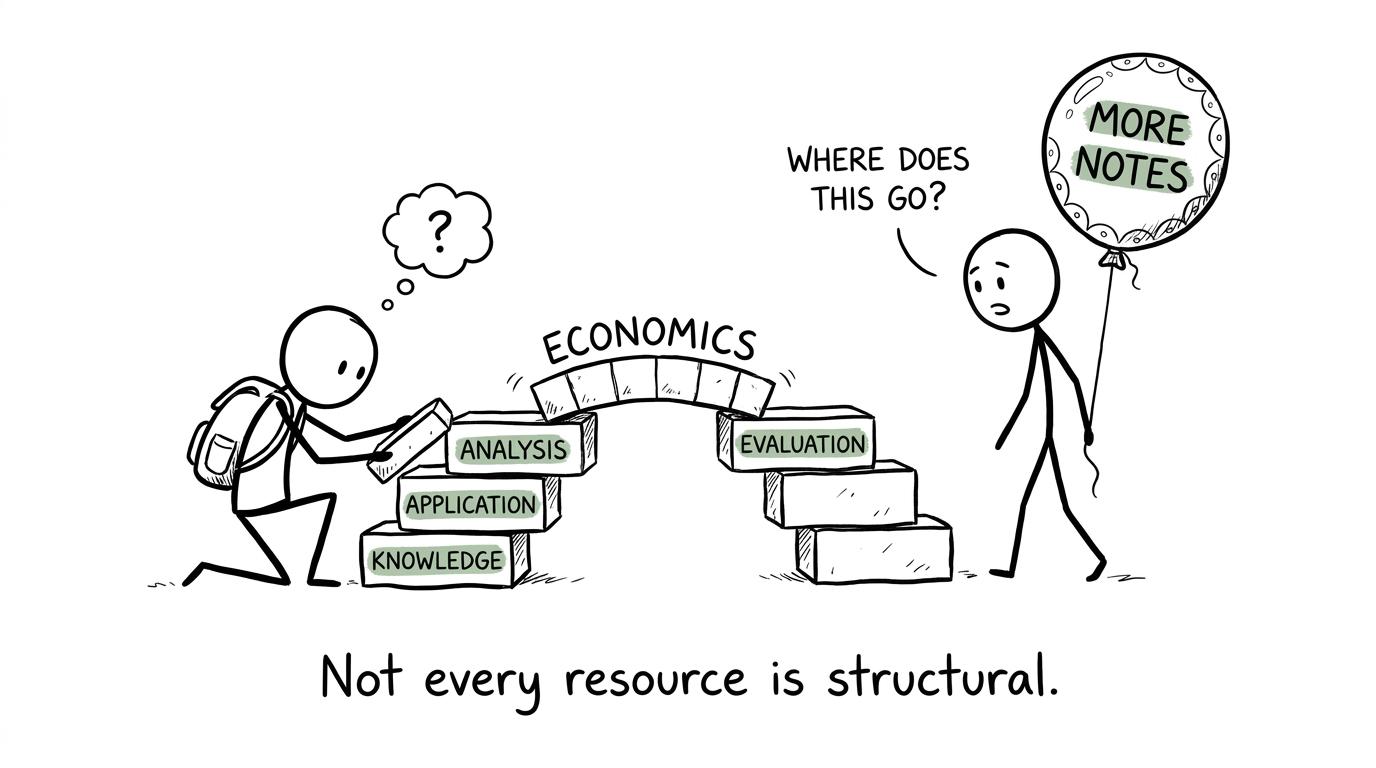 A student building an economics bridge with useful revision skills
Common mistakes when choosing a revision bootcamp
Assuming expensive means personalised
A premium venue may increase the fee without reducing the group size or improving feedback. Pay attention to teaching design, not branding.
Booking before diagnosing the problem
Complete a timed assessment first. Otherwise, you cannot tell whether the advertised course addresses the marks you are losing.
Confusing attendance with revision
Being in a classroom for 151515 hours does not guarantee learning. Students still need to retrieve knowledge, answer questions, review feedback and revisit mistakes.
Ignoring the exact qualification
AQA GCSE, OCR GCSE and Pearson Edexcel International GCSE Economics are not interchangeable. The core ideas overlap, but paper structures and specification details differ.
Sacrificing every other subject
An intensive course can create the comforting feeling that revision is “sorted”. Meanwhile, maths skills may fade through lack of practice. A small daily routine is often enough to protect them.
Replacing past papers with predictions
Predicted materials are useful extra practice, not a promise about the examination. For maths, combine official past-paper practice with MathsGenie’s GCSE predicted papers, then use mark schemes and video solutions to correct weaknesses.
Make the decision based on the bottleneck
A GCSE economics revision bootcamp is worth the cost when it removes a real obstacle: missing knowledge, weak written analysis, inaccurate calculations, poor exam technique or lack of structured feedback. It is not automatically valuable because it is intensive, takes place at Easter or carries a high price.
Diagnose first. Ask precise questions. Compare the full cost with the quality of targeted teaching you will receive. Then protect enough time for maths and your other examinations.
Whatever you decide, revision still succeeds through the same quiet loop: learn, practise, mark, correct and return. MathsGenie makes that process free and manageable with revision lessons, practice questions, mini tests, past papers, predicted papers, mark schemes and video solutions. Open the GCSE Maths revision hub, choose one weak area and make your next revision session produce something you can mark.