GCSE Economics Grade Boundaries History and Trends
GCSE economics grade boundaries history explained with AQA data from 2019 to 2025, year-by-year trends, pandemic context and practical revision advice.

A grade boundary can feel like a finish line that moves while you are running towards it. One year a grade 777 needs slightly more; another year it needs less. The useful answer behind the GCSE economics grade boundaries history is simple: boundaries do change, but they respond to the demands of each paper and the performance of that year's cohort. They are not reliable predictions of the marks you will need next summer.
Recent AQA figures show modest movement at the top boundaries and somewhat greater variation around grade 444. The best response is not to guess the next boundary. It is to build a margin of safety through accurate knowledge, strong evaluation and timed practice.
GCSE economics grade boundary trends at a glance
This article focuses on AQA GCSE Economics specification 813681368136, making comparisons consistent. The qualification has two papers worth 808080 marks each, producing a total of 160160160 marks.
Keep these points in mind:
- A boundary is the minimum mark required for a grade.
- Boundaries are set after papers have been marked.
- AQA and OCR boundaries cannot be compared as though their papers are identical.
- There were no normal summer exam boundaries in 202020202020 or 202120212021.
- Past boundaries offer context, not a guaranteed target.
You can check the latest figures on MathsGenie's AQA GCSE Economics grade boundaries page.
Past GCSE Economics grade boundaries by year
The table shows selected overall AQA boundaries. Every examined year had a maximum mark of 160160160.
| Year | Grade 999 | Grade 777 | Grade 555 | Grade 444 | Grade 111 | Context |
|---|---|---|---|---|---|---|
| 201920192019 | 129129129 | 114114114 | 909090 | 797979 | 262626 | Last summer exams before the pandemic |
| 202020202020 | Not set | Not set | Not set | Not set | Not set | Summer exams were cancelled |
| 202120212021 | Not set | Not set | Not set | Not set | Not set | Teacher-assessed grades replaced summer exams |
| 202220222022 | 133133133 | 115115115 | 888888 | 757575 | 171717 | First full summer exam series since 201920192019 |
| 202320232023 | 133133133 | 118118118 | 939393 | 818181 | 202020 | Return towards pre-pandemic grading standards |
| 202420242024 | 130130130 | 115115115 | 898989 | 777777 | 202020 | Normal examined series |
| 202520252025 | 133133133 | 118118118 | 949494 | 828282 | 161616 | Latest published AQA series |
These are qualification-level boundaries, so the marks from both papers are combined. Component boundaries published for individual papers are notional and should not be mistaken for separate grades.
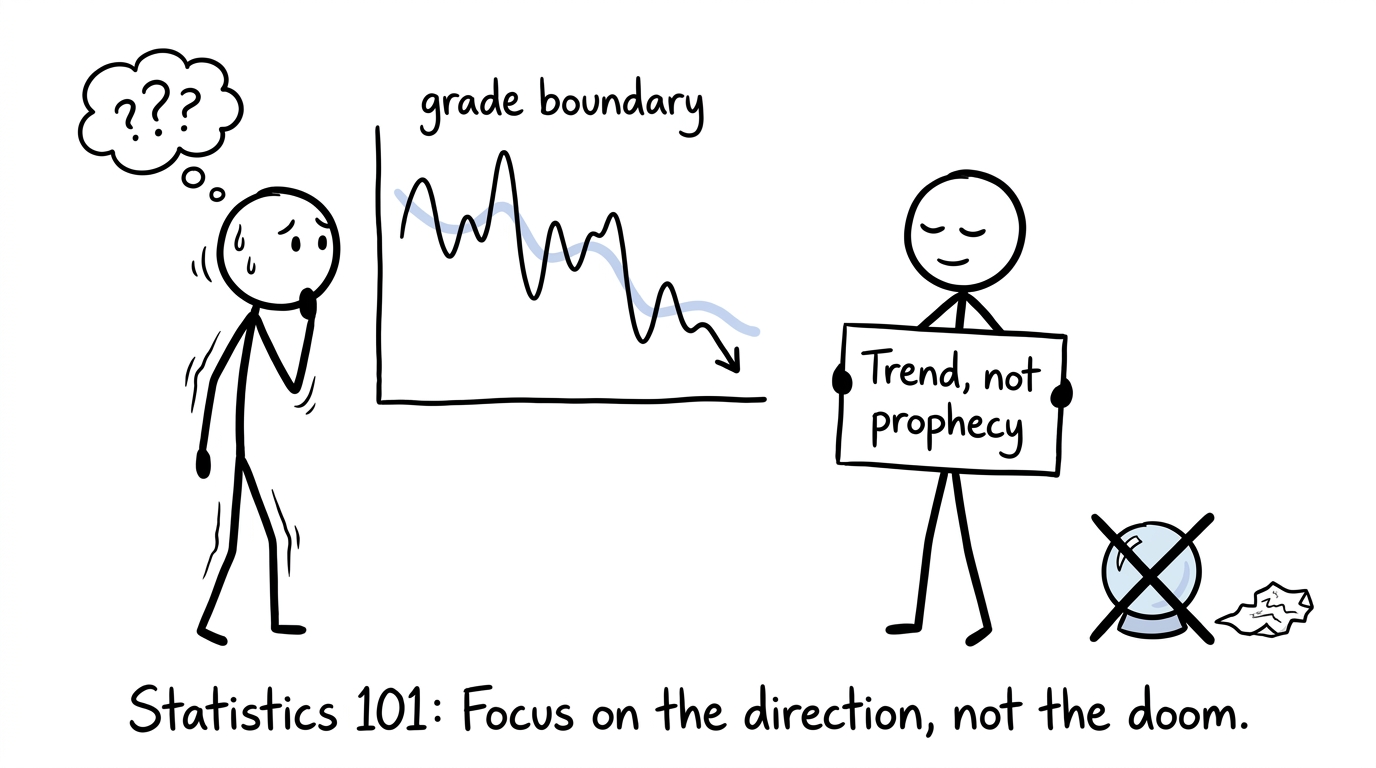 A student learns that a grade-boundary trend is not a prophecy
What changed from year to year?
The 201920192019 baseline
In 201920192019, a grade 999 required 129129129 marks, equivalent to
129160×100=80.625%.\frac{129}{160}\times 100=80.625\%.160129×100=80.625%.A grade 444 required 797979 marks, or approximately 49.4%49.4\%49.4%. This year is especially useful historically because it was the final summer examination series before pandemic disruption.
No normal boundaries in 202020202020 and 202120212021
Students did not sit the usual summer GCSE examinations in these years. Grades were awarded through alternative arrangements, including teacher-assessed grades in 202120212021. It would therefore be misleading to insert estimated exam boundaries into the sequence.
This gap matters. A line graph joining 201920192019 directly to 202220222022 can make the change look continuous when the assessment conditions were not.
The transition year of 202220222022
Summer exams returned in 202220222022. Ofqual described this as a transition year, with overall grading intended to sit between 201920192019 and 202120212021 outcomes.
For AQA Economics, the grade 999 boundary rose to 133133133, while the grade 444 boundary fell to 757575. That does not mean the paper became simultaneously harder and easier. Different parts of the mark distribution can move differently, and awarding considers evidence across the cohort.
A return towards normal grading in 202320232023
Ofqual returned to pre-pandemic grading standards in 202320232023, with protection where national performance was weaker because of disruption. The AQA Economics grade 777 boundary increased from 115115115 to 118118118, while grade 444 moved from 757575 to 818181.
The change is meaningful when analysing history, but it is not a revision forecast. The next paper will contain different questions and generate new performance evidence.
A small dip in 202420242024
Most selected boundaries fell slightly in 202420242024. Grade 999 moved to 130130130, grade 777 to 115115115, and grade 444 to 777777. Boundaries can fall when a paper proves more demanding overall, helping maintain a comparable standard between years.
Boundaries rose again in 202520252025
In 202520252025, grade 999 returned to 133133133, grade 777 to 118118118, and grade 444 reached 828282. Across the examined years shown, grade 999 stayed within a range of only 444 marks, from 129129129 to 133133133. Grade 444 varied by 777 marks, from 757575 to 828282.
That is the clearest summary of recent GCSE economics grade boundary trends: movement exists, but it is measured rather than chaotic.
Why exam boards must be analysed separately
AQA and OCR assess GCSE Economics through different specifications and papers. In 202520252025, AQA's grade 999 boundary was 133133133 out of 160160160, while OCR's was 121121121 out of 160160160. This does not show that one board was easier. Raw marks only make sense within the assessment that produced them.
Confirm your board before revising. MathsGenie provides separate hubs for AQA GCSE Economics revision and OCR GCSE Economics, alongside specification-matched OCR Economics revision guides.
How to use boundary history sensibly
Treat a past boundary as a minimum, not a target. If a previous grade 777 boundary was 118118118, aiming for exactly 118118118 leaves no allowance for an unfamiliar context, a missed calculation or weaker evaluation.
A more useful routine is:
- complete the correct board's paper under timed conditions;
- mark it using the official mark scheme;
- compare your total with that paper's actual boundaries;
- classify lost marks as knowledge, application, analysis, evaluation or calculation errors;
- revise the weakness before attempting another paper.
Start with AQA GCSE Economics past papers or the papers available through the OCR GCSE Economics hub. If quantitative questions cost you marks, use the GCSE Economics calculations guide and MathsGenie's percentage change revision.
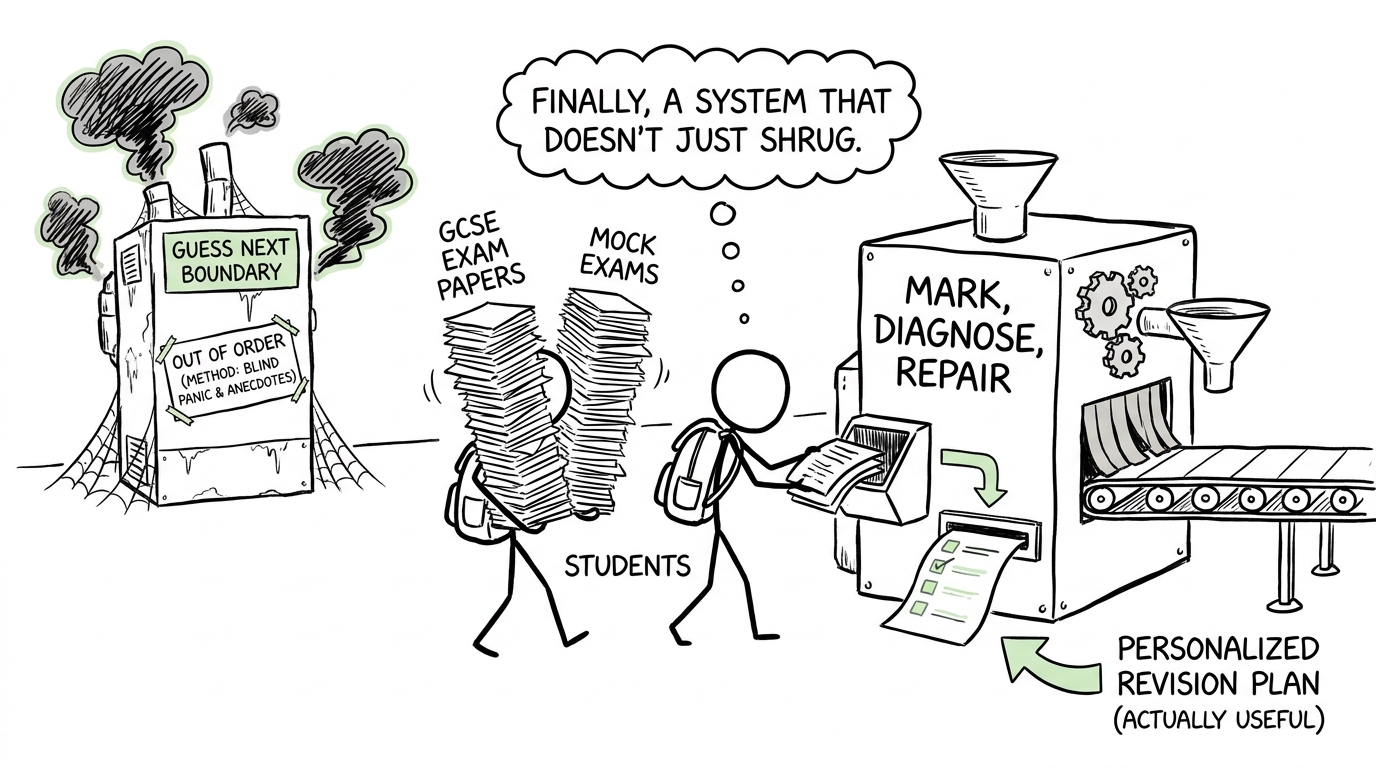 Students choose a mark and repair revision machine instead of guessing boundaries
Common mistakes when analysing boundaries
Comparing different boards directly. The same maximum mark does not make AQA and OCR papers equivalent.
Treating component boundaries as final grades. Your qualification grade comes from the combined total, not a separate grade on each paper.
Inventing figures for 202020202020 and 202120212021. Normal summer exam boundaries were not set, so those years need explanatory labels rather than estimates.
Assuming a higher boundary means an easier qualification. Boundaries help maintain standards when paper demand and cohort performance vary.
Revising to scrape a historical minimum. A narrow target makes your result vulnerable to ordinary mistakes. Build knowledge and exam technique beyond the old threshold.
Turn the trend into a revision plan
Past GCSE Economics grade boundaries show where previous finishing lines were. They cannot tell you where the next one will be. Your controllable advantage is the quality of the work you produce before results day.
Use MathsGenie's free revision lessons to strengthen content, then move into practice questions, past papers and mark schemes. Review every lost mark, revisit weak topics and use mini tests or predicted papers as diagnostics rather than promises. Begin with the AQA GCSE Economics past papers, and make each completed paper produce a specific improvement for the next one.