

GCSE Economics Grade 7 Meaning: What It Shows
GCSE economics grade 7 meaning explained: understand the standard, old grade A comparison, exam skills and how maths revision supports your target.
A result can look wonderfully precise while hiding a complicated story. You open the envelope, see a 777, and immediately wonder what it says about your actual ability. The short answer to the GCSE economics grade 7 meaning is this: it represents strong performance, with the bottom of grade 777 officially comparable to the bottom of the old grade A.
It suggests that you can do more than remember definitions. Across the examination, you have shown secure economic knowledge, applied ideas to different contexts, interpreted evidence and produced reasoned analysis and judgements. It is a demanding result, although it does not mean every answer was perfect or that you achieved a fixed percentage.
Grade 777 at a glance
A grade 777 usually indicates that you can:
- explain a broad range of economic concepts accurately;
- apply those concepts to real or unfamiliar situations;
- analyse causes, consequences and relationships;
- use evidence to support arguments;
- reach reasoned conclusions rather than making unsupported assertions;
- interpret graphs, charts and economic data confidently;
- use relevant quantitative skills with reasonable accuracy.
The important word is overall. GCSE grades reflect performance across the complete assessment. A strong response in one area can compensate for a weaker response elsewhere.
 A student on grade seven sees the bigger economic picture
What a grade 777 actually represents
Economics exams test several kinds of thinking at once. Under Ofqual's current requirements, the assessment objectives for GCSE Economics are weighted as follows:
| Assessment objective | What it measures | Weighting |
|---|---|---|
| AO1 | Knowledge and understanding of economic concepts and issues | 35%35\%35% |
| AO2 | Application of knowledge and understanding to different contexts | 35%35\%35% |
| AO3 | Analysis and evaluation of evidence and issues, including judgements and conclusions | 30%30\%30% |
A grade 777 therefore cannot be reduced to knowing lots of definitions. Knowledge matters, but it accounts for only part of the qualification. You also need to recognise when an idea is relevant, connect it to the information in the question and explain why the evidence leads towards a particular conclusion.
Ofqual publishes broad GCSE Economics grade descriptors at grades 888, 555 and 222, rather than a separate official descriptor for every individual grade. A grade 777 should consequently be understood as an overall standard between the published descriptions for grades 555 and 888, not as a rigid checklist containing one skill for every mark.
At the upper end of that range, students demonstrate comprehensive knowledge, select suitable economic tools, use quantitative skills and make substantiated judgements. Grade 777 performance is approaching that standard, while not necessarily showing the same consistency, precision or depth as grade 888 performance.
How grade 777 compares with the old letter grades
The safest official comparison is simple: the bottom of grade 777 is comparable to the bottom of the old grade A.
That does not mean every grade on the numerical scale has an exact letter-grade partner. The current grades 999 to 111 contain more differentiation at the top than the former A* to G scale. Ofqual identifies comparable points, not a perfect conversion table.
| Current grading point | Official comparison with the former scale |
|---|---|
| Bottom of grade 777 | Comparable to the bottom of grade A |
| Bottom of grade 444 | Comparable to the bottom of grade C |
| Bottom of grade 111 | Comparable to the bottom of grade G |
You may see informal charts describing grade 777 as an A and grades 888 or 999 as versions of an A*. That can provide rough orientation, but it oversimplifies the system. If a sixth form, college or future course has an entry requirement, use the numerical grade it publishes rather than attempting your own conversion.
A grade is not a fixed percentage
One of the easiest misconceptions is that grade 777 always means achieving a particular percentage. It does not.
Your raw mark can be expressed as:
Percentage score=marks achievedtotal available marks×100\text{Percentage score}=\frac{\text{marks achieved}}{\text{total available marks}}\times 100Percentage score=total available marksmarks achieved×100However, the grade attached to that raw mark depends on the grade boundaries for your exam board and examination series. Boundaries are set after papers have been taken so that differences in paper demand can be considered. They can therefore change from one series to another.
A boundary is a threshold, not a description of the questions you answered. Finishing one mark above it and finishing comfortably above it both produce the same reported grade, although the underlying raw scores differ.
Use boundaries to interpret a completed paper, not to predict a guaranteed result from an old percentage. Always check the official information for your own board and series.
The ability behind a grade 777 answer
Knowledge that can travel
A student working at this level does not merely repeat a memorised account of inflation, market failure or competition. They can take the relevant concept and move it into the context provided.
That distinction matters. A definition stays in your notes. Applied understanding travels into a question about a household, business, government policy or national economy.
Analysis with connected reasoning
Strong analysis builds a chain. It identifies a change, explains the mechanism and follows the likely consequences. Each sentence should move the argument forward.
Grade 777 performance will often show these connections securely, although some chains may be less developed than those associated with the highest grades. The examiner should not have to guess why one point leads to the next.
Evaluation that makes a decision
Evaluation is not the habit of adding “however” near the end. It means weighing relevant considerations: short-run and long-run effects, the scale of a change, who is affected, assumptions in the argument and limitations of the available evidence.
A judgement becomes convincing when it follows from the analysis. It answers the exact question and explains which consideration matters most.
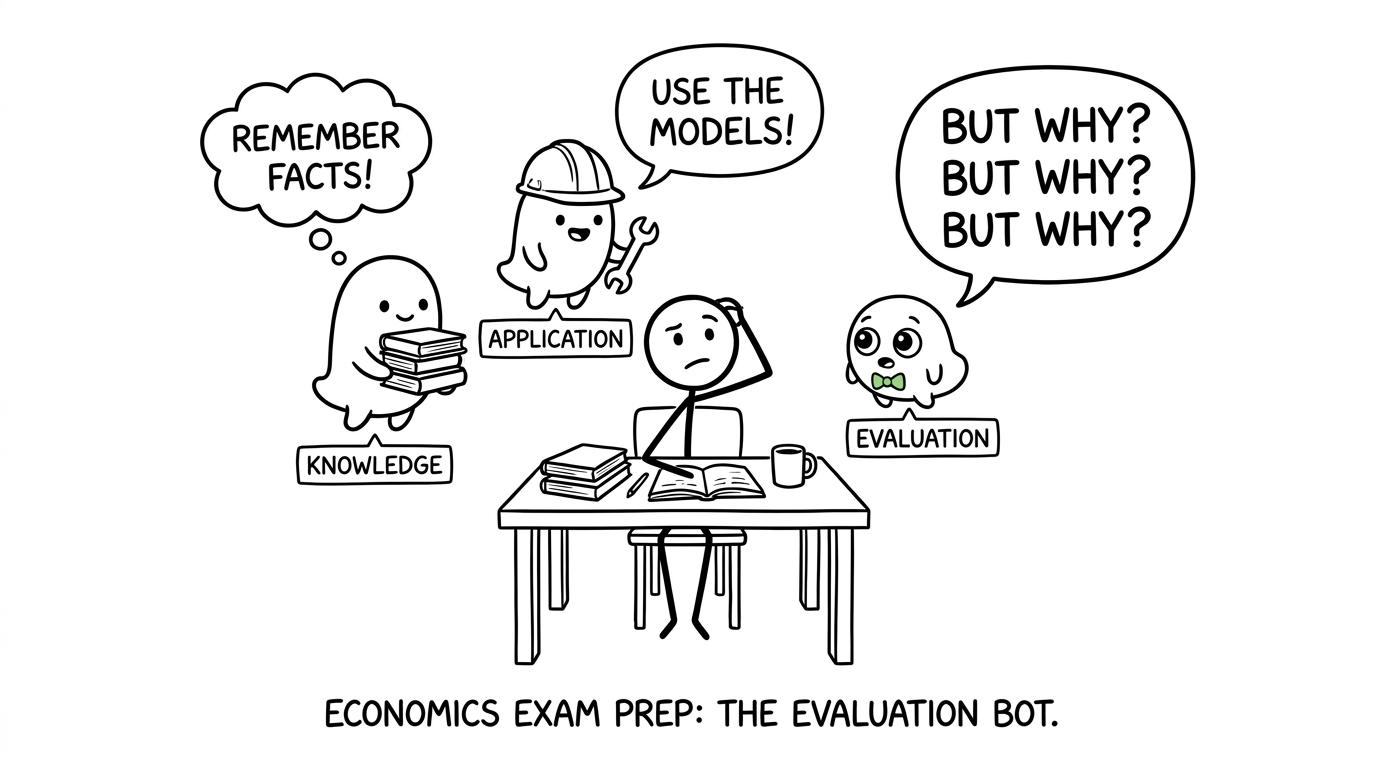 Knowledge application and evaluation prepare for an economics exam
Why maths matters in GCSE Economics
GCSE Economics is not a substitute for GCSE maths, but quantitative reasoning is part of the subject. Ofqual requires at least 10%10\%10% of the total qualification marks to reward quantitative skills, assessed in an economic context and at no lower than Key Stage 333 demand.
Relevant skills include:
- percentages and percentage changes;
- interest on savings;
- averages, including average cost;
- revenue, cost and profit calculations;
- gross and net pay;
- constructing and interpreting graphs;
- using data on matters such as unemployment, imports and exports;
- supporting economic decisions with numerical evidence.
This is where preparation for maths exams can reinforce economics. MathsGenie's free percentages revision resources build the fluency needed for changes in prices, wages or output. If conversions remain uncertain, revisit the fractions, decimals and percentages revision guide.
For tables, averages and data displays, the GCSE Statistics revision hub provides focused practice. The goal is not calculation for its own sake. A numerical answer becomes economically useful when you interpret what it means and connect it to the decision being discussed.
 Economic data tries unsuccessfully to hide from a student
How to revise towards grade 777
Diagnose the missing skill
Do not label every lost mark as “I need more revision”. Be more precise. Was the problem missing knowledge, weak application, incomplete analysis, unsupported evaluation or inaccurate data handling?
Maths students can use the same diagnostic method described in how to find your weakest GCSE topics: attempt, mark, classify the error, repair it and retest it. For economics, classify mistakes by assessment objective as well as topic.
Separate content from answer construction
First check whether you understand the economic idea. Then check whether you can use it under examination conditions. These are related but different abilities.
A useful revision cycle is:
- retrieve a concept without notes;
- answer an exam-style question;
- compare the response carefully with the mark scheme;
- identify the weakest link in the reasoning;
- rewrite only that section more precisely;
- return to a similar question later.
Keep quantitative skills active
Short, regular maths practice is better than discovering during the economics exam that percentage change has become unfamiliar. Use the free MathsGenie revision planner to schedule small sessions around your other subjects.
For maths itself, Edexcel GCSE Maths past papers combine papers with official mark schemes and worked solutions where available. The broader principle transfers to economics: timed practice reveals whether your knowledge survives pressure.
Common mistakes when interpreting or targeting grade 777
Treating grade 777 as a guaranteed percentage
Old boundaries are useful evidence, not promises. Paper difficulty and boundaries vary by series, so avoid building your target around one historical figure.
Calling grade 777 an exact old grade A
The official statement concerns comparable boundary points: the bottom of grade 777 aligns with the bottom of the old A. The two grading systems are not identical throughout.
Revising definitions without application
Accurate recall can earn marks, but grade 777 requires a broader performance. Practise using concepts in unfamiliar contexts and referring directly to the information supplied.
Confusing evaluation with balance
Listing one advantage and one disadvantage is not automatically evaluation. Compare their importance, consider conditions and reach a supported judgement.
Calculating without interpreting
A correct percentage or average may answer only part of an economics question. State what the figure reveals and explain how it affects the argument.
Chasing harder material while basics remain unreliable
Strong grades are often built on secure foundations. MathsGenie's guide to the best order for learning GCSE maths topics reflects the same idea: fluency in percentages, graphs and statistics supports more complicated reasoning later.
Turn the grade into a practical target
A grade 777 in GCSE Economics represents strong, adaptable understanding. It sits at a standard whose lower boundary is comparable to the old grade A, but it is awarded from your total performance rather than a fixed percentage or a single perfect answer.
Your next step is not to stare harder at the number. Find what currently separates your responses from it. Strengthen economic knowledge, practise application, build connected analysis, make evidence-led judgements and keep quantitative skills accurate.
For the maths supporting those skills, begin with MathsGenie's free GCSE revision resources. Use revision lessons to repair methods, practice questions and mini tests to build fluency, then mark past papers carefully with the available mark schemes and video solutions. Nearer your maths exams, add predicted papers for fresh exam-style practice. A grade is the final label; the useful work happens in the feedback loop that comes before it.











