

GCSE Economics Exam Length: Your Real-Time Plan
GCSE economics exam length explained by exam board, with practical timing, energy and focus plans for AQA, OCR and Pearson Edexcel International GCSE.
The clock can make an exam feel more complicated than it is. You know the content, but a second question sits underneath every page: Will I have enough time?
The GCSE economics exam length depends on your exam board. For AQA, each of the two papers lasts one hour 45 minutes. For OCR, each of the two papers lasts one hour 30 minutes. Pearson Edexcel offers International GCSE Economics rather than the standard GCSE qualification; its two papers also last one hour 30 minutes each.
Those figures tell you how long the paper lasts. They do not quite describe how long exam day feels. You must also account for arriving, hearing instructions, settling your attention and sustaining useful concentration until the final check.
GCSE economics exam length at a glance
The current official specifications give the following paper lengths:
| Qualification | Papers | Length per paper | Marks per paper | Total examining time |
|---|---|---|---|---|
| AQA GCSE Economics 813681368136 | 222 | 111 hour 454545 minutes | 808080 | 333 hours 303030 minutes |
| OCR GCSE Economics J205J205J205 | 222 | 111 hour 303030 minutes | 808080 | 333 hours |
| Pearson Edexcel International GCSE Economics 4EC14EC14EC1 | 222 | 111 hour 303030 minutes | 808080 | 333 hours |
Always check the qualification code on your school timetable. AQA and OCR offer GCSE Economics in England, while Pearson's current Economics course at this level is an International GCSE. Eduqas currently offers Economics at AS and A Level rather than GCSE, so do not assume that every familiar exam board has a GCSE Economics paper.
The official duration begins when the examination starts. In practice, you will be in the room longer while candidates are seated, instructions are read and papers are collected. Your school or college will tell you when to arrive. If you have approved access arrangements, such as extra time or supervised rest breaks, use the personalised finish time supplied by your centre rather than the standard duration.
Your quick exam-day checklist
- Confirm your exam board, qualification code and paper number.
- Check whether the paper begins in the morning or afternoon.
- Know the official duration and your own access arrangements.
- Bring the equipment listed on the paper and required by your centre.
- Practise at least one paper or substantial section under timed conditions.
- Plan a first pass, a deeper second pass and a final check.
- Protect your energy before the exam rather than exhausting it with last-minute revision.
 A student realises that the exam clock is waiting rather than chasing them
What the AQA Economics papers involve
AQA GCSE Economics has two equally weighted papers:
- Paper 111: How Markets Work
- Paper 222: How the Economy Works
Each paper is worth 808080 marks, lasts 105105105 minutes and contributes 50%50\%50% of the qualification. Both contain multiple-choice questions, short responses and questions based on economic contexts, including extended writing.
A crude average timing calculation is:
105 minutes80 marks=1.3125 minutes per mark\frac{105\text{ minutes}}{80\text{ marks}}=1.3125\text{ minutes per mark}80 marks105 minutes=1.3125 minutes per markThat is about one minute and 191919 seconds per mark. It is a planning guide, not a command. Reading a source, interpreting data and organising an evaluative response all take time before marks appear on the page. Some short questions should therefore take less than the average, leaving time for longer analysis and evaluation.
A sensible target is to reserve roughly the final ten minutes for checking. That leaves 959595 minutes for the main attempt:
105−10=95 minutes105-10=95\text{ minutes}105−10=95 minutesUse past-paper practice to adjust that reserve. If you usually finish comfortably, you may choose a longer check. If you frequently leave extended responses incomplete, focus first on moving on promptly rather than creating an ambitious checking window that never arrives.
What the OCR Economics papers involve
OCR GCSE Economics also has two equally weighted components:
- Component 010101: Introduction to Economics
- Component 020202: National and International Economics
Each paper lasts 909090 minutes, carries 808080 marks and contributes 50%50\%50% of the final qualification. The current specification states that each paper contains 202020 multiple-choice questions in Part A. Part B contains three questions built around short case studies, with short, medium and extended responses.
The overall average is:
90 minutes80 marks=1.125 minutes per mark\frac{90\text{ minutes}}{80\text{ marks}}=1.125\text{ minutes per mark}80 marks90 minutes=1.125 minutes per markThat equals one minute and 7.57.57.5 seconds per mark. Again, do not force every question into that exact allowance. Multiple-choice questions should usually create time for reading the case studies, building chains of reasoning and making justified judgements later.
If you protect the final eight minutes for checking, your main working period is:
90−8=82 minutes90-8=82\text{ minutes}90−8=82 minutesThe important skill is not obeying a universal schedule. It is noticing whether one stubborn question is consuming time that belongs to several accessible marks elsewhere.
How long Pearson Edexcel International GCSE takes
Pearson Edexcel International GCSE Economics 4EC14EC14EC1 is separate from GCSE Economics. It has two papers:
- Paper 111: Microeconomics and Business Economics
- Paper 222: Macroeconomics and the Global Economy
Each paper lasts 909090 minutes, is worth 808080 marks and represents 50%50\%50% of the qualification. Each contains four compulsory questions worth 202020 marks, combining multiple-choice, short-answer, data-response and open-ended tasks.
If your timetable says Edexcel Economics, check whether the code is 4EC14EC14EC1. Revision resources and advice labelled simply “GCSE Economics” may describe AQA or OCR instead, whose paper structures are different. The qualification code is more reliable than the colour of a revision guide or what a friend remembers.
A real-time breakdown for exam day
Your attention is not equally strong from the first minute to the last. A useful plan respects that instead of pretending tiredness will not happen.
Before the official start
Arrive at the time your centre specifies. Avoid doing an entire practice paper immediately beforehand. A short review of definitions, diagrams or command words may help, but the purpose is to become ready, not mentally spent.
Once seated, listen carefully to instructions. Check that you have the correct paper and write the required candidate details. Do not begin until told to do so.
The opening phase
Use the first few minutes after the start to read the paper instructions and establish control. Notice the sections, total marks and command words. Begin collecting accessible marks, but read every question precisely.
“Explain”, “analyse” and “evaluate” ask for different things. Speed without attention can produce an answer to a question that was never asked.
The middle phase
This is where most marks are earned and where time can quietly disappear. Check the clock at natural section boundaries rather than after every sentence. If a question has stalled, leave enough space, mark it clearly and continue.
The MathsGenie guide to using past papers properly explains the same useful cycle for maths: complete timed work, mark it honestly, diagnose the weakness and retest it. That process transfers well to Economics timing practice.
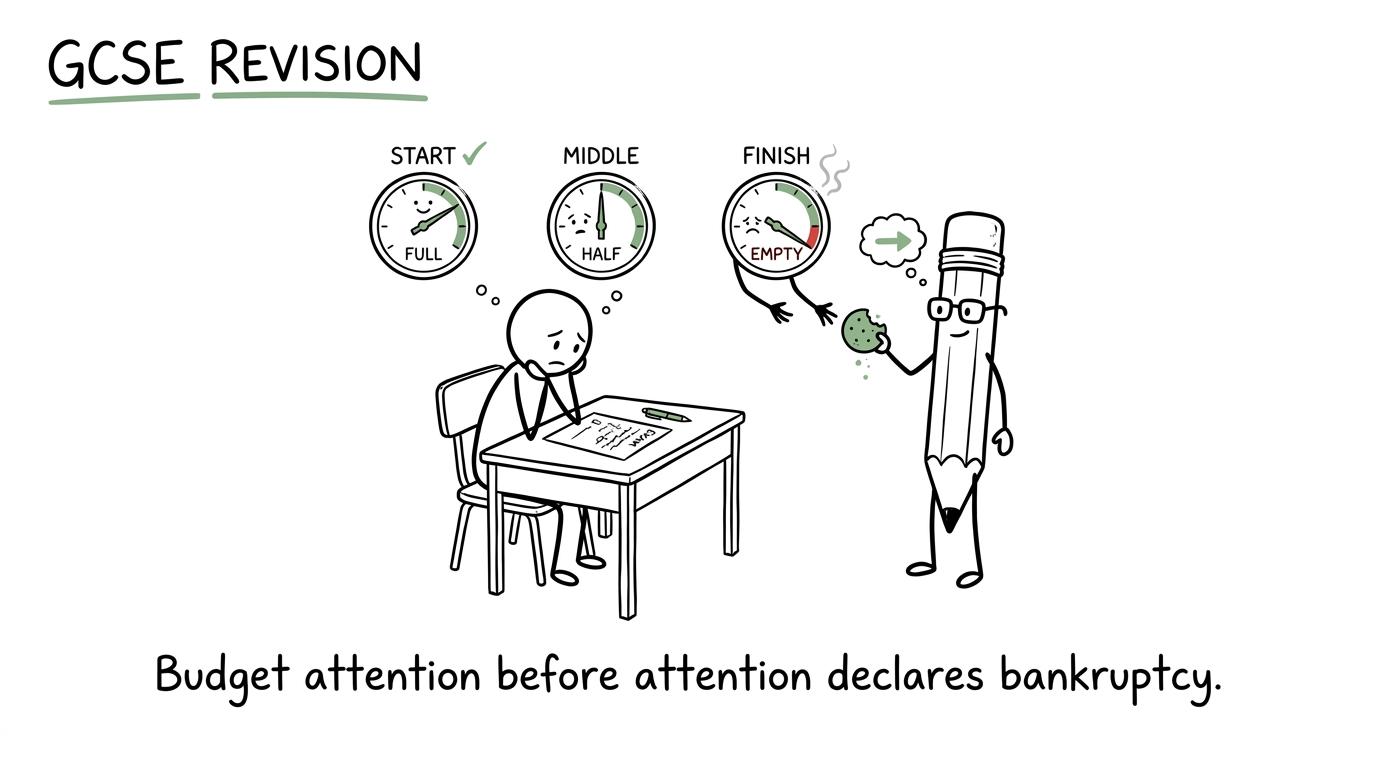 A student's attention budget is protected for the end of the exam
The final phase
Do not treat checking as simply staring at completed answers. Give it jobs:
- finish any answer you deliberately postponed;
- check that calculations include working and appropriate units;
- make sure written conclusions answer the exact question;
- look for unanswered pages or parts;
- review doubtful multiple-choice answers without changing them on impulse.
A correction is useful when you identify a reason. Nervousness alone is not evidence that your first answer was wrong.
Planning energy as well as minutes
An Economics paper combines memory, numerical work, source interpretation and extended writing. Switching between these modes costs attention.
Eat and drink in the normal way recommended by your family or school, and follow your centre's rules about water. Pack your equipment in advance. Removing small decisions protects concentration for the paper itself.
Maths revision can strengthen the quantitative skills that Economics assessments require. Percentages, percentage change, averages, totals, graphs and data interpretation all matter. MathsGenie's free GCSE maths revision hub lets you select your exam board and practise these foundations. The focused percentages revision lesson and questions are especially useful when percentage change or economic data feels slow.
For stamina, build gradually. Start with a short timed set, then a substantial section, then a full paper. Maths students can use GCSE maths mini tests and later move to Edexcel GCSE Maths predicted papers. The subjects differ, but the habit is identical: make clear thinking survive contact with a clock.
Common mistakes with Economics exam timing
Revising the wrong paper length
Students sometimes remember a friend's duration without checking the board. AQA papers are 151515 minutes longer than OCR papers. Confirm your qualification code from your timetable or teacher.
Using equal time for every question
Questions carry different marks and cognitive demands. Use the marks as a guide, while allowing time to read sources and plan longer responses.
Writing beyond the value of the question
A long answer is not automatically a strong answer. Once you have answered the command word with relevant knowledge, application and reasoning, additional repetition has a cost: the marks waiting later in the paper.
Saving all difficult questions until the end
Skipping one stalled task is sensible. Postponing every demanding response can leave too much work for your lowest-energy minutes. Return at planned checkpoints.
 A student makes a strategic retreat from one difficult exam question
Treating practice papers as a score only
A score says what happened. Your timings explain why. Record where you were at sensible intervals, then compare this with the marks completed. MathsGenie's one-month GCSE revision plan shows how timed work, marking and targeted repair can fit into a repeatable revision routine.
Turn the clock into part of your preparation
The exam duration is fixed, but your experience of it is trainable. Know the correct paper length. Practise starting calmly, moving on deliberately and preserving enough attention to finish. The goal is not to write at maximum speed for every minute. It is to spend your limited time where it can earn marks.
Start with MathsGenie's guide to the best order for learning GCSE maths topics, then use free revision lessons and practice questions to strengthen the percentages, graphs and data skills that support Economics. Build stamina with mini tests, past papers and predicted papers, and learn from mark schemes and video solutions after every timed attempt.
The clock will still be on the wall. But after enough deliberate practice, it stops feeling like a threat and starts becoming part of the plan.











