GCSE Economics 5 to 7: How to Raise Your Grade
GCSE Economics 5 to 7 guidance: improve application, analysis, evaluation and quantitative skills with a focused revision and exam practice plan.
A grade 5 often means you know more economics than your exam answers reveal. You can define inflation, recognise a demand curve and explain why firms seek profit. Yet longer answers remain descriptive, evidence goes unused and conclusions arrive without a clear judgement.
Moving from GCSE Economics 5 to 7 is therefore not mainly about collecting more notes. It is about using what you know with greater precision. You need to apply concepts to the case, build connected chains of reasoning, interpret data accurately and make justified judgements. Those are the changes most likely to move your performance into a higher grade band.
Official GCSE Economics assessment objectives give substantial weight to all three areas: knowledge and understanding, application, and analysis and evaluation. Quantitative skills matter too. The most effective plan trains each skill deliberately rather than treating every lost mark as a content problem.
Your grade 5 to grade 7 checklist
Use this as a quick audit:
- Know the specification content accurately, including key terminology.
- Apply every developed answer to the business, market, household or economy in the question.
- Extend explanations through several connected economic effects.
- Use figures from extracts, tables and graphs as evidence.
- Evaluate by considering conditions, limitations, affected groups and time periods.
- Finish extended responses with a supported judgement.
- Secure percentages, averages, revenue, cost, profit and graph interpretation.
- Practise under timed conditions and correct answers with the mark scheme.
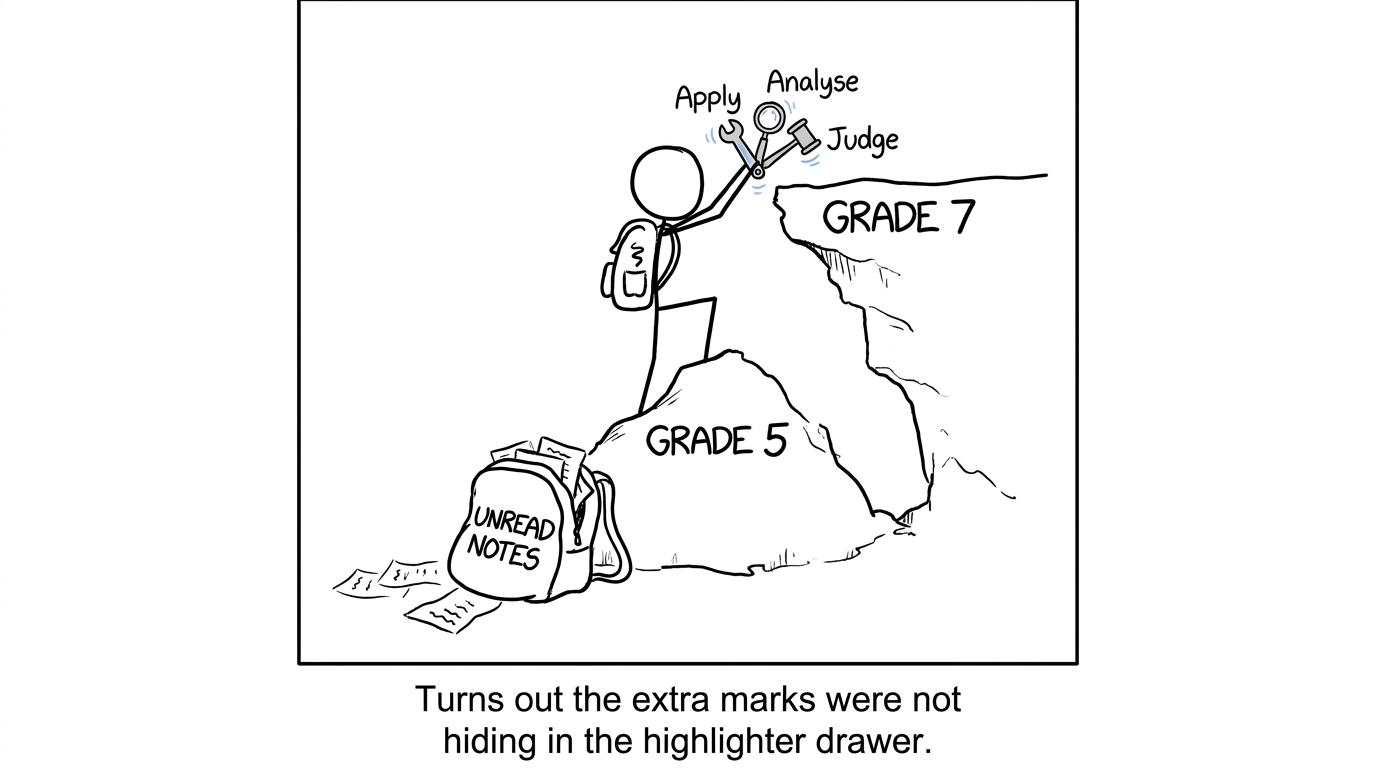 A student leaves unread notes behind and climbs from grade 5 towards grade 7 using application, analysis and judgement
What separates a grade 5 from a grade 7 in GCSE Economics?
Ofqual publishes broad descriptors at grades 2, 5 and 8 rather than a separate official description for every grade. Its grade 5 descriptor refers to mostly accurate knowledge, the selection of basic economic tools, some relevant quantitative skills, some evaluation and plausible conclusions. A grade 7 should therefore be understood as performance moving securely towards the stronger qualities associated with grade 8, not as a fixed list of phrases or a guaranteed raw mark.
In practice, the distinction often looks like this:
| Grade 5 tendency | Grade 7 direction |
|---|---|
| Mostly accurate definitions | Precise knowledge selected for the question |
| General explanation | Consistent application to the stated context |
| One economic consequence | A developed chain of linked consequences |
| Data copied from the extract | Data interpreted and used as evidence |
| An advantage and disadvantage | Evaluation of significance, conditions and limitations |
| A brief opinion | A justified conclusion based on earlier analysis |
| Correct basic calculation | Accurate calculation followed by economic interpretation |
This is not a promise that displaying every quality will produce a particular grade. Grade boundaries are set after each examination series and can change. The table is better used as a description of stronger performance.
Turn knowledge into application
A grade 5 answer may accurately explain that higher interest rates encourage saving. A stronger answer asks: for whom, in this context, and with what consequence?
Application means selecting details from the question and making them economically useful. The name of a firm alone is not meaningful application. Its size, costs, market, workforce, competitors and customers might be.
Before writing a developed response, underline:
- the economic agent affected;
- the market or country involved;
- any figures or trends;
- the relevant time period;
- details that change the likely outcome.
Then connect your economics to those details. If an extract says a firm imports raw materials, an exchange-rate change has a specific route through import costs, total costs, prices and competitiveness. If a household has a variable-rate loan, an interest-rate change affects it differently from a household with savings.
The key shift is from naming the case to reasoning through it.
Build longer chains of analysis
Analysis answers the question, “What happens next, and why?” Strong responses do not simply list separate effects. They connect them.
A useful underlying structure is:
change →\rightarrow→ direct effect →\rightarrow→ response by an economic agent →\rightarrow→ wider consequence
For example, a change in production costs may influence supply, market price, quantity traded, consumer behaviour and business objectives. You do not need to force every possible link into an answer. Select the chain that is relevant and explain each step.
Use linking language with purpose:
- because;
- this increases or reduces;
- consequently;
- therefore;
- which may lead to.
Each phrase should add a new causal step. Rephrasing the same idea does not deepen analysis.
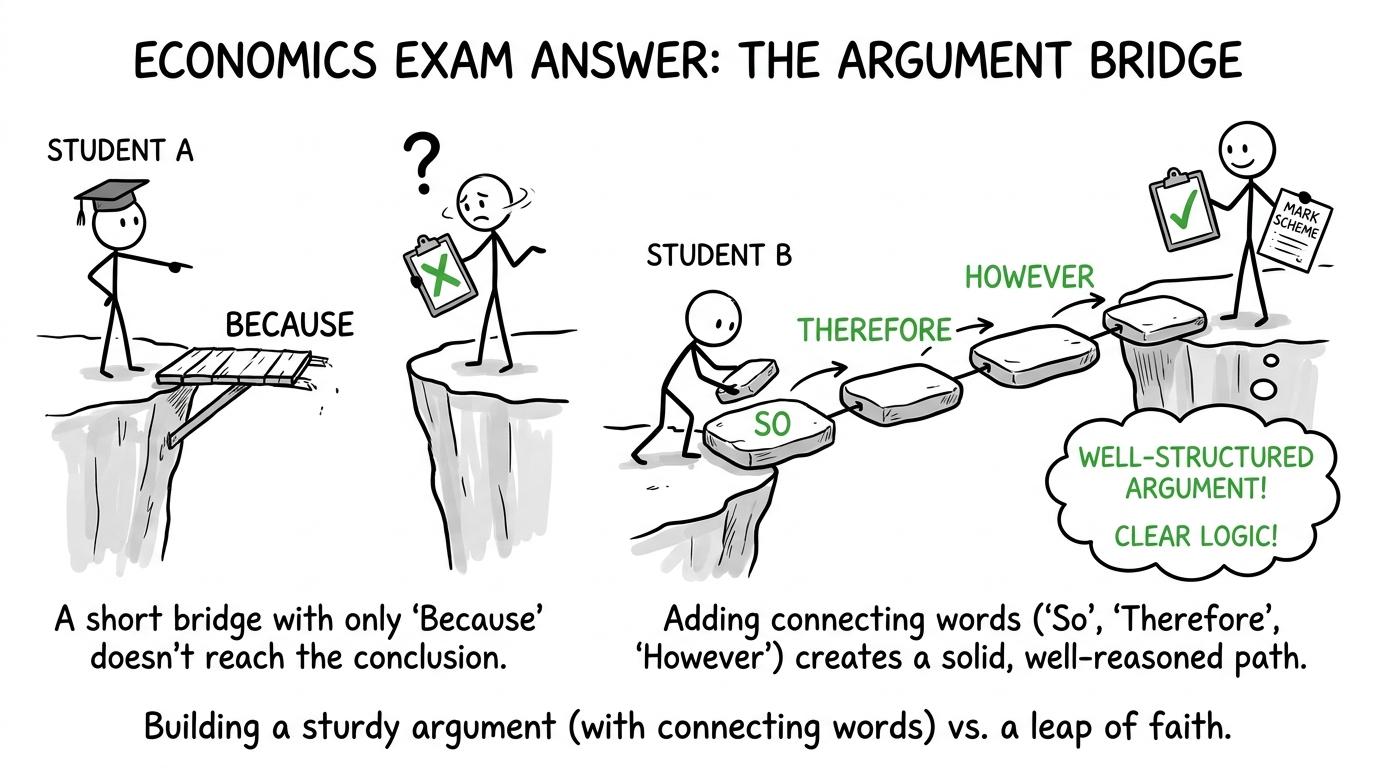 An economics answer becomes a bridge as a student adds because, therefore and however
Make evaluation conditional and decisive
Students sometimes interpret evaluation as “give both sides”. That is only the beginning. Higher-level evaluation weighs the arguments and explains which is more convincing.
Useful questions include:
- Does the outcome differ in the short run and long run?
- Which stakeholder gains, and which loses?
- How large is the change?
- What does the result depend on?
- Is the market competitive?
- How responsive are consumers or producers?
- Is the data current, representative and sufficient?
- Could another policy or external event alter the result?
A developed judgement should answer the exact question, identify the most important reason and acknowledge a condition that could change the conclusion. “It depends” is not evaluation by itself. You must say what it depends on and why that condition matters.
Plan judgement throughout the answer rather than attaching a vague conclusion in the final minute. If your earlier paragraphs compare impact, scale and time, the conclusion becomes a decision rather than a summary.
Strengthen your quantitative economics
Across GCSE Economics specifications, at least 10%10\%10% of the total marks must reward quantitative skills at no lower than Key Stage 3 demand. AQA and OCR both identify skills including percentages, percentage changes, averages, totals, revenue, costs, profit, income, graph construction and data interpretation.
Start with the free quantitative skills in economics revision guide. The essential relationships include:
Percentage change=new value−original valueoriginal value×100%\text{Percentage change}=\frac{\text{new value}-\text{original value}}{\text{original value}}\times 100\%Percentage change=original valuenew value−original value×100% Total revenue=price×quantity sold\text{Total revenue}=\text{price}\times\text{quantity sold}Total revenue=price×quantity sold Profit=total revenue−total cost\text{Profit}=\text{total revenue}-\text{total cost}Profit=total revenue−total cost Average cost=total costoutput\text{Average cost}=\frac{\text{total cost}}{\text{output}}Average cost=outputtotal costA calculation is not always the end of the task. Explain what the result means for the firm, consumer or economy. Include units, distinguish a percentage change from a change in percentage points, and check whether your answer is plausible.
If the calculation itself is holding you back, use MathsGenie's percentage change revision resources and averages revision lesson. For broader data work, the GCSE Statistics revision hub can strengthen graph and table interpretation. These maths resources supplement, rather than replace, Economics questions from your own exam board.
Use diagrams as economic arguments
A supply and demand diagram is not decoration. It should communicate the reasoning in your answer.
Check that you have:
- labelled both axes;
- labelled supply and demand curves;
- shown the original equilibrium;
- shifted the correct curve for a non-price factor;
- used an arrow to show the direction of the shift;
- indicated the new equilibrium where required;
- explained the resulting price and quantity changes in words.
Remember the distinction between a movement along a curve and a shift of the curve. A change in the good's own price produces movement along an existing curve. A relevant non-price determinant can shift demand or supply.
When reading charts, inspect the title, units, scale and time period before drawing a conclusion. Quote evidence selectively. A figure earns value when it supports your reasoning, not when it is copied without interpretation.
Practise the skill that lost the mark
A paper score tells you where you finished. An error log tells you what to do next.
After each assessment, classify lost marks as:
- inaccurate or missing knowledge;
- weak application;
- an incomplete analytical chain;
- unsupported evaluation;
- quantitative error;
- poor diagram or data interpretation;
- timing or question-reading error.
MathsGenie's guide to finding your weakest GCSE topics explains this evidence-led approach. You can also adapt the 20-minute revision routine: retrieve one Economics topic, answer a short exam question, mark it and record one precise improvement.
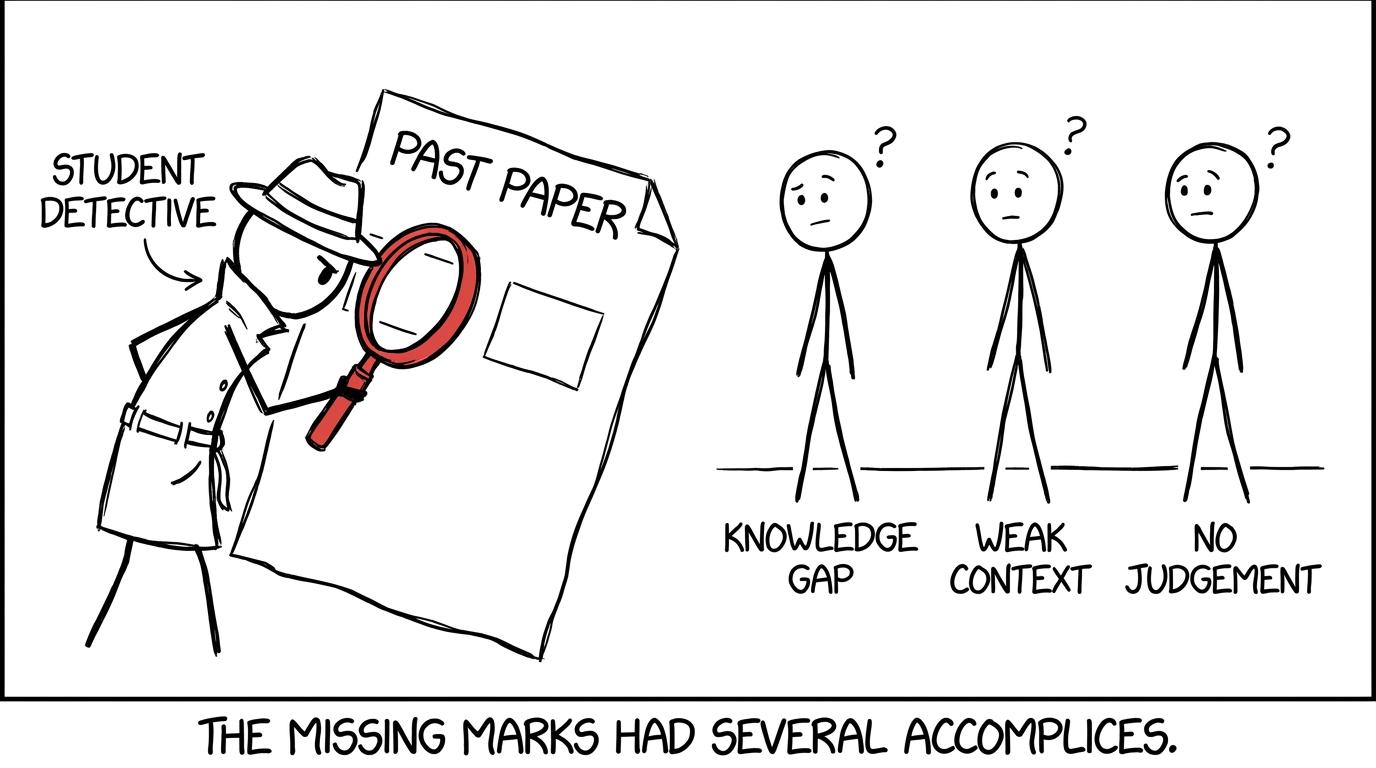 A student detective investigates knowledge, context and judgement as accomplices in missing marks
A weekly plan for moving towards grade 7
A sustainable week might contain:
- One knowledge session: retrieve definitions, diagrams and relationships without notes.
- One application session: annotate extracts and connect details to economic concepts.
- One analysis session: plan causal chains for several questions.
- One evaluation session: write judgements using conditions, evidence and time periods.
- One quantitative session: practise percentages, averages, business calculations and data.
- One timed section: answer questions in your board's format and mark them carefully.
Do not measure revision only in hours. Measure outputs: questions attempted, answers corrected and weaknesses retested. The GCSE revision efficiency guide offers a useful learn, practise, mark and fix cycle that transfers well to Economics.
Use Economics papers supplied by your school or exam board for exact question formats. The wider MathsGenie GCSE papers hub and GCSE maths mini tests are valuable for keeping the quantitative foundations secure.
Common mistakes that keep answers at grade 5
Revising only by reading
Recognition feels fluent, but the examination requires retrieval and writing. Close the notes and produce the definition, diagram or argument from memory.
Ignoring the command word
A definition does not answer an analyse question. A long balanced essay is unnecessary when the question asks for a calculation. Match the depth and structure of your response to the command word and available marks.
Treating context as a name-dropping exercise
Repeating the organisation's name does not develop application. Use a contextual detail to alter or support the economic reasoning.
Ending analysis too early
If you write that demand rises, ask what happens to price, quantity, revenue, consumers or producers next. Continue only along a relevant causal route.
Giving an unsupported conclusion
A judgement needs a reason grounded in the preceding analysis. State the decisive factor and the condition under which your decision could change.
Doing the calculation but ignoring its meaning
Show the method, include units and interpret the result in economic context. Quantitative evidence should strengthen a decision or explanation.
Make the next answer better than the last
The distance between grades 5 and 7 is rarely crossed by one heroic revision weekend. It is crossed when ordinary answers become more exact: one stronger chain of reasoning, one relevant figure, one properly qualified judgement and one fewer calculation error.
Begin with the MathsGenie quantitative economics revision guide, then use revision lessons and practice questions to repair specific maths weaknesses. Add timed Economics past-paper questions from your board, mark them carefully and revisit every recurring error. Nearer the exam, use predicted papers as additional practice rather than a replacement for specification coverage and official past papers.
MathsGenie's free revision lessons, practice questions, mini tests, mark schemes, video solutions, past papers and predicted papers make the practice cycle simple. Choose one weakness today, correct it properly, and test it again before it has time to become familiar.