

GCSE Design and Technology and Engineering Together
GCSE Design and Technology and GCSE Engineering together can be realistic. Compare overlap, workload, maths content and school option rules.
Choosing GCSE options can feel strangely permanent. Two subjects may both sound right, yet the timetable asks you to place them in separate boxes and move on. If you are considering GCSE Design and Technology and GCSE Engineering together, the short answer is: yes, it can be possible and realistic, but only if your school offers both qualifications, places them in compatible option blocks and permits the combination.
They are separate subjects rather than two names for the same course. There is useful overlap in materials, manufacturing, technical drawing, practical work and mathematical reasoning. However, the courses have different emphases, and taking both can create a substantial non-exam assessment workload. Before choosing, check the exact specifications your school teaches rather than relying on course names alone.
The quick decision checklist
Before putting both subjects on your options form, find out:
- Does your school actually offer both in your year?
- Are they in different option blocks?
- Is the engineering course a GCSE or a vocational Level 111/222 qualification?
- Which exam board and specification does each course follow?
- How much non-exam assessment, or NEA, is required?
- Can the two projects be scheduled without major deadline clashes?
- Are you interested in both user-centred design and technical engineering analysis?
- Will you still have protected time for English, science and GCSE maths revision?
A yes to the first three questions establishes whether the combination is possible. The remaining answers tell you whether it is sensible for you.
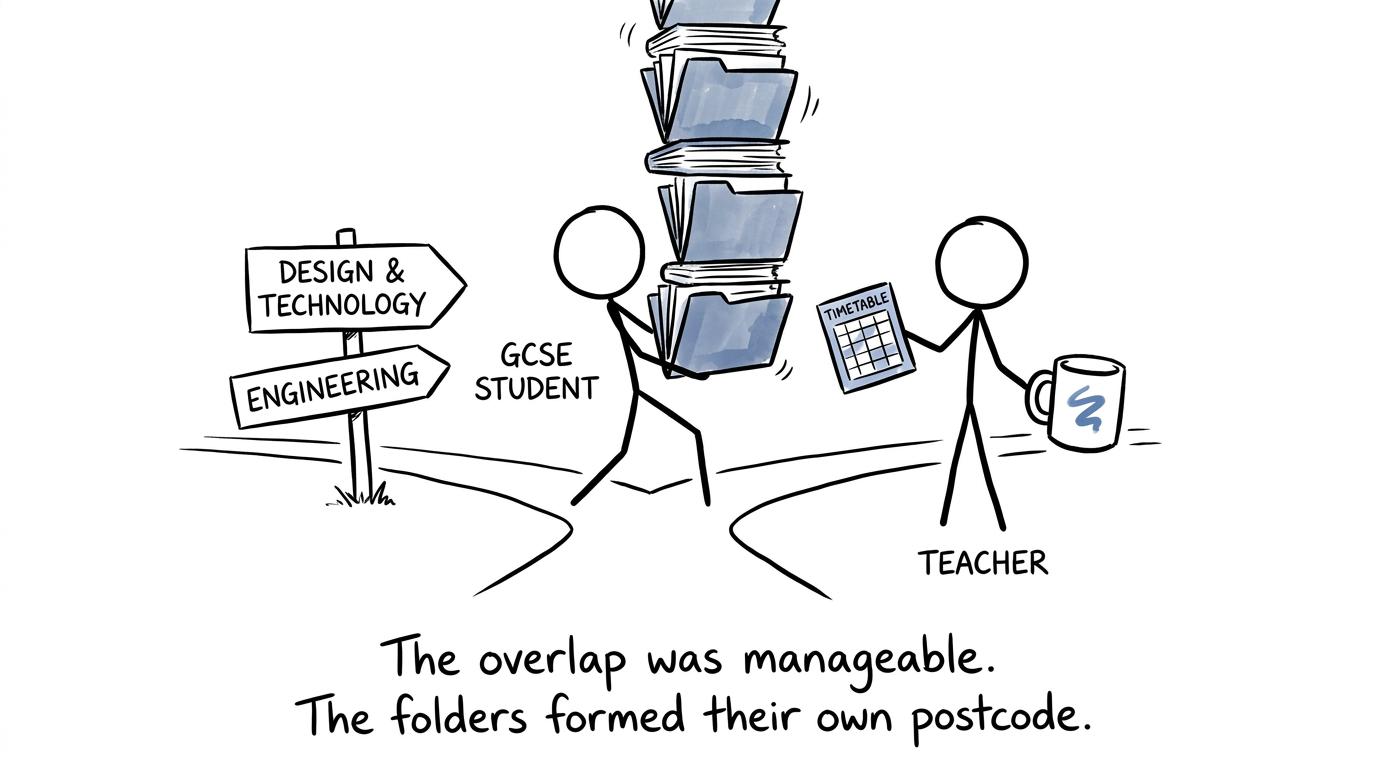 A student attempts to follow both technical GCSE paths while carrying a tower of project folders
Can you take both qualifications at the same time?
There is no general rule preventing a student from entering both GCSE Design and Technology and GCSE Engineering. They are recognised as distinct subject areas. Department for Education data has listed GCSE Design and Technology and GCSE Engineering Studies under different performance-table discount groups, although schools should still confirm the current treatment of the exact qualifications they offer.
The practical decision belongs largely to your school. A school may:
- offer Design and Technology but not Engineering;
- offer a vocational engineering Technical Award rather than GCSE Engineering;
- place both courses in the same option block;
- restrict similar combinations because of staffing or workshop capacity;
- advise against two project-heavy subjects because deadlines may coincide.
None of these decisions means that the subjects are academically incompatible. They reflect local timetabling, facilities and curriculum planning.
Ask your options lead or examinations officer for the full qualification title, exam board, specification code and current options policy. This avoids a common misunderstanding: a course described informally as “engineering” is not necessarily GCSE Engineering.
How much overlap is there really?
The overlap is meaningful, but not complete. Imagine two circles that meet in the middle. The shared section contains materials, manufacturing, drawing, testing, evaluation and practical problem-solving. Outside that shared section, Design and Technology leans towards designing for people, while Engineering leans towards understanding and applying engineered systems.
| Area | Design and Technology | Engineering | Degree of overlap |
|---|---|---|---|
| Materials | Selection, properties and suitability | Properties, performance and testing | High |
| Manufacturing | Making methods and production processes | Engineering processes and quality control | High |
| Design work | User needs, creativity and iterative development | Solutions constrained by technical requirements | Moderate |
| Drawing and CAD | Communicating and developing designs | Sector-specific technical communication | High |
| Systems | Inputs, processes, outputs and mechanisms | Mechanical, electrical and other engineered systems | Moderate to high |
| Testing | Evaluating a prototype against a specification | Measuring and analysing performance | High |
| Wider context | Sustainability, users and social consequences | Engineering sectors, systems and industrial practice | Moderate |
| Mathematics | Dimensions, percentages, area, scale and data | Formulae, forces, stress, density, circuits and gears | Moderate to high |
The shared knowledge can reduce the feeling of starting from zero in each lesson. Knowing why a material is selected, how tolerances affect manufacture or how CAD communicates an idea may support both courses.
Yet overlap does not halve the work. Each qualification has its own assessment objectives, terminology, evidence requirements and mark scheme. One project cannot simply be submitted twice, and assessed work must follow the rules of the relevant exam board and the Joint Council for Qualifications.
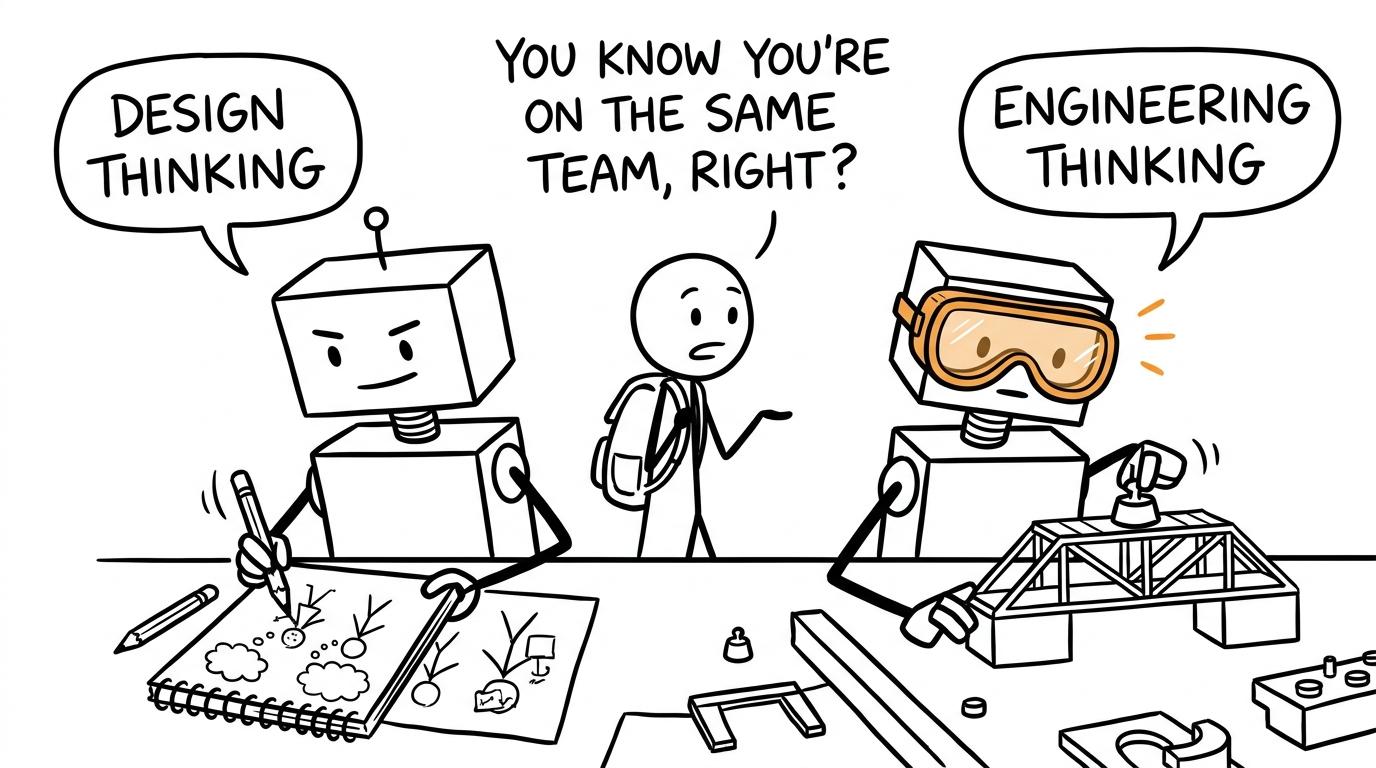 Design thinking and engineering thinking discover that they are on the same team
The main difference in emphasis
Design and Technology begins with people
GCSE Design and Technology usually asks how a product can address needs and wants. Students investigate a context, identify users, create a specification, generate ideas, develop a solution, make a prototype and evaluate it.
For example, AQA's current specification divides assessment equally between a written examination and NEA. Its NEA is a substantial design-and-make task expected to take approximately 303030 to 353535 hours. Other boards, including OCR, Eduqas and Pearson Edexcel, organise their content and assessment differently, so use your school's specification.
Engineering begins with technical performance
Engineering is generally more focused on how engineered products and systems operate, how components perform and how solutions are manufactured and tested. It can involve mechanical systems, electrical principles, materials, production, quality and technical calculations.
Under AQA GCSE Engineering, the written paper contributes 60%60\%60% and the practical engineering NEA contributes 40%40\%40%. The NEA takes approximately 303030 hours and includes a working prototype, technical evidence and evaluation.
These AQA figures show why the combination needs planning. If your school uses these specifications, the expected NEA time across both courses could exceed 606060 supervised hours. That does not include ordinary lessons, revision or independent preparation.
Is taking both realistic?
It is realistic for a student who enjoys sustained project work, keeps evidence organised and is willing to revise the theory behind practical decisions. It becomes less realistic when the choice is based only on enjoying workshop lessons.
Practical subjects are not an escape from writing. Portfolios require concise explanations, justified decisions and evaluation. Written papers also test technical knowledge. The strongest reason to take both is that you genuinely value both perspectives: designing useful products and understanding engineered performance.
The combination may suit you if you:
- meet deadlines without repeated reminders;
- enjoy improving an idea after testing it;
- can document decisions as the project develops;
- are comfortable moving between creativity and calculation;
- want broader preparation for technical study after GCSE.
Taking both may be less suitable if you dislike recording practical work, already have several NEA-heavy subjects or need more time to secure core GCSE grades. Choosing one does not close the door to engineering, product design or technical apprenticeships later. Your wider profile, particularly maths, science and problem-solving, also matters.
Why maths matters in both subjects
Maths gives technical decisions a reason. A dimension is not merely a label; it determines whether components fit. A percentage is not merely an exam exercise; it can express waste, efficiency or change. A graph can reveal whether a test result supports a design decision.
AQA GCSE Design and Technology specifies that at least 15%15\%15% of its written examination assesses mathematical skills. Its engineering specification includes arithmetic, ratios, percentages, standard form, significant figures, graphs, geometry, Pythagoras' theorem and trigonometry, alongside engineering relationships.
Relevant mathematical ideas include:
ρ=mV\rho = \frac{m}{V}ρ=Vmfor density, and
P=FAP = \frac{F}{A}P=AFfor pressure. Students may also need area, volume, gear ratios, scale, unit conversion and accurate substitution into formulae.
You do not need to wait until an engineering lesson exposes a gap. Build the foundations through MathsGenie's GCSE maths topics by exam board and tier. The conversions and units revision resources are particularly relevant when technical dimensions use different units, while similar shapes, area and volume revision supports scale models and three-dimensional reasoning.
How to manage two project-based GCSEs
The hardest part is rarely understanding that both subjects use materials. It is managing two long tasks when each suddenly becomes urgent.
Create one calendar containing internal deadlines for research, design development, manufacture, testing and evaluation. Then add maths assessments and mock examinations. Work backwards from each deadline and protect short, regular sessions rather than expecting one heroic weekend to repair a neglected portfolio.
Keep the subjects separate in your notes. Use the correct vocabulary and assessment criteria for each specification. Shared understanding is useful; blurred evidence is not.
A balanced weekly routine might include:
- one session for the nearest project milestone;
- one session for technical theory and retrieval practice;
- one short GCSE maths topic session;
- one review of outstanding evidence and deadlines.
For maths, follow a learn, practise, check cycle. MathsGenie's guide to the best order for learning GCSE maths topics can help you secure number, ratio and algebra before moving into geometry and more demanding problem-solving. Use mini tests and topic questions to find weaknesses early rather than discovering them during mocks.
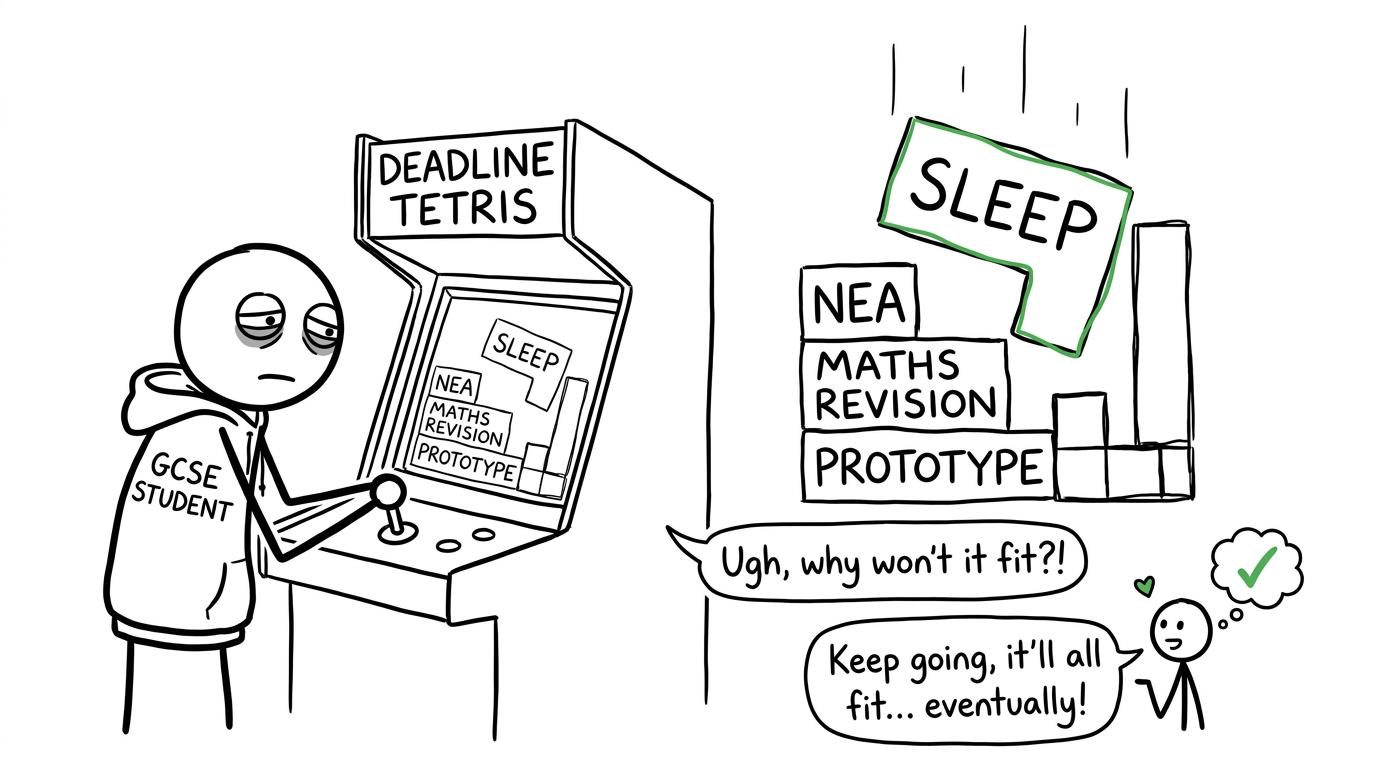 A GCSE student plays deadline Tetris with projects, maths revision and sleep
Common mistakes when choosing both subjects
Assuming the course name confirms the qualification
“Engineering” may mean GCSE Engineering, a Technical Award or a school-designed course. Check the full title, awarding organisation and specification code.
Treating overlap as duplicated marks
Similar knowledge can make learning more efficient, but each course remains separately assessed. Learn what each mark scheme expects.
Underestimating NEA pressure
Practical work, technical drawings, testing and written evidence all consume time. Ask when major internal deadlines fall and compare them with your other subjects.
Neglecting the written examinations
Making a strong prototype is not enough. Technical principles, calculations and extended responses still need deliberate revision.
Letting technical subjects displace maths revision
Engineering calculations become harder when units, ratios, rearranging formulae or area are insecure. Use MathsGenie's GCSE revision hub for board-specific lessons, question banks, worksheets and videos.
Choosing two subjects for one future career
You do not need both qualifications to prove an interest in engineering. Choose them because you value the content and can manage the workload, not because the combination sounds impressive.
Make the decision with evidence
The right GCSE combination is not the one with the greatest apparent ambition. It is the one that lets you do sustained, high-quality work across your whole timetable.
Speak to both subject teachers. Ask to see the specification, a typical project timeline and sample examination questions. Confirm the option blocks and exact qualification titles. Then consider whether the workload leaves enough space for your core subjects and wellbeing.
If you take both, let the overlap work for you without pretending the courses are identical. Build reliable maths alongside your technical knowledge. Start with focused revision lessons and practice questions, then check progress through GCSE past-paper planning advice. Near the exams, use MathsGenie GCSE predicted papers, mark schemes and video solutions to sharpen your exam technique.
MathsGenie gives you the free structure that busy project subjects often make necessary: revision lessons, mini tests, practice questions, past papers, predicted papers and clear solutions. Choose carefully, plan honestly and make maths the tool that supports both sides of your technical education.











